Hubbry Logo
Annapolis ValleyAnnapolis ValleyMain
Open search
Annapolis Valley
Community hub
Annapolis Valley
logo
8 pages, 0 posts
0 subscribers
Be the first to start a discussion here.
Annapolis Valley
Annapolis Valley
from Wikipedia

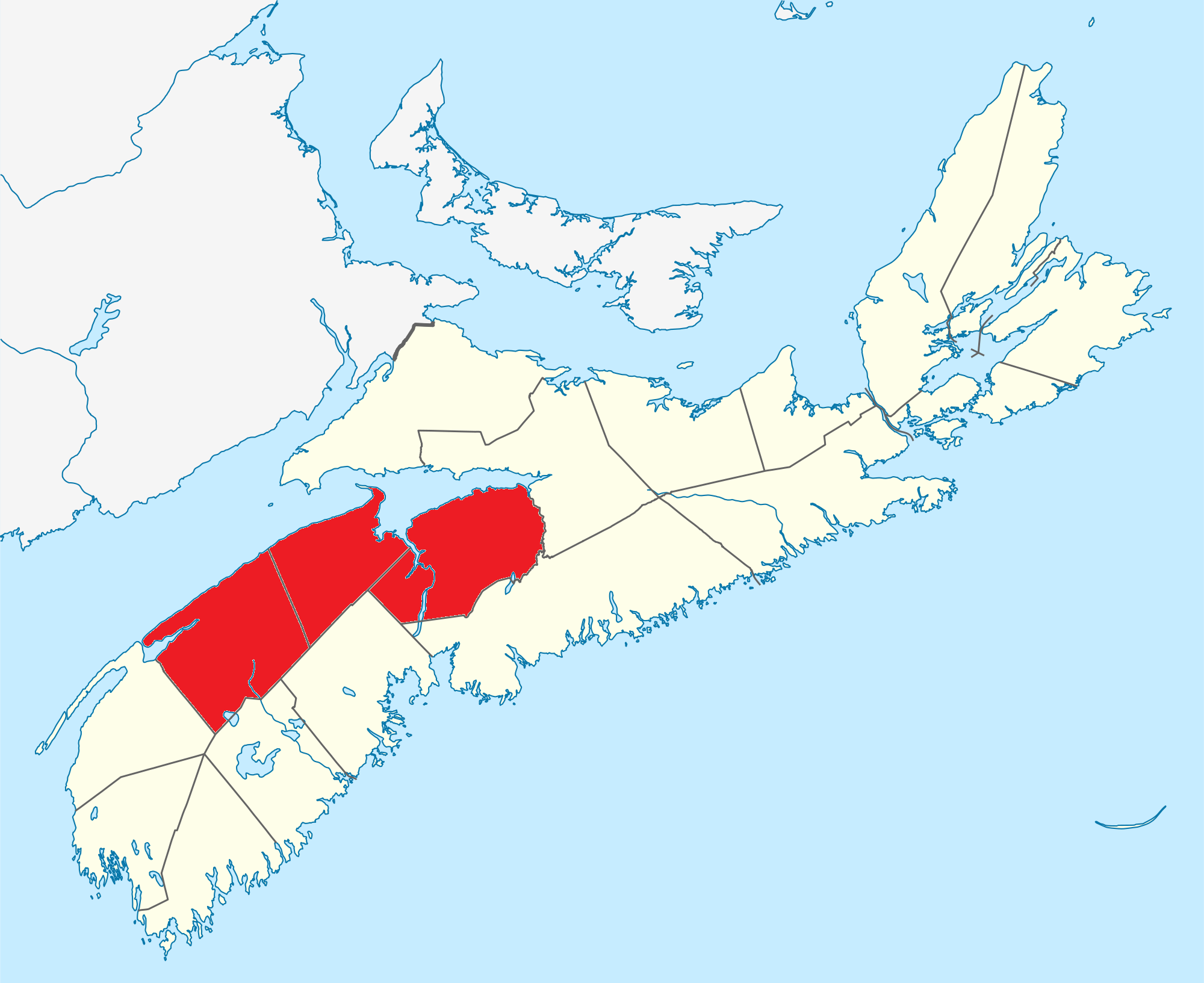
The Annapolis Valley is a valley and region in the province of Nova Scotia, Canada. It is located in the western part of the Nova Scotia peninsula, formed by a trough between two parallel mountain ranges along the shore of the Bay of Fundy. Statistics Canada defines the Annapolis Valley as an economic region, composed of Annapolis County, Kings County, and Hants County.

Key Information

Geography

[edit]

The valley measures approximately 126 kilometres (78 mi) in length from Annapolis Royal and the Annapolis Basin in the west to Wolfville and the Minas Basin in the east, spanning the counties of Digby, Annapolis and Kings.

Some also include the western part of Hants County, including the towns of Hantsport and Windsor even further to the east, but geographically speaking they are part of the Avon River valley.

The steep face of basaltic North Mountain shelters the valley from the adjacent Bay of Fundy and rises over 260 metres (850 ft) in elevation near Lawrencetown.[2] The granitic South Mountain rises to a somewhat higher elevation and shelters the valley from the climate of the Atlantic Ocean approximately 100 kilometres further south on the province's South Shore.

The shelter provided by these two mountainous ridges has produced a microclimate which provides relatively mild temperatures for the region and, coupled with the fertile glacial sedimentary soils on the valley floor, the region is conducive to growing vegetable and fruit crops.[3] Particularly famous for its apple crop, the valley hosts in excess of 1,000 farms of various types, the majority being relatively small family-owned operations.

Within the valley itself are two major rivers, the Annapolis River which flows west from Caribou Bog in the central part of the valley into Annapolis Basin, and the Cornwallis River which flows east from Caribou Bog into Minas Basin. The North Mountain ridge forms the north side of the Annapolis Valley. Also flowing east, in two smaller valleys north of the Cornwallis River, are the Canard River and the Habitant River, both of which also flow into the Minas Basin.

History

[edit]
Annapolis Valley from North Mountain in Valleyview Provincial Park, north of Bridgetown
Eastern End, with the Minas Basin to the right
Eastern end looking southeast across Annapolis Valley from "The Lookoff", North Mountain

Long settled by the Mi'kmaq nation, the valley experienced French settlement at the Habitation at Port-Royal, near modern-day Annapolis Royal in the western part of the valley, beginning in 1605. From there, the Acadians spread throughout the Valley, in various communities, building dykes to claim the tidal lands along the Annapolis and Cornwallis Rivers. They continued throughout the Annapolis Valley until the British-ordered expulsion of Acadians in 1755 which is memorialized at Grand-Pré in the eastern part of the valley. New England Planters moved in to occupy the abandoned Acadian farming areas and the region also saw subsequent settlement by Loyalist refugees of the American Revolutionary War, as well as foreign Protestants. These were followed by significant numbers of freed Africans in the War of 1812, Irish immigrants in the mid-19th century and Dutch immigrants after World War II. Agriculture in the Annapolis valley boomed in the late 19th century with the arrival of the Windsor and Annapolis Railway, later the Dominion Atlantic Railway, which developed large export markets for Annapolis Valley apples.

The Annapolis Valley Regional Library was established in 1949. It was the first regional library system in Nova Scotia.[4]

Economy

[edit]
Central Valley, looking west southwest across farms in Clarence
Western Valley, overlooking narrowest part of Annapolis Valley towards Bridgetown
Eastern end, overlooking Wolfville, Nova Scotia
Western end, at Port-Royal habitation, where Annapolis River widens to form the Annapolis Basin
Corn at Grafton
Lawrencetown Exhibition

The Valley has traditionally been built on a diversified agricultural industry, with a wide range of output ranging from livestock to fruit trees and berries. The last quarter-century has also seen the development of a wine industry, with such notable wineries as Gaspereau Vineyards winning national and international awards for their produce.

Today, the Valley is still largely dominated by agriculture but also has a growing diversity in its economies, partly aided by the importance of post-secondary education centres provided by Acadia University in Wolfville, and the Nova Scotia Community College campuses located in Kentville, Middleton, Lawrencetown, and Digby.

Michelin has an important truck tire manufacturing plant in Waterville and the Department of National Defence has its largest air force base in Atlantic Canada located at CFB Greenwood along with an important training facility at Camp Aldershot, near Kentville.

Tourism is also an important industry and the Annapolis Valley is known for its scenic farmland, although today some is threatened with suburban development in the eastern end, and a great deal has been abandoned. The valley also struggles with pollution from farm runoffs and residential sewers in its two major rivers, the Annapolis River and the Cornwallis River. The Annapolis Valley additionally has become home to the majority of Nova Scotia wineries, located in either the Gaspereau Valley or in the Canning, Grand Pré, or Bear River areas.[5]

The Valley is home to the annual Apple Blossom Festival, held in late spring. In July is the annual Steer Bar-B-Que in Kingston, and Heart of the Valley Festival in Middleton. August sees Mud Creek Days in Wolfville and the Annapolis Valley Exhibition in Lawrencetown. Bridgetown's Cider Festival comes in mid-September. The Canadian Deep Roots Music Festival is held each year at the end of September in Wolfville, a community-based festival, supported by both the Town of Wolfville and Acadia University and built by over 100 volunteers, and on in-kind and financial support from virtually all sectors of the Valley community. Late October sees Wolfville and Kings County play host to Devour! The Food Film Fest, an annual international film festival celebrating all things culinary. Farmers markets in Annapolis Royal, Bridgetown, Middleton, Kentville, Kingsport, Berwick and Wolfville bring a produce and other goods to the public every week. In the fall, there is the Pumpkin People in Kentville.

Communities

[edit]

Communities in the Valley from west to east include:

Notable residents

[edit]

References

[edit]
[edit]
Revisions and contributorsEdit on WikipediaRead on Wikipedia
from Grokipedia
The Annapolis Valley is a narrow, fertile agricultural lowland in western , , extending approximately 130 kilometres in length and varying from 3 to 11 kilometres in width between the basaltic North Mountain and the granitic South Mountain, with the Annapolis River running through its centre. Geologically underlain by sedimentary formations such as the Blomidon and groups, the valley's soils consist primarily of sandy textures derived from these deposits, supplemented by fertile alluvial materials along rivers and glacial till, enabling high agricultural productivity across its 92,800 hectares. The topography provides shelter from coastal winds, fostering a with early springs, hot summers, and moderated winters that supports the cultivation of temperate fruits and on 43 percent of the land area. Renowned as the epicentre of apple production in , the region has hosted orchards since the introduction of apple trees by early French settlers, contributing the majority of 's apple output, which positions the province as a key eastern supplier despite its northern . The local economy centres on diversified farming, including fruits, vegetables, and , alongside , emerging wineries leveraging the , and limited manufacturing, sustaining communities such as and amid a broader regional exceeding 120,000 across encompassing counties.

Geography

Physical Features

The Annapolis Valley constitutes a narrow trough in western , bounded northward by the south-facing slopes of North Mountain and southward by the north-facing slopes of South Mountain. This lowland extends roughly 130 kilometres eastward from the Annapolis Basin toward the , with widths ranging from 3 to 11 kilometres and a total area of 92,800 hectares. The valley floor exhibits relatively flat interspersed with hummocky , small hills, and drumlins particularly near Middleton. Geologically, the region rests upon Triassic sedimentary bedrock dominated by the Blomidon and formations, comprising approximately 95% of exposures, overlain by glacial surficial deposits including silty , glaciofluvial sands and gravels, and glaciolacustrine or marine sediments. North Mountain consists of basalt flows forming a prominent along the , while South Mountain features granites, slates, and shales associated with the South Mountain . Elevations across the valley floor remain low, transitioning from at the extremities to modest rises in the interior, with bounding mountains attaining heights exceeding 200 metres on North Mountain and 180–210 metres along South Mountain's northern . Drainage is provided chiefly by the Annapolis River, which meanders approximately 142 kilometres southwestward through the valley to the Annapolis Basin, supplemented by the parallel Cornwallis River system. Soils derive from the underlying sediments, yielding predominantly sandy profiles susceptible to but with fertile silty alluvial variants along fluvial corridors that facilitate ; notable soil series include , Bridgeville, , and . Unique landforms such as globally rare sand heathlands further characterize the ecodistrict's diverse physiography.

Climate and Environmental Conditions

The Annapolis Valley exhibits a (Köppen classification Dfb) moderated by maritime influences from the and , featuring mild winters relative to inland areas, cool summers, and consistent that supports its agricultural productivity. At the station, temperatures typically range from an average low of -9.4°C to a high of 25.0°C, with an annual mean of approximately 7.5°C based on 1981-2010 normals. averages about 1,150 mm annually, with roughly 140-150 rainy days, concentrated slightly more in autumn and spring, though summers can experience dry spells critical for fruit ripening. The region's environmental conditions are shaped by its physiography: a low-lying floor between the North and Mountains, which shelter it from harsh coastal winds and foster a 2-3°C warmer than Nova Scotia's coastal averages, ideal for apple and grape cultivation. Soils consist primarily of well-drained sandy loams and silty loams from post-glacial marine and fluvial deposits, including series such as , Bridgeville, and , with moderate fertility enhanced by organic amendments in agricultural areas but prone to erosion and nutrient leaching under heavy rainfall. The Annapolis River, influenced by extreme tides reaching 12 meters, causes periodic flooding and sediment deposition, while upland slopes support mixed deciduous-coniferous forests dominated by , , and . Ecological features include diverse habitats like riparian wetlands, sand barrens, and old-field successions, though has reduced native , with contributing to issues such as runoff and . Recent observations, including the 2025 drought—classified as extreme by regional metrics—resulted in widespread crop failures for tree fruits and field crops, underscoring vulnerabilities to variability amid observed trends of warmer temperatures and shifting seasonal patterns. These conditions, while historically favorable, face pressures from increased storm intensity and drier summers, potentially altering composition toward more drought-tolerant like .

History

Indigenous Presence and Pre-Colonial Era

The Annapolis Valley formed part of the broader territory of , divided into seven traditional districts, with the eastern portion aligning with Sipekne'katik ("land of abundant wild potatoes") and the western Annapolis Basin within Kespukwitk ("land's end" or "end of flow"). Mi'kmaq bands maintained presence in the region for millennia prior to European arrival, employing semi-nomadic patterns that exploited the valley's rivers, tidal marshes, and woodlands for sustenance without evidence of intensive or permanent urban centers. Archaeological investigations reveal early human occupation, including the Boswell site (BfDf-08) along the Annapolis River—the first pre-contact site systematically excavated in the valley—yielding artifacts such as bifaces and projectile points associated with the Transitional Archaic period, approximately 4,000–3,000 years ago, indicating seasonal encampments focused on resource processing. Later evidence from the Ceramic period appears at the Melanson site (BgDb-7) on the Gaspereau River in Kings County, a large village site with domestic features, ceramics, and faunal remains reflecting reliance on (e.g., anadromous like gaspereau and ), hunting deer and small game, and gathering from the fertile floodplains. These sites underscore a sustainable adaptation to the valley's ecology, where groups followed seasonal cycles: summer coastal fishing and inland foraging in spring and fall, with winter pursuits shifting to sheltered valleys for trapping and minimal of crops like corn in some areas, though the Annapolis region's marshy dykelands primarily supported wild resource harvesting rather than cultivated fields. No records or artifacts suggest inter-tribal conflict or large-scale societal hierarchies in the pre-contact era; instead, oral traditions and point to kinship-based bands maintaining fluid mobility across districts.

European Exploration, Acadian Settlement, and Conflicts

In 1604, French explorer Pierre Dugua, Sieur de Mons, along with Samuel de Champlain, attempted a settlement on Saint Croix Island but relocated due to harsh conditions, exploring the Annapolis Basin and establishing the Habitation at Port-Royal in July 1605 as the first permanent European settlement in North America north of Florida. This site in the Annapolis Valley offered fertile marshlands and a milder climate, enabling early agricultural experiments and fur trading with local Indigenous peoples. The settlement served as the administrative center for Acadia, fostering initial French colonial presence through figures like Jean de Biencourt de Poutrincourt, who expanded operations until internal disputes and resource shortages led to temporary abandonment by 1613. Acadian settlement solidified in the Annapolis Valley from the 1630s under Charles de Menou, Seigneur d'Aulnay, who brought families from and developed dyke systems (aboiteaux) to reclaim tidal marshlands for farming, creating a distinctive agricultural suited to the region's tides and soils. Port-Royal emerged as Acadia's capital, with the valley's communities focusing on of grains, , and orchards, while maintaining trade ties that supported population growth to several hundred by the late . These techniques, adapted from Dutch methods, transformed low-lying areas into productive dykelands, underpinning Acadian economic self-sufficiency amid ongoing colonial uncertainties. Conflicts arose from Anglo-French rivalries, with Port-Royal raided and captured multiple times: destroyed in 1613 by English forces from under , rebuilt under French control; seized in 1654 by forces and held until 1670 per the Treaty of Breda; briefly taken in 1690 during but recaptured by French allies including ; and definitively conquered in 1710 by British and colonial troops under Francis Nicholson, renaming it . The 1713 Treaty of Utrecht ceded mainland to Britain, yet French influence persisted via on Cape Breton, fueling border disputes and proxy raids in the valley through the 1740s, as navigated neutrality pressures amid divided loyalties. These hostilities disrupted settlement but reinforced Acadian resilience, with communities like Melanson exemplifying adaptation through fortified farms and selective allegiance.

Acadian Expulsion, British Consolidation, and Subsequent Settlement

The Acadian Expulsion, also known as the Great Upheaval, began in earnest on August 11, 1755, when British colonial authorities under Governor Charles Lawrence issued deportation orders targeting Acadian communities across , including the fertile Annapolis Valley, which had been a core area of Acadian settlement since the early 1600s. In the Annapolis region, British forces deported thousands of from settlements like and surrounding dykelands, with operations continuing sporadically until 1763 amid the Seven Years' War; overall, approximately 11,500 were removed from , many via ships from ports including Annapolis, leading to high mortality rates during voyages and dispersals to British colonies like and . Acadian resistance persisted locally, as evidenced by their victory alongside allies in the Battle of Bloody Creek near on December 8, 1757, but British military superiority ultimately enforced the clearances, emptying much of the Valley's Acadian population and confiscating their improved farmlands to prevent French-allied resurgence. British consolidation of Nova Scotia intensified post-expulsion, as the 1763 Treaty of Paris ceded French claims in the region, prompting authorities to repopulate vacated Acadian lands with Protestant settlers loyal to the Crown to secure demographic and economic control against lingering French and Indigenous threats. Lieutenant Governor Charles Lawrence actively recruited from New England, offering land grants on former Acadian dykelands to encourage agricultural revival and township formation, a policy driven by the need to cultivate the Valley's tidal marshes, which Acadians had engineered with extensive aboiteaux systems for grain production. Subsequent settlement primarily involved the influx of approximately 8,000 New England Planters between 1759 and 1768, who established townships across the Annapolis Valley, reviving dykeland farming on a commercial scale with crops like wheat and exporting surpluses to New England markets. By late 1760, Annapolis County mirrored Massachusetts in settler origins, with groups like those arriving on the Charming Molly in Annapolis Royal claiming grants; Kings County drew Connecticut families, focusing on Horton and Cornwallis townships; these migrants, largely Congregationalist farmers and traders, adapted Acadian techniques while introducing English legal and governance structures, though initial hardships from isolation and soil recovery delayed full prosperity. Later waves included United Empire Loyalists fleeing the , with several hundred settling in the Valley by the mid-1780s, often on marginal lands near existing Planter communities, alongside smaller numbers of Black Loyalists—free Black evacuees from New York and other ports—who received grants in Annapolis County but faced discrimination and land disputes, prompting many to relocate to by 1792. Limited Acadian returns occurred after a 1764 British order-in-council allowed small groups to resettle isolated areas, but most reintegration happened post-1780s in less contested regions outside the core Valley, preserving Acadian enclaves amid the dominant Anglo-Protestant settlement pattern.

Modern Developments from the 19th Century Onward

The arrival of rail service in the mid- to late marked a pivotal shift in the Annapolis Valley's economic landscape, enabling the efficient export of agricultural goods beyond local markets. The Windsor and Annapolis Railway, chartered in 1864, began construction shortly thereafter, with initial segments connecting key farming areas to Windsor by the 1870s and extending toward over subsequent decades; full completion to Annapolis occurred in 1905, but earlier phases already facilitated the shipment of fruits and grains. This infrastructure spurred a boom in , particularly apples, which became a staple due to the valley's fertile dyked marshlands and temperate . In 1894, the Windsor and Annapolis Railway merged with the Western Counties Railway to form the Dominion Atlantic Railway (DAR), which dominated regional transport through the and solidified the valley's role as Nova Scotia's agricultural heartland. The DAR's network, peaking at over 200 miles of track, transported millions of barrels of apples annually during the industry's height from the 1880s to the 1950s, with exports reaching Britain and the ; innovations like cooperative marketing and cold storage facilities further enhanced productivity. The Apple Blossom Festival, inaugurated in 1933 amid Depression-era challenges, promoted the sector and drew tourists, evolving into an annual event that underscored the valley's orchard heritage. Post-World War II, Dutch immigrants introduced specialized horticultural techniques, diversifying fruit varieties and bolstering dairy operations. The late 20th century brought infrastructural and economic transitions, including the DAR's progressive abandonment starting in the due to trucking competition and declining rail viability, with passenger services ending in 1978 and freight lines dismantled by the early 1990s. adapted through mechanization and shifts toward high-value crops, though farmland abandonment accelerated from the 1950s onward amid and farm consolidation. Into the , the valley has pursued diversification, with the wine industry emerging since the 1990s via vineyards leveraging the same soils that support apples; has grown as a key pillar, generating significant revenue through heritage sites, festivals, and , contributing to regional GDP increases averaging around 2-3% annually in recent years. These developments reflect resilience, with policy efforts focusing on sustainable farming and rural economic retention amid broader provincial trends.

Demographics and Society

The population of the Annapolis Valley economic region, as defined by , stood at 123,749 in the 2016 census and rose to 129,306 in the 2021 census, yielding an intercensal growth rate of 4.5%. This modest increase contrasts with faster provincial growth in , driven largely by immigration to urban centers, while rural regions like the Valley exhibit slower natural increase and net out-migration of younger residents. Population density remained low at 14.8 persons per square kilometer in 2016, climbing slightly to 15.5 by 2021. The median age in the region advanced from 46.9 years in 2016 to 48.0 years in 2021, exceeding the provincial median of 43.5 years as of July 2024 and underscoring a demographic profile skewed toward older residents amid low fertility rates and limited in-migration of working-age individuals. Estimates for the constituent counties of Annapolis, Kings, and Hants—which approximate the Valley's core—indicate further growth to 139,061 residents by July 2024, reflecting some rebound from earlier stagnation tied to economic reliance on and out-migration pressures. Demographic composition remains overwhelmingly of European ancestry, consistent with centuries of British, Acadian, and other inflows, with visible minorities and immigrants comprising a small fraction compared to urban (where immigrants form 7.4% of the population per the 2021 census). Indigenous residents, primarily , represent a minor but historically significant presence province-wide at about 2.8% in 2021, though specific Valley figures align with this low baseline given limited reserve populations in the region.

Communities and Settlement Patterns

The Annapolis Valley exhibits a pattern aligned with its narrow, fertile , bounded by the North and South Mountains, which confines development to a ribbon-like configuration along the Annapolis River and parallel highways such as Route 101. This topography fosters dispersed rural hamlets and farmsteads amid orchards and croplands, with small towns functioning as localized service and commercial nodes rather than large urban agglomerations. Key communities include Kentville, the region's primary administrative and economic center with a 2021 population of 6,271; Wolfville, anchored by Acadia University and noted for its academic and cultural role; Berwick, dubbed the "Apple Capital" for its fruit industry prominence; Middleton; Annapolis Royal, the valley's oldest European settlement; and Bridgetown. Additional population clusters occur in areas like New Minas, Greenwood (site of a Canadian Forces base), and Kingston, supporting agriculture, military, and commuter functions. Indigenous settlement includes the Annapolis Valley First Nation near , comprising 124 residents on-reserve as of recent counts, maintaining traditional ties amid broader European-derived patterns. The region's low of 15.5 persons per square kilometer in 2021 reflects sustained rural character, with minimal suburban sprawl despite proximity to Halifax influences in eastern portions. Settlement remains oriented toward agricultural viability, with historical dykeland reclamation shaping persistent farm-centric distributions.

Economy

Agricultural Foundations and Innovations

The agricultural foundations of the Annapolis Valley originate from the reclamation of tidal marshlands through Acadian dykes and aboiteaux systems constructed beginning in the early , which excluded seawater while permitting drainage via one-way sluices, thereby converting saline marshes into fertile polders for arable farming. These earthen structures, often built from and reinforced with wooden frames, enabled the cultivation of staple crops including , oats, , and on lands enriched by annual silt deposition from controlled tidal flooding. Following the Acadian Expulsion in 1755, incoming New England Planters repaired and expanded these dykelands, sustaining mixed that capitalized on the Valley's loamy soils and moderate climate moderated by the . Apple cultivation emerged as a cornerstone crop with the planting of the first trees in by French settlers near around 1611, leveraging the region's frost-protected and well-drained slopes for orchards that by the late 19th century dominated exports. The arrival of rail infrastructure, including the Windsor and Annapolis Railway completed in phases from to , catalyzed a boom in commercial fruit production by enabling efficient shipment to markets in Halifax and beyond, with apple shipments peaking in the early . and dairy farming also thrived, supported by the Valley's class 2-4 Canada Land Inventory soils, which constitute a significant portion under cultivation, particularly in Annapolis and Kings Counties. Key innovations include the establishment of the Research and Development Centre in 1911, which has advanced horticultural practices through breeding programs yielding disease-resistant apple varieties, , and early research conducted from 1928 to 1932 that improved fruit set yields. Over its first century, the Centre contributed to enhancements across Nova Scotia's agricultural commodities, including orchard efficiency and techniques tailored to dykeland vulnerabilities. Contemporary efforts encompass the development of an Apple Collection planted between 2016 and 2022, comprising over 4,000 trees to safeguard against climate threats, alongside adoption of and expansions to bolster resilience in tree fruit production concentrated in the Valley due to its superior edaphic and climatic conditions.

Diversification into Tourism and Other Industries

The Annapolis Valley has increasingly diversified its economy through tourism, leveraging its scenic landscapes, historical significance, and agricultural heritage to attract visitors. Tourism supports local businesses and generates employment by highlighting the region's natural beauty along the Bay of Fundy, cultural sites such as Port Royal National Historic Site, and outdoor activities in areas like Blomidon Provincial Park. The sector's growth is tied to the area's fertile farmlands and mild climate, which draw tourists for experiential activities including farm visits and seasonal events. A key driver of tourism diversification is the wine industry, concentrated in the Annapolis Valley, which has expanded rapidly since the late 20th century. Nova Scotia's wine sector, with many vineyards in the Valley, contributes over $245 million annually to the provincial economy through production, sales, and related tourism. This growth stems from the region's microclimate suitable for hybrid grape varieties, fostering winery tours and tastings that integrate with broader agri-tourism offerings. The industry now includes 19 grape wineries across Nova Scotia, with the Annapolis Valley as a primary hub, enhancing visitor stays and local revenue. Beyond tourism, and have emerged as complementary industries, building on agricultural outputs. The sector in the Annapolis Valley region encompasses food production and advanced manufacturing, employing over 5,000 workers annually. Food processing firms, such as those handling apples and other Valley produce, have pursued export expansion to U.S. markets, improving capacity and efficiency. Non-agricultural industrial employment totals around 3,550 jobs, diversifying from traditional farming dependencies. These sectors provide economic resilience amid agricultural fluctuations.

Challenges, Policy Responses, and Recent Economic Shifts

The Annapolis Valley's agricultural sector, a of the local economy, has faced significant challenges from events, including a severe in 2025 that reduced crop yields, strained water supplies, and necessitated extensive efforts among growers. Orchards in the region experienced prolonged dry conditions, leading to dying and heightened concerns over and future productivity amid broader climate variability. Persistent labor shortages, exacerbated by an aging workforce and difficulties attracting skilled workers, have further constrained operations in and other industries. High costs of living, particularly affordability, have deterred young residents and hindered , with the region identified as one of Nova Scotia's most expensive areas outside Halifax. In response, the Nova Scotia government introduced measures in its 2025-26 budget to address affordability and sectoral vulnerabilities, including over $500 million in tax cuts—such as reducing the HST to 14% effective April 1, 2025—and raising the minimum wage to $15.70 on April 1 and $16.50 on October 1. Agricultural supports encompassed $1.65 million for the grape and wine industries, a $308,000 increase in crop insurance funding to $1.3 million total, and $1.25 million for clean farming technologies to enhance resilience. Infrastructure investments exceeded $500 million province-wide, with specific allocations for Highway 101 improvements in the Valley, such as the Cambridge interchange and twinning from Three Mile Plains to Falmouth. Regionally, the Valley Regional Enterprise Network (REN) has pursued a four-year plan emphasizing population readiness, prosperity, and resilience, including development of an agri-food technology corridor and anti-poverty initiatives like Annapolis County's working group. Recent economic shifts reflect a softening labor market, with in the Annapolis Valley declining by 2,300 jobs (-3.7%) over the year ending 2025, including a drop of 1,200 full-time positions, amid broader provincial losses in sectors like accommodation, food services, and . edged higher in mid-2025, though the region maintained a relatively low rate of around 5.1% through 2023 prior to these declines. Counterbalancing trends include a 5.5% year-to-date rise in average weekly earnings—the highest in —and a 92.5% surge in non-residential building permits outside Halifax, signaling investment potential. Job vacancy rates fell sharply from Q1 2024 to Q1 2025, the largest drop province-wide in the Valley. Diversification efforts have accelerated, with REN-led regenerative strategies and agri-food innovations aiming to reduce reliance on traditional farming, supported by federal funding for a 2021 tourism plan to position the Valley as a premier destination.

Culture and Legacy

Heritage Sites, Traditions, and Events

The Annapolis Valley preserves several national historic sites administered by Parks Canada, reflecting Mi'kmaq, French Acadian, and British colonial histories. Port-Royal National Historic Site features a reconstruction of the 1605 Habitation established by Pierre Dugua and Samuel de Champlain, marking one of the earliest permanent European settlements in North America. Fort Anne National Historic Site in Annapolis Royal encompasses fortifications from the 17th to 19th centuries, including remnants of French and British defenses, and serves as Canada's first designated national historic site in 1917. Grand-Pré National Historic Site commemorates Acadian settlement and the 1755 expulsion, with landscaped grounds and a church replica symbolizing 17th- and 18th-century Acadian life. The Annapolis Royal Historic District, designated a National Historic Site of Canada, includes over 30 pre-1834 buildings clustered around the original Port-Royal settlement at the Annapolis River's mouth. Local heritage organizations maintain additional sites tied to agricultural and settler traditions. The Annapolis Heritage Society oversees the O'Dell House Museum, showcasing 19th-century Planter furnishings, and the Sinclair Inn Museum, featuring 18th-century architecture from the Planter period. The Annapolis Royal Historic Gardens span 17 acres demonstrating four centuries of gardening practices, from Acadian dykes to Victorian formal designs, with period-specific sections like the Acadian planted with heirloom vegetables. Melanson Settlement National Historic Site preserves archaeological evidence of 17th- and 18th-century Acadian farming along the Annapolis River, including dyke systems for reclamation. Traditions in the Valley center on agriculture, particularly apple orcharding introduced by New England in the 1760s, which evolved into commercial cultivation emphasizing heirloom varieties and sustainable practices. heritage persists through oral histories and seasonal resource use, while Acadian influences endure in dyke-building techniques for marshland farming and bilingual place names. British Loyalist and Planter customs include community barn-raisings and harvest suppers, fostering intergenerational knowledge transfer in cider-making and fruit preservation. Annual events highlight these legacies, with the Annapolis Valley Apple Blossom Festival, held since 1933, drawing over 100,000 visitors from May 28 to June 2 for parades, orchard tours, baking contests, and celebrating the region's apple heritage. In , the Natal Day festivities in August feature historical reenactments and markets evoking colonial-era markets, while harvest festivals in fall showcase local produce through fairs and tastings across communities like and . These gatherings reinforce communal ties to land stewardship and seasonal cycles central to Valley identity.

Notable Individuals and Their Impacts

Rose Fortune, who arrived in Annapolis Royal as a child around 1783 following the , established herself as a businesswoman hauling goods and enforcing informal policing against , earning recognition as North America's first female . Her entrepreneurial activities and community role advanced opportunities for settlers in the region, contributing to the early social fabric of Annapolis County. Mona Louise Parsons, born on February 17, 1901, in Middleton, Annapolis County, pursued acting and nursing before marrying into a Dutch family; during , she joined the resistance in the , sheltering Allied pilots and sabotaging German efforts, leading to her , , and by a Nazi in 1942. Her defiance highlighted Canadian civilian contributions to the Allied cause, and she received posthumous honors including a stamp in 2017. Daurene E. Lewis, born in 1943 in as a descendant of Black Loyalists, was elected mayor of the town in 1984, serving until 1988 and becoming Canada's first Black female mayor. Her leadership promoted local arts, education, and , earning her the in 2008 for advancing equality and community development. In military annals, William Hall, born April 28, 1827, in Horton Township, Kings County, enlisted in the British Navy and received the on November 16, 1857, for bravery under fire during the Siege of in the Indian Rebellion, as the first Black Canadian and Nova Scotian so honored. His achievement elevated the profile of African Nova Scotian contributions to imperial forces from the Annapolis Valley area. Sir Frederick William Borden, born May 14, 1847, in Upper Canard, Kings County, practiced medicine before entering politics; as Minister of Militia and Defence from 1896 to 1911, he modernized Canada's military by creating the Permanent Active , establishing the Army Medical Corps in 1904, and initiating naval policy reforms amid growing imperial tensions. These efforts strengthened national defense infrastructure with roots in regional leadership. Joseph Broussard, born circa 1702 in , Annapolis County, organized Acadian guerrilla resistance against British encroachments during and the , leading raids that delayed colonial expansion; after the 1755 expulsion, he guided exiles to , where his legacy as "" endures in Cajun founding narratives, underscoring the Valley's Acadian foundational conflicts.

References

Add your contribution
Related Hubs
User Avatar
No comments yet.