
Recent from talks
Anser (bird)
Knowledge base stats:
Talk channels stats:
Members stats:
Anser (bird)
Anser is a waterfowl genus that includes the grey geese and the white geese. It belongs to the true goose and swan subfamily of Anserinae under the family of Anatidae. The genus has a Holarctic distribution, with at least one species breeding in any open, wet habitats in the subarctic and cool temperate regions of the Northern Hemisphere in summer. Some also breed farther south, reaching into warm temperate regions. They mostly migrate south in winter, typically to regions in the temperate zone between the January 0 °C (32 °F) and 5 °C (41 °F) isotherms.
The genus contains 11 living species.
The species of this genus span nearly the whole range of true goose shapes and sizes. The largest are the bean, greylag and swan geese at up to around 4 kg (9 lb) in weight (with domestic forms far exceeding this), and the smallest are the lesser white-fronted and Ross's geese, which range from about 1.3 to 2.3 kg (3–5 lb).
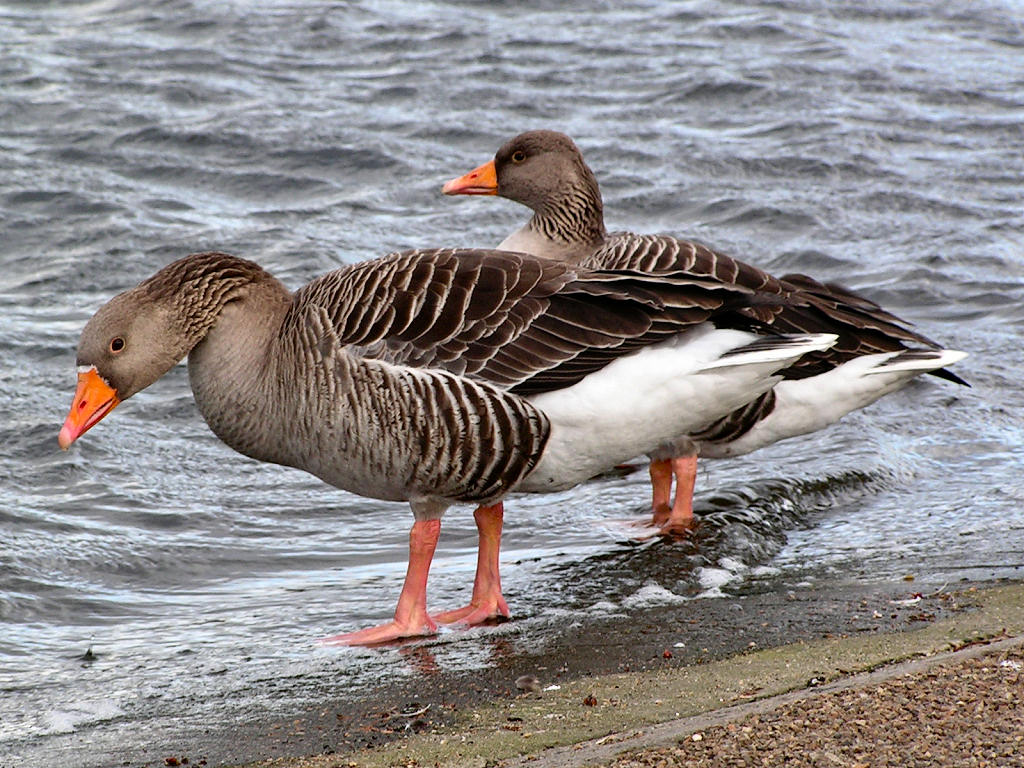
All have legs and feet that are pink or orange, and bills that are pink, orange, black, or patterned in a combination of these colours. All have white under- and upper-tail coverts, and some have some extent of white on their heads. The neck, body and wings are grey or white, with black or blackish primary—and also often secondary—remiges (pinions). The three species of "white geese" (emperor, snow and Ross's geese) were formerly treated as a separate genus Chen, but are now generally included in Anser, as their exclusion would leave Anser paraphyletic with the bar-headed goose A. indicus being basal in the genus. The closely related "black" geese in the genus Branta differ in having black legs, and generally darker body plumage.
The genus Anser was introduced by the French zoologist Mathurin Jacques Brisson in 1760. The name comes from the Latin word anser meaning "goose" used as the specific epithet for the greylag goose (Anas anser) introduced by Linnaeus in 1758, that epithet was repeated to become its generic name as the type species.
The evolutionary relationships between Anser geese have been difficult to resolve because of their rapid radiation during the Pleistocene and frequent hybridisation. In 2016 Ottenburghs and colleagues published a study that established the phylogenetic relationships between the species by comparing exonic DNA sequences; a further analysis by the same group in 2023 refined the relationships in the bean goose complex, with pink-footed goose closest to taiga bean goose, rather than tundra bean goose as had been thought before.
The genus contains 11 species:
Some authorities also treat some subspecies as potential future species splits, notably the Greenland white-fronted goose A. albifrons flavirostris. The three east Asian subspecies of the bean goose complex (currently treated as A. fabalis johanseni, A. fabalis middendorfii, and A. serrirostris serrirostris) also await genetic analysis to discern their affinities.
Hub AI
Anser (bird) AI simulator
(@Anser (bird)_simulator)
Anser (bird)
Anser is a waterfowl genus that includes the grey geese and the white geese. It belongs to the true goose and swan subfamily of Anserinae under the family of Anatidae. The genus has a Holarctic distribution, with at least one species breeding in any open, wet habitats in the subarctic and cool temperate regions of the Northern Hemisphere in summer. Some also breed farther south, reaching into warm temperate regions. They mostly migrate south in winter, typically to regions in the temperate zone between the January 0 °C (32 °F) and 5 °C (41 °F) isotherms.
The genus contains 11 living species.
The species of this genus span nearly the whole range of true goose shapes and sizes. The largest are the bean, greylag and swan geese at up to around 4 kg (9 lb) in weight (with domestic forms far exceeding this), and the smallest are the lesser white-fronted and Ross's geese, which range from about 1.3 to 2.3 kg (3–5 lb).
All have legs and feet that are pink or orange, and bills that are pink, orange, black, or patterned in a combination of these colours. All have white under- and upper-tail coverts, and some have some extent of white on their heads. The neck, body and wings are grey or white, with black or blackish primary—and also often secondary—remiges (pinions). The three species of "white geese" (emperor, snow and Ross's geese) were formerly treated as a separate genus Chen, but are now generally included in Anser, as their exclusion would leave Anser paraphyletic with the bar-headed goose A. indicus being basal in the genus. The closely related "black" geese in the genus Branta differ in having black legs, and generally darker body plumage.
The genus Anser was introduced by the French zoologist Mathurin Jacques Brisson in 1760. The name comes from the Latin word anser meaning "goose" used as the specific epithet for the greylag goose (Anas anser) introduced by Linnaeus in 1758, that epithet was repeated to become its generic name as the type species.
The evolutionary relationships between Anser geese have been difficult to resolve because of their rapid radiation during the Pleistocene and frequent hybridisation. In 2016 Ottenburghs and colleagues published a study that established the phylogenetic relationships between the species by comparing exonic DNA sequences; a further analysis by the same group in 2023 refined the relationships in the bean goose complex, with pink-footed goose closest to taiga bean goose, rather than tundra bean goose as had been thought before.
The genus contains 11 species:
Some authorities also treat some subspecies as potential future species splits, notably the Greenland white-fronted goose A. albifrons flavirostris. The three east Asian subspecies of the bean goose complex (currently treated as A. fabalis johanseni, A. fabalis middendorfii, and A. serrirostris serrirostris) also await genetic analysis to discern their affinities.
Recent media