Hubbry Logo
Antimony potassium tartrateAntimony potassium tartrateMain
Open search
Antimony potassium tartrate
Community hub
Antimony potassium tartrate
logo
8 pages, 0 posts
0 subscribers
Be the first to start a discussion here.
Antimony potassium tartrate
from Wikipedia
Antimony potassium tartrate trihydrate
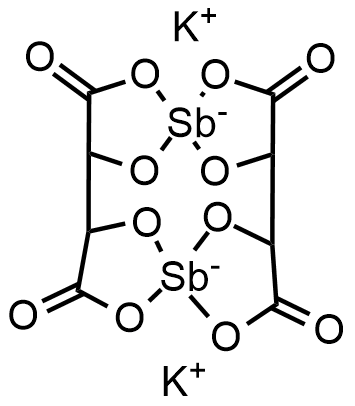
Ball-and-stick model of the bis(μ2-tartrato)-di-antimony anion,[1][2] [Sb2(C4H2O6)2]2−

Carbon Hydrogen

Oxygen Antimony
Names
Other names
potassium antimonyl tartrate
emetic tartar
tartar emetic
Identifiers
3D model (JSmol)
ChEBI
ChemSpider
ECHA InfoCard 100.116.333 Edit this at Wikidata
EC Number
  • 234-293-3
1332600
KEGG
UNII
  • InChI=1S/2C4H4O6.2K.3H2O.2Sb/c2*5-1(3(7)8)2(6)4(9)10;;;;;;;/h2*1-2H,(H,7,8)(H,9,10);;;3*1H2;;/q2*-2;2*+1;;;;2*+3/p-4
    Key: WBTCZEPSIIFINA-UHFFFAOYSA-J
  • [K+].[K+].O.O.O.O=C1O[Sb-]23OC1C1O[Sb-]4(OC(C(O2)C(=O)O3)C(=O)O4)OC1=O
Properties
K2Sb2(C4H2O6)2 · 3 H2O
Molar mass 667.87 g/mol
Appearance white crystalline powder
Density 2.6 g/cm3
8.3 g/100 mL (0 °C)
35.9 g/100 mL (100 °C)
Hazards
GHS labelling:
GHS07: Exclamation markGHS09: Environmental hazard
Warning
Lethal dose or concentration (LD, LC):
110 mg/kg
Except where otherwise noted, data are given for materials in their standard state (at 25 °C [77 °F], 100 kPa).

Antimony potassium tartrate, also known as potassium antimonyl tartrate, potassium antimontarterate, or tartar emetic,[3] has the formula K2Sb2(C4H2O6)2. The compound has long been known as a powerful emetic, and was used in the treatment of schistosomiasis and leishmaniasis. It is used as a resolving agent. It typically is obtained as a hydrate.

Medical

[edit]

The first treatment application against trypanosomiasis was tested in 1906, and the compound's use to treat other tropical diseases was researched.[4] The treatment of leishmania with antimony potassium tartrate started in 1913. After the introduction of antimony(V) containing complexes like sodium stibogluconate and meglumine antimoniate, the use of antimony potassium tartrate was phased out.[4][5] After British physician John Brian Christopherson's discovery in 1918 that antimony potassium tartrate could cure schistosomiasis, the antimonial drugs became widely used.[6][7][8] However, the injection of antimony potassium tartrate had severe side effects such as Adams–Stokes syndrome[9] and therefore alternative substances were under investigation. With the introduction and subsequent larger use of praziquantel in the 1970s, antimony-based treatments fell out of use.[10][11]

Tartar emetic was used in the late 19th and early 20th century in patent medicine as a remedy for alcohol intoxication, and was first ruled ineffective in the United States in 1941, in United States v. 11 1/4 Dozen Packages of Articles Labeled in Part Mrs. Moffat's Shoo-Fly Powders for Drunkenness.[12][13]

The New England Journal of Medicine reported[14] a case study of a patient whose wife secretly gave him a dose of a product called "tartaro emetico" which contained trivalent antimony (antimony potassium tartrate) and is sold in Central America as an aversive treatment for alcohol use disorder. The patient, who had been out drinking the night before, developed persistent vomiting shortly after being given orange juice with the drug. When admitted to the hospital, and later in the intensive care unit, he experienced severe chest pains, cardiac abnormalities, renal and hepatic toxicity, and nearly died. The Journal reports that "Two years later, he [the patient] reports complete abstinence from alcohol."

Emetic

[edit]
500 mg tartar emetic

Antimony potassium tartrate's potential as an emetic has been known since the Middle Ages. The compound itself was considered toxic and therefore a different way to administer it was found. Cups made from pure antimony were used to store wine for 24 hours and then the resulting solution of antimony potassium tartrate in wine was consumed in small portions until the wanted emetic effect was reached.[15][16][17]

Poisoning by "tartarised antimony" or "emetic tartar" is a plot device in the first modern detective novel, The Notting Hill Mystery (1862). The emetic tartar was kept by a character in the novel because he was "addicted to the pleasures of the table, and was in the habit of taking an occasional emetic."[18]

The compound is still used to induce vomiting in captured animals in order to study their diets.[19][20][21]

Insecticide

[edit]

Antimony potassium tartrate is used as an insecticide against thrips.[22] It is in IRAC class 8E.[23]

Preparation, structure, reactions

[edit]

Antimony potassium tartrate is prepared by treating a solution of potassium hydrogen tartrate and antimony trioxide:

2 KOH + Sb2O3 + (HOCHCO2H)2 → K2Sb2(C4H2O6)2 + 3 H2O

With an excess of tartaric acid, the monoanionic monoantimony salt is produced:[2]

2 KOH + Sb2O3 + 4 (HOCHCO2H)2 → 2 KSb(C4H2O6)2 + 2 H2O

Antimony potassium tartrate has been the subject of several X-ray crystallography studies.[24][25][26][27][28][2] The core complex is an anionic dimer of antimony tartrate (Sb2(C4H2O6)22-) which is arranged in a large ring with the carbonyl groups pointing outwards. The complex has D2 molecular symmetry with two Sb(III) centers bonded in distorted square pyramids. Water and potassium ions are held within the unit cell but are not tightly bound to the dimer. The anion is a well-used resolving agent.[29]

Viewed along the x axis
Viewed along the y axis
Viewed along the z axis

Further reading

[edit]

References

[edit]

Further reading

[edit]
Revisions and contributorsEdit on WikipediaRead on Wikipedia
from Grokipedia
Antimony potassium tartrate, also known as tartar emetic, is a with the K₂[Sb₂(C₄H₂O₆)₂]·3H₂O (trihydrate form), appearing as colorless or white, odorless crystals or powder that are highly soluble in but insoluble in alcohol. It possesses a sweetish metallic and has a density of 2.6 g/cm³, with applications rooted in its emetic, expectorant, and properties. Historically, antimony potassium tartrate has been employed in since the , initially as a purgative and later gaining popularity among European elites for treating various ailments, including as a cure for King in the . Despite bans in in 1566 and 1615 due to its toxicity, it was officially approved as a in in 1666 and used worldwide for nearly 600 years in internal treatments. Beyond medicine, it served as a in and , an , and a component in rodenticides to induce emesis. Historically, in , antimony potassium tartrate was used primarily as a schistosomicide, effective against parasites like Schistosoma japonicum when administered intravenously, and was investigated for other parasitic infections such as and . It also acts as a diaphoretic and expectorant in low doses for cough syrups and symptomatic relief of respiratory issues, though its use has declined due to safer alternatives. As of 2025, its medical use has been discontinued in favor of safer alternatives, though it remains available for research and industrial purposes. However, it is highly toxic, with an oral LD50 of 115 mg/kg in rats and potential for severe adverse effects including , cardiac toxicity, and organ damage; the fatal human dose is around 130 mg, necessitating careful administration.

Nomenclature and Overview

Synonyms and Historical Names

Antimony potassium tartrate is commonly known by several synonyms, including tartar emetic, antimonyl tartrate, tartrate, tartarized , tartrated , and the Latin name antimonium tartaratum. The name "tartar emetic" derives from its chemical relation to , historically called "cream of tartar," combined with its potent emetic properties that made it a staple in 17th- and 18th-century . This designation first appeared in European pharmacological texts around 1631, when German physician Adrian von Mynsicht described its preparation in his Medico-Chemical Treatise. The term "antimonium tartaratum" reflects Latin prevalent in early modern European , emphasizing the compound's content and base, and was widely used in through the 19th and early 20th centuries for treatments like bilharziosis. Its historical role as an emetic underscores the origin of these names, linking directly to its therapeutic applications.

Chemical Formula and Structure

Antimony potassium tartrate is commonly encountered as the hemihydrate with the molecular formula KSbOC₄H₄O₆·½H₂O, corresponding to a of 333.88 g/mol. The form is represented as K[Sb(OH)₂(C₄H₄O₆)], though the compound is typically a dimeric with the formula K₂[Sb₂(C₄H₄O₆)₂] or C₈H₄K₂O₁₂Sb₂ ( 613.83 g/mol). The trihydrate variant, often used in preparations, has the formula K₂[Sb₂(C₄H₄O₆)₂]·3H₂O or C₈H₁₀K₂O₁₅Sb₂ ( 667.87 g/mol). The structure consists of a dimeric anion [Sb₂(C₄H₄O₆)₂]²⁻ balanced by two cations, where each Sb(III) center is bridged by two bidentate ligands derived from (2R,3R)-, also known as L-tartrate. This imparts to the complex, with the tartrate providing oxygen donor atoms from and groups to achieve coordination. The (III) adopts a distorted octahedral geometry around each Sb center, influenced by the stereochemically active on the metal, which occupies one coordination position in the . Crystallographic analysis reveals that antimony potassium tartrate crystallizes in the orthorhombic system with Pca2₁. The unit cell parameters, as determined by single-crystal , align with previously reported values for the compound, confirming its organometallic framework suitable for nonlinear optical applications. No significant isomeric forms beyond the L-tartrate derivative are commonly reported, though computational studies suggest potential coexistence of metal-oxygen-bridged isomers with subtle energetic differences.

Physical and Chemical Properties

Appearance and Solubility

Antimony potassium tartrate typically appears as a colorless, odorless crystalline solid or white powder, making it readily identifiable in settings by its lack of color and scent. It exhibits moderate in , dissolving at approximately 8.3 g per 100 mL at 20°C and increasing to about 33–36 g per 100 mL at higher temperatures near 100°C, which facilitates its preparation in aqueous solutions for various applications. The compound is insoluble in alcohol and practically insoluble in , limiting its dissolution in non-polar or organic solvents. Upon heating, antimony potassium tartrate decomposes at around 100°C without undergoing a distinct phase, releasing from its hydrated form. Its is approximately 2.6 g/cm³ at 20°C, contributing to its solid, compact nature.

Stability and Reactivity

Antimony potassium tartrate is chemically stable under standard ambient conditions, such as and normal , but it effloresces upon exposure to air, gradually losing its . This efflorescent nature indicates it readily loses moisture, necessitating storage in tightly sealed containers to prevent degradation. The compound is incompatible with strong bases and their carbonates, where it undergoes decomposition, potentially forming antimonous oxide or other species. In acidic environments, antimony potassium tartrate exhibits pH sensitivity, hydrolyzing to release Sb(III) ions, which may lead to precipitation if the tartrate complex is disrupted. This decomposition is exacerbated by acid secretions or strong acids, contributing to the formation of more irritant antimony compounds like antimonous oxide. Under normal conditions, the compound does not react with water, but its stability diminishes in the presence of nascent hydrogen, produced for instance from zinc and hydrochloric acid, resulting in the generation of toxic stibine gas (SbH3). The simplified reaction for stibine formation is: 3\ceKSbOC4H4O6+6\ceHCl+3\ceZn3\ceSbH3+3\ceKCl+3\ceZnCl2+3\ceC4H4O63 \ce{KSbOC4H4O6} + 6 \ce{HCl} + 3 \ce{Zn} \rightarrow 3 \ce{SbH3} + 3 \ce{KCl} + 3 \ce{ZnCl2} + 3 \ce{C4H4O6} This process highlights the compound's reducing reactivity, as stibine is a highly flammable and poisonous gas. Additionally, antimony potassium tartrate can be oxidized by strong oxidizing agents to form antimony(V) compounds, such as antimonates, underscoring its susceptibility to redox interactions.

Synthesis and Preparation

Traditional Preparation

The traditional preparation of antimony potassium tartrate, also known as tartar emetic, dates back to the early , with the first documented method described by the German iatro-chemist Adrian von Mynsicht in his 1631 work Thesaurus et Armamentarium Medico-Chymicum. This compound was synthesized through a straightforward reaction involving (Sb₂O₃) and (commonly called cream of tartar), reflecting the era's rudimentary chemical techniques focused on medicinal production. Johann later refined and popularized similar processes in his writings around 1648, contributing to its widespread adoption in pharmaceutical practices. The core method entailed boiling with an excess of in to form the soluble . Typically, three parts of finely powdered —often sourced as "argentine flowers of antimony," a purified oxide—were combined with four parts of in water and heated for about an hour until a clear solution resulted. The mixture was then filtered to remove any undissolved residues, and the filtrate was allowed to cool and evaporate slowly, yielding colorless, odorless octahedral crystals of the product upon concentration. The bitartrate-based approach remained dominant for its simplicity and reliance on readily available wine-derived materials. During the 17th to 19th centuries, this compound was primarily produced on a small scale in apothecaries and early chemical laboratories to meet demand for medical applications, such as inducing to treat various ailments. Early batches frequently contained impurities, including residual or unreacted compounds from impure sources, which could exacerbate in therapeutic use. Purification was achieved through recrystallization from hot water, dissolving the crude product and isolating purer crystals by controlled cooling, a technique that became standard to enhance and .

Laboratory Synthesis

The laboratory synthesis of antimony potassium tartrate employs a controlled reaction between , , and in , yielding the target compound through upon cooling. This modern procedure ensures high purity suitable for analytical or pharmaceutical applications, typically achieving yields around 80%. The process begins by dissolving in a hot solution of , followed by the addition of to form the potassium antimonyl tartrate complex. The balanced for the reaction is: \ceSb2O3+2C4H6O6+2KOH>2KSbOC4H4O6+3H2O\ce{Sb2O3 + 2 C4H6O6 + 2 KOH -> 2 KSbOC4H4O6 + 3 H2O} In a typical protocol, 8.4 g of and 3.0 g of are dissolved in 50 mL of water, and 7.3 g of is added to the mixture, which is then heated on a for approximately 5 hours with stirring until the trioxide largely dissolves. The hot solution is filtered to remove any undissolved particles, and the filtrate is cooled, often with the addition of alcohol to enhance , resulting in the formation of colorless, prismatic needles of the product. Purification involves of the crystals followed by recrystallization from hot water, which effectively removes residual antimony oxides and impurities, yielding a final product of high purity. Yields from optimized conditions are approximately 80%, with the process scalable for small-batch production while maintaining control over reaction parameters to minimize side products. During handling, appropriate ventilation and are essential due to the toxicity of antimony compounds; conditions that might generate gas, such as unintended reduction of antimony species, should be avoided by adhering strictly to the alkaline reaction conditions.

Historical and Medical Uses

As an Emetic

Antimony potassium tartrate, commonly known as tartar emetic, served as a standard emetic agent from the 18th to the mid-20th century, employed to induce vomiting in various medical contexts, particularly for managing acute poisonings and intoxications. Its use declined in the 1950s as safer alternatives, such as , gained favor due to the compound's narrow and potential for severe toxicity. By the mid-20th century, modern treatments like activated charcoal and ipecac syrup further supplanted it in clinical practice. The emetic action of antimony potassium tartrate primarily involves local irritation of the following , triggering afferent impulses via the to stimulate the vomiting center in the . This mechanism ensures rapid onset of vomiting, typically within 10-30 minutes of ingestion. Intravenous administration can induce emesis systemically via cardiac afferents, but oral use relies mainly on local effects. In clinical applications for inducing emesis, particularly in cases of poisoning such as , the typical oral dosage ranged from 30 to 60 mg (0.03 to 0.06 g) dissolved in water, administered to adults to evacuate gastric contents and prevent further absorption of toxins. This dose was selected to balance efficacy with the risk of , though monitoring for adverse effects like was essential. The compound's irritant properties made it particularly useful in protocols before the advent of more targeted antidotes. Historical case studies from the document successful applications in treating , where tartar emetic induced prompt to remove unabsorbed toxin, averting severe systemic effects in several reported instances. For example, physicians employed it in acute exposures to mitigate gastrointestinal and neurological symptoms, contributing to patient recovery when administered early. Such uses underscored its role in prior to the recognition of its own profile.

Antiparasitic Applications

Antimony potassium tartrate, also known as tartar emetic, was first introduced as a treatment for (bilharzia) in 1918 by British physician John Brian Christopherson through intravenous administration at Khartoum Civil Hospital in . This marked the beginning of effective for the disease, with early trials demonstrating the elimination of schistosome eggs from urine in treated patients, achieving parasitological cures in a significant proportion of cases. The compound was also employed against other parasitic infections, including and , where it targeted protozoan parasites such as species and . The involves trivalent ions disrupting the parasites' energy metabolism, primarily by inhibiting , a rate-limiting in essential for glucose breakdown in schistosomes and other parasites. This inhibition impairs ATP production, leading to and death of the worms, with the effect being more pronounced in parasite enzymes than in mammalian counterparts due to higher affinity for schistosomal . In schistosomes, the block at this glycolytic step reduces overall energy yield, contributing to the drug's schistosomicidal efficacy. Treatment regimens typically involved intravenous injections of a 0.5% to 1% , starting at low doses of approximately 40 mg and progressively increasing in 20 mg increments to a maximum of 140 mg (about 2 mg/kg body weight for a 70 kg adult) administered on alternate days to minimize , for a total course of 10 to 15 doses and a cumulative dose around 2.5 g. Emetic side effects, such as and , often accompanied therapy but were managed as part of the emetic properties detailed elsewhere. By the 1980s, antimony potassium tartrate had largely been phased out for treatment due to its narrow and significant toxicity risks, including cardiac and hepatic effects. It was replaced by , a safer oral introduced in the late that offers higher , better tolerability, and single-dose convenience against all major species. Although less toxic alternatives like continued for , the original tartar emetic formulation saw diminished use globally by the end of the decade.

Toxicity and Safety

Health Effects

Antimony potassium tartrate is highly toxic upon acute exposure, primarily through , with an oral LD50 of approximately 115 mg/kg in rats. leads to severe gastrointestinal symptoms including , , , and , often progressing to cardiovascular effects such as , , and potential . In humans, a dose as low as 0.2 g has been reported as fatal, though survival has occurred at much higher levels depending on individual factors and prompt treatment. Exposure can also occur via of , causing respiratory , and dermal contact, though systemic absorption through the skin is minimal. of antimony-containing dusts, including from this compound, may contribute to , a chronic lung condition characterized by and impaired clearance of particulates. Chronic exposure to antimony potassium tartrate results in accumulation of antimony in tissues, leading to liver and damage, such as fatty degeneration and potential . lesions, including pustular eruptions, have been observed with prolonged dermal contact. Additionally, cardiac arrhythmias may develop due to ongoing exposure. Antimony compounds, including trivalent forms like antimony potassium tartrate, are classified by the International Agency for Research on Cancer (IARC) as probably carcinogenic to humans (Group 2A), based on limited evidence in humans for and sufficient evidence from animal studies. Historical medical applications, such as its use as an emetic, have contributed to unintentional chronic exposures in patients.

Handling and Regulatory Status

Handling antimony potassium tartrate requires strict adherence to safety protocols to minimize exposure risks. (PPE), including impervious gloves, safety goggles, and protective clothing, must be worn to prevent , eye, and exposure. Adequate ventilation should be ensured in work areas to avoid formation and , as the compound can generate hazardous aerosols during processing. For storage, the material should be kept in a cool, dry, well-ventilated area in tightly sealed containers, isolated from incompatible substances such as acids, reducing agents, strong oxidizers, and metals to prevent reactive hazards. Disposal of antimony potassium tartrate must follow regulations for management. It is classified as a hazardous substance under U.S. EPA guidelines, requiring collection and disposal at approved facilities, often through or specialized treatment to mitigate environmental release of . Prior to disposal, neutralization or stabilization may be necessary in accordance with local environmental regulations to reduce toxicity, though specific methods depend on the and waste volume. Regulatory frameworks impose significant restrictions on antimony potassium tartrate due to its toxicity. In the , antimony and its compounds, including antimony potassium tartrate, are prohibited in cosmetic products under Annex II of Regulation (EC) No 1223/2009. In the United States, the (OSHA) sets a (PEL) of 0.5 mg/m³ (as antimony) for an 8-hour time-weighted average for antimony compounds. As of 2025, antimony potassium tartrate has no approved therapeutic uses in conventional medicine in most countries, reflecting global shifts toward safer pharmaceuticals, and its application is confined to controlled and settings under stringent safety oversight.

References

Add your contribution
Related Hubs
User Avatar
No comments yet.