



Community hub
Recent from talks
Knowledge base stats:
Talk channels stats:
Members stats:
Antiquization
Antiquization (Macedonian: антиквизација), also sometimes referred as ancient Macedonism (Macedonian: антички македонизам), is a term used mainly to critically describe the identity policies conducted by the nationalist VMRO-DPMNE-led governments of North Macedonia in the period between 2006 and 2017. In the contemporary Macedonian discourse, antiquization refers to the identitarian policies based on the assumption that there is a direct link between today's ethnic Macedonians and Ancient Macedonians. The politics of the ex-Yugoslav era therefore not only embrace the revival of the ancient heritage of the Ancient Macedonians, including the heritage of Philip II and his son Alexander the Great, but also seek to depict a coherent continuity of history and descendancy from the ancient Kingdom of Macedon until the modern Republic of North Macedonia in order to prove the uninterrupted existence of the contemporary Macedonians. Although criticized as causing inter-ethnic and intra-ethnic tensions, even as pseudohistoric, this idea was widespread as of 2019 in North Macedonia despite the fact that there is no evidence for the alleged ethnic continuum.
The expression "antiquization" originates from the history of arts and describes "the Renaissance practice of giving a city the appearance of ancient Rome or Athens through the introduction of structures organized in the classical mode." Critics use the term "antiquization" in order to reveal "a state-framed set of actions such as direct interventions in the public space and in the public sphere of society in general".
The narrative promoted by VMRO-DPMNE goes back to the ancient Kingdom of Macedon, continues with personalities from early Christianity, distinguished historical figures who were born in or ruled in or around Skopje and also embraces a group of freedom fighters who struggled for Macedonian independence.
In ancient times Philip II of Macedon was the first who united the Greek city-states and created the basis for the empire which, later on, was expanded by his son, Alexander III of Macedon, also known as Alexander the Great. Alexander's empire is regarded as being important for the spread of Hellenistic culture, arts and sciences in much of the Old World. Modern scholarly discourse has produced several hypotheses about the Macedonians' place within the Greek world, about whether the Ancient Macedonians were Greeks and whether the Ancient Macedonian language was a form of the Greek language or related to it. In parts of the available ancient literature they are described as a Greek tribe, in others the Ancient Macedonians were regarded as barbarians by the Athenians, and who were gradually Hellenized. What the general consensus does agree on is that Philip II was the one who united most of the Greek states, and his son Alexander the Great conquered much of the known world, all the way to India.
In the narrative brought forward by the VMRO-DPMNE, Alexander the Great was clearly not a Greek. According to this version of history, most of the cultural achievements which are perceived as being of Greek origin by historians and laypersons around the world are actually ethnic Macedonian achievements. Therefore, in the view of some,[who?] Hellenism's true name would actually be Macedonianism. The Republic of North Macedonia would thus be the owner of great cultural heritage, which always had been denied by the world. And as the then Prime Minister of the Republic of Macedonia Nikola Gruevski put it,[citation needed] it can finally present its true history that has been silenced for so long. North Macedonia, in this view, is seen as the cradle of European civilization.
Moderate Macedonians concede that they speak the Macedonian language, a southern Slavic language and that they are not descendants of the ancient Macedonians. It is the general consensus in historical sciences that Slavic people immigrated into the Balkans and the region of Macedonia around the 6th century. Per the extreme nationalist Macedonian perspective, the modern Macedonians are not Slavs and they are the direct descendants of ancient Macedonians, regarded as non-Greeks. The more moderate Macedonian nationalist perspective is that the Macedonians are the result of the Slavic people who intermingled with the ancient Macedonians.
Strongly promoted by VMRO-DPMNE politicians, the recollection of Macedonia's heroic past is supported by (pseudo-) scientists, media and civil society efforts. Some historians emphasize the before-mentioned historical continuity; archaeologists and linguists present spurious evidence for the resemblance of the language of the ancient Macedonians – a Hellenic language – and the modern Macedonian – a south Slavic language; genealogists offer the alleged scientific proof of the similarity of the DNA of ancient Macedonians and the DNA of the modern Macedonians, whereas their neighboring Greeks have to accept that a blood relationship with the ancient Macedonians cannot be testified.
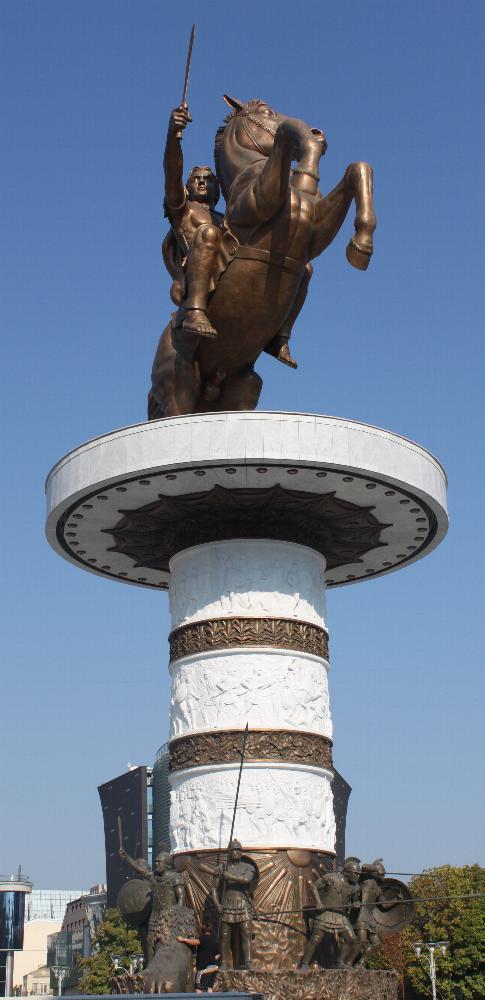
The extensive cultural politics described by "antiquization" not only describe an identitarian narrative promoted by VMRO-DPMNE. It also supports this narrative with the renaming of important public places, the staging of public events, architectural projects and interference in public education. The former City Stadium was renamed "Philip II Arena". The Skopje International Airport was called "Alexander the Great", just as one of the main motorways, which is part of the pan-European Corridor Nr. 10. A central square in Skopje bears the name "Pella Square" named after Pella, the capital of the ancient kingdom of Macedon. Moreover, traces of so-called "antiquization" can even be found in history schoolbooks. The most explicit, Macedonia's new politics of history become visible in Europe's currently most ambitious urban development project "Skopje 2014". The numerous statues which represent supposed Macedonian heroes, the newly erected triumphal arch Porta Makedonija, the lately constructed buildings for cultural and governmental purposes in neo-Baroque and Neoclassical architecture, the renewed facades of old socialist blocks, the new and the recently redesigned bridges: It all gives the impression of a manifestation of the Macedonian identity politics being carved in stone.
Hub AI
Antiquization AI simulator
(@Antiquization_simulator)
Antiquization
Antiquization (Macedonian: антиквизација), also sometimes referred as ancient Macedonism (Macedonian: антички македонизам), is a term used mainly to critically describe the identity policies conducted by the nationalist VMRO-DPMNE-led governments of North Macedonia in the period between 2006 and 2017. In the contemporary Macedonian discourse, antiquization refers to the identitarian policies based on the assumption that there is a direct link between today's ethnic Macedonians and Ancient Macedonians. The politics of the ex-Yugoslav era therefore not only embrace the revival of the ancient heritage of the Ancient Macedonians, including the heritage of Philip II and his son Alexander the Great, but also seek to depict a coherent continuity of history and descendancy from the ancient Kingdom of Macedon until the modern Republic of North Macedonia in order to prove the uninterrupted existence of the contemporary Macedonians. Although criticized as causing inter-ethnic and intra-ethnic tensions, even as pseudohistoric, this idea was widespread as of 2019 in North Macedonia despite the fact that there is no evidence for the alleged ethnic continuum.
The expression "antiquization" originates from the history of arts and describes "the Renaissance practice of giving a city the appearance of ancient Rome or Athens through the introduction of structures organized in the classical mode." Critics use the term "antiquization" in order to reveal "a state-framed set of actions such as direct interventions in the public space and in the public sphere of society in general".
The narrative promoted by VMRO-DPMNE goes back to the ancient Kingdom of Macedon, continues with personalities from early Christianity, distinguished historical figures who were born in or ruled in or around Skopje and also embraces a group of freedom fighters who struggled for Macedonian independence.
In ancient times Philip II of Macedon was the first who united the Greek city-states and created the basis for the empire which, later on, was expanded by his son, Alexander III of Macedon, also known as Alexander the Great. Alexander's empire is regarded as being important for the spread of Hellenistic culture, arts and sciences in much of the Old World. Modern scholarly discourse has produced several hypotheses about the Macedonians' place within the Greek world, about whether the Ancient Macedonians were Greeks and whether the Ancient Macedonian language was a form of the Greek language or related to it. In parts of the available ancient literature they are described as a Greek tribe, in others the Ancient Macedonians were regarded as barbarians by the Athenians, and who were gradually Hellenized. What the general consensus does agree on is that Philip II was the one who united most of the Greek states, and his son Alexander the Great conquered much of the known world, all the way to India.
In the narrative brought forward by the VMRO-DPMNE, Alexander the Great was clearly not a Greek. According to this version of history, most of the cultural achievements which are perceived as being of Greek origin by historians and laypersons around the world are actually ethnic Macedonian achievements. Therefore, in the view of some,[who?] Hellenism's true name would actually be Macedonianism. The Republic of North Macedonia would thus be the owner of great cultural heritage, which always had been denied by the world. And as the then Prime Minister of the Republic of Macedonia Nikola Gruevski put it,[citation needed] it can finally present its true history that has been silenced for so long. North Macedonia, in this view, is seen as the cradle of European civilization.
Moderate Macedonians concede that they speak the Macedonian language, a southern Slavic language and that they are not descendants of the ancient Macedonians. It is the general consensus in historical sciences that Slavic people immigrated into the Balkans and the region of Macedonia around the 6th century. Per the extreme nationalist Macedonian perspective, the modern Macedonians are not Slavs and they are the direct descendants of ancient Macedonians, regarded as non-Greeks. The more moderate Macedonian nationalist perspective is that the Macedonians are the result of the Slavic people who intermingled with the ancient Macedonians.
Strongly promoted by VMRO-DPMNE politicians, the recollection of Macedonia's heroic past is supported by (pseudo-) scientists, media and civil society efforts. Some historians emphasize the before-mentioned historical continuity; archaeologists and linguists present spurious evidence for the resemblance of the language of the ancient Macedonians – a Hellenic language – and the modern Macedonian – a south Slavic language; genealogists offer the alleged scientific proof of the similarity of the DNA of ancient Macedonians and the DNA of the modern Macedonians, whereas their neighboring Greeks have to accept that a blood relationship with the ancient Macedonians cannot be testified.
The extensive cultural politics described by "antiquization" not only describe an identitarian narrative promoted by VMRO-DPMNE. It also supports this narrative with the renaming of important public places, the staging of public events, architectural projects and interference in public education. The former City Stadium was renamed "Philip II Arena". The Skopje International Airport was called "Alexander the Great", just as one of the main motorways, which is part of the pan-European Corridor Nr. 10. A central square in Skopje bears the name "Pella Square" named after Pella, the capital of the ancient kingdom of Macedon. Moreover, traces of so-called "antiquization" can even be found in history schoolbooks. The most explicit, Macedonia's new politics of history become visible in Europe's currently most ambitious urban development project "Skopje 2014". The numerous statues which represent supposed Macedonian heroes, the newly erected triumphal arch Porta Makedonija, the lately constructed buildings for cultural and governmental purposes in neo-Baroque and Neoclassical architecture, the renewed facades of old socialist blocks, the new and the recently redesigned bridges: It all gives the impression of a manifestation of the Macedonian identity politics being carved in stone.