


Community hub
Recent from talks
Contribute something
Nothing was collected or created yet.
Toše Proeski Arena
View on Wikipedia
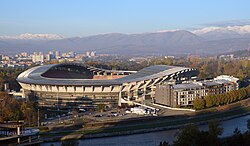
National Arena Toše Proeski (Macedonian: Национална арена „Тоше Проески“) is a sports stadium in Skopje, North Macedonia. It is currently used mostly for football matches, but also for concerts or athletics. It is the home stadium of Vardar and Rabotnichki from Skopje, who compete in the Macedonian First League, as well as the home ground of the North Macedonia national football team on almost all occasions (the other venues rarely chosen being the Goce Delčev Stadium in Prilep, or SRC Biljanini Izvori in Ohrid).
Key Information


The stadium was previously known as the City Park Stadium (Macedonian: Cтадион Градски парк; Stadion Gradski Park) until 2009 and Philip II National Arena (Macedonian: Национална арена "Филип Втори") until 2019. By an executive decision of the government of North Macedonia adopted on 9 April 2019, the National Arena was renamed "National Arena Todor Proeski" in honour of the Macedonian pop icon Todor "Toše" Proeski and as result of the Prespa agreement's obligation to de-antiquization.[1][2][3][4][5] With the capacity of just over 33,000, the National Arena is the largest stadium in the country and one of the largest in Southeastern Europe.[6]
The stadium hosted the 2017 UEFA Super Cup.[7]
Reconstruction and expansion
[edit]The project for the City Park stadium was designed in 1975 by architects Dragan Krstev and Todorka Mavkova from BetonConstruction Company. The South Stand started with construction in 1977. Construction of the South stand took 2 years and it was finished in 1978. The whole stadium was supposed to be finished the same year. Somehow the money from the budget were transferred to the federal budget and used for other projects. The reconstruction and expansion started after a long delay in project implementation in January 2008. The construction of a new north stand was finished in August 2009 and was put in use on 2 August 2009, the Macedonian national holiday "Ilinden". Ten days later, on 12 August, the North Macedonia national football team played a friendly match against then European Champions Spain, as part of the 100-year anniversary of football in the country.[8]
The reconstruction of the southern stand started in 2009, which was put into operation on 30 July of that year for the match between FK Rabotnički and Liverpool FC.[9]
On 8 September 2009, the construction of the new western and eastern stands started. The two new stands were open for the public on 24 April 2011.[5] By mid July 2012, the majority of the stadium was completed with the reconstruction of the new pitch and athletic track. On 25 July 2012, FK Vardar played FC BATE Borisov in the second qualifying round of the UEFA Champions League to re-open the stadium.[10][11] On 8 September 2012, the Independence Day of Macedonia, a celebration was held when almost 50,000 visitors attended the event (in the stands and on the field).[5] This event set the record of attendance for the stadium.[5]
Construction cost
[edit] | This section needs to be updated. (September 2020) |
Since 2008, the stadium has seen investment of about two billion denari, or €32 million. The second phase, which got underway in November 2011, saw the reconstruction of the pitch and athletic track. The athletic track around the pitch, from the original 6 was extended to 8 running tracks and it uses Tartan track surface. Total cost for this phase is €3.5 million.[12] The stadium was finished in 2013 with the completion of a new illuminated outer facade. The total construction cost for all actions related to the stadium in the period 2008–2013 reached over €60 million.[13]

Notable matches
[edit]- 1985–86 UEFA Cup First round, Second leg – 2 October 1985 between FK Vardar and FC Dinamo București.[14]
- 1987–88 European Cup First round, Second leg – 30 September 1987 between FK Vardar and FC Porto.[15]
- 1992–93 Macedonian Cup Final – 23 May 1993 between FK Vardar and FK Pelister.[16]
- UEFA Euro 1996 qualifying – 7 September 1994 between Macedonia and Denmark.[17]
- UEFA Euro 1996 qualifying – 12 October 1994 between Macedonia and Spain.[18]
- 2000–01 UEFA Cup First round, First leg – 14 September 2000 between FK Pobeda and AC Parma.[19]
- 2003–04 UEFA Champions League Second qualifying round, Second leg – 6 August 2003 between FK Vardar and CSKA Moscow.[20]
- 2003–04 UEFA Champions League Third qualifying round, First leg – 13 August 2003 between FK Vardar and AC Sparta Prague.[21]
- UEFA Euro 2004 qualifying – 6 September 2003 between Macedonia and England.[22]
- 2003–04 UEFA Cup First round, Second leg – 15 October 2003 between FK Vardar and AS Roma.[23]
- 2006 FIFA World Cup qualification – 9 October 2004 between Macedonia and Netherlands.[24]
- 2005–06 UEFA Champions League Second qualifying round, First leg – 27 July 2005 between FK Rabotnički and Lokomotiv Moscow.[25]
- 2006–07 UEFA Champions League Third qualifying round, Second leg – 23 August 2006 between FK Rabotnički and LOSC Lille.[26]
- 2007–08 UEFA Cup First round, First leg – 20 September 2007 between FK Rabotnički and Bolton Wanderers.[27]
- UEFA Euro 2008 qualifying – 17 November 2007 between Macedonia and Croatia.[28]
- 2010 FIFA World Cup qualification – 6 September 2008 between Macedonia and Scotland.[29]
- 2010–11 UEFA Europa League Third qualifying round, First leg – 29 July 2010 between FK Rabotnički and Liverpool.[30]
- UEFA Euro 2012 qualifying – 4 June 2011 between Macedonia and Republic of Ireland.[31]
- 2011–12 UEFA Europa League Play-offs, Second leg – 25 August 2011 between FK Rabotnički and SS Lazio.[32]
- 2012–13 UEFA Champions League Second qualifying round, Second leg – 25 July 2012 between FK Vardar and BATE Borisov.[33]
- 2015–16 UEFA Champions League Second qualifying round, Second leg – 21 July 2015 between FK Vardar and APOEL.[34]
- 2015–16 UEFA Europa League Play-offs, First leg – 20 August 2015 between FK Rabotnički and Rubin Kazan.[35]
- UEFA Euro 2016 qualifying – 8 September 2015 between Macedonia and Spain.[36]
- 2018 FIFA World Cup qualification – 9 October 2016 between Macedonia and Italy.[37]
- 2017 UEFA European Under-21 Championship qualification – 11 October 2016 between Macedonia and Scotland.[38]
- 2017 UEFA Super Cup – 8 August 2017 between Real Madrid and Manchester United
- 2017–18 UEFA Europa League Play-offs, First leg – 17 August 2017 between FK Vardar and Fenerbahçe.[39]
- 2017–18 UEFA Europa League group stage – 14 September 2017 between FK Vardar and Zenit Saint Petersburg.[40]
- UEFA Euro 2020 qualifying play-offs semi-finals – 8 October 2020 between North Macedonia and Kosovo.[41]
- UEFA Euro 2024 Qualifying - 23 March 2023 between North Macedonia and Malta.[42]
- UEFA Euro 2024 Qualifying - 16 June 2023 between North Macedonia and Ukraine.[43]
- 2026 FIFA World Cup qualification - 25 March 2025 between North Macedonia and Wales.
- 2026 FIFA World Cup qualification - 6 June 2025 between North Macedonia and Belgium.
- 2026 FIFA World Cup qualification - 7 September 2025 between North Macedonia and Liechtenstein.
- 2026 FIFA World Cup qualification - 13 October 2025 between North Macedonia and Kazakhstan.
Concerts
[edit]- 1995 – Lepa Brena held a concert in front of 35,000 people.
- 1996 – Dragana Mirković held a concert in front of 15,000 people.
- 2004 – Toše Proeski held a concert in front of 20,000 people.
- 2005 – Svetlana Ražnatović held a concert in front of 30,000 people.
- 2006 – Toše Proeski held a concert in front of 30,000 people.
- 2007 – Toše Proeski held a concert in front of 50,000 people.
- 2007 – Pink held a concert in front of 20,000 people.
- 2007 – Tarkan held a concert in front of 6,000 people.[44]
- 2009 – Carlos Santana held a concert in front of 15,000 people.
- 2012 – Garo & Tavitjan Brothers with the project Macedonian heart beats in 7/8 featuring Nina Badrić, Željko Bebek, Dado Topić, Tereza Kesovija, Josipa Lisac, Kaliopi, Hari Varešanović, Sergej Ćetković, Goran Karan, Jelena Tomašević, Antonija Šola, and Aki Rahimovski, held a concert in front of 61,000 people honoring the 21 years of Macedonian independence.[45]
- 2014 – Željko Joksimović held a concert in front of 50,000 people.
- 2016 – David Guetta held a concert in front of 15,000 people.
- 2019 – Sting held a concert in front of an undisclosed number of people
Gallery
[edit]-
 Uefa Super Cup 2017
 -
 Uefa Super Cup Ceremony
 -

-
 View from the south stand


-
 Exterior shot
 -
 View from Skopje Fortress
 -
 Skopje view of Kliment Ohridski boulevard and Toše Proeski Arena

.jpg)

References
[edit]- ^ Dymitrow, M. (2020). Cultural Atavism in the Face of an Environmental Disaster: Skopje 2014 in the limelight. In: Mihaylov, V. (eds) Spatial Conflicts and Divisions in Post-socialist Cities. The Urban Book Series. Springer, Cham. https://doi.org/10.1007/978-3-030-61765-3_8
- ^ Skopje renames national football stadium from “Philip II” to “Tose Proeski”. Protothema, April 9, 2019.
- ^ However, the Prespa agreement not only stipulates a new name for Macedonia, but Article 8 also requires that Macedonia ‘review the status of the monuments, public buildings and infrastructures on its territory […] insofar as they refer in any way to ancient Hellenic history and civilization’ and effectively ban the Vergina flag from public usage. Article 8(2) demands a six months period in which the Second Party will re-examine the status of its monuments, public buildings and infrastructure on its territory to determine if they, in any way, call upon the ancient Hellenic history and civilization. The Second Party will then have to correct these objects to ensure respect for the Greek cultural heritage and history. For more see: Reef, Paul. "Macedonian Monument Culture Beyond ‘Skopje 2014’" Comparative Southeast European Studies, vol. 66, no. 4, 2018, pp. 451-480. https://doi.org/10.1515/soeu-2018-0037
- ^ "Не било мајтап: "Филип Втори" и официјално преименуван во Арена "Тоше Проески"!". Sport1.mk. 9 April 2019. Retrieved 11 April 2019.
- ^ a b c d "Историјат на Национална Арена Тоше Проески – АДСДП на РМ". Retrieved 26 May 2021.
- ^ "Стадион – Капацитет – АДСДП на РСМ". Retrieved 26 May 2021.
- ^ UEFA (9 August 2016). "FYR Macedonia to host 2017 UEFA Super Cup game". UEFA.
- ^ "Home – Macedonian Football". Macedonian Football.
- ^ Echo, Liverpool (22 July 2010). "Liverpool FC to face FK Rabotnicki in UEFA Europa League qualifier". liverpoolecho.co.uk.
- ^ "Home – Macedonian Football". Macedonian Football.
- ^ "UEFA.com Vardar-BATE 0:0". UEFA. 25 July 2012.
- ^ "Теренот на "Филип Втори" како на "Емирати"". vest.com.mk. Archived from the original on 22 April 2012. Retrieved 15 January 2022.
- ^ Beton, IKT. "HISTORY". beton.com.mk.
- ^ Vardar-Dinamo Bucureşti 1:0; UEFA Cup First round
- ^ Vardar-Porto 0:3; European Cup First round
- ^ Vardar-Pelister 1:0; Macedonian Cup final
- ^ Macedonia-Denmark 1:1; UEFA Euro 1996 qualifying
- ^ Macedonia-Spain 0:2; UEFA Euro 1996 qualifying
- ^ Pobeda-Parma 0:2; UEFA Cup First round
- ^ Vardar-CSKA Moscow 1:1; UEFA Champions League 2nd qual. Round
- ^ Vardar-Sparta Prague 2:3; UEFA Champions League 3rd qual. Round
- ^ Macedonia-England 1:2; UEFA Euro 2004 qualifying
- ^ Vardar-Roma 1:1; UEFA Cup first round
- ^ Macedonia-Netherlands 2:2; FIFA World Cup qualification
- ^ Rabotnički-Lokomotiv Moscow 1:1; UEFA Champions League 2nd qual. Round
- ^ Rabotnički-Lille 0:1; UEFA Champions League 3rd qual. Round
- ^ Rabotnički-Bolton 1:1; UEFA Cup first round
- ^ Macedonia-Croatia 2:0; UEFA Euro 2008 qualifying
- ^ Macedonia-Scotland 1:0; FIFA World Cup qualification
- ^ Rabotnički-Liverpool 0:2; UEFA Europa League 3rd qual. Round
- ^ Macedonia-Ireland 0:2; UEFA Euro 2012 qualifying
- ^ Rabotnički-Lazio 1:3; UEFA Europa League Play-offs
- ^ Vardar-BATE Borisov 0:0; UEFA Champions League 2nd qual. Round
- ^ Vardar-APOEL 1:1; UEFA Champions League 2nd qual. Round
- ^ Rabotnički-Rubin Kazan 1:1; UEFA Europa League Play-offs
- ^ Macedonia-Spain 0:1; UEFA Euro 2016 qualifying
- ^ Macedonia-Italy 2:3; FIFA World Cup qualification
- ^ Macedonia-Scotland 2:0; UEFA European Under-21 Championship qualification
- ^ Vardar-Fenerbahçe 2:0; UEFA Europa League Play-offs
- ^ Vardar-Zenit 0:5; UEFA Europa League Group stage
- ^ North Macedonia-Kosovo 2:1; UEFA Euro 2020 qualifying play-offs
- ^ North Macedonia-Malta; UEFA Euro 2024 Qualifying.
- ^ North Macedonia=Ukraine; UEFA Euro 2024 Qualifying.
- ^ Шекеровска, Катерина (19 June 2007). "Таркан – професионалец за спектакли". Utrinski vesnik. Archived from the original on 8 August 2014. Retrieved 27 July 2014.
- ^ "61.000 гледачи на Филип Втори – спектакуларна прослава на Денот на независноста". Bukvar.mk. 9 September 2012. Archived from the original on 27 July 2014. Retrieved 27 July 2014.
External links
[edit]


- Toše-Proeski-Arena – Skopje (in German)
- Национална арена "Тодор Проески" (in Macedonian)
- Toŝe Proeski National Arena Archived 16 May 2021 at the Wayback Machine at WorldStadiums.com (in English)
- Arena Philip II of Macedon at MacedonianFootball.com (in English)
- Новиот градски стадион (photo gallery) (in Macedonian)


Toše Proeski Arena
View on GrokipediaNational Arena Toše Proeski is a multi-purpose sports stadium in Skopje, North Macedonia, functioning primarily as a venue for association football matches, athletics competitions, and concerts.[1] With a seating capacity of 33,460, it stands as the largest stadium in the country and among the most prominent in Southeastern Europe.[2]
The arena serves as the home ground for the North Macedonia national football team, as well as domestic clubs FK Vardar Skopje and FK Rabotnički Skopje.[2] Originally constructed in 1947 as Gradski Stadion Skopje, it underwent extensive reconstruction and was officially reopened on 12 September 2009 following major upgrades to modern standards.[3] Previously known as Nacionalna Arena Filip II Makedonski, it was renamed National Arena Toše Proeski on 9 April 2019 by government decree to honor the popular Macedonian singer Toše Proeski, who perished in a 2007 car accident.[4]
A defining moment in its history came in 2017 when the stadium hosted the UEFA Super Cup final, where Real Madrid defeated Manchester United 2–1 before a capacity crowd, marking the first UEFA club final held in North Macedonia.[5] This event underscored the arena's capability to stage high-profile international fixtures, alongside its routine hosting of UEFA Champions League qualifiers, Europa League matches, and national team qualifiers.[6]
History
Origins and early development
The stadium now known as Toše Proeski Arena originated as the City Park Stadium (Gradski Stadion) in Skopje, constructed in 1947 shortly after the formation of its primary tenant club, FK Vardar.[7] [8] Initially designed as a simple, uncovered bowl-shaped venue with earthen terraces, it accommodated early post-World War II football matches and served the needs of local and national teams within the Yugoslav federation, reflecting the modest sporting infrastructure of the era.[7][8] Significant early development commenced in 1978 amid Yugoslavia's push for improved sports facilities, when construction began on permanent, high-quality concrete stands to replace the rudimentary setup.[1][9] The south grandstand, a key component, required two years to complete and opened in 1980, followed shortly by the north stand, increasing capacity and safety for spectators while enabling larger crowds for FK Vardar and occasional Yugoslav national team fixtures.[1][9] These upgrades marked the venue's transition from a basic municipal ground to a more structured multi-purpose facility, though it remained partially incomplete and below modern standards until later interventions.[1]Major reconstruction and opening
The major reconstruction of the stadium, then known as the City Stadium or Gradski Stadion, began in early 2008 amid efforts to modernize the aging facility to international standards following years of neglect after the dissolution of Yugoslavia. The initial phase focused on the north stand, with construction starting that year to replace outdated infrastructure with covered seating, improved access, and enhanced safety features. This work enabled partial utilization of the venue during ongoing development, including hosting the 2010 UEFA European Women's Under-19 Championship finals.[10] Subsequent phases addressed the remaining stands, culminating in the completion of the east and west sections by spring 2011. The project, which transformed the bowl-shaped stadium into a multi-purpose arena with a capacity of 32,580 seats, 494 VIP places, 245 seats for commentators, and accommodations for 141 journalists, was primarily financed by the government of the Former Yugoslav Republic of Macedonia at a cost of €50 million, supplemented by €625,000 from UEFA via its Win In Europe initiative aimed at stadium upgrades across Europe.[10] The arena, renamed Philip II Arena in 2009 to honor the ancient Macedonian king, was officially opened on April 24, 2011, during a modest ceremony attended by Prime Minister Nikola Gruevski, senior officials from the Football Federation of Macedonia, and other political figures. This event marked the venue's readiness for full operations, with the first senior international match—a UEFA EURO 2012 qualifier against the Republic of Ireland—held on June 4, 2011. A follow-up phase commencing in November 2011 reconstructed the pitch and athletic track to further elevate facilities.[10]Renaming and subsequent modifications
The Philip II National Arena was renamed the Toše Proeski Arena (full name: National Arena Todor Proeski) on April 9, 2019, following an executive decision by the Government of North Macedonia. The renaming honored Todor Proeski, a celebrated Macedonian singer and songwriter who represented the country at the Eurovision Song Contest 2004 and died in a car accident on June 16, 2007, near Skopje.[11][12] Government officials cited Proeski's profound cultural impact as the rationale, describing him as a figure who left an indelible mark on contemporary Macedonian history.[13] This change was enacted shortly after the Prespa Agreement took effect on February 12, 2019, which resolved the long-standing naming dispute with Greece by requiring North Macedonia to abstain from using symbols or names associated with ancient Macedonian heritage, such as Philip II of Macedon, in official contexts to avoid irredentist implications.[12] The prior name, adopted in 2009 during a period of heightened national identity assertions, had been a point of contention in bilateral relations. The selection of Proeski, a modern non-historical icon, aligned with the agreement's stipulations while fulfilling domestic commemorative aims.[12] Post-renaming modifications have primarily involved maintenance and incremental improvements rather than large-scale reconstruction. In early 2025, renovation efforts included repainting the stadium's seats in the yellow and red colors of the North Macedonian flag to enhance aesthetics and durability. These works, overseen in coordination with the Football Federation of Macedonia, were part of broader upkeep to ensure compliance with hosting standards for national team matches and events. No major structural expansions have been documented since 2019, with prior significant upgrades completed by 2013.[14]Design and facilities
Capacity and layout
The Toše Proeski Arena features an all-seated capacity of 33,460 spectators for football matches.[15][16] This configuration makes it the largest stadium in North Macedonia.[8] The layout comprises four principal stands—North, South, East, and West—encircling the pitch, with the athletics running track removed during 2017 renovations to position seating closer to the field and comply with UEFA standards for the Super Cup final.[17] The South Stand functions as the primary grandstand, while the West Stand is designated for home supporters of clubs like FK Vardar, and the East Stand for away fans.[17] All stands are covered, providing shelter across the venue.[1] Dedicated facilities include 276 VIP seats and a press section with 264 positions, supporting high-profile events.[1] The design prioritizes sightlines and accessibility, with the oval-shaped bowl ensuring unobstructed views from most seats.[18]Pitch and technical features
The pitch at Toše Proeski Arena measures 105 metres in length by 68 metres in width, adhering to standard FIFA dimensions for international football matches.[16][8]
It features a hybrid grass surface, utilizing the HATKO Hybridgrass system where natural grass is reinforced with synthetic fibers on a prepared root zone layer filled with a specialized mixture and seeded with high-quality sports turf.[19] This installation, completed with seeding at the end of October 2023 and first used in a match on 3 March 2024, includes a new irrigation system to support consistent playability.[19]
Undersoil heating enables year-round usage regardless of weather conditions, while the design promotes durability and high standards for both national and club fixtures.[16][19] The pitch is encircled by an eight-lane athletics running track, facilitating multi-sport events but distancing spectators from the action during football games.[16]
Technical infrastructure includes LED floodlights for evening matches and LED scoreboards for real-time game information.[8]