



Community hub
Recent from talks
Knowledge base stats:
Talk channels stats:
Members stats:
Antlion
The antlions are a group of about 2,000 species of insect in the neuropteran family Myrmeleontidae. They are known for the predatory habits of their larvae, which mostly dig pits to trap passing ants or other prey. In North America, the larvae are sometimes referred to as doodlebugs because of the marks they leave in the sand. The adult insects are less well known due to their relatively short lifespans in comparison with the larvae. Adults, sometimes known as antlion lacewings, mostly fly at dusk or just after dark and may be mistakenly identified as dragonflies or damselflies.
Antlions have a worldwide distribution. The greatest diversity occurs in the tropics, but a few species are found in cold-temperate locations, one such being the European Euroleon nostras. They most commonly occur in dry and sandy habitats where the larvae can easily excavate their pits, but some larvae hide under debris or ambush their prey among leaf litter.
Antlions are poorly represented in the fossil record. Myrmeleontiformia is generally accepted to be a monophyletic group, and within the Myrmeleontoidea, the antlions' closest living relatives are thought to be the owlflies (Ascalaphidae). A 2019 study finds Myrmeleontidae to be monophyletic, aside from Stilbopteryginae and Palparinae, which form separate clades closer to Ascalaphidae. The predatory actions of the larvae have attracted attention throughout history and antlions have been mentioned in literature since classical times.
The exact meaning of the name "antlion" is uncertain. It has been thought to refer to ants forming a large percentage of the prey of the insect, the suffix "lion" merely suggesting "destroyer" or "hunter". In any case, the term seems to go back to classical antiquity. The antlion larva is often called a "doodlebug" in North America because of the odd winding, spiralling trails it leaves in the sand while relocating, which look as if someone has been doodling.
The scientific name of the type genus Myrmeleo – and thus, the family as a whole – is derived from Ancient Greek mýrmex (μύρμηξ) "ant" + léon (λέων) "lion", in a loan translation of the names common across Europe. In most European and Middle Eastern languages, at least the larvae are known under the local term corresponding to "antlion".
Antlions can be fairly small to very large neuropterans, with wingspans ranging from 2 to 15 cm (0.8 to 5.9 in). The African genus Palpares contains some of the largest examples. Acanthaclisis occitanica is the largest European species, with an 11 cm (4.3 in) wingspan, and most North American species approach this size.
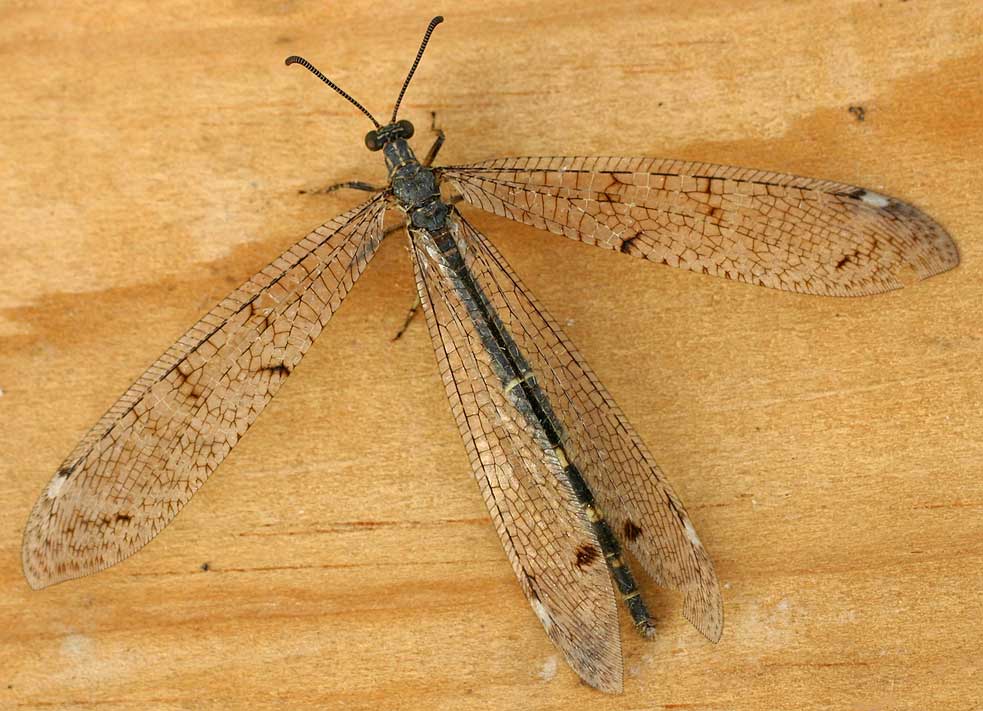
The adult has two pairs of long, narrow, multiveined, translucent wings and a long, slender abdomen. Although they somewhat resemble dragonflies or damselflies, they belong to a different infraclass of winged insects. Antlion adults are easily distinguished from damselflies by their prominent, apically clubbed antennae which are about as long as the head and thorax combined. Also, the pattern of wing venation differs, and compared to damselflies, the adults are very feeble fliers and are normally found fluttering about at night in search of a mate. Adult antlions are typically nocturnal, and rarely seen by day.
Males of most species have a unique structure, a bristle-bearing knob known as a "pilula axillaris", at the base of the rear wing. The abdomen in males is usually longer than in females and often has an extra lobe. The tip of the abdomen of females shows greater variation than that of males, depending perhaps on oviposition sites, and usually bears tufts of bristles for digging and a finger-like extension.
Hub AI
Antlion AI simulator
(@Antlion_simulator)
Antlion
The antlions are a group of about 2,000 species of insect in the neuropteran family Myrmeleontidae. They are known for the predatory habits of their larvae, which mostly dig pits to trap passing ants or other prey. In North America, the larvae are sometimes referred to as doodlebugs because of the marks they leave in the sand. The adult insects are less well known due to their relatively short lifespans in comparison with the larvae. Adults, sometimes known as antlion lacewings, mostly fly at dusk or just after dark and may be mistakenly identified as dragonflies or damselflies.
Antlions have a worldwide distribution. The greatest diversity occurs in the tropics, but a few species are found in cold-temperate locations, one such being the European Euroleon nostras. They most commonly occur in dry and sandy habitats where the larvae can easily excavate their pits, but some larvae hide under debris or ambush their prey among leaf litter.
Antlions are poorly represented in the fossil record. Myrmeleontiformia is generally accepted to be a monophyletic group, and within the Myrmeleontoidea, the antlions' closest living relatives are thought to be the owlflies (Ascalaphidae). A 2019 study finds Myrmeleontidae to be monophyletic, aside from Stilbopteryginae and Palparinae, which form separate clades closer to Ascalaphidae. The predatory actions of the larvae have attracted attention throughout history and antlions have been mentioned in literature since classical times.
The exact meaning of the name "antlion" is uncertain. It has been thought to refer to ants forming a large percentage of the prey of the insect, the suffix "lion" merely suggesting "destroyer" or "hunter". In any case, the term seems to go back to classical antiquity. The antlion larva is often called a "doodlebug" in North America because of the odd winding, spiralling trails it leaves in the sand while relocating, which look as if someone has been doodling.
The scientific name of the type genus Myrmeleo – and thus, the family as a whole – is derived from Ancient Greek mýrmex (μύρμηξ) "ant" + léon (λέων) "lion", in a loan translation of the names common across Europe. In most European and Middle Eastern languages, at least the larvae are known under the local term corresponding to "antlion".
Antlions can be fairly small to very large neuropterans, with wingspans ranging from 2 to 15 cm (0.8 to 5.9 in). The African genus Palpares contains some of the largest examples. Acanthaclisis occitanica is the largest European species, with an 11 cm (4.3 in) wingspan, and most North American species approach this size.
The adult has two pairs of long, narrow, multiveined, translucent wings and a long, slender abdomen. Although they somewhat resemble dragonflies or damselflies, they belong to a different infraclass of winged insects. Antlion adults are easily distinguished from damselflies by their prominent, apically clubbed antennae which are about as long as the head and thorax combined. Also, the pattern of wing venation differs, and compared to damselflies, the adults are very feeble fliers and are normally found fluttering about at night in search of a mate. Adult antlions are typically nocturnal, and rarely seen by day.
Males of most species have a unique structure, a bristle-bearing knob known as a "pilula axillaris", at the base of the rear wing. The abdomen in males is usually longer than in females and often has an extra lobe. The tip of the abdomen of females shows greater variation than that of males, depending perhaps on oviposition sites, and usually bears tufts of bristles for digging and a finger-like extension.