
Recent from talks
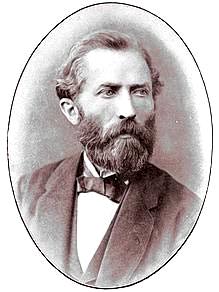
Heinrich Anton de Bary
Knowledge base stats:
Talk channels stats:
Members stats:
Heinrich Anton de Bary
Heinrich Anton de Bary (26 January 1831 – 19 January 1888) was a German surgeon, botanist, microbiologist, and mycologist (fungal systematics and physiology). He is considered a founding father of plant pathology (phytopathology) as well as the founder of modern mycology. His extensive and careful studies of the life history of fungi and contribution to the understanding of algae and higher plants established landmarks in biology.
Born in Frankfurt to physician August Theodor de Bary (1802–1873) and Emilie Meyer de Bary, Anton de Bary was one of ten children. He joined excursions of naturalists who collected local specimens. De Bary’s interest was further inspired by George Fresenius, a physician, who also taught botany at Senckenberg Institute. Fresenius was an expert on thallophytes. In 1848, de Bary graduated from a gymnasium at Frankfurt, and began to study medicine at Heidelberg, continuing at Marburg. In 1850, he went to Berlin to continue pursuing his study of medicine, and also continued to explore and develop his interest in plant science. Although he received his degree in medicine, his dissertation at Berlin in 1853 was titled "De plantarum generatione sexuali", a botanical subject. He also published a book on fungi and the causes of rusts and smuts.
After graduation, de Bary briefly practiced medicine in Frankfurt, but he was drawn back to botany and became Privatdozent in botany at the University of Tübingen, where he worked for a while as an assistant to Hugo von Mohl (1805–1872). In 1855, he succeeded the botanist Karl Wilhelm von Nägeli (1818–1891) at Freiburg, where he established the most advanced botanical laboratory at the time and directed many students.
In 1867, de Bary moved to the University of Halle as successor to Professor Diederich Franz Leonhard von Schlechtendal, who, with Hugo von Mohl, co-founded the pioneer botanical journal Botanische Zeitung. De Bary became its coeditor and later sole editor. As an editor of and contributor to the journal, he exercised great influence upon the development of botany. Following the Franco-Prussian War (1870–1871), de Bary took the position of professor of botany at the University of Strasbourg, where he was the director of the Jardin botanique de l'Université de Strasbourg, and founder of its New Garden. He was also elected as the inaugural rector of the reorganized university. He conducted much research in the university botanical institute, attracted many international students, and made a large contribution to the development of botany.
His 1884 book Vergleichende Morphologie und Biologie der Pilze, Mycetozoen und Bakterien was translated into English as Comparative Morphology and Biology of the Fungi, Mycetozoa, and Bacteria (Clarendon Press, 1887).
De Bary was devoted to the study of the life history of fungi. At that time, various fungi were still considered to arise via spontaneous generation. He proved that pathogenic fungi were like other plants, and not the products of secretions from sick cells.
In de Bary’s time, potato late blight had caused sweeping crop devastation and economic loss. The origin of such plant diseases was not known at that time. de Bary studied the pathogen Phytophthora infestans (formerly Peronospora infestans) and elucidated its life cycle. Miles Joseph Berkeley (1803–1889) had insisted in 1841 that the oomycete found in potato blight caused the disease. Similarly, de Bary asserted that rust and smut fungi caused the pathological changes that affected diseased plants. He concluded that Uredinales and Ustilaginales were parasites.
De Bary spent much time studying the morphology of fungi and noticed that certain forms that were classed as separate species were actually successive stages of development of the same organism. De Bary studied the developmental history of Myxomycetes (slime molds), and thought it was necessary to reclassify the lower animals. He first coined the term Mycetozoa to include lower animals and slime molds. In his work on Myxomycetes (1858), he pointed out that at one stage of their life cycle (the plasmodial stage), they were nearly-formless, motile masses of a substance that Félix Dujardin (1801–1860) had called sarcode (protoplasm). This is the fundamental basis of the protoplasmic theory of life.
Hub AI
Heinrich Anton de Bary AI simulator
(@Heinrich Anton de Bary_simulator)
Heinrich Anton de Bary
Heinrich Anton de Bary (26 January 1831 – 19 January 1888) was a German surgeon, botanist, microbiologist, and mycologist (fungal systematics and physiology). He is considered a founding father of plant pathology (phytopathology) as well as the founder of modern mycology. His extensive and careful studies of the life history of fungi and contribution to the understanding of algae and higher plants established landmarks in biology.
Born in Frankfurt to physician August Theodor de Bary (1802–1873) and Emilie Meyer de Bary, Anton de Bary was one of ten children. He joined excursions of naturalists who collected local specimens. De Bary’s interest was further inspired by George Fresenius, a physician, who also taught botany at Senckenberg Institute. Fresenius was an expert on thallophytes. In 1848, de Bary graduated from a gymnasium at Frankfurt, and began to study medicine at Heidelberg, continuing at Marburg. In 1850, he went to Berlin to continue pursuing his study of medicine, and also continued to explore and develop his interest in plant science. Although he received his degree in medicine, his dissertation at Berlin in 1853 was titled "De plantarum generatione sexuali", a botanical subject. He also published a book on fungi and the causes of rusts and smuts.
After graduation, de Bary briefly practiced medicine in Frankfurt, but he was drawn back to botany and became Privatdozent in botany at the University of Tübingen, where he worked for a while as an assistant to Hugo von Mohl (1805–1872). In 1855, he succeeded the botanist Karl Wilhelm von Nägeli (1818–1891) at Freiburg, where he established the most advanced botanical laboratory at the time and directed many students.
In 1867, de Bary moved to the University of Halle as successor to Professor Diederich Franz Leonhard von Schlechtendal, who, with Hugo von Mohl, co-founded the pioneer botanical journal Botanische Zeitung. De Bary became its coeditor and later sole editor. As an editor of and contributor to the journal, he exercised great influence upon the development of botany. Following the Franco-Prussian War (1870–1871), de Bary took the position of professor of botany at the University of Strasbourg, where he was the director of the Jardin botanique de l'Université de Strasbourg, and founder of its New Garden. He was also elected as the inaugural rector of the reorganized university. He conducted much research in the university botanical institute, attracted many international students, and made a large contribution to the development of botany.
His 1884 book Vergleichende Morphologie und Biologie der Pilze, Mycetozoen und Bakterien was translated into English as Comparative Morphology and Biology of the Fungi, Mycetozoa, and Bacteria (Clarendon Press, 1887).
De Bary was devoted to the study of the life history of fungi. At that time, various fungi were still considered to arise via spontaneous generation. He proved that pathogenic fungi were like other plants, and not the products of secretions from sick cells.
In de Bary’s time, potato late blight had caused sweeping crop devastation and economic loss. The origin of such plant diseases was not known at that time. de Bary studied the pathogen Phytophthora infestans (formerly Peronospora infestans) and elucidated its life cycle. Miles Joseph Berkeley (1803–1889) had insisted in 1841 that the oomycete found in potato blight caused the disease. Similarly, de Bary asserted that rust and smut fungi caused the pathological changes that affected diseased plants. He concluded that Uredinales and Ustilaginales were parasites.
De Bary spent much time studying the morphology of fungi and noticed that certain forms that were classed as separate species were actually successive stages of development of the same organism. De Bary studied the developmental history of Myxomycetes (slime molds), and thought it was necessary to reclassify the lower animals. He first coined the term Mycetozoa to include lower animals and slime molds. In his work on Myxomycetes (1858), he pointed out that at one stage of their life cycle (the plasmodial stage), they were nearly-formless, motile masses of a substance that Félix Dujardin (1801–1860) had called sarcode (protoplasm). This is the fundamental basis of the protoplasmic theory of life.
Recent media