Hubbry Logo
MicrobiologistMicrobiologistMain
Open search
Microbiologist
Community hub
Microbiologist
logo
8 pages, 0 posts
0 subscribers
Be the first to start a discussion here.
Microbiologist
Microbiologist
from Wikipedia
Microbiologist
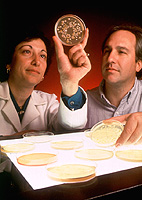
Microbiologists examining cultures on a Petri dish
Occupation
Activity sectors
Biotechnology, Government, Research, Environmental, Academia
Description
Related jobs
Scientist, Educator

A microbiologist (from Greek μῑκρος) is a scientist who studies microscopic life forms and processes. This includes study of the growth, interactions and characteristics of microscopic organisms such as bacteria, algae, fungi, and some types of parasites and their vectors.[1] Most microbiologists work in offices and/or research facilities, both in private biotechnology companies and in academia. Most microbiologists specialize in a given topic within microbiology such as bacteriology, parasitology, virology, or immunology.

Duties

[edit]

Microbiologists generally work in some way to increase scientific knowledge or to utilise that knowledge in a way that improves outcomes in medicine or some industry. For many microbiologists, this work includes planning and conducting experimental research projects in some kind of laboratory setting.[1] Others may have a more administrative role, supervising scientists and evaluating their results. Microbiologists working in the medical field, such as clinical microbiologists, may see patients or patient samples and do various tests to detect disease-causing organisms.[1]

For microbiologists working in academia, duties include performing research in an academic laboratory, writing grant proposals to fund research, as well as some amount of teaching and designing courses.[2] Microbiologists in industry roles may have similar duties except research is performed in industrial labs in order to develop or improve commercial products and processes. Industry jobs may also not include some degree of sales and marketing work, as well as regulatory compliance duties. Microbiologists working in government may have a variety of duties, including laboratory research, writing and advising, developing and reviewing regulatory processes, and overseeing grants offered to outside institutions.[2] Some microbiologists work in the field of patent law, either with national patent offices or private law practices. Their duties include research and navigation of intellectual property regulations.[2] Clinical microbiologists tend to work in government or hospital laboratories where their duties include analyzing clinical specimens to detect microorganisms responsible for the disease. Some microbiologists instead work in the field of science outreach, where they develop programs and materials to educate students and non-scientists and encourage interest in the field of microbiology for the younger generation .[2]

Education

[edit]

Entry-level microbiology jobs generally require at least a bachelor's degree in microbiology or a related field.[3] These degree programs frequently include courses in chemistry, physics, statistics, biochemistry, and genetics, followed by more specialized courses in sub-fields of interest. Many of these courses have laboratory components to teach trainees basic and specialized laboratory skills.[3]

Higher-level and independent jobs like a clinical/Medical Microbiologist in a hospital or medical research centre generally require a Masters in Microbiology along with PhD in any of the life-sciences (Biochem, Micro, Biotech, Genetics, etc) as well as several years experience as a microbiologist. This often includes time spent as a postdoctoral researcher wherein one leads research projects and prepares to transition to an independent career. Postdoctoral researchers are often evaluated largely based on their record of published academic papers, as well as recommendations from their supervisors and colleagues.[3]

In certain sub-fields of microbiology, licenses or certifications are available or required in order to qualify for certain positions. This is true for clinical microbiologists, as well as those involved in food safety and some aspects of pharmaceutical/medical device development.[3]

Job outlook

[edit]

Microbiologists are expected to be needed to help pharmaceutical and biotechnology companies develop new drugs that are produced with the aid of microorganisms. In addition, demand for biofuels production is expected to increase the need for microbiologists to conduct advanced research and development in these areas.[4]

In the United States, the Bureau of Labor Statistics predicts that employment of microbiologists will grow 5 percent from 2022 (20,900 employed) to 2032 (22,000 employed). This represents slower growth than the average occupation, as well as slower growth than life scientists as a whole (7 percent projected).[4]

See also

[edit]

References

[edit]
[edit]
Revisions and contributorsEdit on WikipediaRead on Wikipedia
from Grokipedia
A microbiologist is a who studies microorganisms such as , viruses, fungi, , and , investigating their , growth, , , and interactions with humans, animals, , and the environment. These professionals play crucial roles in advancing knowledge about microbial processes that impact , , , and environmental . Microbiologists typically perform a range of duties, including planning and conducting experiments, isolating and cultivating microbial cultures, analyzing data using advanced techniques like microscopy and genetic sequencing, and interpreting results to develop applications such as vaccines, antibiotics, or bioremediation strategies. They may specialize in areas like bacteriology, virology, mycology, or public health microbiology, working in laboratories to identify pathogens, test antimicrobial resistance, or study microbial ecology. In clinical settings, they contribute to disease diagnosis and outbreak response, while in industry, they support product development in pharmaceuticals, biotechnology, and food production. Most microbiologists work in research and development facilities (27% of jobs), government agencies (20%), or pharmaceutical and medicine manufacturing (15%), often in or office environments, with some fieldwork involving sample collection from natural sites. The profession requires full-time employment for the majority, though roles may involve irregular hours during experiments or emergencies like infectious disease outbreaks. In 2024, there were approximately 20,700 microbiologists employed in the United States, with a annual of $87,330, ranging from $51,220 for the lowest 10% to over $150,650 for the highest earners. Entry into the field generally requires a in , , or a related , often supplemented by experience through internships or undergraduate . Advanced positions, such as or directors, typically demand a master's or doctoral degree, with Ph.D. holders pursuing independent or academic roles. Certification, such as from the American Society for , can enhance employability, particularly in . The job outlook projects a 4% growth from 2024 to 2034, adding about 800 new positions, driven by needs in healthcare, , and innovation.

Overview

Definition and Scope

A microbiologist is a scientist specializing in the study of microorganisms, which are microscopic organisms including , , viruses, fungi, , and . These entities form the basis of , a discipline that examines their structure, function, genetics, and interactions with larger biological systems. The scope of microbiology is broad, encompassing several subdisciplines that apply microbial knowledge to diverse contexts, such as (focusing on disease-causing agents), environmental microbiology (exploring microbial roles in natural habitats), (utilizing microbes for manufacturing processes), and (addressing microbial impacts on and production). This interdisciplinary field integrates principles from , chemistry, and to address global challenges. Microorganisms play pivotal roles in human health and disease, where they can act as pathogens causing infections or as commensals supporting immune function and nutrient processing. In ecosystems, they drive nutrient cycling, decomposition, and symbiotic relationships essential for environmental stability. In biotechnology, microbes enable innovations like development and sustainable material production. For instance, such as lead to foodborne illnesses, whereas beneficial yeasts facilitate in and , and certain bacteria aid by degrading oil spills and pollutants.

Historical Development

The origins of microbiology as a scientific discipline trace back to the late , when Dutch draper and microscopist crafted simple microscopes capable of magnifying up to 270 times, allowing him to observe and describe previously unseen microorganisms in samples like pond water and . In letters to the Royal Society of London starting in 1676, Leeuwenhoek detailed "animalcules"—now recognized as and —marking the first documented visual evidence of microbial life and laying the groundwork for as a field of study. These observations shifted perceptions from to the existence of a vast, invisible world, though the profession remained informal, pursued by naturalists rather than dedicated scientists. The 19th century saw emerge as a rigorous profession through foundational work on microbial roles in and . French chemist Louis Pasteur's experiments in the 1860s disproved and established the , demonstrating that microorganisms cause fermentation and spoilage, leading to innovations like to prevent wine spoilage and milk contamination. Building on this, German physician in the 1870s and 1880s isolated pathogens like Bacillus anthracis () and Mycobacterium tuberculosis (), formulating in 1890 as criteria to prove microbial causation of —criteria that standardized pathogen identification and elevated to a cornerstone of medical science. These breakthroughs professionalized the field, attracting physicians and chemists into dedicated laboratories and fostering the first departments in universities. In the , advanced rapidly with discoveries that expanded its scope and applications. Scottish Alexander Fleming's 1928 observation of the mold notatum inhibiting bacterial growth led to the isolation of penicillin, the first , revolutionizing infectious disease treatment by 1940s mass production efforts. emerged as a subdiscipline around the same era, following Dmitri Ivanovsky's 1892 identification of the as a filterable agent and Martinus Beijerinck's 1898 coinage of "," with the field solidifying in through and cultivation techniques that revealed viruses' non-cellular nature. Molecular techniques further transformed the discipline; American biochemist invented the (PCR) in 1983 while at , enabling exponential DNA amplification for diagnostics and research, a method commercialized in the late . Post-2000 developments in and have profoundly shaped modern microbiologists' roles. The Project, launched in 2007 by the , sequenced microbial communities across the human body, revealing their influence on health and disease and spurring interdisciplinary research. Concurrently, the CRISPR-Cas9 system, adapted as a gene-editing tool by Jennifer and microbiologist Emmanuelle in their 2012 publication, harnessed bacterial immune mechanisms to precisely edit microbial and eukaryotic genomes, earning them the 2020 and enabling applications in antibiotic resistance studies and . The profession of has evolved from 17th-century solitary observers like Leeuwenhoek, who worked outside formal academia, to a specialized requiring advanced degrees. By the late , Pasteur and Koch's institutionalization of labs integrated microbiology into medicine and , while 20th-century expansions into industry and necessitated PhD-level training. Today, microbiologists operate in diverse settings, from academic research on to applied roles in , reflecting the field's maturation into a cornerstone of life sciences.

Education and Training

Academic Pathways

Aspiring microbiologists typically begin their academic journey with a strong foundation in high school sciences, particularly and chemistry, which provide essential prerequisites for undergraduate admission. These subjects ensure students are prepared for the rigorous scientific coursework ahead, with many programs also recommending and physics to build quantitative skills. Common pathways into microbiology often stem from premed tracks, , or general biology majors, allowing flexibility for students to explore related fields before specializing. At the undergraduate level, a in , , or a closely related field forms the core entry point, typically spanning four years in the United States. Programs emphasize foundational courses such as general , biochemistry, , and laboratory techniques, including microbial culturing and identification methods, to develop hands-on expertise. For instance, students at institutions like Penn State University complete sequences in , physics, and advanced alongside microbiology-specific classes to meet degree requirements, often culminating in a capstone research project. This structure equips graduates for entry-level roles or further study, with a minimum GPA of 2.0-3.0 commonly required in major courses. Graduate education advances specialization and research proficiency, with master's programs lasting about two years and focusing on coursework plus a thesis based on original . PhD programs, essential for academic or advanced careers, extend 4-6 years and include lab rotations in the first year to identify a dissertation advisor, followed by comprehensive exams and a defended . Specializations may include , examining host-pathogen interactions, or microbial ecology, studying microorganisms in environmental contexts, as seen in programs at . These degrees build on undergraduate knowledge, requiring a bachelor's in a relevant field and prior experience for admission. Global variations in program structure reflect differing educational systems; , the four-year bachelor's emphasizes broad liberal arts alongside sciences and heavy involvement, while European programs, such as the three-year BSc in at , focus more intensively on the discipline from the outset. In , standalone master's degrees often last one to two years post-bachelor's, prioritizing specialization over the broader foundational training common in U.S. graduate tracks. These differences influence mobility, with U.S. degrees sometimes viewed as equivalent to European bachelor's plus partial master's in terms of depth.

Required Skills and Certifications

Microbiologists require a robust set of technical skills to conduct experiments and analyze microbial systems effectively. Proficiency in , including , , and techniques, is fundamental for visualizing microorganisms and their structures. Culturing techniques, such as aseptic handling and microbial isolation, enable the growth and maintenance of pure cultures for study. Molecular methods like (PCR) are essential for amplifying DNA and detecting genetic material, often involving assay design and optimization. Sequencing technologies, including next-generation sequencing (NGS), allow for genomic analysis to identify microbial strains and variations. Bioinformatics skills are increasingly vital for processing large datasets from sequencing and other high-throughput methods, facilitating and interpretation. In addition to technical expertise, are crucial for professional success in . supports and of unexpected results, while ensures accurate and minimizes errors in procedures. Ethical data handling, guided by principles of and , is paramount to maintain scientific validity and comply with regulatory standards. Interdisciplinary collaboration, such as partnering with chemists for development or engineers for design, enhances project outcomes in applied settings. Relevant certifications validate a microbiologist's competence and are often required for roles involving regulated work. The (ASM), in partnership with , offers the ASM-WSU Microbiology Certificate Program, which provides essential training for clinical laboratory work. (GLP) training, available through programs like those from CITI Program, ensures adherence to standards for non-clinical studies, emphasizing and . certifications, such as the Certified Biological Safety Professional (CBSP) from ABSA International, qualify individuals to handle pathogens at various containment levels (BSL-1 to BSL-4), focusing on and protective measures. Continuing education is vital to keep pace with advancing technologies in . Workshops on emerging tools like next-generation sequencing (NGS) are particularly important, with ASM offering accredited training modules on NGS applications in infectious disease diagnostics. These programs, often spanning 50 hours, cover workflows, , and clinical integration to build proficiency. Skills are typically acquired through practical experiences beyond formal . Internships and lab experiences provide hands-on training in techniques like culturing and PCR, often through university research programs or industry placements. Professional societies, such as ASM and the Microbiology Society, facilitate skill development via workshops, fellowships, and networking opportunities. Academic programs in lay the groundwork for these abilities through structured coursework and labs.

Professional Roles

Research and Laboratory Duties

Microbiologists in research settings design and conduct experiments to test hypotheses related to microbial growth, , and interactions with hosts or environments. This involves formulating research questions, such as how adapt to stressors or evolve resistance mechanisms, and developing protocols to culture microorganisms under controlled conditions using media like agar plates or broths. For instance, experiments may involve exposing bacterial strains to varying concentrations to assess minimum inhibitory concentrations (MICs), as detailed in studies on resistance mechanisms where employ efflux pumps or enzymatic degradation to survive. These efforts often occur in academic labs or institutions like the , focusing on fundamental questions rather than immediate applications. Data collection in microbiological research entails isolating and maintaining pure cultures of microbes, such as or viruses, while monitoring variables like growth rates. Techniques include optical density measurements via spectrophotometers to generate growth curves, which plot microbial population changes over time, and genetic sequencing to analyze s. Analysis follows using statistical software like or GraphPad Prism to interpret results, ensuring reproducibility through controls and replicates; for example, viral evolution studies might track rates in controlled infections to understand pathogenicity. Laboratory maintenance requires adherence to sterile techniques to prevent contamination, including flame sterilization of tools, use of laminar flow hoods, and regular calibration of equipment like incubators and centrifuges. Safety protocols are tiered by biosafety levels (BSL-1 to BSL-4), with BSL-1 for low-risk agents involving basic practices like handwashing and no aerosols, escalating to BSL-4 for high-risk pathogens requiring full-body suits and airlocks to contain aerosols and prevent exposure. These measures, outlined in federal guidelines, ensure personnel safety and data integrity across all experiments. Publishing findings and collaboration form integral duties, where microbiologists draft manuscripts for journals like those from the (ASM), detailing methods, results, and implications. They also prepare grant proposals to agencies such as the to secure funding for ongoing projects. Collaboration occurs through presentations at conferences, including ASM Microbe, where researchers share data on topics like antibiotic resistance mechanisms to foster interdisciplinary advancements.

Industry and Applied Duties

In industry, microbiologists contribute significantly to product development by engineering microorganisms for practical applications in healthcare, , and sectors. They design and optimize microbial strains to produce , where attenuated or inactivated pathogens are cultivated in controlled bioreactors to generate immunogenic components, ensuring and through rigorous testing. Similarly, in probiotic development, microbiologists isolate and characterize beneficial such as and species, evaluating their viability, stability, and health-promoting properties for incorporation into dietary supplements and functional s. For biofuels, they employ to enhance , enabling efficient conversion of into fuels like bioethanol and via processes. Quality control represents a core applied duty, where microbiologists test products for microbial contaminants to safeguard across manufacturing lines. In the , they perform sterility assays and endotoxin detection on drugs and medical devices, using standardized methods to verify absence of harmful or fungi. For and food production, they analyze samples for pathogens like or E. coli employing techniques such as PCR and , helping prevent outbreaks by identifying contamination sources early in the supply chain. This testing ensures products meet microbial limits specified in industry guidelines, maintaining consistency and reducing recall risks. Regulatory compliance duties involve microbiologists in upholding standards set by agencies like the FDA and EPA during manufacturing. They develop and implement protocols for Good Manufacturing Practices (GMP), including validation of sterilization processes and environmental monitoring in production facilities to prevent cross-contamination. In environmental applications, they conduct risk assessments for microbial releases, ensuring adherence to Clean Water Act requirements for effluent discharge. Field work engages microbiologists in on-site environmental sampling and agricultural interventions, directly applying microbial to real-world challenges. They collect and water samples to monitor levels, identifying indicator microbes that signal from industrial runoff or agricultural pesticides. In agriculture, microbiologists assess microbes to promote growth and nutrient cycling, engineering biofertilizers that enhance without synthetic chemicals. For wastewater treatment, they optimize anaerobic digesters by selecting microbial consortia that efficiently break down organic waste into and treated effluent. Representative examples illustrate these duties' impact: in the , microbiologists develop cultures by selecting synergistic strains of and to achieve optimal acidification and flavor profiles during fermentation. In wastewater processes, they engineer microbial communities to degrade recalcitrant pollutants, as seen in systems that achieve over 90% removal of in municipal treatment plants.

Career Prospects

The employment of microbiologists is projected to grow 4 percent from 2024 to 2034, about as fast as the average for all occupations, with approximately 1,700 openings expected annually due to the need to replace workers who retire or transfer fields. This growth is primarily driven by expanding demand in the and healthcare sectors, where microbiologists are essential for developing treatments for infectious diseases, including those exacerbated by pandemics and emerging resistance. Climate-related issues, such as the spread of vector-borne diseases, further contribute to this demand by necessitating microbial surveillance and adaptation strategies. Key employment sectors for microbiologists include scientific research and development services, which account for about 27 percent of positions, often in academic or private labs focused on fundamental studies. The pharmaceutical and medicine manufacturing industry employs around 15 percent, emphasizing applied roles in and . Government and agencies represent approximately 20 percent, with roles in regulatory oversight and monitoring at organizations like the U.S. Centers for Disease Control and Prevention (CDC). Overall, about two-thirds of the workforce is in for-profit sectors, reflecting a shift toward industry applications. Geographically, the hosts the highest concentration of microbiologist jobs, with top employment in (over 2,000 positions), (near NIH facilities), and Georgia (CDC hub in ). In , opportunities are prominent in pharmaceutical powerhouses like and , where companies such as and drive demand for expertise in drug . Emerging markets in Asia, particularly and , show rising employment in agrobiotechnology, fueled by needs for and development amid . Influencing factors include a post-COVID-19 surge in virology-related positions, with job postings in clinical and microbiology increasing by over 30 percent since 2018 due to heightened focus on viral diagnostics and development. Additionally, the integration of for analyzing large microbial datasets, such as genomic sequences and imaging, is creating hybrid roles that combine with computational skills. Regarding career levels, entry-level positions are available for bachelor's and master's holders in lab support, but PhD-qualified microbiologists have greater access to roles, with about 50 percent in industry management and 20 percent in academic positions. As of October 2025, the reported rising resistance in over 40% of monitored pathogen-antibiotic combinations, further driving demand for microbiologists in and development.

Challenges and Ethical Considerations

Microbiologists encounter significant professional challenges that impact their ability to conduct effective research and maintain operational efficiency. Funding shortages remain a primary obstacle, as laboratory budgets often fail to keep pace with rising costs for equipment, reagents, and personnel, leading to delayed projects and limited innovation in microbial studies. Additionally, lab safety risks are inherent when handling pathogens, including potential exposure to biohazards that necessitate stringent biosafety protocols to prevent accidental releases or infections, as outlined in established guidelines for microbiological laboratories. Work-life balance is further strained in high-pressure environments, where long hours, staffing shortages, and burnout contribute to diminished productivity and high turnover rates among professionals. Ethical considerations in microbiology are multifaceted, particularly surrounding dual-use research that can simultaneously advance knowledge and pose security threats. Gain-of-function studies on viruses, for instance, aim to enhance understanding of pathogen evolution for vaccine development but raise concerns over potential misuse for bioterrorism, creating an ethical tension between scientific progress and harm prevention. Equitable access to microbial technologies in contexts is another key issue, where disparities in resource distribution exacerbate inequalities, limiting the benefits of innovations like diagnostics in low-income regions during outbreaks. in publications demands rigorous adherence to standards, as fabrication or selective reporting undermines trust in microbiological findings and can mislead responses. Diversity and inclusion challenges persist in the field, with women and minorities facing underrepresentation that hinders broader perspectives in . Globally, women comprise approximately 60% of the workforce, yet they receive fewer grants and publications compared to men, perpetuating imbalances. Minorities, including and scientists, are similarly underrepresented, making up less than 10% of the workforce in many institutions, which limits innovation and equitable representation. Efforts by organizations like the (ASM) address these gaps through task forces that promote mentorship programs and inclusive policies to foster participation from underrepresented groups. Looking ahead, microbiologists must navigate future risks such as threats from , where engineered microbes could be weaponized, amplifying the potential for unintended ecological or disruptions. The antibiotic resistance crisis compounds these concerns, with multidrug-resistant pathogens causing 1.27 million direct deaths annually (as of ) and projected to escalate without novel interventions, placing urgent demands on microbial research. To mitigate these challenges and ethical dilemmas, microbiologists adhere to established codes and frameworks that emphasize responsible conduct. The ASM Code of Ethics mandates upholding scientific , discouraging misuse of microbes, and promoting in all endeavors. Similarly, the World Health Organization's global guidance framework advocates for risk assessments, transparent governance, and international collaboration to manage dual-use and ensure equitable benefits in life sciences, including . These strategies, combined with ongoing training in and , help safeguard the field's and societal impact.

References

Add your contribution
Related Hubs
User Avatar
No comments yet.