Hubbry Logo
OomyceteOomyceteMain
Open search
Oomycete
Community hub
Oomycete
logo
8 pages, 0 posts
0 subscribers
Be the first to start a discussion here.
Oomycete
Oomycete
from Wikipedia

Oomycetes
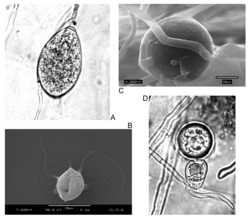
Asexual (A: sporangia, B: zoospores, C: chlamydospores) and sexual (D: oospores) reproductive structures of Phytophthora infestans (Peronosporales)
Scientific classification Edit this classification
Domain: Eukaryota
Clade: Sar
Clade: Stramenopiles
Clade: Pseudofungi
Phylum: Oomycota
Class: Oomycetes
Winter, 1880[1]
Orders and families
Synonyms
  • Peronosporomycetes Dick, 2001[2]

The Oomycetes (/ˌ.əˈmsts/),[3] or Oomycota, form a distinct phylogenetic lineage of fungus-like eukaryotic microorganisms within the Stramenopiles. They are filamentous and heterotrophic, and can reproduce both sexually and asexually. Sexual reproduction of an oospore is the result of contact between hyphae of male antheridia and female oogonia; these spores can overwinter and are known as resting spores.[4]: 409  Asexual reproduction involves the formation of chlamydospores and sporangia, producing motile zoospores.[4] Oomycetes occupy both saprophytic and pathogenic lifestyles, and include some of the most notorious pathogens of plants, causing devastating diseases such as late blight of potato and sudden oak death. One oomycete, the mycoparasite Pythium oligandrum, is used for biocontrol, attacking plant pathogenic fungi.[5] The oomycetes are also often referred to as water molds (or water moulds), although the water-preferring nature which led to that name is not true of most species, which are terrestrial pathogens.

Oomycetes were originally grouped with fungi due to similarities in morphology and lifestyle. However, molecular and phylogenetic studies revealed significant differences between fungi and oomycetes which means the latter are now grouped with the stramenopiles (which include some types of algae). The Oomycota have a very sparse fossil record; a possible oomycete has been described from Cretaceous amber.[6]

Etymology

[edit]

Oomycota comes from oo- (Ancient Greek: ωόν, romanizedōon, lit.'egg') and -mycete (Ancient Greek: μύκητας, romanizedmýkitas, lit.'fungus'), referring to the large round oogonia, structures containing the female gametes, that are characteristic of the oomycetes.

The name "water mold" refers to their earlier classification as fungi and their preference for conditions of high humidity and running surface water, which is characteristic for the basal taxa of the oomycetes.

Morphology

[edit]

The oomycetes rarely have septa (see hypha), and if they do, they are scarce,[7] appearing at the bases of sporangia, and sometimes in older parts of the filaments.[8] Some are unicellular, while others are filamentous and branching.[8]

Representation of an oomycete
  1. Anterior flagellum
  2. Mastigonemes, "hairs" attached to flagellum
  3. Flattened cisternae
  4. Peripheral vesicle
  5. Phospholipid vesicle
  6. Contractile vacuole, regulates the quantity of water inside a cell
  7. Groove
  8. Golgi apparatus; modifies proteins and sends them out of the cell
  9. Flagellar rootlet
  10. K-body (microbody)
  11. Basal body
  12. Nucleolus
  13. Nucleus
  14. Endoplasmic reticulum, the transport network for molecules going to specific parts of the cell
  15. Mitochondrion, creates ATP (energy) for the cell
  16. Lipid vesicle
  17. Cellulose vesicle
  18. Posterior flagellum

Classification

[edit]
Simplified phylogeny.[citation needed]
Asexual structures (sporangia) in Saprolegniales, Albuginales and Peronosporales[citation needed]
Sexual structures (only oogonia, antheridia not shown) of Saprolegnia.[citation needed]

Previously the group was arranged into six orders.[8]

  • The Saprolegniales are the most widespread. Many break down decaying matter; others are parasites.
  • The Leptomitales have wall thickenings that give their continuous cell body the appearance of septation. They bear chitin and often reproduce asexually.
  • The Rhipidiales use rhizoids to attach their thallus to the bed of stagnant or polluted water bodies.
  • The Albuginales are considered by some authors to be a family (Albuginaceae) within the Peronosporales, although it has been shown that they are phylogenetically distinct from this order.
  • The Peronosporales too are mainly saprophytic or parasitic on plants, and have an aseptate, branching form. Many of the most damaging agricultural parasites belong to this order.
  • The Lagenidiales are the most primitive; some are filamentous, others unicellular; they are generally parasitic.

However more recently this has been expanded considerably.[9][10]

Phylogenetic relationships

[edit]
Pythium sp. (Peronosporales), which causes pythiosis in animals, under microscope.
Symptom of late blight (P. infestans, Peronosporales) on the underside of a potato leaf.
Albugo candida (Albuginales) on shepherd's purse (Capsella bursa-pastoris, Brassicales).

Internal

[edit]

External

[edit]

This group was originally classified among the fungi (the name "oomycota" means "egg fungus") and later treated as protists, based on general morphology and lifestyle.[6] A cladistic analysis based on modern discoveries about the biology of these organisms supports a relatively close relationship with some photosynthetic organisms, such as brown algae and diatoms.[11] A common taxonomic classification based on these data, places the class oomycetes class along with other classes such as the brown algae within the phylum Stramenopile.

This relationship is supported by a number of observed differences between the characteristics of oomycetes and fungi. For instance, the cell walls of oomycetes are composed of cellulose rather than chitin[12] and generally do not have septations. Also, in the vegetative state they have diploid nuclei, whereas fungi have haploid nuclei. Most oomycetes produce self-motile zoospores with two flagella. One flagellum has a "whiplash" morphology, and the other a branched "tinsel" morphology. The "tinsel" flagellum is unique to the Kingdom Heterokonta. Spores of the few fungal groups which retain flagella (such as the Chytridiomycetes) have only one whiplash flagellum.[12] Oomycota and fungi have different metabolic pathways for synthesizing lysine and have a number of enzymes that differ.[12] The ultrastructure is also different, with oomycota having tubular mitochondrial cristae and fungi having flattened cristae.[12]

In spite of this, many species of oomycetes are still described or listed as types of fungi and may sometimes be referred to as pseudofungi, or lower fungi.

Biology

[edit]

Reproduction

[edit]
Life cycle of Phytophthora infestans (Peronosporales) on potato. M: meiosis, P: plasmogamy, K: karyogamy, n: haploid, 2n: diploid.

Most of the oomycetes produce two distinct types of spores. The main dispersive spores are asexual, self-motile spores called zoospores, which are capable of chemotaxis (movement toward or away from a chemical signal, such as those released by potential food sources) in surface water (including precipitation on plant surfaces). A few oomycetes produce aerial asexual spores that are distributed by wind. They also produce sexual spores, called oospores, that are translucent, double-walled, spherical structures used to survive adverse environmental conditions.

Ecology and pathogenicity

[edit]
Unidentified water mold on dead larval mayfly.
A culture of Achlya sp. (Saprolegniales) isolated from a stream.
Sea trout suffering from UDN with secondary Saprolegnia infections.

Many oomycetes species are economically important, aggressive algae and plant pathogens.[13][14] Some species can cause disease in fish, and at least one is a pathogen of mammals. The majority of the plant pathogenic species can be classified into four groups, although more exist.

References

[edit]
[edit]
Revisions and contributorsEdit on WikipediaRead on Wikipedia
from Grokipedia
Oomycota, also known as oomycetes or water molds, are a of filamentous protists in the , distinguished from true fungi by their evolutionary affinity to and diatoms rather than the fungal kingdom Eumycota. Comprising over 1,200 described species, they exhibit mycelium-like growth with coenocytic hyphae containing diploid nuclei and cell walls primarily composed of and beta-glucans, in contrast to the chitin-based walls of fungi. These organisms are predominantly aquatic or terrestrial in moist environments, functioning as saprotrophs that decompose or as parasites affecting plants, animals, and occasionally humans. Historically classified among fungi due to their absorptive and filamentous morphology, oomycetes were reclassified in the late based on molecular, biochemical, and ultrastructural evidence, including tubular mitochondrial cristae and flagella on motile spores. Their life cycle is characterized by oogamous , where large non-motile oospores form via fertilization of oogonia by antheridia, alongside through biflagellate zoospores that facilitate dispersal in or soil. Phylogenetically, oomycetes form a monophyletic within the stramenopiles, with origins likely tracing to marine parasites and diversification into subgroups such as Saprolegniomycetidae (including saprophytic molds) and Peronosporomycetidae (encompassing many plant pathogens). Oomycetes hold significant ecological and economic importance, particularly as devastating plant pathogens; for instance, triggered the Irish Potato Famine of the 1840s, leading to approximately one million deaths and 1.5 million emigrations. Other notable species include Plasmopara viticola, causing in grapes, and various and taxa responsible for root rots and blights in crops, forestry, and turf. While most are plant-associated, some like Saprolegnia parasitize and amphibians, and rare cases such as Pythium insidiosum infect mammals, including humans in tropical regions. Advances in and continue to reveal their and evolutionary history, underscoring their role as model organisms for studying host-pathogen interactions in non-fungal eukaryotes.

Overview and Etymology

Definition and General Characteristics

Oomycetes, also known as water molds, form the Oomycota within the kingdom . They are filamentous, heterokont protists that resemble fungi in their absorptive nutrition and hyphal growth but are phylogenetically related to and diatoms rather than true fungi. Over 800 have been described, many of which are aquatic or thrive in moist terrestrial environments. Their vegetative body consists of coenocytic (aseptate) hyphae with diploid nuclei and cell walls composed mainly of and β-glucans, differing from the chitinous walls of fungi. Oomycetes can act as saprotrophs, decomposing , or as parasites of , animals, and occasionally humans, with significant economic impacts through diseases like blights and rots.

Etymology

The term "Oomycota" derives from the Greek roots ōon (egg) and mykēs (fungus), alluding to the prominent egg-like oogonia that characterize the sexual reproductive structures of these organisms. This nomenclature highlights their superficial resemblance to fungi while emphasizing a key morphological feature that sets them apart. The name reflects early observations of their reproductive biology, where the oogonium serves as the female structure fertilized by antheridia to produce oospores. The class name "Oomycetes" was formally introduced by German mycologist Georg Winter in 1880 as part of his contributions to Rabenhorst's Kryptogamen-Flora, grouping these aquatic and terrestrial pathogens based on shared reproductive traits like oogonia and antheridia. This classification helped consolidate diverse fungus-like protists previously scattered under broader categories such as . The designation "Oomycota" was later established by J.A. von Arx in 1967, aligning with modern taxonomic practices that recognize their affinity rather than true fungal lineage. Earlier work by in 1863, particularly his detailed studies on the life cycle of species in Recherches sur le développement de quelques champignons parasites, played a pivotal role in distinguishing oomycetes from true fungi through observations of their diploid somatic phase and motile zoospores. Oomycetes are commonly referred to as water molds owing to the aquatic lifestyle of many species, which rely on for zoospore dispersal, or as egg fungi to underscore their oogonial . In some older taxonomic systems, the group was classified under the division Oomycophyta to denote their plant-like division status alongside other lower fungi. These alternative names persist in both scientific literature and applied contexts, such as , where their destructive potential on crops is emphasized.

Morphology and Cellular Structure

Vegetative Body

The vegetative body of oomycetes consists of filamentous, mycelium-like structures formed by coenocytic hyphae, which are tubular filaments lacking cross-walls () except in specialized regions such as reproductive structures or during aging. These hyphae are multinucleate, containing diploid nuclei throughout most of the life cycle, in contrast to the haploid nuclei typical of many fungi. The cell walls are primarily composed of and β-1,3- and β-1,6-glucans, with minor amounts of proteins and , differing from the chitin-based walls of true fungi. Oomycetes also exhibit tubular mitochondrial cristae and, in motile stages, heterokont flagella, reflecting their phylogenetic position among stramenopiles.

Reproductive Structures

Oomycetes exhibit diverse asexual reproductive structures, primarily sporangia, which are specialized hyphal tips that produce zoospores. Sporangia vary in form, often being terminal or intercalary and bulbous or elongated, and can be classified as papillate, featuring a distinct apical projection, or non-papillate, lacking such a feature. Additionally, sporangia may be caducous, readily detaching for dispersal, or non-caducous, remaining attached to the . Within sporangia, zoospores develop as biflagellate, wall-less cells with a - or kidney-shaped body, possessing an anterior flagellum and a posterior whiplash flagellum attached in a ventral groove. Upon encystment, zoospores retract their flagella, become spherical, and secrete a thin along with a mucilaginous matrix, forming durable cysts that adhere to substrates. Sexual reproductive structures in oomycetes include oogonia and antheridia, which together produce oospores. Oogonia are typically spherical gametangia, ranging from 20 to 100 μm in diameter, with a thick wall and containing one or more eggs surrounded by . Antheridia, the male gametangia, are smaller, often clavate or club-shaped, and attach to oogonia in specific configurations that serve as taxonomic markers: paragynous attachment occurs laterally along the side of the oogonium, amphigynous attachment encircles the base forming a collar-like structure, and hypogynous attachment positions the antheridium below the oogonium. These variations are exemplified in genera such as (predominantly paragynous) and (amphigynous). Oospores form as thick-walled, diploid zygotes within fertilized oogonia, providing resilience for . They are globose, often 40–55 μm in , and feature a multilayered wall structure: an outer exospore composed of pectic substances and an inner of and proteins, which enables long-term survival in adverse conditions such as soil desiccation. In some lineages like Sclerosporales, oospores may exhibit a verrucate (warty) surface. These structures facilitate transitions in the oomycete life cycle by enabling persistence and germination under favorable conditions.

Classification

Taxonomic History

Oomycetes were historically classified among the fungi owing to their filamentous growth habit, absorptive nutrition, and superficial morphological resemblances in reproductive structures, such as the production of spores and hyphae-like filaments. In the mid-19th century, the German botanist pioneered their systematic study, particularly through his work on , the causal agent of potato late blight, and grouped them with other lower fungi in the class based on shared coenocytic organization and gametangial reproduction. This classification emphasized their fungus-like ecology and morphology, despite early observations by de Bary of reproductive similarities to the alga . By the early 20th century, oomycetes continued to be encompassed within , a heterogeneous assemblage of aquatic and terrestrial organisms with flagellated spores, but debates arose over their precise affinities. Some taxonomists, influenced by oogamous reminiscent of , proposed algal classifications, as noted in early works by Pringsheim (1858) and later by Bessey (1942), while others included asexual forms in the due to the prevalence of zoosporangia over perfect sexual stages in many species. These pre-molecular era discussions highlighted uncertainties, with oomycetes often treated as a subclass within alongside chytrids and zygomycetes, reflecting limited understanding of their cellular details. Significant shifts occurred in the mid-20th century through ultrastructural and biochemical investigations. Starting in the , studies revealed that oomycete cell walls contained and β-glucans rather than , distinguishing them from true fungi, as demonstrated by analyses from Bartnicki-García (1968) and others. By the 1970s, electron microscopy uncovered critical differences in flagellation, including the heterokont arrangement with a posterior whiplash flagellum and anterior tinsel flagellum, unlike the uniflagellate or non-motile spores of fungi; key work by Holloway and Heath (1977) on the flagellar apparatus solidified this divergence. These findings prompted their reassignment to the subdivision Mastigomycotina within the kingdom Fungi, a grouping for zoosporic forms proposed by Sparrow (1943) and refined by Ainsworth (1971), emphasizing and aquatic habits over fungal phylogeny. The 1980s marked a pivotal transition with the advent of molecular techniques, particularly (rDNA) sequencing, which refuted fungal . Gunderson et al. (1987) analyzed small subunit rDNA sequences and found oomycetes clustered more closely with algae than with any fungal lineage, challenging longstanding affinities and fueling debates on their kingdom-level placement. This evidence, corroborated by Förster et al. (1990) on sequences, led to proposals by Cavalier-Smith (1981, 1986) to relegate oomycetes to the pseudofungi within the kingdom , a revision that addressed pre-molecular inconsistencies and set the stage for their recognition as stramenopiles distinct from fungi.

Current Taxonomy

Oomycota is recognized as a phylum within the stramenopiles clade of the kingdom Chromista (or Harosa in some classifications). The phylum encompasses over 800 described species divided into early-diverging lineages, primarily holocarpic parasites, and two main crown classes: Saprolegniomycetes and Peronosporomycetes. The class Saprolegniomycetes includes saprotrophic and animal-parasitic species, with key orders such as Saprolegniales (e.g., genera Saprolegnia, Aphanomyces) and Leptomitales. The class Peronosporomycetes comprises mostly plant-pathogenic forms, featuring orders like Peronosporales (e.g., downy mildews such as Plasmopara, Peronospora), Pythiales (e.g., Pythium, Phytophthora), and Rhipidiales. Early-diverging groups, such as the class Olpidiomycetes, include obligate parasites of algae, invertebrates, and plants, with orders like Olpidiales and Lagenidiales. This classification, based on molecular phylogenetics including rDNA and mitochondrial genes, reflects ongoing refinements as of 2024.

Phylogenetic Relationships

External Relationships

Oomycetes form a monophyletic within the stramenopiles (also known as heterokonts), a diverse supergroup of eukaryotes that includes photosynthetic ochrophytes such as diatoms and , as well as other heterotrophic and parasitic protists. Molecular phylogenetic analyses, including multi-gene and genomic data, consistently place oomycetes as a derived lineage within stramenopiles, likely evolving from a photosynthetic with subsequent loss of plastids. This affiliation is supported by shared features like heterokont flagella and tubular mitochondrial cristae, distinguishing them from true fungi.

Internal Relationships

The internal relationships of oomycetes reveal a deep evolutionary history marked by early diverging basal lineages and a subsequent radiation of core clades, all nested within the supergroup. Basal lineages, such as those in Eurychasmales and Olpidiomycetes, represent early branching groups characterized by holocarpic (whole-body parasitic) lifestyles and simple structures, often found as parasites in aquatic environments. These groups, including genera like Eurychasma in Eurychasmales and Olpidiopsis in Olpidiomycetes, diverge prior to the major crown clades and exhibit primitive traits such as endoparasitism without extensive hyphal growth. The core clades of oomycetes comprise two primary classes: Saprolegniomycetes and Peronosporomycetes, which diverged early in the group's history and display contrasting ecological adaptations. Saprolegniales, within Saprolegniomycetes, predominantly consists of freshwater saprotrophs and facultative parasites, such as Saprolegnia species that decompose or infect weakened and amphibians. In contrast, Peronosporales, part of Peronosporomycetes, includes obligate biotrophs like downy mildews () and white rusts (), which are specialized plant pathogens relying on host nutrients for survival. These core clades highlight a diversification from saprotrophic to highly host-dependent lifestyles. Phylogenetic analyses, drawing on 18S rDNA sequences alongside multi-locus datasets (e.g., nrLSU, cox2, and up to 40 orthologous genes), depict oomycete origins around 430–400 million years ago during the mid- era, with the divergence of core crown clades (Saprolegniomycetes–Peronosporomycetes) occurring approximately 225–190 million years ago in the early , coinciding with further land plant diversification. This tree topology consistently positions basal holocarpic lineages outside the Saprolegniomycetes–Peronosporomycetes split, with strong support from and maximum likelihood methods, underscoring a marine-to-freshwater/terrestrial transition in oomycete evolution. A key in pathogen clades, particularly within Peronosporales, involves the of effector proteins that manipulate host defenses to promote . Families like RXLR and CRN effectors have undergone significant expansions—e.g., over 600 RXLR effectors in Phytophthora infestans—through mechanisms such as , recombination, and diversifying selection, enabling these biotrophs to suppress immunity. This effector arsenal likely arose post-divergence in core pathogenic lineages, enhancing in terrestrial hosts.

Reproduction

Asexual Reproduction

Asexual reproduction in oomycetes primarily occurs through the formation of sporangia, which serve as the key propagules for clonal propagation. These structures develop at the tips of specialized hyphae called sporangiophores, often in response to environmental conditions conducive to dispersal. Sporangium formation involves coordinated cellular processes, including the regulation of G-proteins, kinases, and transcription factors such as MYB and MADS family members, which control hyphal differentiation and sporangiophore branching. Sporangia exhibit two distinct modes of : direct and indirect. In direct , the sporangium wall ruptures to produce a germ tube that develops into a new , bypassing release; this mode is favored in warmer conditions and is common in aerially dispersed sporangia. Indirect , or zoosporogenesis, involves cleavage of the within the to form multiple , typically triggered by immersion in water and lower temperatures (around 10–18°C). In some genera, such as those causing downy mildews (e.g., and Plasmopara), sporangia function similarly to conidia, germinating directly via germ tubes without production, facilitating rapid colonization on leaf surfaces. Zoospores released from indirectly germinating sporangia are biflagellate, possessing a posterior whiplash flagellum for propulsion and an anterior flagellum for steering, enabling chemotactic swimming toward host surfaces in aquatic or moist environments. Motility is regulated by and G-protein-coupled pathways, allowing zoospores to navigate gradients of nutrients or host-derived cues over distances of several millimeters. Upon contact with a suitable substrate, zoospores encyst by shedding flagella and secreting a within seconds, followed by the emergence of a germ tube that penetrates the host or substrate to initiate new growth. Sporulation and the choice between direct and indirect germination are heavily influenced by abiotic factors, particularly and . High (above 90%) and free water availability promote sporangium maturation and release, while diurnal cycles and light exposure can synchronize sporulation peaks, as observed in species like . Temperature thresholds are critical: above 20°C, direct predominates to avoid zoospore vulnerability, whereas cooler conditions (below 15°C) favor indirect modes for enhanced dispersal in wet soils or foliage.

Sexual Reproduction

Sexual reproduction in oomycetes is oogamous and involves the production of gametangia: female oogonia and male antheridia. Oogonia are spherical or ovoid structures that develop at hyphal tips and contain one or more eggs (oospheres). Antheridia are elongated structures that produce sperm nuclei, which fertilize the eggs via a fertilization tube, resulting in thick-walled diploid oospores that function as resting spores for long-term survival. Oomycetes display both homothallic and heterothallic mating systems. Homothallic species, such as many , can self-fertilize within the same . Heterothallic species, like , require opposite (A1 and A2) and often rely on hormonal signals from one type to induce gametangia formation in the other. Oospores can persist in soil for years, germinating under favorable conditions (e.g., adequate moisture and moderate temperatures) to produce or sporangia, thereby enhancing and pathogen persistence.

Ecology and Pathogenicity

Habitats and Distribution

Oomycetes primarily inhabit aquatic environments, including freshwater systems such as lakes, rivers, and sediments, as well as marine settings like oceans and sea ice, where they thrive in moist conditions conducive to their motile zoospores. In terrestrial ecosystems, they are commonly found in damp soils, forest litter, and rhizospheres, particularly in areas with high organic matter and humidity. These organisms exhibit a strong preference for cool, wet conditions, with soil-borne species showing heightened activity and diversity in temperate, moist habitats where water saturation facilitates zoospore dispersal and infection. For instance, genera like Pythium and Saprolegnia dominate in freshwater lakes and adjacent forest soils in regions such as northeastern Germany, highlighting their adaptability across interconnected aquatic-terrestrial interfaces. The distribution of oomycetes is cosmopolitan, spanning diverse global biomes from tropical agricultural fields to polar regions, though abundance and peak in temperate zones due to favorable and regimes. Marine oomycetes, such as those in the , are widespread in , sediments, and across sites like and , with operational taxonomic units (OTUs) shared over vast distances, underscoring their broad oceanic occurrence. In terrestrial contexts, they are prevalent in cool, humid soils of forested and agricultural landscapes, as observed in long-term studies across North American and European sites. Ecologically, oomycetes serve as key decomposers, breaking down like and algal remains through enzymatic degradation, which contributes to nutrient cycling in both aquatic and environments. They also function as parasites, targeting , amphibians, and ; for example, species infect salmonids and amphibians in freshwater habitats, while marine forms like Miracula helgolandica parasitize diatoms and crustaceans. Saprotrophic oomycetes rely on osmotrophy, absorbing dissolved nutrients directly from their surroundings after external , enabling efficient exploitation of decaying substrates. For host location, many employ , where zoospores navigate toward chemical gradients emitted by potential hosts or , enhancing encounter rates in heterogeneous environments.

Role as Pathogens

Oomycetes are significant pathogens, primarily affecting plants but also animals and, rarely, humans. In plants, they cause devastating diseases such as late blight (Phytophthora infestans on potatoes and tomatoes), downy mildew (Plasmopara viticola on grapes), and root rots and damping-off by species of Pythium and Phytophthora, leading to substantial agricultural losses worldwide. These pathogens infect via zoospores that encyst and penetrate host tissues, often thriving in wet conditions that promote disease epidemics. In animals, oomycetes like Saprolegnia spp. cause saprolegniasis in fish and amphibians, leading to skin lesions and mortality in aquaculture and wild populations, exacerbated by environmental stressors such as pollution and temperature changes. Rare human infections occur, primarily pythiosis caused by Pythium insidiosum, an emerging disease in tropical and subtropical regions where individuals are exposed to contaminated water; it manifests as cutaneous, gastrointestinal, or vascular lesions with high morbidity and mortality if untreated, often requiring surgical intervention.

Genomics and Molecular Biology

Genome Organization

Oomycete genomes exhibit considerable variation in size, typically ranging from approximately 35 Mb to over 250 Mb, which is generally larger than those of many fungal genomes due to extensive expansions in transposable elements and repetitive sequences, as well as proliferations in specific gene families associated with pathogenicity and adaptation. For instance, the genome of measures about 240 Mb and contains roughly 74% repetitive DNA, predominantly Gypsy-like retrotransposons such as the Pi-1 and elements, which contribute to genome plasticity by facilitating insertions and rearrangements in gene-sparse regions. In contrast, smaller genomes, such as that of at around 42 Mb, have lower repeat content (about 7%), highlighting how lifestyle differences, like necrotrophy versus biotrophy, influence these expansions. Oomycete nuclei are diploid during the vegetative stage, with numbers varying between 8 and 20 across , often resulting in assemblies of 10 to 17 chromosomes in well-studied phytopathogens. Intergenic regions are notably heterogeneous: gene-dense euchromatic areas feature compact spacing with median intergenic distances of around 435 , while gene-poor heterochromatic zones are enriched with repeats, including short interspersed elements and retrotransposons, which can occupy up to 33% of the genome in like P. infestans. This bipartite architecture, with repeats clustering near centromeres and telomeres, supports evolutionary dynamics such as and effector diversification without disrupting core metabolic functions. Gene content in oomycete genomes comprises approximately 10,000 to 26,000 protein-coding genes, with a conserved core of 8,000 to 9,500 orthologs shared among species, alongside expansions in families encoding secreted proteins and -specific features like flagellar apparatus components. For example, P. sojae has about 19,000 genes, including those for motility-related structures inherited from ancestors, while Peronosclerospora sorghi encodes nearly 20,000 genes in its 303 Mb genome. These genomes also harbor unique innovations, such as RXLR effector families, which have undergone tandem duplications in repeat-rich regions to enhance host manipulation. Key sequencing milestones began with the 2006 assemblies of Phytophthora sojae (95 Mb) and P. ramorum (65 Mb), which first revealed the repeat-driven expansions distinguishing oomycetes from fungi, followed by the 2009 P. infestans genome that enabled detailed comparative analyses of effector evolution and genome architecture. Subsequent efforts have produced high-quality assemblies for dozens of species, including the chromosome-level reference for P. agathidicida (57 Mb, 10 chromosomes) in 2022, complete telomere-to-telomere assemblies for species such as P. sojae, Globisporangium ultimum, , and G. spinosum in 2024, and a high-quality draft assembly for P. oleae (43.7 Mb) in 2025, facilitating ongoing studies of intraspecific variation and pathogenicity mechanisms up to the present.

Key Molecular Features

Oomycetes exhibit distinctive molecular features that distinguish them from true fungi, particularly in , , and , reflecting their ancestry. The flagellar apparatus of oomycete zoospores is characterized by heterokont mastigonemes, which are tubular, tripartite hairs attached in two rows to the anterior , enabling reverse thrust for . These structures are encoded by stramenopile-specific genes, such as PnMas2 in Phytophthora nicotianae, which produces a with an N-terminal signal and four cysteine-rich EGF-like domains that form oligomeric complexes via bridges. Mastigoneme proteins are upregulated during asexual sporulation and are conserved across stramenopiles, including diatoms and , underscoring their role in the shared heterokont flagellar architecture. Key pathogenicity genes in oomycetes encode RXLR and CRN effectors, small secreted proteins that manipulate host processes to promote infection. RXLR effectors, prevalent in Peronosporales, feature an N-terminal RXLR motif (or variant) following a , facilitating translocation into host cells via host-mediated uptake mechanisms rather than a dedicated apparatus. CRN effectors, produced by all oomycetes, contain a conserved LFLAK motif for similar host entry and target nuclear or cytoplasmic processes, such as inhibiting transcription factors or aquaporins to suppress immunity. These effectors are often secreted unconventionally through extracellular vesicles in some cases, highlighting the molecular sophistication of oomycete virulence strategies. Oomycete metabolic pathways diverge notably from those of fungi in sterol biosynthesis, with many plant-pathogenic species in the Peronosporales, such as Phytophthora spp., being sterol auxotrophs incapable of de novo synthesis and instead relying on sterol acquisition from host plants for membrane integrity and reproduction. This dependency is facilitated by elicitins, oomycete-specific proteins that bind and transport sterols like ergosterol or cholesterol via a hydrophobic cavity, as demonstrated in uptake studies. In contrast, some saprophytic oomycetes like Aphanomyces euteiches possess a partial pathway producing fucosterol from lanosterol via CYP51 demethylase, but even these can incorporate exogenous sterols. Unlike fungi, which synthesize ergosterol endogenously, oomycete sterol metabolism links them phylogenetically to algae and underscores their parasitic adaptations. Post-2020 advances in CRISPR/Cas9 gene editing have illuminated oomycete molecular biology, enabling precise knockouts that reveal functional roles in pathways like sterol metabolism; for instance, editing DHCR7 in Phytophthora capsici confirmed its necessity for converting host ergosterol to brassicasterol during zoospore formation. These tools have also facilitated multiplex editing to dissect virulence gene networks, accelerating studies on effector functions. Additionally, high-resolution genomic analyses have identified meiotic recombination hotspots in oomycete pathogens, such as those near telomeres in Phytophthora infestans, where elevated crossover rates drive genetic diversity and karyotypic variation, as mapped using long-read sequencing and linkage data.

References

Add your contribution
Related Hubs
User Avatar
No comments yet.