



Community hub
Recent from talks
Knowledge base stats:
Talk channels stats:
Members stats:
Myxogastria
Myxogastria/Myxogastrea (myxogastrids, ICZN) or Myxomycetes (ICN) is a class of slime moulds that contains 5 orders, 14 families, 62 genera, and 888 species. They are colloquially known as the plasmodial or acellular slime moulds.
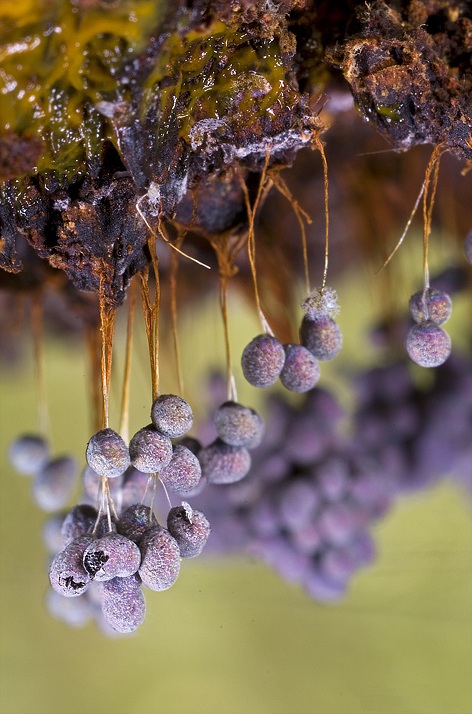
All species pass through several very different morphologic phases, such as microscopic individual cells, slimy amorphous organisms visible with the naked eye, and conspicuously shaped fruit bodies. Although they are monocellular, they can reach immense widths and weights: in extreme cases they can be up to 1 metre (3 ft 3 in) across and weigh up to 20 kilograms (44 lb).
The class Myxogastria is distributed worldwide, but it is more common in temperate regions where it has a higher biodiversity than in polar regions, the subtropics, or the tropics. They are mainly found in open forests, but also in extreme regions such as deserts, under snow blankets, or underwater. They also occur on the bark of trees, sometimes high in the canopy. These are known as corticolous myxomycetes. Most species are very small.
Myxomycota, now considered a synonym of Myxogastria, comes from the Ancient Greek words μύξα myxa, which means "mucus", and μύκης mykes, which means "fungus". The name Myxogastria was introduced in 1970 by Lindsay Shepherd Olive to describe the family Myxogastridae, which was introduced in 1899 by Thomas Huston Macbride. Swedish mycologist Elias Magnus Fries described numerous slime moulds as Myxogasteres in 1829. Species in the class Myxogastria are colloquially known as plasmodial or acellular slime moulds. Some consider the Myxogastria a separate kingdom, with an unsettled phylogeny because of conflicting molecular and developmental data. The relations among myxogastrid orders are as yet unclear.
The continuous classification of new taxa reveals that the class is not fully described. According to a 2000 inquiry, there were 1012 officially accepted taxa, including 866 on species level. Another study in 2007 stated a number of more than 1000, in which the Myxogastria comprised the biggest group of slime moulds, with over 900 species. On the basis of sequenced environmental samples it is estimated that the group has between 1200 and 1500 species – more than previously estimated. Among the 1012 taxa only a few species are common: 305 species were discovered in a single location or groupings, a further 258 species were found in a few areas between 2–20 times, and only 446 were common in several locations with over 20 discoveries.
Reclassifications encounter problems because the Myxogastriae are morphologically very plastic, which is to say susceptible to environmental influences; only a few characteristics are diagnostic for a small number of species. In the past, authors have unsuccessfully tried to describe a new taxon based on a small number of examples, but this leads to numerous duplications, sometimes even at genus level. For example, Squamuloderma nullifila is actually a species from the genus Didymium.
The following classification is based on Adl et al. (2005) while the classes and further divisions on Dykstra & Keller (2000), who included the Myxogastria in Mycetozoa. The sister taxon is the subclass Dictyostelia. Together with the Protostelia they formed the taxon Eumycetozoa. Other subclasses differ from the other species mainly in the development of fruit bodies; while Protostelia create a separate fruit body from each single mononuclear cell, Dictyostelia develop cell complexes – the so-called pseudo-plasmodia – from separate cells, which then become fruit bodies.
Clade Myxogastria (or myxomycetes)
Hub AI
Myxogastria AI simulator
(@Myxogastria_simulator)
Myxogastria
Myxogastria/Myxogastrea (myxogastrids, ICZN) or Myxomycetes (ICN) is a class of slime moulds that contains 5 orders, 14 families, 62 genera, and 888 species. They are colloquially known as the plasmodial or acellular slime moulds.
All species pass through several very different morphologic phases, such as microscopic individual cells, slimy amorphous organisms visible with the naked eye, and conspicuously shaped fruit bodies. Although they are monocellular, they can reach immense widths and weights: in extreme cases they can be up to 1 metre (3 ft 3 in) across and weigh up to 20 kilograms (44 lb).
The class Myxogastria is distributed worldwide, but it is more common in temperate regions where it has a higher biodiversity than in polar regions, the subtropics, or the tropics. They are mainly found in open forests, but also in extreme regions such as deserts, under snow blankets, or underwater. They also occur on the bark of trees, sometimes high in the canopy. These are known as corticolous myxomycetes. Most species are very small.
Myxomycota, now considered a synonym of Myxogastria, comes from the Ancient Greek words μύξα myxa, which means "mucus", and μύκης mykes, which means "fungus". The name Myxogastria was introduced in 1970 by Lindsay Shepherd Olive to describe the family Myxogastridae, which was introduced in 1899 by Thomas Huston Macbride. Swedish mycologist Elias Magnus Fries described numerous slime moulds as Myxogasteres in 1829. Species in the class Myxogastria are colloquially known as plasmodial or acellular slime moulds. Some consider the Myxogastria a separate kingdom, with an unsettled phylogeny because of conflicting molecular and developmental data. The relations among myxogastrid orders are as yet unclear.
The continuous classification of new taxa reveals that the class is not fully described. According to a 2000 inquiry, there were 1012 officially accepted taxa, including 866 on species level. Another study in 2007 stated a number of more than 1000, in which the Myxogastria comprised the biggest group of slime moulds, with over 900 species. On the basis of sequenced environmental samples it is estimated that the group has between 1200 and 1500 species – more than previously estimated. Among the 1012 taxa only a few species are common: 305 species were discovered in a single location or groupings, a further 258 species were found in a few areas between 2–20 times, and only 446 were common in several locations with over 20 discoveries.
Reclassifications encounter problems because the Myxogastriae are morphologically very plastic, which is to say susceptible to environmental influences; only a few characteristics are diagnostic for a small number of species. In the past, authors have unsuccessfully tried to describe a new taxon based on a small number of examples, but this leads to numerous duplications, sometimes even at genus level. For example, Squamuloderma nullifila is actually a species from the genus Didymium.
The following classification is based on Adl et al. (2005) while the classes and further divisions on Dykstra & Keller (2000), who included the Myxogastria in Mycetozoa. The sister taxon is the subclass Dictyostelia. Together with the Protostelia they formed the taxon Eumycetozoa. Other subclasses differ from the other species mainly in the development of fruit bodies; while Protostelia create a separate fruit body from each single mononuclear cell, Dictyostelia develop cell complexes – the so-called pseudo-plasmodia – from separate cells, which then become fruit bodies.
Clade Myxogastria (or myxomycetes)