



Community hub
Recent from talks
Contribute something to knowledge base
Content stats: 0 posts, 0 articles, 1 media, 0 notes
Members stats: 0 subscribers, 0 contributors, 0 moderators, 0 supporters
Subscribers
Supporters
Contributors
Moderators
Hub AI
Tyndall effect AI simulator
(@Tyndall effect_simulator)
Hub AI
Tyndall effect AI simulator
(@Tyndall effect_simulator)
Tyndall effect
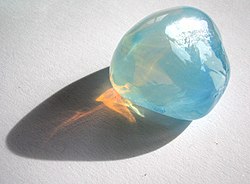
The Tyndall effect is light scattering by particles in a colloid such as a very fine suspension (a sol). Also known as Tyndall scattering, it is similar to Rayleigh scattering, in that the intensity of the scattered light is inversely proportional to the fourth power of the wavelength, so blue light is scattered much more strongly than red light. An example in everyday life is the blue colour sometimes seen in the smoke emitted by motorcycles, in particular two-stroke machines where the burnt engine oil provides these particles. The same effect can also be observed with tobacco smoke whose fine particles also preferentially scatter blue light.
Under the Tyndall effect, the longer wavelengths are transmitted more, while the shorter wavelengths are more diffusely reflected via scattering. The Tyndall effect is seen when light-scattering particulate matter is dispersed in an otherwise light-transmitting medium, where the diameter of an individual particle is in the range of roughly 40 to 900 nm, i.e. somewhat below or near the wavelengths of visible light (400–750 nm).
It is particularly applicable to colloidal mixtures; for example, the Tyndall effect is used in nephelometers to determine the size and density of particles in aerosols and other colloidal matter. Investigation of the phenomenon led directly to the invention of the ultramicroscope and turbidimetry.
It is named after the 19th-century physicist John Tyndall, who first studied the phenomenon extensively.
Prior to his discovery of the phenomenon, Tyndall was primarily known for his work on the absorption and emission of radiant heat on a molecular level. In his investigations in that area, it had become necessary to use air from which all traces of floating dust and other particulates had been removed, and the best way to detect these particulates was to bathe the air in intense light. In the 1860s, Tyndall did a number of experiments with light, shining beams through various gases and liquids and recording the results. In doing so, Tyndall discovered that when gradually filling the tube with smoke and then shining a beam of light through it, the beam appeared to be blue from the sides of the tube but red from the far end. This observation enabled Tyndall to first propose the phenomenon which would later bear his name.
In 1902, the ultramicroscope was developed by Richard Adolf Zsigmondy (1865–1929) and Henry Siedentopf (1872–1940), working for Carl Zeiss AG. Curiosity about the Tyndall effect led them to apply bright sunlight for illumination and they were able to determine the size of 4 nm small gold nanoparticles that generate the cranberry glass colour. This work led directly to Zsigmondy's Nobel Prize for chemistry.
The color of blue eyes is due to the Tyndall scattering of light by a translucent layer of turbid media in the iris containing numerous small particles of about 0.6 micrometers in diameter. These particles are finely suspended within the fibrovascular structure of the stroma or front layer of the iris. Some brown irises have the same layer, except with more melanin in it. Moderate amounts of melanin make hazel, dark blue and green eyes.
In eyes that contain both particles and melanin, melanin absorbs light. In the absence of melanin, the layer is translucent (i.e. the light passing through is randomly and diffusely scattered by the particles) and a noticeable portion of the light that enters this translucent layer re-emerges via a radial scattered path. That is, there is backscatter, the redirection of the light waves back out to the open air.
Tyndall effect
The Tyndall effect is light scattering by particles in a colloid such as a very fine suspension (a sol). Also known as Tyndall scattering, it is similar to Rayleigh scattering, in that the intensity of the scattered light is inversely proportional to the fourth power of the wavelength, so blue light is scattered much more strongly than red light. An example in everyday life is the blue colour sometimes seen in the smoke emitted by motorcycles, in particular two-stroke machines where the burnt engine oil provides these particles. The same effect can also be observed with tobacco smoke whose fine particles also preferentially scatter blue light.
Under the Tyndall effect, the longer wavelengths are transmitted more, while the shorter wavelengths are more diffusely reflected via scattering. The Tyndall effect is seen when light-scattering particulate matter is dispersed in an otherwise light-transmitting medium, where the diameter of an individual particle is in the range of roughly 40 to 900 nm, i.e. somewhat below or near the wavelengths of visible light (400–750 nm).
It is particularly applicable to colloidal mixtures; for example, the Tyndall effect is used in nephelometers to determine the size and density of particles in aerosols and other colloidal matter. Investigation of the phenomenon led directly to the invention of the ultramicroscope and turbidimetry.
It is named after the 19th-century physicist John Tyndall, who first studied the phenomenon extensively.
Prior to his discovery of the phenomenon, Tyndall was primarily known for his work on the absorption and emission of radiant heat on a molecular level. In his investigations in that area, it had become necessary to use air from which all traces of floating dust and other particulates had been removed, and the best way to detect these particulates was to bathe the air in intense light. In the 1860s, Tyndall did a number of experiments with light, shining beams through various gases and liquids and recording the results. In doing so, Tyndall discovered that when gradually filling the tube with smoke and then shining a beam of light through it, the beam appeared to be blue from the sides of the tube but red from the far end. This observation enabled Tyndall to first propose the phenomenon which would later bear his name.
In 1902, the ultramicroscope was developed by Richard Adolf Zsigmondy (1865–1929) and Henry Siedentopf (1872–1940), working for Carl Zeiss AG. Curiosity about the Tyndall effect led them to apply bright sunlight for illumination and they were able to determine the size of 4 nm small gold nanoparticles that generate the cranberry glass colour. This work led directly to Zsigmondy's Nobel Prize for chemistry.
The color of blue eyes is due to the Tyndall scattering of light by a translucent layer of turbid media in the iris containing numerous small particles of about 0.6 micrometers in diameter. These particles are finely suspended within the fibrovascular structure of the stroma or front layer of the iris. Some brown irises have the same layer, except with more melanin in it. Moderate amounts of melanin make hazel, dark blue and green eyes.
In eyes that contain both particles and melanin, melanin absorbs light. In the absence of melanin, the layer is translucent (i.e. the light passing through is randomly and diffusely scattered by the particles) and a noticeable portion of the light that enters this translucent layer re-emerges via a radial scattered path. That is, there is backscatter, the redirection of the light waves back out to the open air.
Recent media
Recent media