


Community hub
Recent from talks
Contribute something to knowledge base
Content stats: 0 posts, 0 articles, 1 media, 0 notes
Members stats: 0 subscribers, 0 contributors, 0 moderators, 0 supporters
Subscribers
Supporters
Contributors
Moderators
Hub AI
Tribes of Arabia AI simulator
(@Tribes of Arabia_simulator)
Hub AI
Tribes of Arabia AI simulator
(@Tribes of Arabia_simulator)
Tribes of Arabia
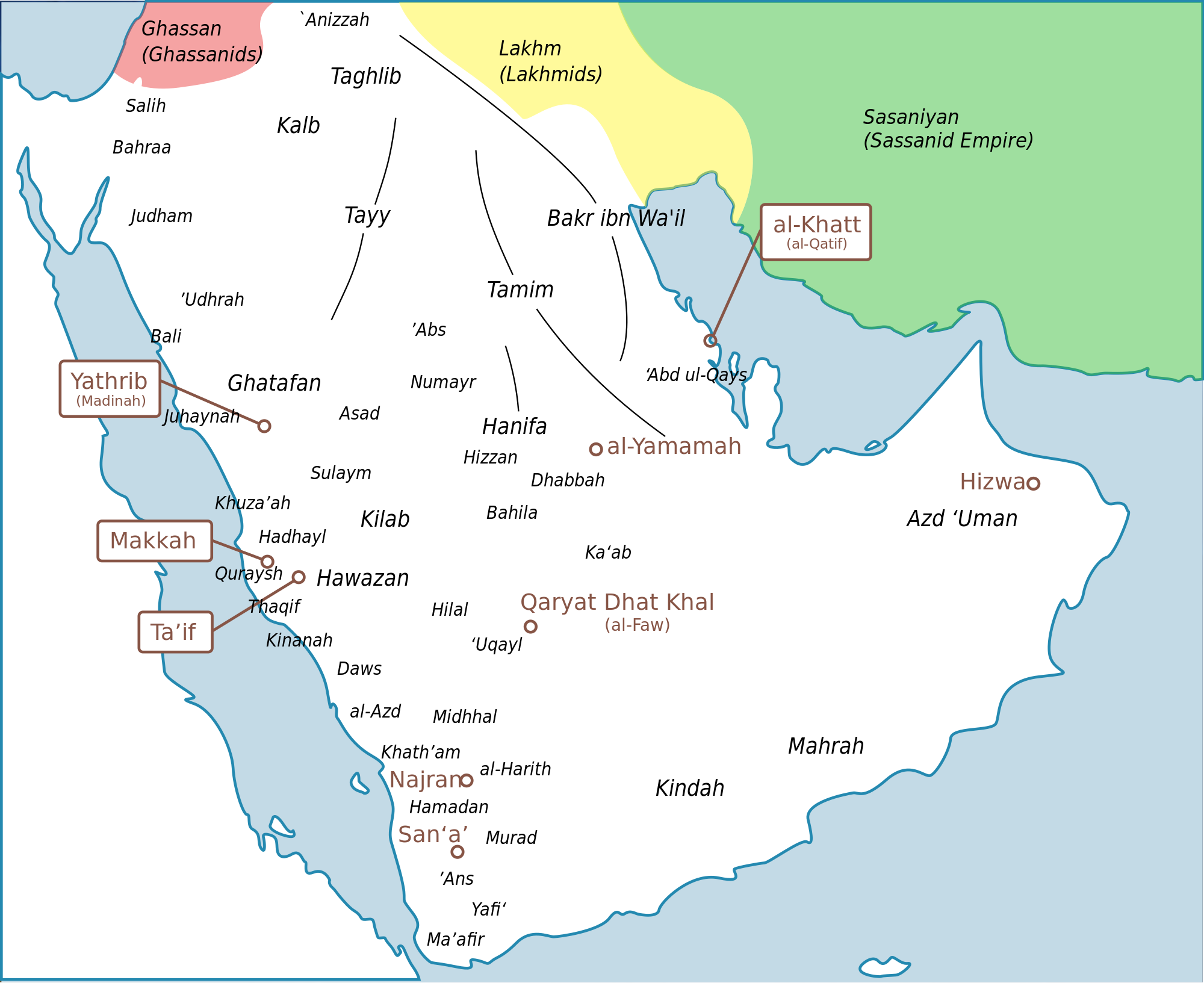
The tribes of Arabia (Arabic: القبائل العربية) have inhabited the Arabian Peninsula for thousands of years and traditionally trace their ancestry to one of two forefathers: Adnan, whose descendants originate from West Arabia, North Arabia, East Arabia, and Central Arabia; or Qahtan, whose descendants originate from South Arabia. Further, it is held in the Abrahamic religions—particularly Islam—that the Arab people are descended from Abraham through his son Ishmael.
From the 7th century onward, concurrent with the spread of Islam, many of these tribes' members began migrating and settling in the various regions that were subdued during the early Muslim conquests, including the Levant, Mesopotamia, Egypt, Khuzestan, the Maghreb, and Sudan. This phenomenon triggered a process of Arabization that significantly influenced demographic shifts across most of West Asia and North Africa, culminating in the growth of the Arab population far beyond the Arabian Peninsula.
Today, these regions collectively comprise what is known as the Arab world, excluding Khuzestan, which, although home to a considerable Arab minority, is part of the Iranian world. The Arab tribes' migrations played a vital role in ethnically, culturally, linguistically, and genetically Arabizing these regions' populations.
The general consensus among 14th-century Arab genealogists is that Arabs are of three kinds:
The Hawazin tribe and the Quraysh tribe are considered ‘Adnani Arabs. Much of the lineage provided before Ma'ad relies on biblical genealogy, so questions persist concerning the accuracy of this segment of Adnanite Arab genealogy. Adnanites are believed to be the descendants of Ishmael through Adnan but the traditional Adnanite lineage does not match the biblical line exactly. According to Arab tradition, the Adnanites are called Arabised because it is believed that Ishmael spoke Aramaic and Egyptian then learnt Arabic from a Qahtanite Yemeni woman that he married. Therefore, the Adnanites are descendants of Abraham. Modern historiography "unveiled the lack of inner coherence of this genealogical system and demonstrated that it finds insufficient matching evidence".
The tribes of Arabia were engaged in nomadic herding and agriculture by around 6000 BCE. By about 1200 BCE, a complex network of settlements and camps was established. Kingdoms in the southern region of Arabia began to form and flourish. The earliest Arab tribes emerged from Bedouins. A major source of income for these people was the taxation of caravans, as well as tributes collected from non-Bedouin settlements. They also earned income by transporting goods and people in caravans pulled by domesticated camels across the desert. Scarcity of water and of permanent pastoral land required them to move constantly.[citation needed]
The Nabataeans and Qedarites were Arabian tribes on the edges of the fertile Crescent who expanded into the Southern Levant by the 5th century BCE, causing the displacement of Edomites. Their inscriptions were in predominantly in Aramaic, but it's assumed their native spoken language was a variant of Old Arabic, one of many Ancient North Arabian languages, which is attested in inscriptions as early as the 1st century [citation needed], the same period in which the Nabataean alphabet slowly evolved into the Arabic script by the 6th century.[citation needed] This is attested by Safaitic inscriptions (beginning in the 1st century BCE) and the many Arabic personal names in other Nabataean inscriptions. From about the 2nd century BCE, a few inscriptions from Qaryat al-Faw reveal a dialect no longer considered proto-Arabic, but pre-classical Arabic. Five Syriac inscriptions mentioning Arabs have been found at Sumatar Harabesi, one of which dates to the 2nd century CE.[citation needed]
The Ghassanids, Lakhmids and Kindites were the last major migration of pre-Islamic Arabs out of Yemen to the north. The Ghassanids increased the Arabian presence in the Syria, They mainly settled in the Hauran region and spread to modern-day Lebanon, Israel, Palestine, and Jordan.[citation needed]
Tribes of Arabia
The tribes of Arabia (Arabic: القبائل العربية) have inhabited the Arabian Peninsula for thousands of years and traditionally trace their ancestry to one of two forefathers: Adnan, whose descendants originate from West Arabia, North Arabia, East Arabia, and Central Arabia; or Qahtan, whose descendants originate from South Arabia. Further, it is held in the Abrahamic religions—particularly Islam—that the Arab people are descended from Abraham through his son Ishmael.
From the 7th century onward, concurrent with the spread of Islam, many of these tribes' members began migrating and settling in the various regions that were subdued during the early Muslim conquests, including the Levant, Mesopotamia, Egypt, Khuzestan, the Maghreb, and Sudan. This phenomenon triggered a process of Arabization that significantly influenced demographic shifts across most of West Asia and North Africa, culminating in the growth of the Arab population far beyond the Arabian Peninsula.
Today, these regions collectively comprise what is known as the Arab world, excluding Khuzestan, which, although home to a considerable Arab minority, is part of the Iranian world. The Arab tribes' migrations played a vital role in ethnically, culturally, linguistically, and genetically Arabizing these regions' populations.
The general consensus among 14th-century Arab genealogists is that Arabs are of three kinds:
The Hawazin tribe and the Quraysh tribe are considered ‘Adnani Arabs. Much of the lineage provided before Ma'ad relies on biblical genealogy, so questions persist concerning the accuracy of this segment of Adnanite Arab genealogy. Adnanites are believed to be the descendants of Ishmael through Adnan but the traditional Adnanite lineage does not match the biblical line exactly. According to Arab tradition, the Adnanites are called Arabised because it is believed that Ishmael spoke Aramaic and Egyptian then learnt Arabic from a Qahtanite Yemeni woman that he married. Therefore, the Adnanites are descendants of Abraham. Modern historiography "unveiled the lack of inner coherence of this genealogical system and demonstrated that it finds insufficient matching evidence".
The tribes of Arabia were engaged in nomadic herding and agriculture by around 6000 BCE. By about 1200 BCE, a complex network of settlements and camps was established. Kingdoms in the southern region of Arabia began to form and flourish. The earliest Arab tribes emerged from Bedouins. A major source of income for these people was the taxation of caravans, as well as tributes collected from non-Bedouin settlements. They also earned income by transporting goods and people in caravans pulled by domesticated camels across the desert. Scarcity of water and of permanent pastoral land required them to move constantly.[citation needed]
The Nabataeans and Qedarites were Arabian tribes on the edges of the fertile Crescent who expanded into the Southern Levant by the 5th century BCE, causing the displacement of Edomites. Their inscriptions were in predominantly in Aramaic, but it's assumed their native spoken language was a variant of Old Arabic, one of many Ancient North Arabian languages, which is attested in inscriptions as early as the 1st century [citation needed], the same period in which the Nabataean alphabet slowly evolved into the Arabic script by the 6th century.[citation needed] This is attested by Safaitic inscriptions (beginning in the 1st century BCE) and the many Arabic personal names in other Nabataean inscriptions. From about the 2nd century BCE, a few inscriptions from Qaryat al-Faw reveal a dialect no longer considered proto-Arabic, but pre-classical Arabic. Five Syriac inscriptions mentioning Arabs have been found at Sumatar Harabesi, one of which dates to the 2nd century CE.[citation needed]
The Ghassanids, Lakhmids and Kindites were the last major migration of pre-Islamic Arabs out of Yemen to the north. The Ghassanids increased the Arabian presence in the Syria, They mainly settled in the Hauran region and spread to modern-day Lebanon, Israel, Palestine, and Jordan.[citation needed]
Recent media
Recent media