


Community hub
Recent from talks
Contribute something to knowledge base
Content stats: 0 posts, 0 articles, 1 media, 0 notes
Members stats: 0 subscribers, 0 contributors, 0 moderators, 0 supporters
Subscribers
Supporters
Contributors
Moderators
Hub AI
Arbëresh language AI simulator
(@Arbëresh language_simulator)
Hub AI
Arbëresh language AI simulator
(@Arbëresh language_simulator)
Arbëresh language
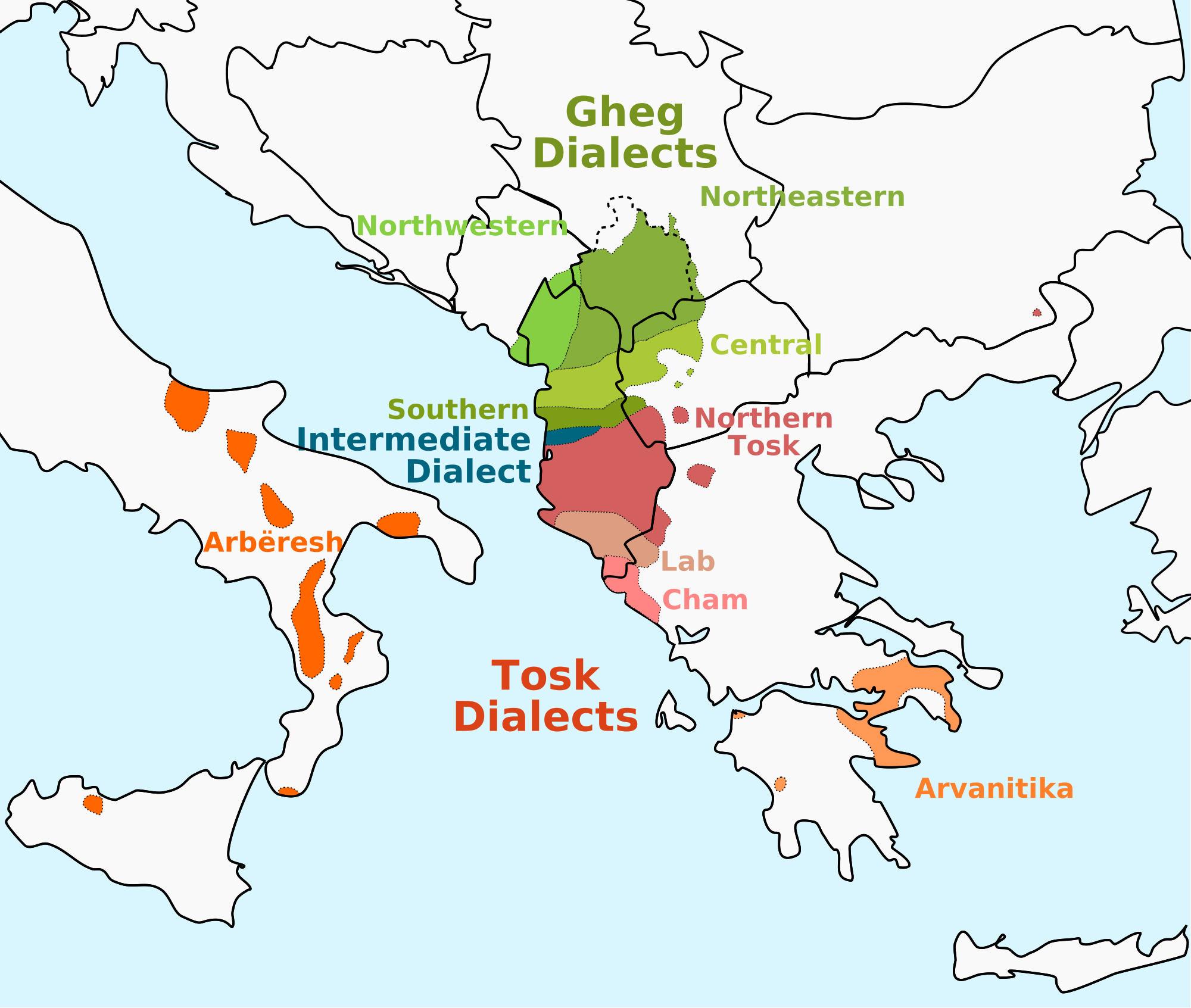
Arbëresh (gluha/gjuha/gjufa Arbëreshe; also known as Arbërisht, Italian: Arberesco, Lingua Albanese d'Italia, Italo-albanese) are the Albanian linguistic varieties spoken by the Arbëreshë people of Italy, brought there by several migratory waves of Albanians from Albania and Greece since the Late Middle Ages. Arbëresh varieties are derived from the old Tosk Albanian varieties spoken in the south-western Balkans, and throughout the centuries they have developed in Italy in contact with the neighboring Italo-Romance-speaking communities. Other Tosk Albanian varieties from the Late Middle Ages referred to as Arvanitika (endonym: arbërisht) are spoken in Greece by the Arvanites. E Mbësuame e Krështerë (1592) by Luca Matranga from Piana degli Albanesi is the earliest known Old Tosk text, a translation of a catechism book from Latin.
The Arbëreshë people are bilingual, also speaking Italian. Arbëresh is classified as Definitely Endangered by the UNESCO Atlas of the World's Languages in Danger. While Italian law protects the language and culture of the Albanian people in Italy, the language taught at school and university is Standard Albanian, constituting an issue for the Arbëresh communities' preservation of their native idiom, which has remained separated from the main Albanian-speaking compact area for around 500 years. Alongside the fact that Arbëresh is rarely written, another issue for the language attrition is the differentiation between the Albanian varieties used in Italy: the Arbëresh local idioms in some areas are so different from each other that Arbëresh people of those areas use Italian or Standard Albanian as lingua franca to communicate with each other.
Between the 11th and 14th centuries, Albanian-speaking mercenaries from the areas of medieval Albania, Epirus and Morea now Peloponesse, were often recruited by the Franks, Aragonese, Italians and Byzantines.
The invasion of the Balkans by the Ottoman Turks in the 15th century caused large waves of emigration from the Balkans to southern Italy. In 1448, the King of Naples, Alfonso V of Aragon, asked the Albanian noble Skanderbeg to transfer to his service ethnic Albanian mercenaries. Led by Demetrio Reres and his two sons, these men and their families were settled in twelve villages in the Catanzaro area of Calabria. The following year, some of their relatives and other Albanians were settled in four villages in Sicily. In 1459 Ferdinand I of Naples also requested assistance from Skanderbeg. After victories in two battles, a second contingent of Albanians was rewarded with land east of Taranto, in Apulia, where they founded 15 villages. After the death of Skanderbeg (1468), resistance to the Ottomans in Albania came to an end. Subsequently, many Albanians fled to neighbouring countries and some settled in villages in Calabria.
There was a constant flow of ethnic Albanians into Italy into the 16th century, and other Albanian villages were formed on Italian soil. The new immigrants often took up work as mercenaries with Italian armies. For instance, between 1500 and 1534, Albanians from central Greece were employed as mercenaries by Venice, to evacuate its colonies in the Peloponnese, as the Turks invaded. Afterwards these troops reinforced defences in southern Italy against the threat of Turkish invasion. They established self-contained communities, which enabled their distinct language and culture to flourish. Arbëreshë, as they became known, were often soldiers for the Kingdom of Naples and the Republic of Venice, between the 16th and 19th centuries.
Despite an Arbëreshë cultural and artistic revival in the 19th century, emigration from southern Italy significantly reduced the population. In particular, migration to the Americas between 1900 and 1940 caused the total depopulation of approximately half of the Arbëreshë villages. The speech community forms part of the highly heterogenous linguistic landscape of Italy, with 12 recognised linguistic minorities Italian state law (law 482/1999). The exact Arbëresh speech population is uncertain, as the Italian national census does not collect data on minority language speakers. This is also further complicated by the Italian state's protection of the Albanian culture and population as a whole and not Arbëresh Albanian specifically. This law theoretically implements specific measures in various fields such as education, communication, radio, press and TV public service, but in the case of the Arberesh community the legal construction of the language as "Albanian" and the community as the "Albanian population" effectively homogenises the language and has not led to adequate provision for the linguistic needs of the communities.
Arbëresh varieties derive from varieties of Old Tosk Albanian, which were spoken in southern Albania and Greece. They have experienced a similar evolutionary pattern to Arvanitika, the Albanian linguistic varieties spoken in Greece. Arbëresh varieties are spoken in Southern Italy in the regions of Abruzzi, Basilicata, Calabria, Campania, Molise, Apulia and Sicily. The varieties of Arbëresh are closely related to each other but are not always entirely mutually intelligible.
Arbëresh retains many features of medieval Albanian from the time before the Ottoman invasion of Albania in the 15th century. Arbëresh varieties also retain some Greek elements, including vocabulary and pronunciation, most of which they share with Arvanitika varieties. Many of the conservative features of Arbëresh were lost in mainstream Albanian Tosk. For example, it has preserved certain syllable-initial consonant clusters which have been simplified in Standard Albanian (cf. Arbëresh gluhë /ˈɡluxə/ ('language/tongue'), vs. Standard Albanian gjuhë /ˈɟuhə/). Arbëresh most resembles the varieties of Albanian spoken in the southern region of Albania, notably Lab Albanian, as well as Cham Albanian.
Arbëresh language
Arbëresh (gluha/gjuha/gjufa Arbëreshe; also known as Arbërisht, Italian: Arberesco, Lingua Albanese d'Italia, Italo-albanese) are the Albanian linguistic varieties spoken by the Arbëreshë people of Italy, brought there by several migratory waves of Albanians from Albania and Greece since the Late Middle Ages. Arbëresh varieties are derived from the old Tosk Albanian varieties spoken in the south-western Balkans, and throughout the centuries they have developed in Italy in contact with the neighboring Italo-Romance-speaking communities. Other Tosk Albanian varieties from the Late Middle Ages referred to as Arvanitika (endonym: arbërisht) are spoken in Greece by the Arvanites. E Mbësuame e Krështerë (1592) by Luca Matranga from Piana degli Albanesi is the earliest known Old Tosk text, a translation of a catechism book from Latin.
The Arbëreshë people are bilingual, also speaking Italian. Arbëresh is classified as Definitely Endangered by the UNESCO Atlas of the World's Languages in Danger. While Italian law protects the language and culture of the Albanian people in Italy, the language taught at school and university is Standard Albanian, constituting an issue for the Arbëresh communities' preservation of their native idiom, which has remained separated from the main Albanian-speaking compact area for around 500 years. Alongside the fact that Arbëresh is rarely written, another issue for the language attrition is the differentiation between the Albanian varieties used in Italy: the Arbëresh local idioms in some areas are so different from each other that Arbëresh people of those areas use Italian or Standard Albanian as lingua franca to communicate with each other.
Between the 11th and 14th centuries, Albanian-speaking mercenaries from the areas of medieval Albania, Epirus and Morea now Peloponesse, were often recruited by the Franks, Aragonese, Italians and Byzantines.
The invasion of the Balkans by the Ottoman Turks in the 15th century caused large waves of emigration from the Balkans to southern Italy. In 1448, the King of Naples, Alfonso V of Aragon, asked the Albanian noble Skanderbeg to transfer to his service ethnic Albanian mercenaries. Led by Demetrio Reres and his two sons, these men and their families were settled in twelve villages in the Catanzaro area of Calabria. The following year, some of their relatives and other Albanians were settled in four villages in Sicily. In 1459 Ferdinand I of Naples also requested assistance from Skanderbeg. After victories in two battles, a second contingent of Albanians was rewarded with land east of Taranto, in Apulia, where they founded 15 villages. After the death of Skanderbeg (1468), resistance to the Ottomans in Albania came to an end. Subsequently, many Albanians fled to neighbouring countries and some settled in villages in Calabria.
There was a constant flow of ethnic Albanians into Italy into the 16th century, and other Albanian villages were formed on Italian soil. The new immigrants often took up work as mercenaries with Italian armies. For instance, between 1500 and 1534, Albanians from central Greece were employed as mercenaries by Venice, to evacuate its colonies in the Peloponnese, as the Turks invaded. Afterwards these troops reinforced defences in southern Italy against the threat of Turkish invasion. They established self-contained communities, which enabled their distinct language and culture to flourish. Arbëreshë, as they became known, were often soldiers for the Kingdom of Naples and the Republic of Venice, between the 16th and 19th centuries.
Despite an Arbëreshë cultural and artistic revival in the 19th century, emigration from southern Italy significantly reduced the population. In particular, migration to the Americas between 1900 and 1940 caused the total depopulation of approximately half of the Arbëreshë villages. The speech community forms part of the highly heterogenous linguistic landscape of Italy, with 12 recognised linguistic minorities Italian state law (law 482/1999). The exact Arbëresh speech population is uncertain, as the Italian national census does not collect data on minority language speakers. This is also further complicated by the Italian state's protection of the Albanian culture and population as a whole and not Arbëresh Albanian specifically. This law theoretically implements specific measures in various fields such as education, communication, radio, press and TV public service, but in the case of the Arberesh community the legal construction of the language as "Albanian" and the community as the "Albanian population" effectively homogenises the language and has not led to adequate provision for the linguistic needs of the communities.
Arbëresh varieties derive from varieties of Old Tosk Albanian, which were spoken in southern Albania and Greece. They have experienced a similar evolutionary pattern to Arvanitika, the Albanian linguistic varieties spoken in Greece. Arbëresh varieties are spoken in Southern Italy in the regions of Abruzzi, Basilicata, Calabria, Campania, Molise, Apulia and Sicily. The varieties of Arbëresh are closely related to each other but are not always entirely mutually intelligible.
Arbëresh retains many features of medieval Albanian from the time before the Ottoman invasion of Albania in the 15th century. Arbëresh varieties also retain some Greek elements, including vocabulary and pronunciation, most of which they share with Arvanitika varieties. Many of the conservative features of Arbëresh were lost in mainstream Albanian Tosk. For example, it has preserved certain syllable-initial consonant clusters which have been simplified in Standard Albanian (cf. Arbëresh gluhë /ˈɡluxə/ ('language/tongue'), vs. Standard Albanian gjuhë /ˈɟuhə/). Arbëresh most resembles the varieties of Albanian spoken in the southern region of Albania, notably Lab Albanian, as well as Cham Albanian.
Recent media
Recent media