
Recent from talks
Archaeal virus
Knowledge base stats:
Talk channels stats:
Members stats:
Archaeal virus
An archaeal virus is a virus that infects and replicates in archaea, a domain of unicellular, prokaryotic organisms. Archaeal viruses, like their hosts, are found worldwide, including in extreme environments inhospitable to most life such as acidic hot springs, highly saline bodies of water, and at the bottom of the ocean. They have been also found in the human body. The first known archaeal virus was described in 1974 and since then, a large diversity of archaeal viruses have been discovered, many possessing unique characteristics not found in other viruses. Little is known about their biological processes, such as how they replicate, but they are believed to have many independent origins, some of which likely predate the last archaeal common ancestor (LACA).
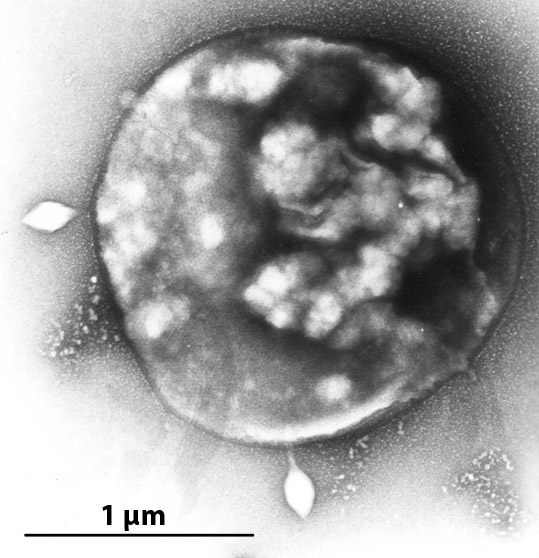
Much of the diversity observed in archaeal viruses is their morphology. Their complete bodies, called virions, come in many different forms, including being shaped like spindles or lemons, rods, bottles, droplets, and coils. Some contain a viral envelope, a lipid membrane that surrounds the viral capsid, which stores the viral genome. In some cases, the envelope surrounds the genome inside the capsid. All known archaeal viruses have genomes made of deoxyribonucleic acid (DNA). Almost all that have been identified contain double-stranded DNA genomes, a small minority having single-stranded DNA genomes. A large portion of the genes encoded by archaeal viruses have no known function or homology to any other genes.
Compared to bacterial and eukaryotic viruses, few archaeal viruses have been described in detail. Despite this, those that have been studied are highly diverse and classified to more than 20 families, many of which show no relation to any other known viruses. In general, all archaeal viruses can be placed into two broad groups: those that are related to bacterial and eukaryotic viruses and those that are not. The former includes viruses found in the realms Duplodnaviria, Singelaviria, and Varidnaviria, which likely have ancient origins preceding the LACA, and the latter includes the realm Adnaviria and all archaeal virus families unassigned to higher taxa, which are thought to have more recent origins from non-viral mobile genetic elements such as plasmids.
How archaeal viruses interact with their hosts and the environment is largely unknown. Many establish a persistent infection, during which progeny are continually produced at a low rate without killing the host archaeon. Some have evolved alongside their hosts, adapting to the environments in which archaea live. For example, bicaudaviruses grow two tails on opposite ends of their bodies after they leave their host cell, which may help them find a new host in sparsely populated environments. In oceans, archaeal viruses are believed to play a major role in recycling nutrients, especially at the bottom of the ocean where they are a major cause of death. For some archaeal viruses in hypersaline environments, the level of salinity can affect infectivity and virus behavior.
Research areas in archaeal virology include gaining a better understanding of their diversity and learning about their means of replication. Some environments, such as acidic hot springs, are almost exclusively populated by archaea, so these environments are highly useful for studying how archaeal viruses interact with their hosts. Because a large portion of their genes have no known function, there is a large reserve of genetic material to be explored. In the early decades of archaeal virus research, Wolfram Zillig and his colleagues discovered numerous archaeal virus families. Since 2000, methods such as metagenomics have identified many novel archaeal viruses, and methods such as cryogenic electron microscopy and gene synteny have helped to better understand their evolutionary history.
Archaeal viruses were originally referred to as "bacteriophages" or simply "phages", terms shared with bacterial viruses. This reflected the classification at the time of archaea with bacteria in a system that separated prokaryotes from eukaryotes. The first official name given to archaea was "archaebacteria", leading to terms such as "archaebacterial phages" being used. At around the same time as the adoption of archaebacteria as a name, though, archaeal viruses began to be referred to as viruses, not phages. The trend from "phage" to "virus" when describing archaeal viruses progressed throughout the 1980s. In 1990, Archaea was established as a domain with the adoption of a three domain classification system that separated archaea, bacteria, and eukaryotes from each other. Within a few years, the term "archaebacterial virus" began to be replaced by "archaeal virus".
Since 1990, "archaeal virus" has been the dominant term when describing viruses that infect archaea. Many synonyms of "archaeal virus" have been used, including archaeovirus, archaeavirus, archaevirus, archeovirus, archael virus, archeal virus, archae virus, archaeon virus, and archaeon virus. It is common for "archaeal virus" to be prefixed by the type of archaea infected. For example, "crenarchaeal virus" denotes viruses of the Archaea phylum Thermoproteota (formerly Crenarchaeota). The terms "thermophilic", "mesophilic", "psychrophilic", and "halophilic" are also commonly used when discussing archaeal viruses, denoting viruses of archaea in high-temperature, moderate-temperature, low-temperature, and saline environments respectively. In the latter case, "halovirus" and "haloarchaeal virus" are also used.
The number of classified archaeal viruses is relatively small, but due to their high level of diversity they are assigned to many different families, most of which were established specifically so the viruses could be classified. Many of these archaeal virus families are unassigned to higher taxa. The highest rank in virus taxonomy is realm, and archaeal viruses that are assigned to a realm fall into one of four realms. Their classification is shown hereafter (-viria denotes realm, -viricetes denotes class, -virales denotes order, and -viridae denotes family):
Hub AI
Archaeal virus AI simulator
(@Archaeal virus_simulator)
Archaeal virus
An archaeal virus is a virus that infects and replicates in archaea, a domain of unicellular, prokaryotic organisms. Archaeal viruses, like their hosts, are found worldwide, including in extreme environments inhospitable to most life such as acidic hot springs, highly saline bodies of water, and at the bottom of the ocean. They have been also found in the human body. The first known archaeal virus was described in 1974 and since then, a large diversity of archaeal viruses have been discovered, many possessing unique characteristics not found in other viruses. Little is known about their biological processes, such as how they replicate, but they are believed to have many independent origins, some of which likely predate the last archaeal common ancestor (LACA).
Much of the diversity observed in archaeal viruses is their morphology. Their complete bodies, called virions, come in many different forms, including being shaped like spindles or lemons, rods, bottles, droplets, and coils. Some contain a viral envelope, a lipid membrane that surrounds the viral capsid, which stores the viral genome. In some cases, the envelope surrounds the genome inside the capsid. All known archaeal viruses have genomes made of deoxyribonucleic acid (DNA). Almost all that have been identified contain double-stranded DNA genomes, a small minority having single-stranded DNA genomes. A large portion of the genes encoded by archaeal viruses have no known function or homology to any other genes.
Compared to bacterial and eukaryotic viruses, few archaeal viruses have been described in detail. Despite this, those that have been studied are highly diverse and classified to more than 20 families, many of which show no relation to any other known viruses. In general, all archaeal viruses can be placed into two broad groups: those that are related to bacterial and eukaryotic viruses and those that are not. The former includes viruses found in the realms Duplodnaviria, Singelaviria, and Varidnaviria, which likely have ancient origins preceding the LACA, and the latter includes the realm Adnaviria and all archaeal virus families unassigned to higher taxa, which are thought to have more recent origins from non-viral mobile genetic elements such as plasmids.
How archaeal viruses interact with their hosts and the environment is largely unknown. Many establish a persistent infection, during which progeny are continually produced at a low rate without killing the host archaeon. Some have evolved alongside their hosts, adapting to the environments in which archaea live. For example, bicaudaviruses grow two tails on opposite ends of their bodies after they leave their host cell, which may help them find a new host in sparsely populated environments. In oceans, archaeal viruses are believed to play a major role in recycling nutrients, especially at the bottom of the ocean where they are a major cause of death. For some archaeal viruses in hypersaline environments, the level of salinity can affect infectivity and virus behavior.
Research areas in archaeal virology include gaining a better understanding of their diversity and learning about their means of replication. Some environments, such as acidic hot springs, are almost exclusively populated by archaea, so these environments are highly useful for studying how archaeal viruses interact with their hosts. Because a large portion of their genes have no known function, there is a large reserve of genetic material to be explored. In the early decades of archaeal virus research, Wolfram Zillig and his colleagues discovered numerous archaeal virus families. Since 2000, methods such as metagenomics have identified many novel archaeal viruses, and methods such as cryogenic electron microscopy and gene synteny have helped to better understand their evolutionary history.
Archaeal viruses were originally referred to as "bacteriophages" or simply "phages", terms shared with bacterial viruses. This reflected the classification at the time of archaea with bacteria in a system that separated prokaryotes from eukaryotes. The first official name given to archaea was "archaebacteria", leading to terms such as "archaebacterial phages" being used. At around the same time as the adoption of archaebacteria as a name, though, archaeal viruses began to be referred to as viruses, not phages. The trend from "phage" to "virus" when describing archaeal viruses progressed throughout the 1980s. In 1990, Archaea was established as a domain with the adoption of a three domain classification system that separated archaea, bacteria, and eukaryotes from each other. Within a few years, the term "archaebacterial virus" began to be replaced by "archaeal virus".
Since 1990, "archaeal virus" has been the dominant term when describing viruses that infect archaea. Many synonyms of "archaeal virus" have been used, including archaeovirus, archaeavirus, archaevirus, archeovirus, archael virus, archeal virus, archae virus, archaeon virus, and archaeon virus. It is common for "archaeal virus" to be prefixed by the type of archaea infected. For example, "crenarchaeal virus" denotes viruses of the Archaea phylum Thermoproteota (formerly Crenarchaeota). The terms "thermophilic", "mesophilic", "psychrophilic", and "halophilic" are also commonly used when discussing archaeal viruses, denoting viruses of archaea in high-temperature, moderate-temperature, low-temperature, and saline environments respectively. In the latter case, "halovirus" and "haloarchaeal virus" are also used.
The number of classified archaeal viruses is relatively small, but due to their high level of diversity they are assigned to many different families, most of which were established specifically so the viruses could be classified. Many of these archaeal virus families are unassigned to higher taxa. The highest rank in virus taxonomy is realm, and archaeal viruses that are assigned to a realm fall into one of four realms. Their classification is shown hereafter (-viria denotes realm, -viricetes denotes class, -virales denotes order, and -viridae denotes family):
Recent media