Hubbry Logo
Area codes 203 and 475Area codes 203 and 475Main
Open search
Area codes 203 and 475
Community hub
Area codes 203 and 475
logo
8 pages, 0 posts
0 subscribers
Be the first to start a discussion here.
Contribute something
Area codes 203 and 475
from Wikipedia

41°21′N 72°54′W / 41.35°N 72.90°W / 41.35; -72.90

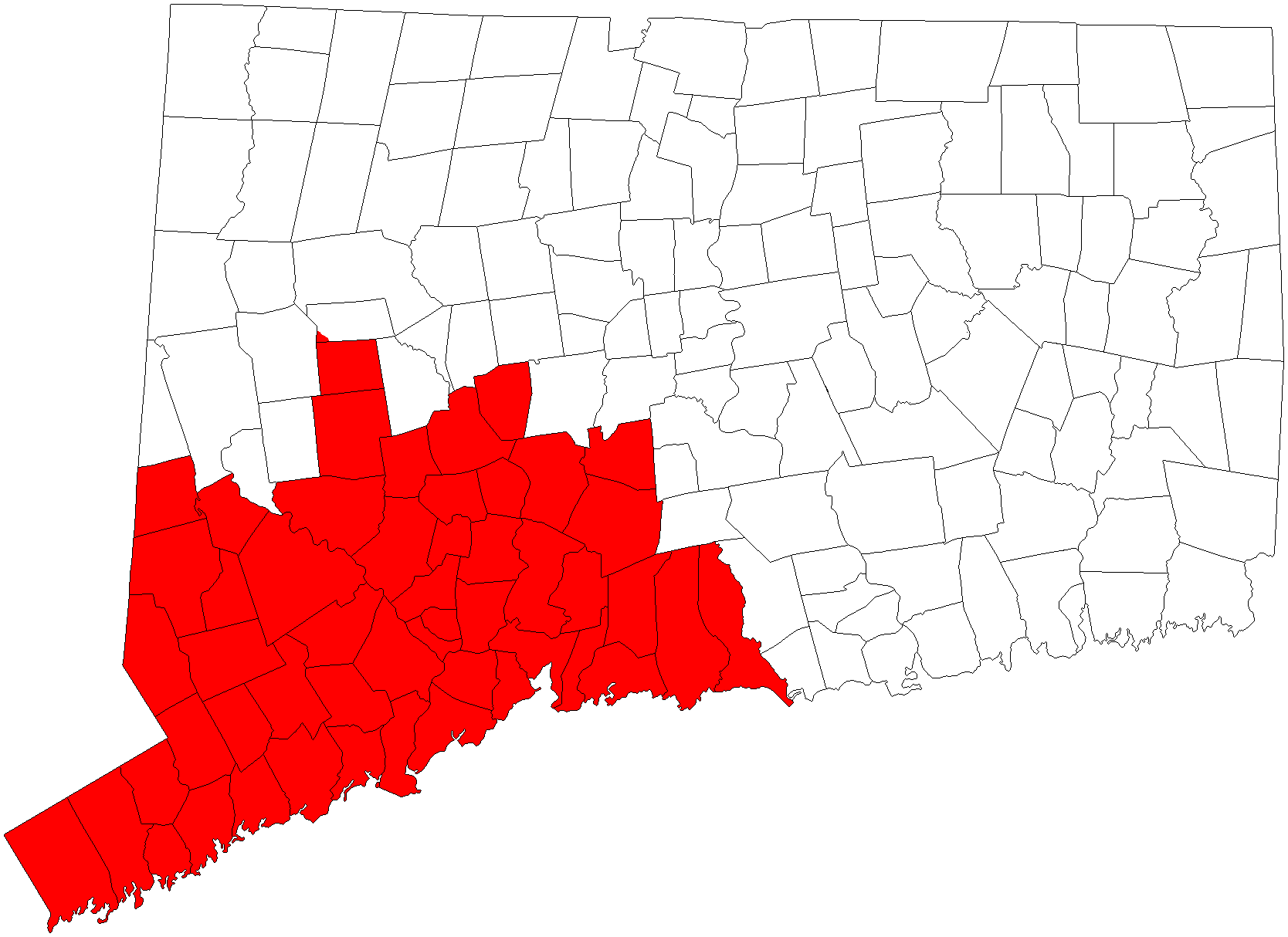
Municipal map of Connecticut with numbering plan area 203/475 highlighted (red).

Area codes 203 and 475 are telephone area codes in the North American Numbering Plan (NANP) for the southwestern part of the U.S. state of Connecticut. The numbering plan area (NPA) is mostly coextensive with the Connecticut portion of the New York metropolitan area, and comprises most of Fairfield County, all of New Haven County, and a small portion of Litchfield County.

History

[edit]

When the American Telephone and Telegraph Company (AT&T) established the first nationwide telephone numbering plan in 1947, Connecticut was designated as a single numbering plan area (NPA), with area code 203, one of the 86 original North American area codes.

On August 28, 1995 the state was divided into two NPAs, reducing the area of 203 to today's extent and adding area code 860 for the remainder of the state. Area code 860 was eventually overlaid with 959,[1] and NPA 203 received a second area code when 475 was added on December 12, 2009.[2] This overlay was first proposed by the Connecticut Department of Public Utility Control in August 1999.

Even though area code 475 overlays only 203, all callers in Connecticut (including those in area code 860) had to dial all calls with ten digits, effective November 14, 2009;[3] this was in preparation for the overlay of area code 959 on area code 860 that was implemented in 2014.

The first range of telephone numbers made available in Connecticut's third area code was (475) 882-4xxx, in the Huntington section of Shelton.[citation needed]

Service area

[edit]

The counties included in the numbering plan area are:[4]

Fairfield (except the Town of Sherman), New Haven, and Litchfield (the towns of Woodbury, Bethlehem, and a small part of Roxbury).

This serves the following cities and towns:[4]

Ansonia, Beacon Falls, Bethany, Bethel, Bethlehem, Branford, Bridgeport, Brookfield, Cheshire, Danbury, Darien, Derby, East Haven, Easton, Fairfield, Greenwich, Guilford, Hamden, Madison, Meriden, Middlebury, Milford, Monroe, Naugatuck, New Canaan, New Fairfield, New Haven, Newtown, North Branford, North Haven, Norwalk, Orange, Oxford, Prospect, Redding, Ridgefield, a small part of Roxbury, Seymour, Shelton, Southbury, Stamford, Stratford, Trumbull, Wallingford, Waterbury, West Haven, Weston, Westport, Wilton, Wolcott, Woodbridge, Woodbury

The city of Meriden is notable as the only place in Connecticut from where one can call towns in either the Hartford or New Haven exchanges toll-free from a landline telephone.[citation needed]

See also

[edit]

References

[edit]
[edit]
Revisions and contributorsEdit on WikipediaRead on Wikipedia
from Grokipedia
Area codes 203 and 475 are telephone area codes in the (NANP) serving southwestern .
Area code 203 was established on October 1, 1947, as one of the original 86 area codes created by and the , initially covering the entire state of .
On September 11, 1995, area code 203 was split to create area code 860 for the northern, eastern, and central portions of the state, leaving 203 to serve the southwestern region.
Due to projected exhaustion of available telephone numbers in the 203 region, area code 475 was introduced as an overlay on December 12, 2009, allowing new assignments to use either code while existing 203 numbers remained unchanged.
The 203/475 numbering plan area encompasses all of Fairfield County except the town of Sherman, all of New Haven County, and portions of Litchfield County including the towns of and Woodbury.
It primarily serves major cities and towns such as Bridgeport, New Haven, Stamford, Waterbury, Norwalk, Danbury, and Milford, supporting both and services amid growing demand from and competition.
The overlay necessitated mandatory (area code plus seven-digit number) for all local calls throughout starting November 14, 2009, to accommodate the dual codes without geographic distinction.

History

Establishment and Early Coverage

The (NANP) was introduced in 1947 by the (AT&T) and the to standardize telephone numbering across the , , and parts of the , enabling direct-dialed without operator assistance. As part of this initial rollout, area code 203 was assigned as one of the 86 original numbering plan areas (NPAs), encompassing the entire state of due to its relatively small population of approximately 1.9 million in 1947 and low telephone density compared to larger urban centers. The code facilitated connectivity across the state's diverse landscape, from coastal urban hubs like New Haven—home to the world's first commercial established in —to inland rural communities. At the time, Connecticut's telephone infrastructure largely relied on manual switchboards operated by human attendants, though the marked the beginning of a widespread transition to automated dial systems, with rotary phones and electromechanical switches gradually replacing operator-assisted connections in major exchanges. Throughout the 1950s and 1960s, rapid —from 2.0 million in 1950 to 2.5 million by 1960—coupled with increasing household adoption of telephones, drove significant expansion of the network under the Southern New England Telephone Company (SNET), which installed its one-millionth phone in 1962. By the 1970s and 1980s, further demographic shifts, including and economic booms in and services, pushed the state's to over 3.1 million by 1980, while telephone penetration approached near-universal levels, with SNET reaching two million installations by 1979. This surge began to strain the limited capacity of area code 203, which supported only about 7.9 million possible numbers, leading to projections by the early that exhaustion could occur by the decade's end without relief measures.

1995 Area Code Split

In the early , the Department of Control (DPUC) began planning for relief of area code 203 due to projected exhaustion by 1998, driven by surging demand for telephone numbers as forecasted by the Southern New England Telephone Company, which anticipated no available prefixes by the fourth quarter of 1996. The DPUC held public hearings in early 1995 and approved the creation of new area code 860 on March 28, 1995, following a customer survey where 91% favored a geographic split over an overlay to minimize dialing confusion. The split took effect on August 28, 1995, when new telephone numbers in the affected regions began being assigned 860, while existing 203 numbers remained unchanged. Mandatory for all local calls across the 203/860 boundary commenced on October 4, 1996, following a permissive period for public education. Under the geographic split, area code 203 was retained for southwestern , primarily Fairfield and New Haven counties, along with customers of the Woodbury Telephone Company serving Woodbury, Southbury, and portions of Roxbury, Bethlehem, and . Area code 860 covered the remainder of the state, including , Litchfield, , New , Tolland, and Windham counties, as well as the town of Sherman in Fairfield County. To maintain service continuity, rate centers in towns such as Danbury and Waterbury were split, with the majority remaining in 203 alongside major business centers like Bridgeport, New Haven, Norwalk, and Stamford. The split impacted more than 2 million telephone lines and customers statewide, requiring updates to phone directories, business listings, and emergency services while aiming to extend the usability of both codes—203 projected to last until 2005 and 860 until 2011. Fewer than 100 protests were received by the DPUC, reflecting broad acceptance of the plan to balance growth across urban and rural areas.

Introduction of the 475 Overlay

By the late , area code 203 faced imminent depletion of available telephone numbers, driven by sustained , urban expansion, and rising demand for services in southwestern Connecticut's densely populated areas such as Fairfield and New Haven counties. Initial projections from the Administration (NANPA) in 2005 estimated exhaustion by the fourth quarter of 2006, but updated forecasts extended this to mid-2010 as conservation measures temporarily alleviated pressure. This shortage necessitated relief planning to ensure continued numbering capacity without interrupting service in the region. In response, the Department of Control (DPUC), the state's regulatory authority for , recommended the creation of an overlay area code in 2008 to address the projected exhaustion. Area code 475 was selected from available codes in the 2000 series, as it met criteria for non-geographic overlays and avoided conflicts with existing assignments. The DPUC's proposal underwent review, culminating in final approval in early 2009, marking a shift toward overlay strategies in line with national trends for managing numbering resources efficiently. The overlay approach for 475 was chosen over a geographic split primarily to minimize disruption to established numbers in southwestern Connecticut's compact, high-density urban corridor, where redrawing boundaries would have required widespread renumbering and logistical challenges for residents and businesses. This made it Connecticut's first area code overlay, following the state's 1995 geographic split that had created area code 860. Existing 203 numbers remained unaffected, preserving continuity for the approximately 2.5 million lines in service at the time. Implementation began on December 12, 2009, when new telephone number assignments in the 203 region started incorporating the 475 overlay, initially focused on high-demand areas like Bridgeport and Stamford to prioritize urban centers facing the most acute shortages. To facilitate the transition, the DPUC and telecommunications providers launched public education campaigns emphasizing the switch to for all local calls within , with permissive dialing introduced on May 16, 2009, and mandatory enforcement by November 14, 2009. These efforts included media announcements, bill inserts, and community outreach to ensure smooth adoption across the overlaid region.

Geography

Counties and Regions Served

Area codes 203 and 475 primarily cover all of except the town of Sherman and all of in southwestern , forming the core of their service area. This encompasses a land area of approximately 1,200 square miles, including key urban centers and suburban communities along the coast and inland valleys. The overlay structure of 475, introduced in , serves the same geographic footprint as 203 to address numbering exhaustion in this high-demand region. Partial coverage extends to northwestern portions of Litchfield County, specifically including the towns of Woodbury and , where certain rate centers and exchanges fall under 203 and 475. These additions reflect post-1995 boundary adjustments to accommodate local telephone service needs in bordering areas. The boundaries largely adhere to county lines but include exceptions: the town of Sherman in Fairfield County is excluded and served by area code 860. The service area incorporates coastal stretches from Greenwich to Milford, aligning closely with the populated Interstate 95 corridor. This geographic scope represents an urban-suburban blend within the commuter belt, characterized by high population density and economic ties to the metro area, which have necessitated expanded numbering capacity. The region excludes the more rural northern hills, focusing instead on the densely developed southwestern corridor that supports commuting patterns and commercial activity.

Major Cities and Communities

The area codes 203 and 475 serve southwestern , encompassing several major urban centers and surrounding communities that form a diverse mix of industrial, commercial, and residential hubs. The largest cities in this region include Bridgeport, Stamford, and New Haven, which anchor the economic and cultural landscape while supporting a significant portion of the area's . Bridgeport, the most populous city in , has approximately 151,599 residents as of 2024 and serves as a key industrial port on , with a history tied to and shipping that continues to influence its economy. Stamford, with 139,134 residents in 2024, functions as a prominent financial hub, hosting corporate headquarters and professional services that draw commuters from across the region. New Haven, home to 137,562 people in 2024, is renowned for its educational institutions, particularly , which drives research, arts, and higher education activities. Other significant population centers include Waterbury (115,908 residents in 2024), a longstanding center focused on and industries; Norwalk (93,661 residents in 2024), a coastal known for its maritime heritage and growing tech sector; and Danbury (88,692 residents in 2024), which has evolved from a hatting industry base into a retail and distribution powerhouse. Smaller communities within the 203/475 overlay add to the region's suburban and rural character, such as Greenwich (64,594 residents in 2024), an affluent enclave with high concentrations of wealth and finance professionals; Fairfield (65,300 residents in 2024), a primarily suburban with strong educational and recreational amenities; Shelton (42,805 residents in 2024), an industrial town supporting and ; and Trumbull (38,073 residents in 2024), featuring mixed-use developments that blend housing, retail, and . Overall, the 203/475 service area supports roughly 1.8 million people, blending diverse urban, suburban, and commuter populations closely linked to the metropolitan area for employment and transportation. This demographic diversity is reflected in sectors like high-tech innovation, , , and , which fuel demand for infrastructure amid rapid urban growth and .

Technical Details

Numbering Plan Allocation

Area codes 203 and 475 operate as an overlay complex, serving the identical geographic region in southwestern without geographic distinction between the two codes. In this setup, telephone numbers are assigned from either code depending on availability, with new assignments typically drawn from the 475 code pool when the 203 code's resources are depleted to conserve the original code's capacity. However, customers may request a number from the 203 code if prefixes remain available, allowing for some flexibility in selection during the provisioning process. The allocation of central office codes, known as NXX codes, provides the foundational structure for telephone numbering in this overlay. Area code 203 currently utilizes 778 assigned NXX codes, while 475 has 279 assigned NXX codes, contributing to a combined capacity that supports landline, wireless, and VoIP services across the region. These codes are managed through the North American Numbering Plan (NANP) framework, with assignments handled by the North American Numbering Plan Administration (NANPA) in coordination with telecommunications carriers such as Frontier Communications (operating as Southern New England Telephone) and AT&T Connecticut. Thousands-block pooling is mandatory in all rate centers within the 203/475 overlay, ensuring efficient distribution of numbering resources among 43 participating operating company numbers (OCNs). Exhaustion monitoring is a critical aspect of numbering plan management, with historical data indicating that the 203 code reached approximately 90-95% utilization by the late 2000s, prompting the 2009 introduction of the 475 overlay to avert imminent depletion. As of the first quarter of 2025, the combined 203/475 resource pool stands at a projected exhaust date of the second quarter of 2047, reflecting reduced demand trends and effective conservation measures. The overlay includes 32 distinct rate centers—such as Bridgeport (BRGPRTCT), New Haven, and Stamford—where local calling boundaries are defined to permit toll-free calls within designated clusters, optimizing connectivity without additional charges for intra-region communications. Ongoing oversight by involves quarterly updates to exhaust forecasts based on Numbering Resource Utilization and Forecasting (NRUF) data, ensuring proactive planning for potential future relief if demand accelerates due to population growth or technological expansions in southwestern . This monitoring framework aligns with broader NANP guidelines to sustain numbering resources beyond the current projection horizon.

Dialing and Usage Procedures

In the 203/475 overlay area, mandatory has been required for all local calls since November 14, 2009, to accommodate the introduction of the 475 area code alongside the existing 203 numbers and ensure calls are routed correctly without ambiguity. Prior to this, was standard for intra-area local calls, but the overlay necessitated the change statewide in to support number conservation. This procedure applies uniformly across the region, including calls between nearby communities such as Stamford and Bridgeport, which are treated as local and require the full area code plus seven-digit number (e.g., 203-XXX-XXXX or 475-XXX-XXXX). Local calling areas within the 203/475 overlay generally encompass most of Fairfield County and New Haven County, allowing toll-free connections for intra-region calls without the need for a long-distance prefix, though specific boundaries depend on individual rate centers and carrier agreements. For example, calls from Norwalk in Fairfield County to Waterbury in New Haven County are typically local and dialed using ten digits. Extended local areas may include select portions of adjacent Litchfield County, but verification via local calling guides is recommended for precise rate center details. Long-distance calls originating from the 203/475 area to numbers outside the overlay follow standard procedures: dial 1 followed by the ten-digit number (1 + area code + seven digits), with no alterations due to the overlay structure. Special services, such as emergency dialing to 911, remain exempt and are accessed by simply dialing the three digits, unaffected by the ten-digit requirement. Mobile and VoIP numbers in the region adhere to the same dialing rules, with new wireless assignments increasingly utilizing the 475 code to preserve 203 number pools. The transition to mandatory in 2009 included a permissive period from May 16 to November 14, during which both seven- and ten-digit formats were accepted, allowing time for public education campaigns led by the Connecticut Department of Public Utility Control to minimize confusion. These efforts, including media announcements and updates to automatic dialing systems, ensured a smooth shift without widespread disruptions.

References

Add your contribution
Related Hubs
Contribute something
User Avatar
No comments yet.