Hubbry Logo
Area codes 619 and 858Area codes 619 and 858Main
Open search
Area codes 619 and 858
Community hub
Area codes 619 and 858
logo
8 pages, 0 posts
0 subscribers
Be the first to start a discussion here.
Area codes 619 and 858
from Wikipedia
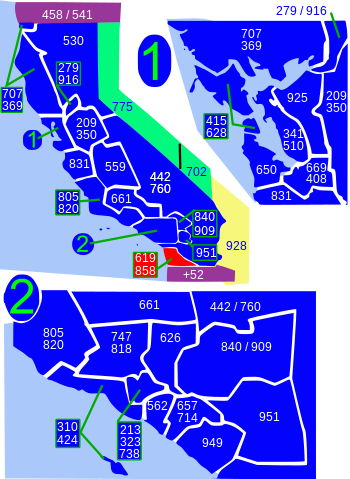
458/541775702928442/760916/279530369/707209559831805661858909951619213323369/707916/279415650341/510925408209831805661442/760310/424747/818626909951949562657/714
Numbering plan areas in California (blue) and border states. Area code 619 is shown in red.

Area codes 619 and 858 are telephone area codes in the North American Numbering Plan (NANP) for most of San Diego County in the U.S. state of California. Area code 619 was created by a split of area code 714 in 1982. In 1999, a part of the 619 numbering plan area was assigned area code 858 in northwest San Diego County. In 2019, the area code boundary between 619 and 858 was eliminated, creating an overlay complex with the two area codes.

History

[edit]

When the American Telephone and Telegraph Company (AT&T) devised the first nationwide telephone numbering plan for Operator Toll Dialing in 1947, California was divided into three numbering plan areas, which were reorganized geographically in 1950. The first area code split became necessary in 1951, when most of the southern and eastern portion, including San Diego and most of Orange County, was assigned area code 714. In 1982, 714 was split and almost all of the southernmost portion of California, from San Diego to the Nevada border received area code 619, the first new area code in California since 1959, when 707 was added.

On March 23, 1997, most of outer northern San Diego County, desert areas and geographical areas in southeastern California were removed from the numbering plan area by a split for area code 760.

On June 30, 1998, the NANPA approved a request by the California Public Utilities Commission for a two-phase three-way split of 619 such that the first phase would introduce the new 858 area code to northwest San Diego County on June 12, 1999, after which the southern and eastern parts of the county would be split off into a new 935 area code on June 10, 2000,[1] leaving the remaining portion of 619 to serve almost exclusively the city of San Diego. However, after the 858 phase of the split, popular and political opposition throughout the country regarding the large number of area code splits being scheduled forced the NANPA to implement 1000-block number pooling, which effectively extended the life of the remaining portion of 619, and the 935 phase of the split was cancelled.[2]

In response to projections that 619 would exhaust its central office prefixes in March 2019, the California Public Utilities Commission approved a relief plan that eliminated the 619/858 boundary, turning 619 and 858 into overlay area codes for all of the inner portion of San Diego County. This change took effect in June 2018; at that time, ten-digit local calling became mandatory.[3] At the time, 858 was not projected to exhaust for at least thirty years, despite North County's continued growth.[4] Under the most recent projections, San Diego will not need relief until 2043.[5]

Service area

[edit]

The service area includes the following cities and communities:

* Communities that are mostly or entirely within San Diego

Incorporated cities within San Diego County

[edit]

Professional wrestler and San Diego native Rey Mysterio named his finishing move "The 619" after the area code.[6] A DVD featuring him is titled Rey Mysterio: 619.[7] His entrance theme is called "Booyaka 619" and is performed by fellow San Diego natives P.O.D.[citation needed]

Football player Reggie Bush explained why he painted the number 619 into his eyeblack during games: "When I do that, it's my way of keeping myself humble, of representing my hometown and letting them know I'm not going to forget where I came from."[8]

The switch of 619 to 858 was referenced in the song "Area Code" by Steve Poltz.[citation needed]

See also

[edit]

References

[edit]
[edit]
Revisions and contributorsEdit on WikipediaRead on Wikipedia
from Grokipedia
Area codes 619 and 858 are (NANP) telephone area codes that serve the central portion of County in , including the city of and its adjacent southern suburbs such as Chula Vista, Coronado, El Cajon, Imperial Beach, La Mesa, Lemon Grove, National City, and Santee. Area code 619 was established on November 5, 1982, through a geographic split of the original area code 714, which had previously covered much of since 1951, to address growing demand in the San Diego region. In response to further population growth and numbering exhaustion, 619 underwent additional splits: first, on March 22, 1997, when area code 760 was created for the inland and northern parts of San Diego County and the ; and second, on June 12, 1999, when area code 858 was introduced as a split for the northern coastal sections of San Diego, including , Del Mar, Poway, Solana Beach, and parts of Encinitas. Due to ongoing demand for telephone numbers, the (CPUC) approved a boundary elimination overlay for 619 and 858 on April 27, 2017, allowing both codes to serve the same geographic area without distinct boundaries, effective with permissive 10-digit dialing starting November 11, 2017, and mandatory 1+10-digit dialing for all local calls implemented on May 19, 2018. This overlay complex now requires dialing the full 1 + area code + seven-digit number for all calls within the region, regardless of whether the call is local or long-distance, to conserve available numbering resources amid San Diego's continued expansion. As of 2025, the 619/858 overlay remains in effect, supporting the area's status as a major economic and population hub in the United States.

History

Establishment of 619

The (NANP), developed by in 1947, introduced a standardized system of three-digit area codes to enable direct-dial long-distance calling across the , , and certain territories. In its early implementation, received only a few codes, with 213 serving —including and surrounding regions—and 415 covering northern and central areas like . This limited allocation reflected the era's modest telephone density, but rapid post-World War II population growth soon strained these resources, particularly in expanding urban centers. By the 1950s, southern California's burgeoning suburbs and industries necessitated further divisions; in 1951, area code 714 was created by splitting from 213, encompassing Orange County, much of San Diego County, and eastern inland areas extending toward the border. San Diego's population, which had surged from about 203,000 in 1941 to over 300,000 by 1942 due to wartime migration and continued to climb past 500,000 by amid and economic expansion, accelerated telephone demand in the region. To address numbering exhaustion in this area, 714 was split again, birthing area code 619 on January 1, 1982, as the 125th code introduced in the NANP. At its inception, 619 served the entirety of San Diego County and portions of neighboring Imperial County in southeastern California, marking the first dedicated code for the San Diego metropolitan area. This split relieved pressure on 714 by reassigning telephone lines in the San Diego region to the new code, supporting the region's ongoing demographic and infrastructural development. The establishment aligned with broader NANP efforts to manage growth through geographic splits, setting the stage for 619's role in one of California's fastest-growing coastal hubs.

Creation and evolution of 858

Area code 858 was introduced on June 12, 1999, as a geographic split from area code 619 to address the rapid exhaustion of telephone numbers in northern County, following the earlier 1997 split that created area code 760 from 619. The split was approved by the (CPUC) in Decision 98-06-018, reflecting customer preferences for geographic divisions over overlays to preserve seven-digit local dialing initially. The initial boundaries of 858 encompassed the coastal and northwestern portions of San Diego County, including areas such as , University City, Del Mar, Poway, Rancho Bernardo, Rancho Santa Fe, Linda Vista, Mira Mesa, and Solana Beach, while 619 retained the central and southern zones. This division aimed to allocate approximately 276 new NXX codes (central office prefixes) to the 619 area, providing relief from the projected depletion of available numbers by the early 2000s. Permissive 10-digit dialing began on June 12, 1999, allowing optional use of the new code, but became mandatory on December 11, 1999, for all calls between the 619 and 858 areas to ensure seamless connectivity and prevent numbering conflicts. In the early , evolution of the 858 area code focused on number conservation to extend its lifespan amid continued population growth and demand for telecommunications services. (FCC) implemented 1,000-block number pooling on September 15, 1999, enabling carriers to share unused blocks of numbers more efficiently within the 858 and 619 areas. By July 2000, the CPUC expanded these efforts with measures such as establishing number pools, enforcing fill rates for assigned blocks, and promoting sequential numbering to minimize waste, which helped delay exhaustion concerns until later in the decade.

Boundary elimination and overlay

In April 2017, the (CPUC) approved the elimination of the geographic boundary between area codes 619 and 858 to address the projected exhaustion of central office codes in the 619 numbering plan area (NPA). This boundary elimination overlay was selected over alternatives like a further geographic split of the 619 NPA, as it would provide relief with minimal disruption to existing customers while extending the usable life of the combined NPAs by approximately 17 years. The decision, formally issued on April 27, 2017 as Decision 17-04-027, responded to forecasts that the 619 NPA would run out of available prefixes by the fourth quarter of 2018. The overlay became effective on May 19, 2018, unifying the service territories so that the 858 NPA covered the entire former 619 territory and vice versa, forming a single overlay complex for the region. On this date, mandatory —requiring the prefix "1" followed by the area code and seven-digit number—was enforced for all local and long-distance calls within the area to accommodate the shared codes. Beginning June 19, 2018, carriers could assign new numbers from either the 619 or 858 NPA across the entire unified territory, based on availability. Implementation required no action from existing subscribers, who retained their current numbers and area codes without mandatory changes. The two codes became fully interchangeable for new services in the region, effectively creating one numbering plan area served by both overlays. This measure built upon prior conservation efforts following the 1999 split that created the 858 NPA from 619.

Service coverage

Geographic boundaries

Area codes 619 and 858 serve a unified geographic territory in the southwestern portion of , following the elimination of the boundary between them in 2018. This overlay complex covers the densely populated urban and coastal regions centered around the city of , spanning approximately 400 square miles in the (UTC−8). The territory is bounded on the west by the , providing direct coastal access from areas like to Imperial Beach. To the south, it extends to the international border with , encompassing communities adjacent to . The eastern limit lies near El Cajon and Santee, where the coverage transitions to the 760/442 area code overlay for more rural and inland eastern San Diego regions. In the north, the area reaches approximately to Torrey Pines and Del Mar along the coast, excluding the inland and outer North County communities served by area code 760, which were separated in the 1997 split from the original 619 territory. This northern cutoff avoids extending into areas like most of Encinitas and all of Carlsbad. The territory includes the island community of Coronado, connected via the Coronado Bridge, but excludes rural eastern areas of what was formerly Imperial County, which were reassigned to 760 in 1997.

Cities and communities served

The area codes 619 and 858, operating as an overlay since 2018, serve the densely populated urban core of County, encompassing the city of and adjacent southern and northern suburbs. This region includes a mix of major municipalities, coastal enclaves, and inland residential areas, supporting a population of approximately 2.1 million people as of the 2020 U.S. Census (estimated at 2.2 million in 2025), with particularly high density in the central urban zones. Major cities served include San Diego, Chula Vista, El Cajon, National City, La Mesa, and Santee, which form the primary hubs of residential, commercial, and industrial activity in the overlay. Coastal communities within the area encompass Coronado, an island city connected by bridge to ; Imperial Beach, bordering the barrier; , known for its upscale shoreline and research institutions; and Pacific Beach, a vibrant beachfront neighborhood. Inland suburbs feature Lemon Grove and Spring Valley, both east of with suburban residential developments; as well as Clairemont and University City, northwest neighborhoods blending family homes, educational facilities, and commercial strips. Additional communities include Del Mar and Solana Beach along the northern coast, Poway as an inland eastern suburb, and a small portion of Encinitas, all integrated into the unified 619/858 service area.

Technical operations

Dialing procedures

In the 619/858 overlay region, calls—whether local, between the two area codes, or to the same area code—must dial 1 followed by the recipient's 10-digit phone number (area code + 7 digits), a procedure that became mandatory on May 19, 2018. and many VoIP services require only the 10-digit format, though dialing 1+10 digits is also accepted, ensuring calls route correctly without altering existing phone numbers or local calling rates. Calls between 619 and 858 numbers are classified as local, with no boundary distinction or additional charges, reflecting the unified numbering plan area established by the overlay. Long-distance calls from the 619/858 region to destinations outside the overlay but within the use the same 1 + 10-digit format, though toll charges may apply based on the carrier's plan. For international calls to 619 or 858 numbers, callers dial their country's international exit (such as 011 in the or 00 in many other countries), followed by +1 (the NANP ), the area (619 or 858), and the 7-digit number. The current dialing rules evolved from earlier transitions: the 1999 split creating the 858 area code introduced permissive 10-digit dialing (area code + 7 digits) in June 1999, which became mandatory in December 1999 for cross-boundary calls. The 2018 overlay expanded this by mandating 1+10-digit dialing for landlines for all intra-region calls, without adding new area codes.

Rate centers and numbering plan areas

The area codes 619 and 858 form an overlay complex within the (NANP), serving as a single Numbering Plan Area (NPA) that encompasses most of County in since the boundary elimination in 2018. This configuration allows both codes to be used interchangeably for number assignments across the region, with administration overseen by the North American Numbering Plan Administrator (NANPA) in coordination with the (CPUC). Rate centers represent the geographic and administrative divisions for assigning central office (NXX) codes within the 619/858 NPA, enabling local call routing and billing. Key rate centers include , which handles multiple districts such as Linda Vista, Mira Mesa, and the central downtown area with NXX codes like 234 and 523; Chula Vista, associated with NXX 280 and serving southern coastal communities; and El Cajon, linked to NXX 444 and covering eastern suburbs. Other notable rate centers encompass (NXX 459), La Mesa (NXX 464), and National City (NXX 336), each tied to specific (ILEC) facilities operated primarily by (). These centers facilitate the distribution of approximately 792 possible NXX codes per area code, though the overlay doubles the available resources without geographic restrictions. To mitigate number exhaustion, the 619/858 NPA employs central office code utilization plans that optimize NXX assignments and thousands-block number pooling, ensuring efficient among carriers. As of 2024, the NPA's overall utilization stands at approximately 80%, providing sufficient capacity without the need for additional overlays or splits in the foreseeable future. Technically, the 619/858 NPA adheres to NANP standards, where numbers follow the format NXX-NXXX (with N representing 2-9 and X 0-9), and 10-digit dialing is enforced for all local calls to distinguish between the overlaid codes, while the underlying network supports internal 7-digit within rate centers.

Cultural references

The area codes 619 and 858 have appeared in various forms of popular media, often as symbols of 's local identity in entertainment set or produced in the region. In , which has a significant television presence, the number 619 gained prominence through superstar , a San Diego native, who named his signature finishing move the "619" after the area's original . The move, involving a hurricanrana whipping the opponent into the ring ropes followed by a springboard kick, became iconic during Mysterio's career, debuting in the early 2000s and featured in numerous broadcasts and events. This wrestling reference extended to music with the release of 's "Booyaka 619" in 2007, a theme song specifically created for Mysterio's entrance. The track, performed by the San Diego-based rock band , explicitly nods to the city's heritage with like "el vato cabrón de " and repeated chants of "Booyaka, booyaka, 6-1-9," embedding the area code as a badge of regional pride in mainstream rock and hip-hop fusion. Local rap artists from the 619 zone, such as Mr. Shadow and G.P.A., have similarly incorporated the code into their since the , portraying it as an emblem of street culture and hometown loyalty in tracks like "Negative Behavior," where it underscores 's gritty urban vibe. Following the 1999 split that introduced the 858 overlay for northern communities, the newer code appeared in television. In the 2006 episode "Lord of the Pi's" of the teen noir series , set in the fictional (modeled after County), a displays Logan's phone number with the 858 area code during a call to protagonist Veronica, reflecting the show's attention to regional details in its portrayal of coastal life.

Notable local associations

The 619 and 858 area codes are closely tied to notable residents who embody 's diverse cultural and professional landscape. , a five-time major champion, has resided in northern County communities within the 858 area code, such as and Rancho Santa Fe, where he has been involved in local and events. These figures highlight the appeal of northern 's upscale communities to high-profile athletes and entertainers seeking privacy and lifestyle amenities. The 619 area code holds a special place in San Diego's local identity as the region's original telephone prefix, established in 1982 from a split of area code 714, fostering a sense of nostalgia and pride among longtime residents. Merchandise such as T-shirts and stickers emblazoned with "619" celebrates this heritage, often marketed as symbols of "SoCal vibes" and hometown loyalty, particularly in southern neighborhoods like Southeast San Diego. In contrast, the 858 area code, introduced in 1999 as an overlay for northern San Diego County, evokes an image of exclusivity and sophistication, serving upscale locales like La Jolla and Del Mar with oceanfront views and high-end office parks that attract tech and biotech professionals. This distinction reinforces community vibes, with 619 representing the "original" urban core and 858 the polished north county extension. San Diego's military prominence is indelibly linked to the 619 area code, which encompasses —the principal homeport for over 50 U.S. Navy ships and a hub for Pacific Fleet operations since its establishment in 1922. This association underscores the region's role in national defense, with the base supporting thousands of personnel and contributing to local events like celebrations that draw community participation. Additionally, the U.S. Border Patrol's San Diego Sector, headquartered in Chula Vista under the 619 code, plays a key role in border security, often featured in regional news coverage of and cross-border activities. In contemporary business practices, both area codes are leveraged for vanity numbers to enhance local branding, particularly in and sectors that capitalize on San Diego's beaches and attractions. Companies in industries like defense, biotech, and services opt for memorable 619 or 858 prefixes to signal authenticity and build customer trust, such as through toll-free extensions that promote regional events and accommodations. This strategic use reinforces the codes' integration into the city's economic fabric, aiding promotions for everything from harbor cruises to convention center bookings.

References

Add your contribution
Related Hubs
User Avatar
No comments yet.