Hubbry Logo
Area codes 707 and 369Area codes 707 and 369Main
Open search
Area codes 707 and 369
Community hub
Area codes 707 and 369
logo
8 pages, 0 posts
0 subscribers
Be the first to start a discussion here.
Area codes 707 and 369
from Wikipedia
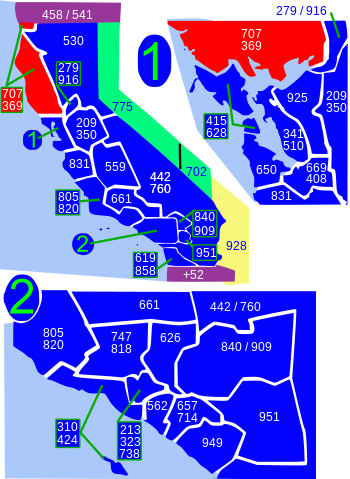
458/541775702928442/760916/279530369/707209559831805661858909951619213323369/707916/279415650341/510925408209831805661442/760310/424747/818626909951949562657/714
Numbering plan areas in California (blue) and border states. Area code 707 is shown in red.

Area codes 707 and 369 are telephone area codes in the North American Numbering Plan (NANP) for the northwestern part of the U.S. state of California. The area codes serve some parts of the northern San Francisco Bay Area, as well as the North Coast. Major cities in the area codes include Napa, Sebastopol, Vallejo, Benicia, Fairfield, Santa Rosa, Windsor, Healdsburg, Rohnert Park, Petaluma, Fort Bragg, Rio Vista, Crescent City, Eureka, Clearlake, Vacaville, Dixon, and Ukiah. 707 was created by a split of area code 415 in 1959. Area code 369 was added to the numbering plan area (NPA) on February 1, 2023, to form an overlay numbering plan in the service area.

History

[edit]

When the American Telephone and Telegraph Company (AT&T) devised the first comprehensive telephone numbering plan for the North American continent in 1947, the far northern part of California received area code 916, with the exclusion of the city of Sacramento, which used area code 415. California area codes were reorganized geographically in 1950, so that 916 was assigned to a numbering plan area that comprised only the northeastern part from the Sierra Nevada to the Central Valley. The coastal area to the west was assigned area code 415. With this change, Sacramento was also changed to area code 916.

In 1959 numbering plan area 415 was divided in a flash-cut (without permissive dialing period) in which the northern part of the numbering plan area (Solano County and north thereof) received area code 707, which was California's eighth area code (along with 213, 415, 916, 714, 408, 805, and 209), and the last new area code in the state until 619 was added in 1982.

When area code 530 was split from area code 916 on November 1, 1997, the Dixon area was renumbered from area code 916 to 707 and switched from the Sacramento local access and transport area (LATA) into the San Francisco LATA.

707 was the last of California's thirteen area codes with only 0 or 1 in middle position, the others being 310, 510, 818 and 909, all of which, in addition to 619, were introduced decades after 707's debut) to require relief from a "new format" area code (those with 2–8 as their middle digit, which were introduced beginning in 1995 when the NANP ran out of the original format NPAs), despite explosive growth in the area, particularly its southern portion, as well as the proliferation of cell phones and pagers.

In 1999, a three-way, two-phase split of area code 707 was scheduled by Pacific Bell[1] such that a new area code (627) would have served most of Napa and Sonoma counties and small portions of Marin and Mendocino counties, while another new area code (369) would have served Solano County as well as a small portion of Napa County, beginning in December 2000 and October 2001, respectively. However, due to the success of number pooling in preserving numbering resources, the California Public Utilities Commission cancelled these actions on July 27, 2000. Still, after twenty more years of continued growth in the region, it was determined that 707 would indeed require relief. On August 1, 2022, the NANP Administrator set the effective implementation date of the overlay of 707 by the new 369 NPA to February 1, 2023.[2]

Prior to October 2021, area code 707 had telephone numbers assigned for the central office code 988. In 2020, 988 was designated nationwide as a dialing code for the National Suicide Prevention Lifeline, which created a conflict for exchanges that permit seven-digit dialing. This area code was therefore scheduled to transition to ten-digit dialing by October 24, 2021.[3]

Service area

[edit]

Del Norte County

[edit]

Humboldt County

[edit]

Lake County

[edit]

Marin County

[edit]

Mendocino County

[edit]

Napa County

[edit]

Solano County

[edit]

Sonoma County

[edit]

Trinity County

[edit]

See also

[edit]

References

[edit]
[edit]
Revisions and contributorsEdit on WikipediaRead on Wikipedia
from Grokipedia
Area codes 707 and 369 are area codes in the (NANP) serving the northwestern portion of , including all or parts of Del Norte, Glenn, Humboldt, Lake, Marin, Mendocino, Napa, Solano, Sonoma, Tehama, and counties. The 707 area was established on January 1, 1959, initially covering a broad region from the border to the . Due to rapid population growth and increasing demand for telephone numbers, the 707 area code faced projected exhaustion by late 2023, prompting the introduction of 369 as an overlay on February 1, 2023. This overlay serves the identical geographic area without requiring changes to existing 707 numbers, but mandates 10-digit dialing for all local calls to accommodate the additional prefixes. The region encompasses diverse landscapes, from coastal areas and redwood forests in Humboldt and Mendocino counties to in Napa and Sonoma, and urban centers like Santa Rosa, Vallejo, Fairfield, Vacaville, and Napa. Major industries include , , , and , contributing to the area's high demand for infrastructure. The overlay was approved by the (CPUC) in 2022 following public consultations to address number shortages without splitting the existing code, which would have disrupted communities. As of 2025, both codes operate concurrently, with new assignments potentially using either, ensuring continued service in the region.

Overview

Geographic Coverage

Area codes 707 and 369 cover northwestern , including the North Coast, parts of the , and inland regions such as . This expansive territory features prominent geographic elements, such as the Pacific coastline extending from Del Norte County in the north to Marin County in the south, towering redwood forests in Humboldt County, and rolling valleys in Sonoma and Napa counties that support extensive . The area lies adjacent to but separate from densely populated urban centers like , blending coastal, forested, and agricultural terrains. On a map, the boundaries generally run along the state line to the north, reaching southward toward the vicinity, while extending inland to encompass rural and semi-rural landscapes.

Usage and Demographics

The area codes 707 and 369 serve a combined population of approximately 1.66 million residents across their coverage area as of 2023. This figure reflects a stable but dynamic demographic, with recent growth in counties like Solano and Napa influenced by spillover migration from the denser urban centers, particularly following the onset of widespread in 2020. Such migration patterns have contributed to modest population increases in select suburban and rural locales, driven by preferences for more and lifestyle amenities amid flexible options. Key economic drivers in the region include the prominent wine industry in Napa and Sonoma counties, which supports thousands of jobs through grape cultivation, winemaking, and related activities. Coastal bolsters economies in areas like Mendocino and Humboldt counties, drawing visitors for , redwood forests, and beaches, with Sonoma County recording $2.3 billion in direct visitor spending in 2022. remains vital in Solano and Lake counties, where field crops, livestock, and contribute significantly to output. Additionally, a post-2020 influx of tech and remote professionals from the Bay Area has stimulated demand for housing, services, and infrastructure in counties like Sonoma and Marin, enhancing economic diversification. Telephony usage in the region features a mix of and mobile services, with national trends showing mobile penetration exceeding 90% overall, though rural areas like Humboldt and counties exhibit relatively higher mobile adoption supplemented by persistent reliance due to uneven cellular coverage. Projected for new numbers, fueled by shifts and , led to the anticipated exhaustion of available 707 prefixes by late 2023, necessitating the 369 overlay to accommodate ongoing growth. Since 2020, and associated migration have accelerated number assignments, as new residents require additional lines for personal, business, and VoIP services, further straining resources and underscoring the need for expanded numbering capacity.

History

Establishment of 707

Area code 707 was established on January 1, 1959, as part of a three-way split of the original area code 415 to address the rapidly growing demand for telephone service in northern California due to post-World War II population expansion and economic development. This split was planned by the Bell System under the broader framework of the North American Numbering Plan (NANP), which divides telephone numbers into area codes and local exchanges to facilitate efficient nationwide dialing. The new code was specifically allocated to relieve congestion in the expansive 415 region, which had initially covered much of the state north of Los Angeles. The initial service area for 707 encompassed northwestern , stretching from the North Coast to the eastern edges of the [San Francisco Bay Area](/page/San_Francisco_Bay Area), including portions of Del Norte, Humboldt, Lake, Marin, Mendocino, Napa, Solano, Sonoma, and other counties, but excluding the (served by 916) and the Central Valley. This geographic designation focused on rural and semi-urban communities north of , such as Vallejo, Napa, Santa Rosa, and Eureka, where telephone usage was surging alongside agricultural, timber, and emerging wine industries. Within the NANP structure, 707 was assigned as the numbering plan area (NPA) code, with central office codes—the three digits following the area code (NXX)—allocated to specific telephone exchanges or central offices in the region to route calls locally. These prefixes were distributed by affiliates like Pacific Telephone and Telegraph, ensuring balanced capacity for the area's projected growth. At its inception, telephone infrastructure in the 707 region predominantly relied on manual switchboards, where operators physically connected calls by plugging cords into jacks, a system that had been standard since the early but was increasingly strained by higher call volumes. Throughout the , the area transitioned toward automated direct dialing, with electromechanical step-by-step and crossbar switches being installed in key exchanges to enable customers to dial numbers independently, reducing operator dependency and improving service speed in remote northern counties. This shift aligned with national trends in the , where automation rates accelerated from about 50% of lines in 1950 to over 90% by 1970, though some manual operations persisted in smaller communities into the late .

Boundary Adjustments

Following its establishment in 1959 through a split from the original area code 415—which had been assigned in 1947 to cover the and extending northward—area code 707 initially absorbed the northern portions of that territory, encompassing the North Coast region from the Bay Area northward to the border. This absorption reflected the need to manage growing demand while preserving local calling efficiencies within the broader footprint. Subsequent boundary adjustments have been limited but targeted, primarily to refine geographic alignments and calling patterns without major expansions or contractions. The most notable change occurred in during the split of area code 916 to create 530; the city of Dixon in Solano County was realigned from 916 to 707, as it represented the southernmost community in Solano County with stronger local calling ties to the 707 region than to central Sacramento areas. Dixon's two central office prefixes were not in use within 707 at the time, allowing the shift without straining numbering resources there. This realignment took effect on November 1, 1997, coinciding with the 530 introduction, and was approved by the (CPUC) in Decision 97-06-067 to promote efficient use of numbering resources and minimize disruptions. The CPUC has played a central role in all such modifications, evaluating proposals through public input, industry recommendations, and assessments of local calling impacts before granting approval.

Introduction of 369 Overlay

The (CPUC) approved an all-services overlay for the existing 707 area code on June 23, 2022, through Decision 22-06-031, in response to the projected exhaustion of central office codes in the 707 numbering plan area (NPA) by the first quarter of 2023. On August 1, 2022, the Administrator (NANPA) issued Planning Letter 599, assigning 369 as the overlay code and formally announcing the implementation date of , 2023, while initiating the public education period. This measure addressed the critical shortage of available telephone numbers in the region, where only 29 usable central office prefixes remained as of December 2020. The primary drivers for the overlay included surging demand for new telephone numbers fueled by the proliferation of mobile devices and voice over (VoIP) services, alongside steady population increases in the covered counties. These factors accelerated the depletion of the 707 NPA's numbering resources, which had been strained despite prior boundary adjustments that stabilized the service area. By 2022, the region's infrastructure could no longer accommodate the growth without introducing additional capacity, making an overlay the most practical solution to avoid widespread disruptions. Under the overlay plan, the 369 NPA would serve the identical geographic territory as 707—encompassing portions of Del Norte, Glenn, Humboldt, Lake, Marin, Mendocino, Napa, Solano, Sonoma, Tehama, and counties—without requiring any changes to existing 707 numbers or local calling boundaries. New numbers issued after implementation would be assigned from the 369 NPA, while all residents and businesses retained their current 707 assignments unaffected. This distributed overlay approach ensured equitable access to numbering resources across wireline, , and IP-based services. To prepare the public, the CPUC launched comprehensive notification campaigns starting in mid-2022, including a dedicated website (cpuc.ca.gov/areacodes), multilingual customer notices via billing statements, and targeted media outreach such as news releases and television announcements at key intervals. These efforts, coordinated with NANPA and telecommunications providers, emphasized the transition's minimal impact and the necessity of 10-digit dialing, which had already become mandatory in the region on July 15, 2022. The education period extended through early 2023 to maximize awareness and compliance. As of 2025, the overlay has successfully alleviated the numbering shortage, with the combined 707/369 NPAs not projected to exhaust in the near term.

Service Area

Del Norte County

Del Norte County, the northernmost county in , is fully encompassed by area codes 707 and 369, serving its coastal communities along the . The county seat, Crescent City, is the primary urban center, with additional key locales including Klamath, Smith River, and Fort Dick, all relying on these area codes for local telephone services. These areas form a remote, rugged stretch of the North Coast, characterized by low of approximately 27,000 residents as of 2025. Landline services in Del Norte County primarily utilize central office codes 464 and 465, both assigned to Crescent City and operated by carriers such as West Coast Inc. Local exchanges extend to Smith River with prefixes 458 and 487, also landline services from , and Klamath with 482, similarly provided as landline connectivity. Fort Dick shares proximity to Crescent City's infrastructure, often falling under the 464 prefix for residential and business lines. Given the county's rural remoteness and limited fixed-line in outlying areas, mobile phone usage predominates, with major carriers like Verizon providing the strongest coverage at about 38% of the county. This reliance on wireless services supports daily communications in sparsely populated regions, where cell towers are concentrated near highways like U.S. Route 101. A distinctive feature of telephony in Del Norte County is its coverage of , which spans much of the county's interior and coastline, emphasizing lines for and visitor services. The park's headquarters in Crescent City operates under the 707-464 prefix, facilitating inquiries and reservations for the millions of annual visitors drawn to the ancient redwoods. This integration highlights the role of area codes 707 and 369 in sustaining the local economy, which includes dedicated lines for lodges, guides, and park-related businesses.

Glenn County

Glenn County is partially served by area codes 707 and 369 in its western portions, adjacent to Lake County, including rural communities like Elk Creek and areas around the Sacramento River. These areas support agricultural operations, with the county's overall population approximately 28,120 as of 2025. Central office codes in the 707 portion include 968 for Elk Creek, operated by Pacific Bell, providing landline services to farming households and small businesses in this remote inland region. The telephony infrastructure here complements the county's rice and almond production, with limited mobile coverage necessitating reliable fixed lines for rural connectivity.

Humboldt County

Humboldt County, with a of approximately 132,380 as of 2025, is comprehensively served by area code 707, encompassing its major urban and rural communities including the of Eureka, as well as Arcata, McKinleyville, , and Garberville. This coverage supports a diverse local centered on , natural resources, and , where telephone infrastructure plays a key role in connecting remote redwood forests and coastal areas to broader networks. Central office codes in the county include 443 and 476, primarily assigned in Eureka for general residential and commercial use, while 825 serves Arcata and surrounding areas. In southern Humboldt County, particularly around Garberville, certain lines under these codes have been notably allocated to support the region's established , facilitating business operations, distribution, and compliance reporting for licensed cultivators and processors. The county's telephony landscape is distinguished by significant rural broadband integration efforts, including fiber-to-the-home deployments by providers like Vero Fiber in Arcata and tribal initiatives such as the Yurok Tribe's high-speed network expansions, which enhance connectivity for isolated households and facilities. These advancements complement traditional landline services, particularly around California State Polytechnic University, Humboldt (Cal Poly Humboldt) in Arcata, and the fishing and port exchanges in Eureka's Humboldt Bay Harbor, where codes like 443 support maritime communications for over 100 commercial vessels. Remote coastal locales rely on specialized local exchanges, such as 677 for Trinidad, which handles community and tourism-related calls in this northern headland area, and for Shelter Cove, serving the isolated community with essential utility and resident lines. The increasing demands from Humboldt's economy, including its sector, have contributed to number exhaustion in the 707 area code, prompting the introduction of the 369 overlay.

Lake County

Lake County, located in California's North Coast region, features a predominantly rural landscape with scattered urban centers, blending agricultural expanses with recreational hubs around Clear Lake. The county's population stands at approximately 67,764 as of 2025. Major cities served by area code 707 include Clearlake, the largest urban area with a focus on residential and service sectors; Lakeport, the county seat known for its administrative and commercial roles; and Kelseyville, a smaller community supporting local agriculture and tourism. These areas reflect the county's urban-rural mix, where small towns provide essential services amid vast farmlands and forested hills. Telephone usage in Lake County is shaped by its agricultural base and recreational economy centered on Clear Lake, the largest natural freshwater lake entirely within , which attracts seasonal visitors for boating and fishing. Central office codes unique to the region include 274 and 995 serving Clearlake and nearby communities like and Lower Lake, supporting residential and business lines for farming operations. In Lakeport, the 349 prefix handles calls for government offices, retail, and lakefront services, while agriculture-related communications, such as those for orchards and vineyards, drive steady demand. The remote inland positioning in a surrounded by mountains contributes to a reliance on infrastructure for reliable connectivity in isolated rural zones. Smaller local exchanges highlight the county's mountainous and lakeside peripheries, including the 275 prefix for Upper Lake, facilitating connections for waterfront properties and seasonal cabins. In the elevated Cobb area, the 928 prefix serves remote households amid timberlands and recreational retreats, underscoring the blend of and -driven lines. High seasonal spikes phone usage, particularly for boating-related inquiries and rentals around Clear Lake, where visitor influxes support additional temporary lines during peak summer months. remains a core driver, with prefixes linking farmers to markets for crops like wine grapes and , emphasizing the county's rural character.

Marin County

Area code 707 provides telephone service to a limited portion of Marin County, primarily the northern coastal enclaves along , including the communities of Tomales and Dillon Beach. These areas were incorporated into 707 during its split from area code 415 to accommodate growth in northwestern . The overlay area code 369, introduced in 2023, serves the same geographic region to address number exhaustion in the 707 numbering plan area. The central office codes active in this part of Marin County include 868 for Tomales and 878 for Dillon Beach, reflecting the low-density rural typical of these coastal zones. These exchanges support a small of approximately 430 residents across the two communities, with Tomales having 187 and Dillon Beach 246 as of the 2020 census. The region's infrastructure emphasizes sparse development due to stringent environmental protection zones, including wetlands and habitats managed by the Point Reyes National Seashore and State Park, which limit urban expansion. This segment of Marin County is distinguished by its focus on eco-tourism and artist communities, drawing visitors for activities like kayaking in , oyster farming, and in preserved natural areas that connect to adjacent Sonoma County landscapes. The low —around 200 people per square mile in these enclaves—fosters a serene, creative environment, with local exchanges like those in Tomales supporting seasonal without high-volume commercial demands.

Mendocino County

Mendocino County, with a population of approximately 89,175 residents as of 2025, is served entirely by area code 707, encompassing both coastal and inland communities that reflect the region's rural character and diverse geography. The county seat, Ukiah, anchors the inland areas as the largest city with around 15,946 inhabitants, while coastal hubs like Fort Bragg (population 7,152) and Willits (4,810) support tourism and agriculture, and the village of Mendocino adds to the scenic appeal. These cities, along with smaller locales, utilize central office codes such as 462 and 463 in Ukiah, 964 in Fort Bragg, and 459 in Willits, facilitating local telephone service primarily through Pacific Bell. The county's economy, influenced by wine production and timber harvesting, shapes its needs, with inland driving connectivity in rural valleys and coastal timber history supporting exchanges in forested zones. Wine grapes represent the leading agricultural crop, comprising 56% of farm crop value and 44% of combined agricultural and timber output, while timber remains a key commodity in the redwood-rich interior. Coastal tourism, bolstered by attractions like the historic Skunk Train—a rail line operating since 1885 between Fort Bragg and Willits through redwood forests—enhances demand for reliable phone services in remote seaside areas. Local exchanges extend to southern rural pockets, including 895 in Boonville and 884 in Gualala, serving isolated communities amid the county's mix of vineyards, woodlands, and oceanfront. These prefixes underscore the area's sparse and emphasis on sustaining connectivity for , , and seasonal visitors drawn to the northern coastal landscape.

Napa County

Napa County, the heart of California's renowned Napa Valley wine region, is served by area code 707, encompassing a blend of urban centers and rural vineyard landscapes. The , Napa, anchors the area as its largest city with a of approximately 78,000, while smaller wine-focused communities like Calistoga, St. Helena, and Yountville contribute to the region's premium viticultural identity. These cities support a thriving wine industry, with numerous wineries, tasting rooms, and related businesses relying on local infrastructure for and operations. The county's overall stands at about 132,727 as of 2025, reflecting a stable yet slightly declining resident base amid economic shifts in the wine sector. Key central office exchanges in the county include 252 and 257 for Napa, which handle a significant volume of calls tied to the city's commercial hub, including administrative lines for county government and services. In Calistoga, the 942 exchange serves the northern end of the valley, supporting hot springs resorts and operations that draw visitors year-round. These exchanges accommodate heavy tourism-related demand, with many business lines dedicated to reservations, bookings, and event coordination in the wine industry. The urban-rural blend is evident in Napa's downtown core contrasting with the expansive agricultural valleys, where telephone services facilitate both residential needs and seasonal commercial spikes. Local exchanges such as 644 in American Canyon and 965 in Angwin highlight the county's diverse locales, with American Canyon representing suburban growth near the Bay Area and Angwin serving the rural, elevated Howell Mountain area known for its boutique wineries. The proximity to the , just 50 miles north, drives substantial demand for telephone numbers, amplified by wine tourism that attracts over 3.7 million visitors annually and creates seasonal surges through stays and events. This influx, generating around $2.5 billion in annual revenue, has contributed to ongoing needs for additional numbering resources in the 707 area code.

Solano County

Solano County, located in the eastern portion of the 707 area code region, encompasses urban and industrial areas with significant military influence, serving a population of approximately 455,000 residents as of 2025, making it one of the most densely populated counties in the area code. The county's proximity to the supports heavy commuting patterns, with many residents traveling to urban centers like Oakland and for work, contributing to high telephone usage for both personal and professional communications. Additionally, the presence of , a major U.S. installation near Fairfield, drives substantial military-related , including dedicated exchanges for base operations and personnel. Major cities served by area code 707 in Solano County include Vallejo, the county's largest city; Fairfield, the ; Vacaville; and Dixon. Central office codes (NXX prefixes) associated with these urban centers include 421 and 429 in the Vallejo-Fairfield vicinity, 864 for Fairfield, and 446 for Vacaville, reflecting the integrated infrastructure across the county's interconnected communities. primarily uses the 424 exchange for base-wide commercial calls, excluding certain medical facilities, underscoring its role in the county's telecommunications network. In the regions of the county, local exchanges include 365 for Suisun City and 374 for Rio Vista, supporting rural and waterfront communities with distinct numbering tied to their geographic isolation from the main urban cores. Dixon's inclusion in area code 707 occurred in 1997 during the split of area code 530 from 916, when its numbers were realigned from the former 916 to prevent overlap and ensure continuity in the North Bay numbering plan.

Sonoma County

Sonoma County, the most populous county within the 707 area code region with an estimated 485,000 residents as of 2025, is served comprehensively by area codes 707 and its overlay 369, encompassing urban centers, wine-producing valleys, and tourism hubs. As the and largest city, Santa Rosa anchors the region's telecommunications infrastructure, utilizing central office codes such as 528 and 538 for services that support both residential and commercial needs in this growing metropolitan area. Adjacent to the , Sonoma County benefits from spillover economic development, enhancing its connectivity demands. Key cities including Petaluma, Rohnert Park, Sonoma, and Healdsburg rely on dedicated exchanges that reflect the county's blend of suburban expansion and agricultural heritage. Petaluma, a historic port city with tech and manufacturing sectors, primarily uses the 778 prefix for local calls, while Rohnert Park employs 584 for its university-adjacent communities. Sonoma and Healdsburg, gateways to renowned wine regions, share in the 707/369 overlay, supporting diverse lines for vineyards, hospitality, and emerging tech firms. The Charles M. Schulz-Sonoma County Airport (STS) in Santa Rosa operates under 707 exchanges, such as 565, facilitating tourism and business travel with direct ties to the area's aviation infrastructure. Rural wine areas further highlight the county's varied telephony landscape, with exchanges like 894 in Cloverdale serving apple orchards and boutique wineries along the Russian River corridor, and 823 in Sebastopol supporting and artisan communities in the Laguna de Santa Rosa watershed. The Russian River Valley, a premier destination known for its cool-climate vineyards and , drives significant call volume through these local exchanges, underscoring Sonoma's role as a high-impact economic driver in the 707 region.

Tehama County

Tehama County is partially served by area codes 707 and 369 in its southwestern portions, near the border with Lake and Glenn counties, including rural areas around Paskenta and parts of the floor. The county's population is approximately 67,000 as of 2025, with the 707-serviced areas focusing on agriculture and small-scale ranching. Central office codes in these portions include limited assignments like 384 for Paskenta, provided by , supporting connectivity in this low-density, inland region dominated by orchards and operations. Telephony here emphasizes reliable service for farming and emergency communications, given the area's isolation and variable cellular coverage.

Trinity County

Trinity County, located in the inland mountainous region of northwestern , includes small portions served by area code 707, primarily in its southern and western areas adjacent to Humboldt County. These areas encompass remote, low-density communities such as Mad River, Ruth, and Zenia, which support local economies tied to historical operations and activities like and at Ruth Lake. The primary central office code in these 707-serviced portions is 574, operated by Frontier California Inc., providing service to these isolated locales where heritage and recreational pursuits remain prominent. Local exchanges under this code, such as those in Mad River, cater to sparsely populated areas with persistent reliance on traditional due to limited cellular coverage in rugged . With Trinity County's overall population estimated at 15,600 in 2025, the 707 overlay serves only a fraction of this, emphasizing the region's status as one of California's least densely populated counties at approximately 3.1 persons per . These communities face heightened vulnerability to wildfires, prompting coordinated efforts through the Trinity County Firesafe Council to enhance communication infrastructure resilience during evacuations and recovery.

Overlay Implementation

Planning and Approval Process

The planning and approval process for the 369 overlay on the 707 numbering plan area (NPA) was initiated by the in response to projected exhaustion of available central office (CO) codes. On March 8, 2021, convened the California 707 Initial Relief Planning Meeting, where industry stakeholders reached consensus on pursuing an all-services overlay as the relief method. Subsequently, on April 16, 2021, the received Application 21-04-009 from telecommunications carriers requesting approval for the overlay. The CPUC, acting under authority delegated by the and per California Public Utilities Code §§ 7936 and 7943(c), managed the regulatory review, including a public comment period from 2021 to 2022. Due to the , traditional public meetings were replaced by a on June 22, 2021, during which no protests were filed against the application. On January 4, 2022, declared a jeopardy situation for the 707 NPA, signaling urgent need for relief and prompting accelerated coordination. Technically, the process focused on allocating the 369 NPA as an overlay to the existing 707 NPA, providing 500 new CO codes without requiring a geographic split. This approach was selected over an initial of splitting the area into 369 and 627 NPAs, as a split would have disrupted numbering across the interconnected counties served by 707, including Del Norte, Glenn, Humboldt, Lake, Marin, Mendocino, Napa, Solano, Sonoma, Tehama, and Trinity. The overlay preserves existing 707 numbers for current subscribers while introducing 369 for new assignments once 707 codes are depleted, ensuring continued service across the region without boundary changes. coordinated the NPA assignment and code allocation details, with CPUC providing final approval on June 23, 2022, via Decision 22-06-031. Stakeholder involvement included input from major providers such as , Verizon, and , who supported the overlay proposal and advocated for a six-month timeline to align with ongoing 988 dialing education efforts. These providers contributed to discussions on CO code assignments to optimize distribution and minimize operational disruptions. The decision to proceed with the overlay was based on NANPA's forecast models, which projected 707 NPA exhaustion by December 2023 upon reaching an 80% utilization threshold of available CO codes, necessitating immediate relief planning under established conservation measures. No additional geographic splits were pursued, prioritizing the maintenance of community ties across the diverse rural and urban areas served by 707.

Rollout Timeline and Changes

The implementation of the 369 area code overlay on the existing 707 area code followed a structured timeline to accommodate the national rollout of the 988 Suicide and Crisis Lifeline. Mandatory 10-digit dialing for all local calls within the 707 region began on October 24, 2021, requiring callers to include the area code for both local and long-distance calls to ensure compatibility with the three-digit 988 service. The 369 area code officially entered service on February 1, 2023, overlaying the entire 707 region without requiring existing customers to change their numbers. As of this date, new service requests, additional lines, or changes to existing services in the region began to be assigned numbers from either the 707 or 369 area code, depending on availability. Key changes from the overlay include the universal requirement for 10-digit dialing across the 707/369 region for all calls, whether local or toll, to distinguish between the two area codes serving the same geographic area. Existing 707 numbers remain valid indefinitely, with no forced migrations, while new assignments prioritize conserving remaining 707 resources before defaulting to 369. To facilitate the transition, the (CPUC) oversaw extensive education campaigns, including targeted mailings to customers over two billing cycles, letters to community organizations, government agencies, alarm providers, and public safety groups by September 1, 2022, and three timed news releases in August, November, and December 2022. announcements (PSAs) were coordinated with major television stations, building on prior 988 dialing awareness efforts, with the campaign running from July 1, 2022, to January 15, 2023. The rollout experienced minimal disruption, as existing services continued uninterrupted and the overlay design preserved number portability. Looking ahead, the 707/369 overlay is projected to provide sufficient numbering resources until at least the fourth quarter of 2067, with ongoing monitoring by the Administration () and CPUC to assess future needs; no additional splits or overlays are currently planned as of 2025.

References

Add your contribution
Related Hubs
User Avatar
No comments yet.