Hubbry Logo
Area codes 760 and 442Area codes 760 and 442Main
Open search
Area codes 760 and 442
Community hub
Area codes 760 and 442
logo
8 pages, 0 posts
0 subscribers
Be the first to start a discussion here.
Area codes 760 and 442
from Wikipedia
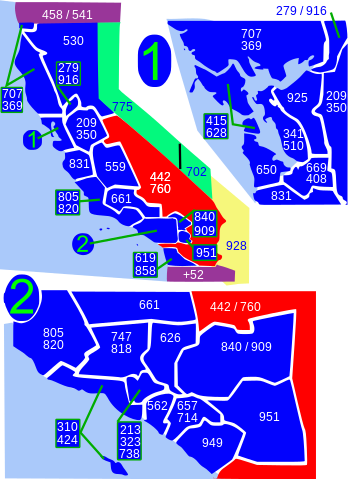
458/541775702928442/760916/279530369/707209559831805661858909951619213323369/707916/279415650341/510925408209831805661442/760310/424747/818626909951949562657/714
Numbering plan areas in California (blue) and border states. Area codes 442 and 760 are shown in red.

Area codes 760 and 442 are telephone area codes in the North American Numbering Plan (NANP) for the U.S. state of California. These area codes serve an overlay complex that comprises much of the southeastern and southernmost portions of California. It includes Imperial, Inyo, and Mono counties, as well as portions of San Diego, Riverside, San Bernardino, Los Angeles, and Kern counties. Area code 760 was created on March 22, 1997, in a split of area code 619.[1] Area code 442 was added to the same area on November 21, 2009.

History

[edit]

Area code 760 was split from 619 in 1997, and 619 had been split from area code 714 in 1982. Within a decade of creation, the proliferation of cell phones and pagers left area code 760 under the threat of exhausting its central office prefixes. The initial relief plan was another area code split, with the San Diego and Imperial areas moving to a new 442 area code. However, this met with protests from businesses who did not want to change their numbers for the second time in a decade. Ultimately, the California Public Utilities Commission decided that 442 would be added as an overlay to 760. Since 2009 all users in the region have been required to include the area code even when dialing local calls.

Comprising 46,666 square miles (120,860 km2), it is the largest numbering plan area in California, with approximately 29% of the state's land area served by the overlay complex.[2]

Service area

[edit]

The following communities are located in the numbering plan area, in their respective counties.

See also

[edit]

References

[edit]
[edit]
Revisions and contributorsEdit on WikipediaRead on Wikipedia
from Grokipedia
Area codes 760 and 442 are overlay telephone area codes in the serving southeastern in the United States. They cover the same expansive geographic region, which includes northern San Diego County (such as Oceanside, Carlsbad, Escondido, and Vista), eastern Riverside County, eastern San Bernardino County (including Victorville and the High Desert), all of Imperial County (the ), Inyo County, Mono County, small portions of Kern County, and small portions of County. This area spans diverse landscapes from coastal communities to inland deserts and mountain regions, encompassing approximately 46,000 square miles and serving a population of more than 2.9 million residents (as of 2025). The overlay requires 10-digit dialing for all local calls within the region to accommodate both codes. Area code 760 was introduced on March 22, 1997, as a split from the overburdened area code 619 to address growing demand for telephone numbers in California's rapidly expanding inland and desert areas. At its creation, 760 covered the eastern and inland portions of what was previously 619, including the North County San Diego suburbs, the Coachella Valley, the Mojave Desert, and remote eastern counties, while 619 retained central and coastal San Diego. The new code was the 187th area code activated in the NANP and quickly became essential for supporting population growth, military installations like Camp Pendleton, and economic development in tourism, agriculture, and logistics sectors. By the mid-2000s, projections indicated that 760 would exhaust its available central office prefixes by late 2009, prompting the (CPUC) to plan relief measures. In April , the CPUC approved a geographic split, assigning the new 442 code to the southern portion of the 760 region, including coastal North communities like Oceanside and Escondido, while the northern desert areas would retain 760. However, after receiving over 1,300 public comments—75% of which opposed the split due to concerns over costs, confusion, and disruption to existing numbers and business branding— the CPUC reversed course in October , opting instead for an all-services overlay. This approach allowed both codes to serve the entire original 760 territory without changing existing numbers. The 442 overlay took effect on November 21, 2009, with permissive 10-digit dialing beginning May 2, 2009, and mandatory 10-digit dialing enforced from October 24, 2009. New telephone numbers assigned after this date could receive either 760 or 442, helping to extend the region's numbering capacity amid continued growth in services and . As of 2025, both codes remain in active use without further relief planned, supporting a mix of urban, rural, and remote communities across the region.

History

Creation of Area Code 760

The region served by what would become area code 760 was originally covered by area code 213, one of the inaugural North American area codes established in 1947 to encompass all of south of the . This expansive territory was later divided when area code 714 was created in a 1951 split from 213, incorporating and Imperial counties along with parts of Riverside and Orange counties. By 1982, the southern portion—including County and surrounding inland areas—was separated into the newly formed area code 619 through another split from 714, reflecting the ongoing population expansion and telephone demand in the region. Rapid population growth in and adjacent inland communities during the 1980s and early 1990s led to heavy utilization of telephone numbers under area code 619, with projections indicating exhaustion of available central office codes (NXX) in 1997. To address this impending shortage and accommodate the increasing demand driven by residential, business, and emerging wireless services, the (CPUC), in coordination with the North American Numbering Plan Administrator (NANPA), approved a geographic split of area code 619 to introduce area code 760 on March 22, 1997. The split redefined boundaries such that area code 760 encompassed the eastern and northern portions of San Diego County—primarily North County areas like Oceanside, Escondido, and Vista—as well as adjacent inland and desert regions including parts of Riverside, San Bernardino, Imperial, Inyo, Mono, and Kern counties, which had previously fallen under 619. Initial central office code assignments under 760 prioritized high-demand exchanges in these areas, with the first numbers becoming available on the effective date. A permissive dialing transition began in late , allowing 7-digit local calls within the affected zones, but mandatory 10-digit dialing (including the area code) was required starting March 22, 1997, to distinguish between the old and new codes and prevent overlap issues. The establishment of area code 760 immediately relieved pressure on 619 by providing a full set of approximately 7.9 million potential numbers (792 prefixes × 10,000 lines each), with around 1.7 million numbers assigned shortly after activation to support the roughly 1.5 million residents in the new service area at the time. This measure extended the usability of both codes amid California's booming telecommunications needs, though 760 itself faced future exhaustion projections within a decade due to similar growth trends.

Introduction of Area Code 442

Area code 442 was introduced as an overlay for the existing 760 area code to address the impending exhaustion of telephone numbers within the 760 numbering plan area, which was projected to occur in the third quarter of 2009 due to rapid population growth and increasing demand for wireless services in the region's desert and coastal communities. By 2008, available numbers in the 760 area code were severely limited, prompting the need for relief measures. The (CPUC) initially approved a geographic split on April 24, 2008, but reversed this decision after receiving over 1,300 public comments—75% of which opposed the split due to concerns over costs, confusion, and disruption to existing numbers and business branding, particularly in the vast rural areas where preserving community identity was prioritized. On October 21, 2008, the CPUC approved an all-services overlay instead, selecting 442 from available codes (with middle digit 4) to superimpose over the entire 760 footprint without altering established numbers. This approach, advocated by telecommunications carriers like Verizon and , minimized economic burdens while providing immediate additional capacity. Implementation began with a permissive 10-digit dialing period starting May 2, 2009, during which callers could dial either 7 digits or the area code plus 7 digits (10 digits total) for local calls within the region. Mandatory 10-digit dialing was enforced beginning October 24, 2009, requiring all local calls to use the full format to accommodate both 760 and 442 numbers. Full service for the 442 area code activated on November 21, 2009, with initial assignments limited to new landlines and mobile services. To facilitate the transition, telephone companies and the CPUC launched public education campaigns aimed at achieving at least 70% consumer awareness, including mailed notices, media announcements, and guidance on updating equipment such as alarm systems, fax machines, and automatic dialers. These efforts emphasized the need to reprogram devices and update contact lists to avoid disruptions. The overlay built on the 1997 creation of area code 760 from a split of 619, maintaining the original boundaries while extending numbering resources.

Service Area

San Diego County

Area codes 760 and 442 cover northern County, extending from Oceanside northward along the coast and including eastern inland areas up to the boundary of the , while excluding the central and southern portions of the county served by area code 619. The northern limit aligns with the , encompassing suburban and rural communities characterized by coastal development and inland valleys. Key cities and communities within this coverage include Oceanside, the largest with a population of about 172,500 residents (2023); Carlsbad (approximately 115,000 as of 2023); Escondido (around 149,000 as of 2024); Vista (about 101,000 as of 2023); San Marcos (roughly 95,000 as of 2023); and Fallbrook (near 30,000 as of 2023). These areas, collectively known as North County, serve approximately 1.17 million residents (2022), with high population density driven by suburban expansion, residential growth, and tourism attractions like beaches and golf resorts. The region's economy features significant military presence at Marine Corps Base Camp Pendleton in Oceanside, which supports thousands of active-duty personnel and contributes to local employment and infrastructure. Carlsbad stands out as a biotechnology hub, hosting over 100 life sciences companies focused on medical devices, pharmaceuticals, and research, fostering innovation and job creation in the sector. In contrast, Fallbrook relies heavily on agriculture, particularly avocado and citrus production, earning it recognition as a key farming area within the county.

Riverside County

The coverage of area codes 760 and 442 in Riverside County is limited to the eastern portions of the county, encompassing the Coachella Valley and select inland desert regions, while excluding the more urbanized western areas served by area codes 909 and 951. This region extends westward from the San Gorgonio Pass, a key mountain gateway separating it from San Bernardino County, eastward to the Salton Sea, and borders San Diego County to the southwest and Imperial County to the southeast. The overlay of 442 on 760, implemented in 2009, applies uniformly across this territory to address growing demand for telephone numbers. Major cities and communities within this coverage include Palm Springs, Indio, La Quinta, Cathedral City, Desert Hot Springs, Coachella, Palm Desert, Rancho Mirage, and Indian Wells, along with smaller locales such as Bermuda Dunes, Chiriaco Summit, and Desert Center. Blythe, located along the in the southeastern corner, also falls under these codes. The population served in this eastern Riverside segment is approximately 496,000 residents as of 2023 for the Indio-Cathedral City-Palm Springs metropolitan area, bolstered by retirement communities attracting older adults and seasonal that swells numbers during winter months. This area is renowned for its desert resorts and agricultural heritage, featuring expansive groves that produce a significant share of the nation's dates, alongside over 100 courses that draw enthusiasts year-round. The economy has transitioned from traditional —once dominated by , vegetables, and palms—to a - and entertainment-driven model, highlighted by the world-famous Music and Arts Festival held annually in Indio since 1999, which attracts hundreds of thousands of visitors and generates substantial economic impact.

San Bernardino County

Area codes 760 and 442 encompass most of San Bernardino County east of the urban core, including extensive portions of the and the . This coverage spans from the near the western county boundary to the along the eastern edge, incorporating high-desert terrain and mountainous areas while featuring partial overlap with the high-desert communities of County. The region excludes the densely populated western valleys but includes key transportation corridors like and (I-40), facilitating connectivity across the desert landscape. Major cities and communities served by these area codes include Victorville, Hesperia, Apple Valley, Barstow, Yucca Valley, Twentynine Palms, and . Twentynine Palms is home to the Marine Corps Air Ground Combat Center, the largest Marine Corps base in the world, supporting training for expeditionary forces. The population in this high-desert subregion exceeds 500,000 residents as of 2021, with projections indicating steady growth to approximately 534,000 by 2026, driven by expanding logistics hubs around Victorville and the enduring military presence. Economically, the area benefits from and defense industries centered in Victorville, where facilities like the support aircraft maintenance, pilot training, and operations for companies such as . Culturally, Barstow holds a prominent place in Route 66 as a major rail and highway junction since the , preserving motels, diners, and the Route 66 Mother Road Museum that highlight its role as a key stop for migrants and travelers. Additionally, communities like Yucca Valley and Twentynine Palms provide primary access to via California Highway 62, enabling entry to the park's western and northern sections for hiking, climbing, and stargazing.

Imperial County

Imperial County, the southernmost county in , is fully covered by area codes 760 and 442, forming the desert region's primary telecommunications footprint. This coverage encompasses the entire 4,598 square miles of the county, supporting connectivity for its rural and agricultural communities. The area codes serve as essential infrastructure for the , facilitating communication in an economy heavily reliant on cross-border interactions and seasonal farming operations. Major cities and communities within the county include El Centro, the and largest city; Brawley, a key agricultural hub; Calexico, situated directly on the U.S.-Mexico border; Imperial, home to administrative and educational facilities; and Holtville, known for its role in vegetable processing. These population centers, along with smaller towns like Ocotillo and Seeley, rely on 760 and 442 for local and international calls, particularly in border trade zones. The population served by these area codes in Imperial County is approximately 180,000 (2024), with a significant or Latino majority comprising about 82.3% of residents (2023), many of whom engage in binational commerce with nearby , .[](https://data.census.gov/table/ACSDT1Y2023.B03002?q=B03002: HISPANIC OR LATINO ORIGIN BY RACE&g=050XX00US06025) This demographic profile underscores the region's cultural and economic ties to , where cross-border trade exceeds $70 billion annually in the broader CaliBaja area, influencing local needs for business and family connections. Area code 442 was introduced as an overlay to 760 in to accommodate this growing demand without requiring number changes. The county's unique aspects are defined by its intensive agriculture in the , which produces over two-thirds of the nation's winter vegetables, including , , and carrots, making it a major U.S. supplier during off-seasons in other regions. This productivity depends on irrigation from the , which supplies nearly all water for the valley's 500,000 acres of farmland, generating an agricultural output valued at $2.6 billion in 2022. The economy is further bolstered by maquiladoras—foreign-owned factories in adjacent that assemble goods for export—contributing to regional manufacturing and logistics supported by 760/442 connectivity. Imperial County's boundaries extend along the to the east, sharing a border with , and along the international boundary with to the south, encompassing diverse terrains from fertile valleys to arid deserts. The western edge includes portions of the , a shallow inland lake that serves as a recreational area for and but faces significant environmental challenges, including rising , toxic algal blooms, and dust storms from its shrinking shoreline that impact air quality in nearby communities. These issues, driven by water diversion and evaporation, affect over 70,000 tons of airborne dust annually in the region, highlighting the interplay between natural resources and human activity in the 760/442 service area.

Inyo County

Inyo County is fully covered by area codes 760 and 442, encompassing the entire expansive region of over 10,000 square miles in eastern California. As one of the least populous counties within the 760/442 service area, it supports a resident population of approximately 18,500 as of 2023. The county's economy relies heavily on tourism, driven by its natural attractions, and mining, which remains a limited but notable sector in select areas. Major communities include , the largest with a of about 3,800 (2023) and serving as the primary commercial hub; Lone Pine, , and Olancha, all small unincorporated areas with populations under 3,000 and no large cities present. These settlements are scattered along the , with located in the northern portion and the others farther south near the county's boundaries. The region features remote, sparsely populated terrain, including the floor and eastern slopes of the Sierra Nevada range, while bordering to the east. Inyo County serves as the eastern gateway to iconic natural sites, including —the highest peak in the —accessible via trails starting from Lone Pine, and , with entry points from communities like Olancha and Lone Pine. The White Mountains host the Ancient Bristlecone Pine Forest, home to some of the world's oldest living trees, exceeding 4,000 years in age, preserved within the . Additionally, the near Lone Pine have a rich film history, with over 400 movies and television productions filmed among its distinctive rock formations since the , earning it recognition as a key location for Westerns and other genres.

Mono County

Mono County is entirely served by area codes 760 and 442, which overlay to provide telephone service across its expansive, rugged terrain in the eastern Sierra Nevada region. This high-elevation area, spanning over 3,000 square miles, is renowned for its outdoor tourism opportunities, including , hiking, and access to natural wonders that draw visitors year-round. The overlay system ensures sufficient numbering resources for the county's sparse but tourism-driven population. The resident population of Mono County stands at approximately 13,000 as of 2023, but it experiences notable seasonal swells, particularly during winter for skiing and snowboarding at major resorts, and in summer for hiking and scenic exploration, with tourism accounting for about 80% of local employment and generating over 6 million visitor-days annually. Key communities within the county include Mammoth Lakes, a central hub for ski resort activities; Bridgeport, the historic county seat; Lee Vining, near Mono Lake; and Walker, in the northern Antelope Valley area. These locales rely on the 760/442 area codes for both residential and business communications, supporting the influx of seasonal workers and tourists. Distinctive features served by these area codes highlight Mono County's appeal as a recreational destination, including the Mammoth Mountain Ski Area with its 3,500 acres of skiable terrain and average annual snowfall exceeding 400 inches; the eastern entrance to Yosemite National Park via Tioga Pass on Highway 120, providing access to high-country trails; and the striking tufa towers at Mono Lake Tufa State Natural Reserve, ancient calcium carbonate formations rising from the saline lake. The local economy centers on tourism alongside ranching and livestock grazing, which utilize the county's meadows and historic agricultural lands. Bordering Nevada to the east and Yosemite National Park to the west, the county also encompasses Bodie State Historic Park, a preserved gold-mining ghost town from the late 19th century that attracts history enthusiasts.

Kern County

Area codes 760 and 442 serve only the eastern portions of Kern County, encompassing the region while excluding the central valley's oil fields and the city of Bakersfield, which fall under area code 661. This coverage includes the sparsely populated high desert terrain, bounded by San Bernardino County to the southeast and Inyo County to the north, forming part of the broader expanse. The primary communities within this area are Ridgecrest, the largest with a population of 28,138 as of 2023, situated adjacent to the Naval Air Weapons Station China Lake, a major U.S. Navy research and testing facility; California City, home to about 14,821 residents (2023) and known for its planned grid layout covering over 200 square miles; Mojave, with portions serving around 2,000 people; and smaller locales like and Inyokern. Edwards Air Force Base, though primarily associated with , lies nearby and significantly influences the region's character. The combined population served in these eastern Kern areas totals approximately 60,000 (2023), with the local economy heavily reliant on defense, , and mining sectors. Distinctive features of the region include NASA's , located at , which conducts advanced aeronautical testing and has a storied legacy in hypersonic research, notably through the X-15 program that achieved speeds over Mach 6 and altitudes exceeding 350,000 feet in the 1960s. Additionally, hosts the , the world's largest open-pit operation, contributing to a historic legacy that dates back over a century and supplies about 30% of global refined used in , , and ceramics. These federal installations and industrial sites underscore the area's strategic importance in national defense and resource extraction.

References

Add your contribution
Related Hubs
User Avatar
No comments yet.