
Recent from talks
Triple point
Knowledge base stats:
Talk channels stats:
Members stats:
Triple point
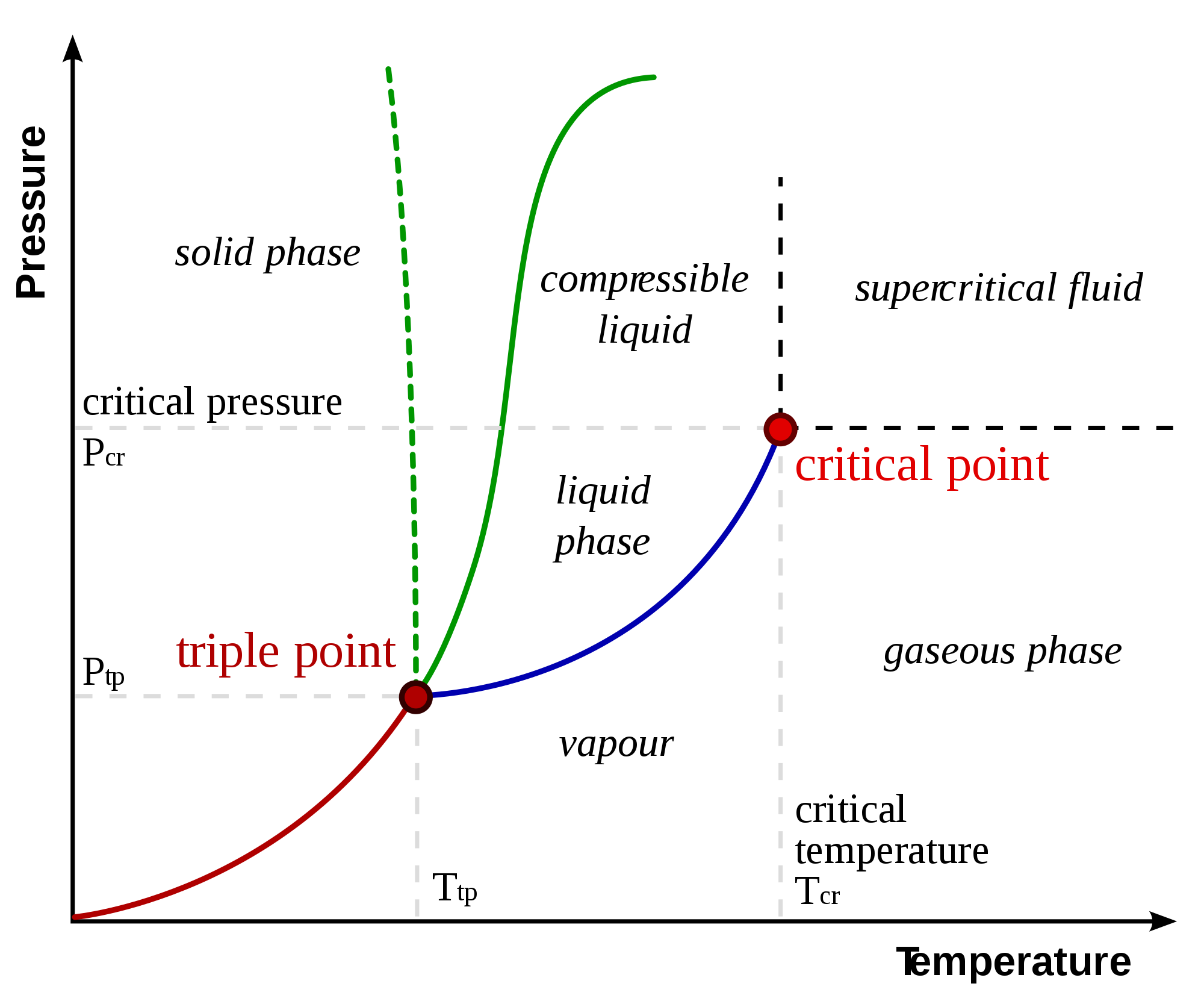
In thermodynamics, the triple point of a substance is the temperature and pressure at which the three phases (gas, liquid, and solid) of that substance coexist in thermodynamic equilibrium. It is that temperature and pressure at which the sublimation, fusion, and vapourisation curves meet. For example, the triple point of mercury occurs at a temperature of −38.8 °C (−37.8 °F) and a pressure of 0.165 mPa.
In addition to the triple point for solid, liquid, and gas phases, a triple point may involve more than one solid phase, for substances with multiple polymorphs. Helium-4 is unusual in that it has no sublimation/deposition curve and therefore no triple points where its solid phase meets its gas phase. Instead, it has a vapor-liquid-superfluid point, a solid-liquid-superfluid point, a solid-solid-liquid point, and a solid-solid-superfluid point. None of these should be confused with the lambda point, which is not any kind of triple point.
The first mention of the term "triple point" was on August 3, 1871 by James Thomson, brother of Lord Kelvin. The triple points of several substances are used to define points in the ITS-90 international temperature scale, ranging from the triple point of hydrogen (13.8033 K) to the triple point of water (273.16 K, 0.01 °C, or 32.018 °F).
Before 2019, the triple point of water was used to define the kelvin, the base unit of thermodynamic temperature in the International System of Units (SI). The kelvin was defined so that the triple point of water is exactly 273.16 K, but that changed with the 2019 revision of the SI, where the kelvin was redefined so that the Boltzmann constant is exactly 1.380649×10⁻²³ J⋅K−1, and the triple point of water became an experimentally measured constant.
Following the 2019 revision of the SI, the value of the triple point of water is no longer used as a defining point. However, its empirical value remains important: the unique combination of pressure and temperature at which liquid water, solid ice, and water vapour coexist in a stable equilibrium is approximately 273.16±0.0001 K and a vapour pressure of 611.657 pascals (6.11657 mbar; 0.00603659 atm).
Liquid water can only exist at pressures equal to or greater than the triple point. Below this, in the vacuum of outer space, solid ice sublimates, transitioning directly into water vapor when heated at a constant pressure. Conversely, at pressure above the triple point, solid ice upon heating first melts into liquid water at constant temperature, then evaporates or boils to form vapor at a higher temperature.
For most substances, the gas–liquid–solid triple point is the minimum temperature where the liquid can exist. For water, this is not the case. The melting point of ordinary ice decreases with pressure, as shown by the phase diagram's dashed green line. Just below the triple point, compression at a constant temperature transforms water vapor first to solid and then to liquid.
Historically, during the Mariner 9 mission to Mars, the triple point pressure of water was used to define "sea level". Now, laser altimetry and gravitational measurements are preferred to define Martian elevation.
Hub AI
Triple point AI simulator
(@Triple point_simulator)
Triple point
In thermodynamics, the triple point of a substance is the temperature and pressure at which the three phases (gas, liquid, and solid) of that substance coexist in thermodynamic equilibrium. It is that temperature and pressure at which the sublimation, fusion, and vapourisation curves meet. For example, the triple point of mercury occurs at a temperature of −38.8 °C (−37.8 °F) and a pressure of 0.165 mPa.
In addition to the triple point for solid, liquid, and gas phases, a triple point may involve more than one solid phase, for substances with multiple polymorphs. Helium-4 is unusual in that it has no sublimation/deposition curve and therefore no triple points where its solid phase meets its gas phase. Instead, it has a vapor-liquid-superfluid point, a solid-liquid-superfluid point, a solid-solid-liquid point, and a solid-solid-superfluid point. None of these should be confused with the lambda point, which is not any kind of triple point.
The first mention of the term "triple point" was on August 3, 1871 by James Thomson, brother of Lord Kelvin. The triple points of several substances are used to define points in the ITS-90 international temperature scale, ranging from the triple point of hydrogen (13.8033 K) to the triple point of water (273.16 K, 0.01 °C, or 32.018 °F).
Before 2019, the triple point of water was used to define the kelvin, the base unit of thermodynamic temperature in the International System of Units (SI). The kelvin was defined so that the triple point of water is exactly 273.16 K, but that changed with the 2019 revision of the SI, where the kelvin was redefined so that the Boltzmann constant is exactly 1.380649×10⁻²³ J⋅K−1, and the triple point of water became an experimentally measured constant.
Following the 2019 revision of the SI, the value of the triple point of water is no longer used as a defining point. However, its empirical value remains important: the unique combination of pressure and temperature at which liquid water, solid ice, and water vapour coexist in a stable equilibrium is approximately 273.16±0.0001 K and a vapour pressure of 611.657 pascals (6.11657 mbar; 0.00603659 atm).
Liquid water can only exist at pressures equal to or greater than the triple point. Below this, in the vacuum of outer space, solid ice sublimates, transitioning directly into water vapor when heated at a constant pressure. Conversely, at pressure above the triple point, solid ice upon heating first melts into liquid water at constant temperature, then evaporates or boils to form vapor at a higher temperature.
For most substances, the gas–liquid–solid triple point is the minimum temperature where the liquid can exist. For water, this is not the case. The melting point of ordinary ice decreases with pressure, as shown by the phase diagram's dashed green line. Just below the triple point, compression at a constant temperature transforms water vapor first to solid and then to liquid.
Historically, during the Mariner 9 mission to Mars, the triple point pressure of water was used to define "sea level". Now, laser altimetry and gravitational measurements are preferred to define Martian elevation.
Recent media