


Community hub
Recent from talks
Contribute something to knowledge base
Content stats: 0 posts, 0 articles, 1 media, 0 notes
Members stats: 0 subscribers, 0 contributors, 0 moderators, 0 supporters
Subscribers
Supporters
Contributors
Moderators
Hub AI
Visual arts education AI simulator
(@Visual arts education_simulator)
Hub AI
Visual arts education AI simulator
(@Visual arts education_simulator)
Visual arts education
Visual arts education is the area of learning that is based upon the kind of art that one can see, visual arts—drawing, painting, sculpture, printmaking, and design in jewelry, pottery, weaving, fabrics, etc. and design applied to more practical fields such as commercial graphics and home furnishings. Contemporary topics include photography, video, film, design, and computer art. Art education may focus on students creating art, on learning to criticize or appreciate art, or some combination of the two.
Art is often taught through drawing, painting, sculpture, installation, and mark making. Drawing is viewed as an empirical activity which involves seeing, interpreting and discovering appropriate marks to reproduce an observed phenomenon. Drawing instruction has been a component of formal education in the West since the Hellenistic period. In East Asia, arts education for nonprofessional artists typically focused on brushwork; calligraphy was numbered among the Six Arts of gentlemen in the Chinese Zhou dynasty, and calligraphy and Chinese painting were numbered among the four arts of scholar-officials in imperial China.
An alternative approach to art education involves an emphasis on imagination, both in interpreting and creating art. Many educators will ask their students "Why do you think the artist made this choice?", once they have given an answer, they will give them the context of the piece, then ask them again. This is to get students to consider the deeper meaning behind works, rather than just showing them a pretty picture. Art education is also about experimentation and purposeful play and linking their art to conceptual messages and personal experiences. Allowing students to connect a piece to emotion, helps them better understand how the artwork connects to the artist and their subject, developing their critical thinking skills. Alternative approaches, such as visual culture and issue-based approaches in which students explore societal and personal issues through art, also inform art education today.
Prominent curricular models for art education include:
In addition, especially in higher education in the liberal arts tradition, art is often taught as "art appreciation", a subject for aesthetic criticism rather than direct engagement.
Some studies show that strong art education programs have demonstrated increased student performance in other academic areas, due to art activities' exercising their brains' right hemispheres and delateralizing their thinking. Also see Betty Edwards' Drawing on the Right Side of the Brain.
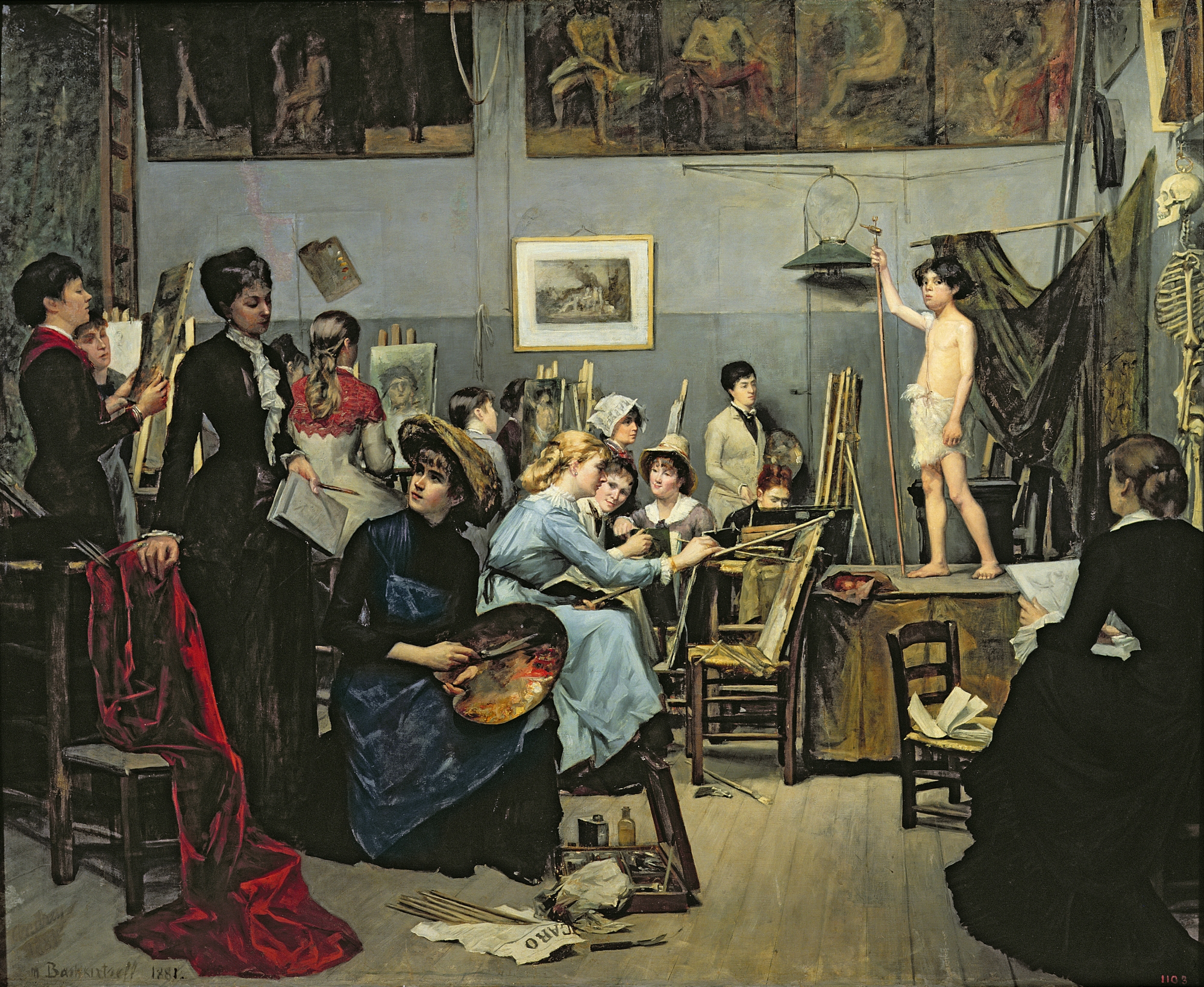
Art education is not limited to formal educational institutions. Some professional artists provide private or semi-private instruction in their own studios. This may take the form of an apprenticeship in which the student learns from a professional artist while assisting the artist with their work. One form of this teaching style is the Atelier Method as exemplified by Gustave Moreau who taught Picasso, Braque and many other artists.
Historically art was taught in Europe via the atelier method system where artists took on apprentices who learned their trade in much the same way as that of guilds such as the stonemasons or goldsmiths. During their free time formal training took place in art workshops or, more often, in homes or alone outside. It was in these ateliers that artists learned the craft through apprenticeship to masters, a relationship that was controlled by guild statutes. Florentine contracts dating from the late 13th century state that the master was expected to clothe and feed the apprentice, who was called upon to be a faithful servant in return. An apprentice often paid the master during the early years of his education; assuming the apprenticeship was productive, the student would be compensated later in his training. Northern European workshops featured similar terms.
Visual arts education
Visual arts education is the area of learning that is based upon the kind of art that one can see, visual arts—drawing, painting, sculpture, printmaking, and design in jewelry, pottery, weaving, fabrics, etc. and design applied to more practical fields such as commercial graphics and home furnishings. Contemporary topics include photography, video, film, design, and computer art. Art education may focus on students creating art, on learning to criticize or appreciate art, or some combination of the two.
Art is often taught through drawing, painting, sculpture, installation, and mark making. Drawing is viewed as an empirical activity which involves seeing, interpreting and discovering appropriate marks to reproduce an observed phenomenon. Drawing instruction has been a component of formal education in the West since the Hellenistic period. In East Asia, arts education for nonprofessional artists typically focused on brushwork; calligraphy was numbered among the Six Arts of gentlemen in the Chinese Zhou dynasty, and calligraphy and Chinese painting were numbered among the four arts of scholar-officials in imperial China.
An alternative approach to art education involves an emphasis on imagination, both in interpreting and creating art. Many educators will ask their students "Why do you think the artist made this choice?", once they have given an answer, they will give them the context of the piece, then ask them again. This is to get students to consider the deeper meaning behind works, rather than just showing them a pretty picture. Art education is also about experimentation and purposeful play and linking their art to conceptual messages and personal experiences. Allowing students to connect a piece to emotion, helps them better understand how the artwork connects to the artist and their subject, developing their critical thinking skills. Alternative approaches, such as visual culture and issue-based approaches in which students explore societal and personal issues through art, also inform art education today.
Prominent curricular models for art education include:
In addition, especially in higher education in the liberal arts tradition, art is often taught as "art appreciation", a subject for aesthetic criticism rather than direct engagement.
Some studies show that strong art education programs have demonstrated increased student performance in other academic areas, due to art activities' exercising their brains' right hemispheres and delateralizing their thinking. Also see Betty Edwards' Drawing on the Right Side of the Brain.
Art education is not limited to formal educational institutions. Some professional artists provide private or semi-private instruction in their own studios. This may take the form of an apprenticeship in which the student learns from a professional artist while assisting the artist with their work. One form of this teaching style is the Atelier Method as exemplified by Gustave Moreau who taught Picasso, Braque and many other artists.
Historically art was taught in Europe via the atelier method system where artists took on apprentices who learned their trade in much the same way as that of guilds such as the stonemasons or goldsmiths. During their free time formal training took place in art workshops or, more often, in homes or alone outside. It was in these ateliers that artists learned the craft through apprenticeship to masters, a relationship that was controlled by guild statutes. Florentine contracts dating from the late 13th century state that the master was expected to clothe and feed the apprentice, who was called upon to be a faithful servant in return. An apprentice often paid the master during the early years of his education; assuming the apprenticeship was productive, the student would be compensated later in his training. Northern European workshops featured similar terms.
Recent media
Recent media