Recent from talks
Nothing was collected or created yet.
Association (object-oriented programming)
View on WikipediaThis article relies largely or entirely on a single source. (March 2024) |
In object-oriented programming, association defines a relationship between classes of objects that allows one object instance to cause another to perform an action on its behalf. This relationship is structural, because it specifies that objects of one kind are connected to objects of another and does not represent behaviour.
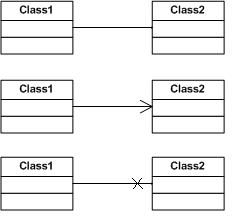
Middle: An association is bidirectional, although it may be limited to just one direction by adorning some end with an arrowhead pointing to the direction of traversal.
Bottom: Association is prohibited
In generic terms, the causation is usually called "sending a message", "invoking a method" or "calling a member function" to the controlled object. Concrete implementation usually requires the requesting object to invoke a method or member function using a reference or pointer to the memory location of the controlled object.
The objects that are related via the association are considered to act in a role with respect to the association, if object's current state in the active situation allows the other associated objects to use the object in the manner specified by the role. A role can be used to distinguish two objects of the same class when describing its use in the context of the association. A role describes the public aspects of an object with respect to an association.[1]
The ends of the association can have all the characteristics of a property:
- They can have a multiplicity, expressed by a lower and an upper limit in the form of "lowerLimit..upperLimit".
- You can have a name.
- You can declare a visibility.
- You can specify whether the end of the association is ordered and / or unique.
See also
[edit]References
[edit]- ^ Rumbaugh, JR; et al. (1991). Object-oriented modeling and design. Prentice Hall. ISBN 0-13-630054-5.
Association (object-oriented programming)
View on GrokipediaFundamentals
Definition
In object-oriented programming, an association is a structural relationship between classes that specifies connections among their instances, enabling objects of one class to interact with objects of another class, typically by sending messages through method calls, without implying ownership, inheritance, or dependency.[4] This relationship models how instances collaborate in a system, where a link represents a specific connection between objects at runtime.[4] Unlike attributes, which relate objects to simple values, associations connect objects to other objects with identity, allowing for more complex interactions such as querying or modifying related instances.[5] For example, a Car class may be associated with a Driver class, where a car instance holds a reference to its current driver instance, permitting the car to invoke methods on the driver without owning or controlling its lifecycle.[6] The concept of association originated in early object-oriented modeling techniques and was formalized in the Object Modeling Technique (OMT), as detailed by James Rumbaugh, Michael Blaha, William Premerlani, Frederick Eddy, and William Lorensen in their 1991 book Object-Oriented Modeling and Design, which introduced associations as a means to represent general relationships between classes in analysis and design phases.[7] This foundation influenced subsequent standards like the Unified Modeling Language (UML), where associations were standardized as a core element for specifying semantic relationships between typed instances.[4]Key Characteristics
Associations in object-oriented programming are inherently bidirectional, meaning that objects from both participating classes can reference and interact with each other unless specified otherwise. This bidirectionality allows for mutual navigation along the relationship, enabling symmetric access and communication between instances. However, associations can be designated as unidirectional to restrict navigation to one direction, which minimizes dependencies and enhances encapsulation by preventing unnecessary knowledge of the other class. In UML, navigability is indicated by an arrowhead on the association line, with the absence of adornments implying unspecified or bidirectional navigability.[1][8] Each end of an association defines a role name that specifies the perspective or function of the class at that end, providing clarity on how instances interact within the relationship. For example, in an association between a Person and a Company class, one end might be labeled "employer" from the Person's view, while the other is "employee" from the Company's view. These role names are optional but essential for disambiguating multiple associations between the same pair of classes or for expressing the semantic intent of the link.[1][9] Association ends can specify visibility levels—such as public, private, protected, or package—to control access to the navigational feature, treating it similarly to an attribute or operation in the owning class. Additionally, constraints on association ends may include properties like ordering (indicating whether linked instances are maintained in a sequence) or uniqueness (ensuring no duplicate links from a given instance). These constraints enforce specific behavioral rules on the relationship, such as requiring ordered collections of associated objects or preventing multiple identical connections.[1][10] Unlike mere data coupling, which involves simple parameter passing or shared data structures between modules without implying deeper relational semantics, associations emphasize meaningful, structural interactions between classes that reflect real-world dependencies and collaborations. This semantic focus distinguishes associations as a higher-level abstraction for modeling object relationships in OOP designs.[11]Types
Binary and Multiary Associations
In object-oriented modeling, a binary association represents a semantic relationship between exactly two classifiers, such as classes, where instances of these classifiers can be linked to form tuples describing their connections.[12] This form is fundamental for capturing straightforward peer-to-peer relationships without implying ownership or hierarchy.[12] For instance, a binary association might link a "Person" class to a "Company" class to model employment relationships, where each link connects one person instance to one company instance.[12] Multiary, or n-ary, associations extend this concept to relationships involving three or more classifiers, enabling the modeling of more complex interactions that cannot be adequately represented by pairwise links.[12] In such associations, a link is a tuple with one value per end, each corresponding to an instance of the associated classifier's type, and the lower multiplicity at each end is typically zero to allow flexible combinations.[12] These are particularly useful in scenarios requiring intermediate coordination among multiple entities, such as a ternary association between "Team," "Year," and "Player" classes to capture a player's role on a team during a specific season.[12] In business modeling, multiary associations often represent contracts or agreements involving parties, terms, and conditions, where binary associations would oversimplify the interdependencies.[13] Association classes provide a mechanism to enrich both binary and multiary associations by attaching class-like properties—such as attributes and operations—to the relationship itself, treating the association as a first-class entity.[12] This is essential when the relationship holds independent data that does not belong to either participating class.[12] For example, in a binary association between "Student" and "Course" classes, an "Enrollment" association class can include attributes like grade or enrollment date to capture details specific to each student-course pairing. Similarly, for multiary associations, an association class might model a "Marriage" relationship linking "Person," "Date," and "Location" classes, with attributes such as ceremony type stored in the association class to represent shared event details.[12] Binary associations suit simple, direct interactions like enrollment or ownership, while multiary forms and association classes address intricate, attribute-rich scenarios in domains like education or legal systems.[12]Aggregation
Aggregation represents a specialized form of association in object-oriented programming, embodying a "has-a" relationship where an aggregate object (the whole) contains one or more part objects, yet the parts maintain independence and can exist outside the context of the aggregate. Unlike stronger forms of containment, the lifecycle of the parts is not tied to the aggregate; they can be shared among multiple aggregates or persist independently after the aggregate's destruction. This weak ownership model facilitates flexible object relationships, allowing parts to be reused across different wholes without exclusive binding.[14] In UML notation, aggregation is visually distinguished by a hollow diamond symbol attached to the end of the association line representing the aggregate (whole), indicating shared or weak ownership. This notation applies to binary associations, where the relationship is asymmetric—only one end features the diamond, and the connection forms a transitive, directed acyclic graph to prevent cycles. The hollow diamond contrasts with filled diamonds used for stronger relationships, emphasizing the non-exclusive nature of the parts.[14] Aggregation promotes key benefits in object-oriented design, including enhanced reusability and modularity, as parts can be shared across multiple aggregates, reducing redundancy and enabling more maintainable systems. By decoupling the existence of parts from any single whole, it supports scalable architectures where components can be dynamically reassembled or redistributed without affecting their integrity. This approach aligns with principles of flexible composition, allowing developers to build complex systems from interchangeable building blocks.[15] A classic example of aggregation is the relationship between a university and its departments: the university (aggregate) "has" departments (parts), but departments can theoretically be reorganized or transferred to another institution without ceasing to exist, and a department might even serve multiple universities in federated structures. Another illustrative case is a library aggregating books, where books can belong to the library's collection while also being loaned out or part of external catalogs, existing independently if the library dissolves. These examples highlight how aggregation models real-world scenarios involving shared, non-exclusive containment.[16][17]Composition
Composition represents a strict form of whole-part association in object-oriented programming, where the composite object (the whole) exclusively owns its constituent parts, and the parts cannot exist independently of the whole.[18] In this "has-a" relationship, the lifecycle of the parts is tightly bound to that of the composite: parts are typically created alongside the whole and are destroyed when the whole is deleted, ensuring that the parts do not survive the composite.[19] This exclusive ownership means a part instance belongs to at most one composite at any time, preventing shared ownership across multiple wholes.[18] In UML notation, composition is depicted by a filled black diamond at the association end connected to the composite (whole), distinguishing it from the hollow diamond used for the weaker aggregation relationship.[18] This visual cue emphasizes the strong dependency, where the composite manages the creation, ownership, and destruction of its parts, often in a transitive manner within hierarchical structures.[18] Unlike aggregation, which allows parts to exist independently and potentially be shared, composition enforces encapsulation by confining parts strictly within their owning whole, though this can introduce tight coupling between the entities involved.[19] A classic example is a House object that composes Room objects: the rooms are integral components created and owned by the house, and they cease to exist (in the model's context) if the house is demolished.[19] Similarly, in a Car class, an Engine may compose Piston objects, where the pistons are meaningless and non-viable outside the engine's lifecycle, illustrating the exclusive and dependent nature of this relationship.[19] These semantics promote modeling of hierarchical containment but require careful design to avoid overly rigid dependencies that complicate maintenance.[18]Representation in UML
Notation Basics
In UML class diagrams, associations are depicted using a solid line connecting the symbols of two classifiers, such as classes, to represent a structural relationship where instances of those classifiers are linked or interact.[1] This line lacks any arrowheads for bidirectional associations, indicating that navigation is possible in both directions between the connected elements; for unidirectional associations, a single open arrowhead (a stick arrow) is placed at the target end to show the direction of traversability from the source to the target.[20][1] Role labels, also called association end names, are positioned near each endpoint of the line to denote the specific role or perspective of the classifier at that end; for instance, in an aggregation, the label "owns" might appear near the aggregating class (the whole) to clarify its responsibility toward the aggregated class (the part).[1][21] Association names provide an optional descriptive label for the overall relationship and are typically placed near the center of the line, away from the ends; examples include "employs" for a relationship between an organization and its employees or "writes" for authors and publications.[1][20] To express additional constraints, UML supports stereotypes applied to the association, and qualifiers, which are shown as a small rectangle attached to an association end containing one or more attribute names that function as partial keys to uniquely identify or select related instances.[1][22]Multiplicity and Navigability
In UML, multiplicity specifies the allowable number of instances that can participate in an association at each end, constraining the cardinality of the relationship between connected classifiers. This is denoted by a text string in the form of a range<lower-bound>..<upper-bound>, where the lower bound is a non-negative integer or expression indicating the minimum number of instances, and the upper bound is similarly a non-negative integer, expression, or * representing an unlimited number.[4] Common notations include 0..1 for zero or one instance, 1..* for one or more instances, and * as shorthand for 0..* meaning zero or more. The multiplicity is placed near the association end adjacent to the classifier it constrains, without square brackets for association ends (unlike attributes).[4]
Navigability defines the direction in which the association can be traversed at runtime, indicating whether instances at one end can access those at the other end efficiently. It is graphically represented by an open arrowhead at the navigable end, pointing toward the target end to show traversability in that direction; a small x denotes a non-navigable end, while the absence of any adornment implies unspecified navigability, which may be bidirectional depending on context.[4] Navigability is orthogonal to multiplicity and aggregation, allowing independent specification of directionality regardless of cardinality.[4]
Examples illustrate these concepts in common association patterns. A one-to-one association uses 1..1 multiplicity at both ends, such as between a Person and Passport class, potentially with bidirectional navigability (no arrows) or unidirectional (arrow from Person to Passport).[4] In contrast, a many-to-many association employs * (or 0..*) at both ends, like between Student and Course classes, often requiring an association class to manage attributes of the link; navigability might be bidirectional for mutual access or unidirectional if only students reference courses.[4] A one-to-many relationship combines 1..1 at one end with 0..* at the other, such as Person (1) to Address (*), with an arrow typically from the "one" side to enable traversal from person instances to their addresses.[4]
These notations significantly influence object-oriented design by clarifying the structural constraints and access patterns, guiding the use of references, collections (e.g., lists for * multiplicities), or bidirectional links in implementations to ensure runtime efficiency and adherence to the model's intent.[4]
Implementation
In Object-Oriented Languages
In object-oriented languages, associations between classes are realized through references or pointers that link instances of one class to instances of another, enabling objects to interact without tight coupling of their lifecycles. This implementation allows an object to "know about" or access another object, representing a "has-a" or "uses-a" relationship. For instance, in languages like Java and C++, a simple binary association can be expressed using a reference field, such as aCar class containing a Driver reference: private Driver driver;.[16][23] Similarly, in C++, pointers facilitate this linkage, as in Driver* driver;, providing flexibility for dynamic allocation while requiring manual memory management.[23]
To handle multiplicity in associations, collections such as lists or arrays are employed for one-to-many or many-to-many relationships. In Java, a University class might include a List<Department> to represent multiple departments associated with the university, allowing the addition or removal of department instances at runtime.[6] For qualified associations, where the relationship is keyed by an attribute, maps are used; for example, a Library class could maintain a Map<String, Book> to associate books by ISBN, ensuring unique identification and efficient lookup.[24]
For multiary associations involving three or more classes, an intermediate association class is typically used to reify the relationship, holding references to instances of each participating class. For example, in a ternary association between Supplier, Product, and Warehouse, a StockLink class might contain fields like private Supplier supplier; private Product product; private [Warehouse](/page/Warehouse) warehouse;, allowing management of the complex linkage without direct multi-class references.[25]
Bidirectional associations, where both classes reference each other, are implemented with mutual references but must address potential cycles to avoid issues like infinite recursion during serialization or traversal. In Java, this can be achieved by adding setter methods to synchronize both ends, such as in a Person and Address pair where Person holds an Address and vice versa, with careful handling using annotations like @JsonIgnore for cyclic dependencies in JSON processing.[26][27]
In Python, associations leverage the language's dynamic nature through attribute assignment, allowing objects to reference others via instance attributes without predefined fields. For example, a Car object can dynamically set self.driver = Driver() to establish the link, supporting flexible, runtime-defined relationships.[28][29]
Aggregation, a subtype of association, is coded using shared references where the aggregating object does not control the lifecycle of the associated objects. In Java, a Department can be added to a List<Department> in a University class via departments.add(new Department()), permitting the department to exist independently or be shared with other entities, without the university assuming deletion responsibility upon its own destruction.[16][6]
Design Patterns and Best Practices
In object-oriented programming, the Observer pattern leverages unidirectional associations to establish a one-to-many relationship between a subject object and multiple observer objects, enabling the subject to notify observers of state changes without direct dependencies. This design promotes loose coupling, as observers can be added or removed dynamically while the subject remains unaware of their specific implementations. For example, a subject maintains a list of observer references and iterates over them to broadcast updates upon state modification.[30] The Factory pattern facilitates the dynamic creation of objects used to establish associations, decoupling object instantiation from the classes that rely on them and enhancing system flexibility. By delegating object creation to a factory method or class, developers avoid hard-coded dependencies on concrete types, allowing runtime selection of objects based on context or configuration. This approach is particularly useful in scenarios where associations vary, such as building graphs of related entities without embedding creation logic in client code. Best practices for associations emphasize maintainability and performance. For aggregation relationships, employing weak references prevents memory leaks by permitting garbage collection of associated objects when no strong references exist, which is essential in long-lived applications like caches or event systems. Associations should reference interfaces rather than concrete classes to support polymorphism and easier substitution of implementations, adhering to dependency inversion principles. Additionally, explicitly documenting the roles of associated objects—such as naming them to reflect their purpose (e.g., "owner" or "dependent")—clarifies intent and aids collaboration.[31][32] Common pitfalls in association design include bidirectional associations that can trigger infinite loops during operations like serialization, traversal, or recursive processing, as mutual references cause endless cycling without termination conditions. Overusing composition, while promoting flexibility, can result in deeply nested object graphs that introduce rigidity by complicating debugging, testing, and extension due to increased interdependence. To mitigate these, unidirectional associations are preferred when possible, and composition should be balanced with simpler structures to maintain design simplicity.[26][33]Comparisons with Other Relationships
Versus Inheritance
Association in object-oriented programming establishes a "has-a" relationship between classes, where one object collaborates with another through a reference or link, allowing them to interact without implying subtype substitution.[34] In contrast, inheritance defines an "is-a" relationship, where a subclass extends and specializes the behavior of a superclass, enabling polymorphic substitution and code reuse through the inheritance hierarchy.[34] This distinction promotes modular designs by separating collaboration from specialization. Association is suitable for flexible, changeable relationships that may evolve at runtime, such as an Employee class referencing a Department object, which can be reassigned without altering the employee's core identity.[35] Inheritance, however, is appropriate for stable hierarchies where the subclass truly represents a specialized form of the superclass, like a Manager being a type of Employee with added responsibilities.[35] Misusing inheritance for mere collaboration can lead to rigid, tightly coupled systems, whereas association maintains looser coupling. A key design principle, "favor composition over inheritance," advocates using associations—particularly composition as a strong form of association—to achieve flexibility and reduce dependencies, as associations permit runtime reconfiguration and easier testing compared to the static nature of inheritance hierarchies. This approach, emphasized in foundational object-oriented design literature, helps avoid the fragility of deep inheritance trees. For illustration, consider a bicycle domain: a Bike class uses association to include Wheel objects, enabling the attachment of various wheel types dynamically for adaptability.[34] Conversely, a SportsBike employs inheritance from Bike to inherit and extend base riding behaviors, reflecting a true specialization.[34] Such choices ensure that designs align with domain semantics while promoting maintainability.Versus Dependency
In object-oriented programming, association represents a structural relationship between classes where one object maintains a reference to another, enabling persistent interaction and potential state sharing throughout the object's lifecycle.[36] In contrast, dependency denotes a weaker, transient "uses-a" relationship, where one class temporarily utilizes another—often through method parameters, local variables, or runtime calls—without holding a direct reference or implying long-term coupling.[36] This distinction emphasizes association's role in modeling enduring connections, such as aSale class referencing LineItem objects, while dependency captures situational usage, like a Sale method temporarily accessing a ProductDescription for pricing without storing it.[36]
In UML class diagrams, the visual notation reinforces this separation: associations are depicted as solid lines connecting classes, optionally with navigability arrows or multiplicity indicators to show direction and cardinality, whereas dependencies are illustrated with dashed arrows pointing from the dependent (client) class to the depended-upon (supplier) class, often labeled with stereotypes like «use».[22] This graphical difference highlights association's emphasis on compile-time structural integrity versus dependency's focus on flexible, runtime or design-time interactions.
The implications of these relationships differ significantly in design and maintenance: associations establish compile-time links that can facilitate state sharing and navigation between objects, potentially increasing coupling but providing stability for core domain logic, as seen in a Register class maintaining a reference to a current Sale.[36] Dependencies, being parameter-based or ad hoc, promote looser coupling and easier refactoring since changes to the depended-upon class have narrower impact, though they may introduce runtime variability; for instance, a sorting algorithm depends on a Comparator passed as a parameter without embedding it as an attribute.[36] By contrast, a Car class associates with an Engine through a persistent reference, allowing ongoing collaboration like starting or monitoring the engine.[36]