Hubbry Logo
BronchioleBronchioleMain
Open search
Bronchiole
Community hub
Bronchiole
logo
8 pages, 0 posts
0 subscribers
Be the first to start a discussion here.
Bronchiole
Bronchiole
from Wikipedia
Bronchiole
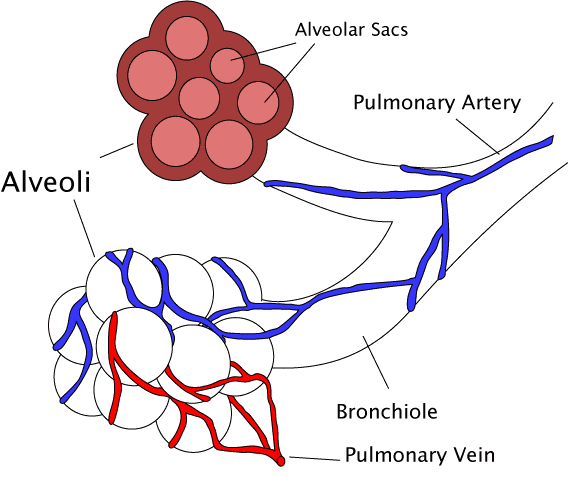
Diagram of the alveoli with both cross-section and external view.
Details
SystemRespiratory system
Identifiers
MeSHD055745
TA98A06.5.02.026
TA23282
THH3.05.02.0.00005
FMA7410
Anatomical terminology

The bronchioles (/ˈbrɑːŋkils/ BRONG-kee-ohls) are the smaller branches of the bronchial airways in the lower respiratory tract. They include the terminal bronchioles, and finally the respiratory bronchioles that mark the start of the respiratory zone delivering air to the gas exchanging units of the alveoli. The bronchioles no longer contain the cartilage that is found in the bronchi, or glands in their submucosa.[1]

Structure

[edit]
A lobule of the lung enclosed in septa and supplied by a terminal bronchiole that branches into the respiratory bronchioles. Each respiratory bronchiole supplies the alveoli held in each acinus accompanied by a pulmonary artery branch.

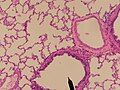
The pulmonary lobule is the portion of the lung ventilated by one bronchiole. Bronchioles are approximately 1 mm or less in diameter and their walls consist of ciliated cuboidal epithelium and a layer of smooth muscle. Bronchioles divide into even smaller bronchioles, called terminal, which are 0.5 mm or less in diameter. Terminal bronchioles in turn divide into smaller respiratory bronchioles which divide into alveolar ducts. Terminal bronchioles mark the end of the conducting division of air flow in the respiratory system while respiratory bronchioles are the beginning of the respiratory division where gas exchange takes place.

The diameter of the bronchioles plays an important role in air flow. The bronchioles change diameter to either increase or reduce air flow. An increase in diameter is called bronchodilation and is stimulated by either epinephrine or sympathetic nerves to increase air flow. A decrease in diameter is called bronchoconstriction, which is the tightening of the smooth muscle surrounding the bronchi and bronchioles due to and stimulated by histamine, parasympathetic nerves, cold air, chemical irritants, excess mucus production, viral infections, and other factors to decrease air flow. Bronchoconstriction can result in clinical symptoms such as wheezing, chest tightness, and dyspnea, which are common features of asthma, chronic obstructive pulmonary disease (COPD), and chronic bronchitis. [2]

Bronchioles

[edit]
Lungs showing bronchi and bronchioles

The trachea divides into the left main bronchus which supplies the left lung, and the right main bronchus which supplies the right lung. As they enter the lungs these primary bronchi branch into secondary bronchi known as lobar bronchi which supply each lobe of the lung. These in turn give rise to tertiary bronchi (tertiary meaning "third"), known as segmental bronchi which supply each bronchopulmonary segment.[1] The segmentary bronchi subdivide into fourth order, fifth order and sixth order segmental bronchi before dividing into the bronchioles. The bronchioles are histologically distinct from the bronchi in that their walls do not have hyaline cartilage and they have club cells in their epithelial lining. The epithelium of the bronchioles starts as a simple ciliated columnar epithelium and changes to simple ciliated cuboidal epithelium as the bronchioles decreases in size. The diameter of the bronchioles is often said to be less than 1 mm, though this value can range from 5 mm to 0.3 mm. As stated, these bronchioles do not have hyaline cartilage to maintain their patency. Instead, they rely on elastic fibers attached to the surrounding lung tissue for support. The inner lining (lamina propria) of these bronchioles is thin with no glands present, and is surrounded by a layer of smooth muscle. As the bronchioles get smaller they divide into terminal bronchioles. Each bronchiole divides into between 50 and 80 terminal bronchioles.[3] These bronchioles mark the end of the conducting zone, which covers the first division through the sixteenth division of the respiratory tract. Alveoli only become present when the conducting zone changes to the respiratory zone, from the sixteenth through the twenty-third division of the tract.

Terminal bronchioles

[edit]

The terminal bronchioles are the most distal segment of the conducting zone. They branch off the lesser bronchioles. Each of the terminal bronchioles divides to form respiratory bronchioles which contain a small number of alveoli. Terminal bronchioles are lined with simple ciliated cuboidal epithelium containing club cells. Club cells are non-ciliated, rounded protein-secreting cells. Their secretions are a non-sticky, proteinaceous compound to maintain the airway in the smallest bronchioles. The secretion, called pulmonary surfactant, reduces surface tension, allowing for bronchioles to expand during inspiration and keeping the bronchioles from collapsing during expiration. Club cells are a stem cell of the respiratory system, and also produce enzymes that detoxify substances dissolved in the respiratory fluid.

Respiratory bronchioles

[edit]

The respiratory bronchioles are the narrowest airways of the lungs, 0.5 mm across.[4] The bronchi divide many times before evolving into the bronchioles. The respiratory bronchioles deliver air to the exchange surfaces of the lungs.[5] They are interrupted by alveoli which are thin walled evaginations. Alveolar ducts are side branches of the respiratory bronchioles. The respiratory bronchioles are lined by ciliated cuboidal epithelium along with some non-ciliated cells called club cells.[6]

Clinical significance

[edit]

Bronchospasm, a potentially life-threatening situation, occurs when the smooth muscular tissue of the bronchioles constricts, severely narrowing their diameter. The most common cause of this is asthma. Bronchospasm is commonly treated by oxygen therapy and bronchodilators such as albuterol.

Diseases of the bronchioles include asthma, bronchiolitis obliterans, respiratory syncytial virus infections, and influenza.

Inflammation

[edit]

The medical condition of inflammation of the bronchioles is termed bronchiolitis.[7]

Additional images

[edit]

References

[edit]

Further reading

[edit]
[edit]
Revisions and contributorsEdit on WikipediaRead on Wikipedia
from Grokipedia
Bronchioles are the smallest branching airways of the in the lungs, originating from the tertiary segmental bronchi and further subdividing into , terminal, and respiratory types that ultimately connect to alveolar ducts and sacs for . These structures mark the transition from the conducting zone, which warms, humidifies, and filters air, to the respiratory zone where oxygen and exchange occurs. Unlike larger bronchi, bronchioles lack and goblet cells, relying instead on a wall composed of , elastic fibers, and lined with ciliated cells and club cells that secrete surfactant-like substances. The primary function of bronchioles is to facilitate the conduction of air deep into the lungs while regulating airflow through contraction and relaxation of their smooth muscle layers, which helps match ventilation to perfusion and prevents airway collapse. Terminal bronchioles represent the endpoint of the purely conducting airways, with diameters narrowing progressively over 20-25 generations of branching, while respiratory bronchioles begin to participate directly in gas exchange due to their partial alveolar linings. This architecture ensures efficient delivery of oxygen-rich air to the alveoli, where diffusion across thin membranes into pulmonary capillaries occurs, driven by partial pressure gradients (e.g., alveolar PO₂ ≈ 100 mmHg equilibrating with capillary blood). Bronchioles play a critical role in respiratory physiology, influencing overall lung compliance and response to stimuli like allergens or irritants.

Definition and overview

Anatomical definition

Bronchioles are defined as the small airways in the lungs that measure less than in diameter and serve as the distal continuation of the bronchi. Unlike larger airways, bronchioles lack cartilaginous support and submucosal glands, consisting primarily of and a simple columnar to cuboidal . They represent the final segment of the conducting zone in the hierarchy, arising from the tertiary bronchi and leading distally toward the alveolar region. The term "bronchiole" originates from the diminutive form of "" in Modern Latin, reflecting its role as a smaller of the bronchial , with the word entering English usage around 1849. This was first systematically described by anatomists in the , building on earlier observations of pulmonary airway subdivisions. Bronchioles are anatomically distinguished from the larger bronchi by the absence of plates, which provide to the proximal airways, and from alveoli by their thicker epithelial lining that does not facilitate direct . This lack of allows for greater flexibility and regulation via , while the epithelial structure maintains a without the specialized type I and II pneumocytes found in alveoli.

Role in respiratory tract

Bronchioles represent the terminal portion of the conducting airways within the , serving to channel air from the upstream bronchi toward the respiratory zone of the s. As the smallest non-alveolarized airways, they complete the conduction pathway by delivering air deep into the parenchyma without participating directly in . This positioning ensures efficient airflow distribution to the peripheral regions, where the transition to actual respiration occurs. The bronchioles delineate the boundary between the conduction zone—which encompasses the trachea, bronchi, and bronchioles—and the respiratory zone, where takes place. Specifically, terminal bronchioles signify the end of the purely conductive segment, beyond which respiratory bronchioles emerge as the initial structures of the respiratory zone, featuring scattered alveoli along their walls. This zonal transition underscores the bronchioles' critical role in bridging anatomical regions optimized for air transport and those dedicated to oxygenation. In terms of airflow dynamics, bronchioles contribute modestly to overall in healthy lungs, accounting for approximately 10-20% of the total due to their extensive parallel branching, which yields a substantial cumulative cross-sectional area despite individual narrow lumens. This low resistance facilitates unobstructed ventilation under normal conditions, minimizing energy expenditure during . Upstream integration occurs at the bronchiole-bronchus junction, where bronchi deliver air to the bronchiolar network; downstream, bronchioles connect seamlessly to alveolar ducts at the bronchiole-alveolar duct junction, enabling smooth progression to the alveolar sacs for gas .

Anatomy

Gross structure and branching

The bronchiolar tree represents the distal segment of the conducting airways, extending from the smaller bronchi and undergoing successive dichotomous branching to facilitate airflow distribution throughout the lung parenchyma. In the widely adopted Weibel model of human lung morphometry, bronchioles span generations approximately 11 through 19 of the 23 total airway generations, with conducting bronchioles in generations 11-15, generation 16 comprising terminal bronchioles, and generations 17–19 consisting of respiratory bronchioles that transition into the gas-exchanging acinar regions. This model, derived from silicone casts of human lungs, assumes symmetrical dichotomous divisions but approximates the overall generational progression observed in vivo. Bronchioles exhibit internal diameters typically ranging from 0.5 mm to 1 mm, decreasing progressively with each generation to optimize resistance and flow uniformity. Their walls are notably thin relative to the lumen, with a wall thickness-to-lumen diameter ratio of approximately 1:4 to 1:10, which enhances distensibility during ventilation. The absence of plates, unlike in proximal bronchi, imparts greater flexibility to the bronchiolar structure, allowing adaptive responses to varying intrathoracic pressures. In reality, bronchiole branching deviates from perfect symmetry, exhibiting in bifurcation angles and daughter branch diameters, particularly from generations 5 onward, to accommodate the irregular lung architecture and ensure equitable ventilation. This asymmetry contributes to the total count of approximately 30,000 terminal bronchioles in the , marking the endpoints of the purely conductive pathway before the onset of respiratory bronchioles.

Types of bronchioles

Bronchioles represent the smallest branches of the airways in the lungs, characterized by a lining of cuboidal and a surrounding layer of that enables of . These structures lack , distinguishing them from larger bronchi, and serve primarily to conduct air toward the respiratory zone. Conducting bronchioles are the initial non-cartilaginous airways following the smaller bronchi, purely conductive without alveoli, spanning approximately generations 11 through 15 in the bronchial tree. Terminal bronchioles form the final segment of the purely conductive portion of the respiratory tract, marking the end of the conduction zone with no alveoli attached to their walls. They are specifically generation 16 in the Weibel model. Respiratory bronchioles initiate the respiratory zone, featuring walls interrupted by scattered alveoli that allow for limited gas exchange. These structures, comprising generations 17 through 19, lead directly into alveolar ducts and represent a transitional area where conduction and respiration overlap.

Histology and cellular components

The walls of bronchioles consist of a thin epithelial layer supported by a , with no distinct or present, distinguishing them from larger bronchi. The epithelium transitions from pseudostratified ciliated columnar in proximal bronchioles to simple cuboidal or columnar in more distal regions, facilitating a streamlined structure for air conduction. Underlying the epithelium is a composed of containing elastic fibers for recoil and a prominent layer of that spirals around the airway, providing structural integrity without rigid support. Key cellular components of the bronchiole include ciliated cells, which predominate and feature apical cilia for coordinated movement, alongside non-ciliated secretory cells. Club cells (previously known as Clara cells) are prominent, particularly in terminal bronchioles, characterized by their dome-shaped apex and secretory granules containing proteins involved in protection. Goblet cells are absent or extremely sparse, unlike in bronchi, reducing production in these finer airways. Neuroendocrine cells occur in small clusters (neuroepithelial bodies), comprising about 3% of the epithelial population, with dense-core granules for hormone storage. A continuous , visible as a thin , anchors the to the underlying , maintaining epithelial integrity. Innervation is sparse, primarily consisting of autonomic nerves from the sympathetic and parasympathetic systems that target the layer for tone regulation, with minimal sensory fibers associated with neuroendocrine cells.

Physiology

Airflow conduction

Bronchioles form a critical component of the conduction zone in the , serving to transport inhaled air from the bronchi toward the respiratory zone while preventing significant in their walls, which lack alveoli. This zone, encompassing the trachea through terminal bronchioles, filters, warms, and humidifies air en route to the alveoli, ensuring that only conditioned air reaches the sites of . In bronchioles specifically, transitions from the turbulent patterns observed in larger proximal airways to predominantly due to decreasing velocity and increasing total cross-sectional area across branching generations, facilitating efficient bulk transport without mixing disruptions. Airflow resistance within bronchioles is particularly sensitive to changes in luminal diameter, as described by Poiseuille's law for conditions prevalent in these smaller airways. According to this principle, resistance (RR) is inversely proportional to the of the (rr), expressed as R1r4R \propto \frac{1}{r^4}, alongside direct proportionality to length (ll) and fluid (η\eta): R=8ηlπr4.R = \frac{8\eta l}{\pi r^4}. This relationship underscores why even minor constriction—such as through contraction—can dramatically increase resistance and impede , a key factor in obstructive respiratory pathologies. Most of the total occurs in medium-sized bronchi and early bronchioles (generations 4–8), where the balance of diameter and branching optimizes flow but amplifies sensitivity to alterations. In a typical , the bronchioles collectively handle a substantial portion of the during quiet , with the anatomic dead space of the entire conduction zone (including bronchioles) approximating 150 mL per breath out of a total of about 500 mL. This dead space volume fills the bronchioles and upstream airways without participating in , ensuring that the remaining ~350 mL reaches the respiratory zone for effective ventilation. The distributed nature of bronchiole branching allows this to be apportioned across thousands of parallel pathways, maintaining overall low resistance despite individual small diameters.

Gas exchange initiation

In respiratory bronchioles, gas exchange begins as a transitional process between air conduction and full alveolar diffusion. These structures feature scattered alveoli embedded in their walls, enabling partial diffusion of oxygen into the pulmonary capillaries and carbon dioxide out, primarily across the extremely thin type I pneumocytes that form 95% of the alveolar lining and minimize diffusion distance to approximately 0.2–1 μm. This limited exchange marks the onset of oxygenation in the respiratory zone. The alveoli within respiratory bronchioles provide an initial interface for gas transfer without impeding airflow. The lung's total alveolar surface area is estimated at 70–100 m² in adults. Oxygen and partial pressure gradients—typically with alveolar PO₂ at ~100 mmHg and PCO₂ at ~40 mmHg versus PO₂ at ~40 mmHg and PCO₂ at ~45 mmHg—initiate here, driving Fickian that bridges the conducting airways to the expansive alveolar networks downstream. This setup ensures efficient transition, with the sparse alveolar coverage preventing significant resistance while optimizing early equilibration.

Neural and muscular regulation

The regulation of bronchiole diameter is primarily governed by the autonomic nervous system and local mediators, which modulate the tone of the circular smooth muscle layer present in the bronchiole walls. Sympathetic influences promote bronchodilation through activation of beta-2 adrenergic receptors on airway smooth muscle cells. Although direct sympathetic innervation to human bronchial and bronchiole smooth muscle is minimal or absent, these receptors are densely expressed and respond to circulating catecholamines such as epinephrine released from the adrenal medulla. Binding of agonists to beta-2 receptors stimulates Gs-protein-coupled pathways, increasing intracellular cyclic AMP (cAMP) levels via adenylate cyclase activation, which in turn reduces calcium influx and promotes relaxation of the smooth muscle, thereby dilating the bronchioles. In contrast, parasympathetic innervation exerts a constrictive effect on bronchioles through mechanisms. Postganglionic parasympathetic fibers, originating from vagal nerves and synapsing in airway ganglia, release that acts on M3 muscarinic receptors located on bronchiole and submucosal glands. Activation of these Gq-protein-coupled M3 receptors triggers phosphoinositide , elevating intracellular calcium and inducing contraction of the , which narrows the bronchiole lumen and increases . Local factors also play a critical role in fine-tuning bronchiole function, independent of neural inputs. Mast cells resident in the airway mucosa release and leukotrienes upon activation, which bind to receptors on cells to induce rapid by increasing calcium sensitivity and promoting contraction. Conversely, the bronchial serves as a source of relaxing factors that counteract ; for instance, epithelium-derived relaxing factor (EpDRF) is released in response to stimuli like hyperosmolarity, modulating tone through mechanisms involving epithelial ion channels and diffusable mediators that promote relaxation. These local interactions help maintain bronchiole patency in response to environmental cues.

Development

Embryonic origins

The bronchioles originate during the embryonic development of the , specifically within the pseudoglandular stage of , which spans weeks 5 to 17 of in humans. This stage follows the initial embryonic phase, where the lung buds emerge from the around week 4, and is characterized by extensive branching that generates the conducting airways, including the bronchioles. The bronchial buds, arising from the primary lung buds, undergo dichotomous branching to form successive generations of airways, with terminal bronchioles appearing by approximately week 16 as the foundational structures of the peripheral . Key genetic signaling pathways orchestrate the specification, outgrowth, and elongation of these bronchial structures leading to bronchiole formation. Fibroblast growth factor 10 (FGF10), secreted by mesenchymal cells adjacent to the epithelial buds, binds to FGFR2b receptors on the epithelium to promote branching and distal airway elongation during the pseudoglandular phase. Complementarily, Sonic hedgehog (SHH) signaling, expressed by the distal epithelial cells, patterns the surrounding mesenchyme to restrict branching domains and ensure proper airway specification, with disruptions in SHH leading to malformed bronchiolar trees. These reciprocal interactions between endoderm and mesoderm drive the iterative budding process that establishes the bronchiole network. At the onset of bronchiole formation, the epithelium consists of primitive cuboidal cells lining the branching buds, which begin to differentiate into specialized cell types by mid-pseudoglandular stage. By around week 16, this cuboidal layer shows initial differentiation into ciliated cells, marked by FOXJ1 expression for motile cilia, and club cells (formerly Clara cells), which emerge as secretory progenitors interspersed among the epithelium to support airway maintenance.01415-5) These early cellular changes lay the groundwork for the functional bronchiolar epithelium without yet supporting gas exchange.

Postnatal maturation

Postnatal maturation of bronchioles involves significant growth and remodeling following birth, extending the foundational branching established during embryonic development. The primary phase, known as alveolarization, spans from birth to approximately 8 years of age and is characterized by the formation of new alveoli through the process of septation, where secondary septa arise from the walls of existing saccular structures, including terminal and respiratory bronchioles. This expansion involves the enlargement, remodeling, and increased complexity of existing bronchioles, particularly respiratory bronchioles, through septation to form new alveoli, supporting enhanced capacity as volume grows rapidly in . Quantitative changes during this period reflect the transition from a relatively simple airway tree at birth to a more elaborate adult structure. At birth, the lung features approximately 16 airway generations, primarily conductive, which expand to 23 generations in adulthood through the of respiratory and alveolar ductal segments within the acini. Bronchiole length and diameter also double or triple from infancy to , driven by elongation and radial growth, while layers in bronchioles mature functionally by around age 2, shifting from phasic to tonic contractility to optimize airflow regulation. Environmental factors and inherent biological variations further shape bronchiolar remodeling. Exposure to air pollution, such as particulate matter and , during early postnatal life can disrupt normal septation and induce premature airway remodeling through and , potentially reducing bronchiole density and function. Additionally, sexual dimorphism emerges prominently in adulthood, with males exhibiting greater branching complexity and larger bronchiole diameters compared to females, even when adjusted for body size, influencing overall lung capacity and susceptibility to respiratory challenges.

Clinical significance

Inflammatory conditions

Inflammatory conditions of the bronchioles encompass both acute and chronic processes that disrupt normal airway function through immune-mediated responses. Acute , primarily affecting infants, is most commonly caused by (RSV), which accounts for 50-90% of cases and leads to epithelial cell necrosis, sloughing, and subsequent mucus plugging of the small airways. This viral triggers widespread and in the bronchioles, exacerbating airway obstruction. The incidence of bronchiolitis peaks during the first two years of life, with over 90% of children experiencing RSV by age two, resulting in significant morbidity including approximately 58,000–80,000 children younger than 5 years hospitalized annually due to RSV (as of 2024). Recent advances in prevention include monoclonal antibodies like (approved 2023) and clesrovimab (approved 2025), which provide to infants, reducing RSV lower infections and hospitalizations by up to 80% in clinical trials and real-world data from 2023-2025 seasons. Chronic inflammation in the bronchioles often manifests as a component of (COPD), particularly , where long-term induces persistent inflammatory changes. Smoking exposure promotes and in the bronchiolar , leading to excessive production and airway remodeling. These metaplastic alterations are more pronounced in smokers with airflow obstruction compared to healthy individuals, contributing to the inflammatory milieu in small airways. The underlying of bronchiolar involves a robust influx of , driven by release such as interleukin-8 (IL-8) from epithelial cells and macrophages, which acts as a potent chemoattractant. This recruitment amplifies tissue damage through the release of proteases and , while also impairing by causing ciliary dysfunction and epithelial barrier disruption. In both acute and chronic settings like COPD, elevated IL-8 levels correlate with disease severity and predominance in airway infiltrates. Club cells within the bronchiolar play a supportive role in modulating this by secreting mediators.

Obstructive diseases

Obstructive diseases of the bronchioles involve pathological narrowing or blockage of these small airways, leading to impaired and ventilation-perfusion mismatches. These conditions primarily manifest as airflow limitation due to reversible or irreversible mechanisms, distinct from inflammatory processes that initiate broader immune responses. In bronchioles, which lack and rely on tone for patency, such obstructions can disproportionately affect distal regions, resulting in gas trapping and . Asthma is characterized by reversible bronchoconstriction in the bronchioles driven by smooth muscle hyperreactivity to various stimuli, such as allergens or irritants. This hyperreactivity leads to episodic narrowing of small airways with diameters less than 2 mm, contributing to disproportionate airflow limitation in these regions compared to larger airways. Small airway involvement in asthma is prevalent, with studies indicating that dysfunction here correlates with poorer symptom control and increased exacerbation risk, often persisting even in well-managed cases. The reversibility distinguishes asthmatic obstruction from fixed lesions, allowing partial restoration of bronchiole patency with bronchodilators. Bronchiolitis obliterans represents an irreversible form of small airway obstruction caused by fibrotic remodeling following epithelial injury, commonly after viral infections, toxic exposures, or . In this condition, inflammation progresses to concentric within bronchioles, obliterating the lumen and causing fixed airflow obstruction unresponsive to bronchodilators. Post-transplant syndrome, a major cause of graft failure, involves progressive decline in forced expiratory volume, with histological evidence of submucosal in terminal bronchioles. The fibrotic process stems from disrupted repair mechanisms in the bronchiolar , leading to chronic occlusion and mosaic attenuation on . Cystic fibrosis exemplifies obstructive disease through mucus hypersecretion and plugging in distal bronchioles, rooted in mutations of the CFTR gene that impair chloride transport and mucociliary clearance. Defective CFTR function results in dehydrated, viscous mucus that adheres to bronchiole walls, promoting bacterial colonization and recurrent obstruction in airways less than 2 mm in diameter. This plugging exacerbates airflow limitation, with genetic analyses confirming over 2,000 CFTR variants, though the most common ΔF508 deletion accounts for the majority of cases and drives the obstructive phenotype. Mucus obstruction in cystic fibrosis thus perpetuates a cycle of infection and further bronchiole damage, underscoring the genetic basis of this inherited disorder.

Diagnostic methods

High-resolution computed tomography (HRCT) is a primary imaging modality for visualizing bronchiole structure, enabling assessment of small airway walls through quantitative measures such as wall area percentage (WA%), where elevated values indicate remodeling associated with disease. HRCT can detect abnormalities like wall thickening and air trapping in the bronchioles, with parametric response mapping (PRM) further correlating these findings to terminal bronchiole narrowing and loss. Magnetic resonance imaging (MRI), particularly dynamic and hyperpolarized gas techniques, provides functional evaluation of bronchiole airflow and ventilation, visualizing expiratory collapse and regional gas exchange initiation down to small airway levels without ionizing radiation. Pulmonary function tests target bronchiole function via parameters sensitive to small airways, notably the forced expiratory flow at 25-75% of (FEF25-75%), which measures flow rates primarily in the bronchioles and detects early obstruction before changes in FEV1. Reduced FEF25-75% values signify impaired bronchiole patency, offering a non-invasive indicator of small airway dysfunction that correlates with histological alterations. These tests, including impulse oscillometry for , complement imaging by quantifying functional impacts on bronchiole airflow conduction. Bronchoscopy allows direct visualization of bronchioles, often using advanced tools like for high-resolution imaging of airway walls and . during provides tissue samples for histological analysis, confirming bronchiole through cellular infiltrates or via collagen deposition patterns. This invasive approach yields diagnostic confirmation in cases of suspected small airway pathology, with aiding in identifying inflammatory cells specific to bronchiole involvement.

References

Add your contribution
Related Hubs
User Avatar
No comments yet.