Hubbry Logo
Astro OrbiterAstro OrbiterMain
Open search
Astro Orbiter
Community hub
Astro Orbiter
logo
8 pages, 0 posts
0 subscribers
Be the first to start a discussion here.
Astro Orbiter
Astro Orbiter
from Wikipedia

Astro Orbiter
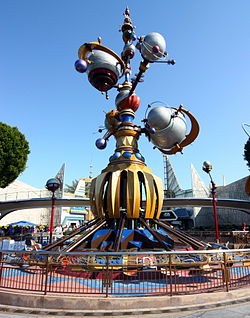
Astro Orbitor at Disneyland
Magic Kingdom
AreaTomorrowland
Coordinates28°25′06″N 81°34′45″W / 28.4184°N 81.57916°W / 28.4184; -81.57916
StatusOperating
Opening dateNovember 28, 1974 (as Star Jets)
April 30, 1994 (as Astro Orbiter)
Closing dateJanuary 10, 1994 (as Star Jets)
Tokyo Disneyland
NameStar Jets
AreaTomorrowland
Coordinates35°37′53″N 139°52′47″E / 35.6313°N 139.8796°E / 35.6313; 139.8796
StatusRemoved
Opening dateApril 15, 1983[1]
Closing dateOctober 10, 2017
Replaced byThe Happy Ride with Baymax
Disneyland Park (Paris)
NameOrbitron
AreaDiscoveryland
Coordinates48°52′25″N 2°46′42″E / 48.8736°N 2.7784°E / 48.8736; 2.7784
StatusOperating
Opening dateApril 12, 1992
Disneyland
NameAstro Orbitor
AreaTomorrowland
Coordinates33°48′44″N 117°55′06″W / 33.8121°N 117.9183°W / 33.8121; -117.9183
StatusOperating
Opening dateMay 22, 1998
ReplacedRocket Jets
Hong Kong Disneyland
NameOrbitron
AreaTomorrowland
Coordinates22°18′49″N 114°02′30″E / 22.3136°N 114.0418°E / 22.3136; 114.0418
StatusOperating
Opening dateSeptember 12, 2005
Shanghai Disneyland
NameJet Packs
AreaTomorrowland
Coordinates31°08′38″N 121°39′16″E / 31.14375°N 121.65439°E / 31.14375; 121.65439
StatusOperating
Soft opening dateMay 7, 2016
Opening dateJune 16, 2016
Ride statistics
Attraction typeAerial carousel
DesignerWED Enterprises/Walt Disney Imagineering
Vehicle typeRockets (all except Hong Kong Disneyland)
Flying saucers (Hong Kong Disneyland)
Vehicles12
16 (Hong Kong Disneyland)
Riders per vehicle2 (all except Hong Kong Disneyland)
4 (Hong Kong Disneyland)
Rows2 (Hong Kong Disneyland)
Duration1:30
Must transfer from wheelchair

The Astro Orbiter is a "rocket-spinner", aerial carousel-type attraction featured at five Disneyland-style parks and Walt Disney Resorts around the world, except for Tokyo Disneyland, where it is replaced by The Happy Ride with Baymax. Although each ride may have a slightly different name, all share the same experience of vehicles traveling through space, spinning around a central monument. In most forms of the ride, the use of a joystick (or steering wheel, buttons, etc.) enables guests to adjust the height of their individual cars at will, usually within a range of no more than 10-15 feet. When the ride cycle comes to its completion, any ascended vehicles are automatically lowered for passenger exit and re-boarding. Over the years, with each new iteration of the ride debuting, new designs, thematic schemes, and locations have been implemented to fit with the changing themes of several Tomorrowlands.[2][3][4][5]

History

[edit]

Disneyland

[edit]

In 1956, the first rocket-spinner attraction opened at Disneyland and was known as the Astro Jets. The attraction was made by Klaus Company Bavaria and similar to several versions found in traveling carnivals. The "jets" made a 50-foot circle around a large red-checkered rocket and guests were able climb upwards of 36 feet in their ride vehicles from the ground level they were boarded at. The attraction stood between the Submarine Voyage and Rocket to the Moon.[6]

The name Astro Jets was changed in 1964 when United Airlines, as a new park sponsor (sponsoring "The Enchanted Tiki Room"), contended the name was free advertising for American Airlines' coast-to-coast Astrojet service. After this dispute, the name was changed to Tomorrowland Jets. The name lasted until September 1966, when the attraction was closed to make room for the new renovated Tomorrowland.

The attraction returned in August 1967 as the Rocket Jets. This version was located on top of the new PeopleMover platform, and was accessible from ground level via an elevator. The focal point of this version was its replica Saturn V/NASA-themed rocket in the center. This version remained open until 1997, when it closed for renovations with the rest of Tomorrowland. The new form of the attraction opened one year later as Astro Orbitor.[6] The new version is a replica of the Orbitron, Machines Volantes at Disneyland Paris.

The Astro Orbitor at Disneyland was planned to be placed where the Rocket Jets were, but weighed too much for the current building. Instead, it was relocated to the entrance of Tomorrowland, and placed on ground level, thus making the ride the new focal point as guests step from the main plaza of Disneyland into Tomorrowland. One concept drawing had guests boarding the attraction underground and others had the center of the attraction featuring a water moat (similar to the "Dumbo the Flying Elephant" attraction in Fantasyland). Neither ideas were ever carried out.

The mechanism for Rocket Jets on top of the PeopleMover was re-used as a kinetic satellite-themed sculpture known as the Observatron, built from the same skeletal structure. The Observatron was originally planned to come to life every fifteen minutes and appear to summon signs from the skies, while a selected soundtrack (such as selected music pieces from Space Mountain and Le Visionarium at Disneyland Paris) would play over Tomorrowland. However, the mechanism has been prone to failure and occasionally will be inactive for periods of months or only play sporadically on certain days. It is unknown if the Observatron still functions.

In April 2009, the Astro Orbitor at Disneyland closed for refurbishment and was stripped down to its skeletal structure.[7] It reopened in June 2009 with a silver, blue, red, and gold trim color scheme.

Magic Kingdom

[edit]
Astro Orbiter at Magic Kingdom

No form of the attraction existed in the Magic Kingdom at Walt Disney World until 1974, three years after the park's opening, when Tomorrowland underwent a massive expansion including the creation of Space Mountain, a new location for the Disneyland-attraction, Carousel of Progress, and the WEDWay PeopleMover. The Star Jets were considered the focal point of Tomorrowland due to its soaring, spinning rockets and central location.

This version of the attraction was based on the Disneyland version, in both location (on top of the PeopleMover platform) and in style (both feature a large Saturn V rocket as the centerpiece). However the attraction vehicles were different from any other previous form as they were much larger and featured a flatter back-end and larger tail fins. While Disneyland's Rocket Jets resembled actual rockets, the Magic Kingdom's Star Jets appeared more like space shuttles. Each of the 12 open-air vehicles was attached to the central axis by a 20-foot arm. The vehicles held up to two passengers who circled round and round, 60 feet above the ground, while controlling their ascent and descent with a metal control stick. On January 10, 1994, the original Star Jets closed in order to undergo a complete makeover as part of the New Tomorrowland.

The attraction was re-designed and re-opened on April 30, 1994, as the Astro Orbiter, part of the complete renovation of the park's Tomorrowland section. The attraction featured a highly stylized iron-work tower in lieu of the center rocket along with various planets on the outside of the attraction as to appear as if the rockets were weaving between the planets. The ride at the Magic Kingdom does 11 rotations per minute and averages 1.2 million miles a year.[8] In the 1994-2009 narration for the Tomorrowland Transit Authority, the ride was referenced as the "League of Planets Astro Orbiter."

Tokyo Disneyland

[edit]
Star Jets at Tokyo Disneyland before it was removed in 2017

The version prepared for Tokyo Disneyland debuted with the park in April 1983, sharing its name ("Star Jets") and design with the first Magic Kingdom version. Even though the park does not have a PeopleMover attraction, designers nonetheless placed their attraction atop an elevated platform similar to that at Florida's Magic Kingdom. This attraction closed on October 10, 2017, and was replaced by The Happy Ride with Baymax.

Disneyland Park (Paris)

[edit]

The opening of Euro Disneyland in April 1992 marked a significant change in the design of Tomorrowland. Known as Discoveryland, the land took on a retro-science-fiction style inspired by some of Europe's greatest writers, such as Jules Verne and H. G. Wells. As such, Orbitron's central axis resembles a bronze 19th century rotating planetarium instead of a rocket. This design was exported to the Disneyland Resort in California when Tomorrowland was renovated in 1998. This was also the first version of the attraction to be installed at ground level instead of atop an elevated platform.

Hong Kong Disneyland

[edit]

Like the other international Disneyland parks, Hong Kong Disneyland opened in September 2005 with its own version, known as the Orbitron, a modified version of the Parisian one. In order to improve the attraction's capacity, the rockets became "flying saucers" and were made large enough to accommodate an average of four riders per saucer, in two rows of two riders.

Shanghai Disneyland

[edit]

It is known as Jet Packs at Shanghai Disneyland. It opened on the same day as Shanghai Disneyland opened, June 16, 2016.

See also

[edit]

References

[edit]
[edit]
Revisions and contributorsEdit on WikipediaRead on Wikipedia
from Grokipedia
The Astro Orbiter is a midway-style spinning ride located in Tomorrowland at Park in , where guests board retro-futuristic rocket ships that rotate around a central tower adorned with planetary models, simulating a journey through space while allowing riders to control their vehicle's height via an in-cab lever. This attraction traces its origins to the Astro Jets, which opened on March 24, 1956, as one of Disneyland's earliest Tomorrowland offerings, featuring 12 two-seat rockets circling a central spindle and reaching a height of about 34 feet. Renamed Tomorrowland Jets in 1964 to align with the area's space-age theme, it operated until September 1966, when it closed for the expansion of the Flight Circle stage show. A successor, the Rocket Jets, opened on July 2, 1967, with an elevated reaching 60 feet and jets inspired by the rocket, but it shuttered in January 1997 amid the redevelopment of Tomorrowland. The current Astro Orbiter iteration premiered on May 22, 1998, redesigned with a brass-and-copper aesthetic drawing from 19th-century astronomical instruments and the Orbitron ride at , featuring 12 rockets, each seating three passengers, that spin at approximately 4 mph. Key features include the ride's 40-foot tower, which provides panoramic views of Tomorrowland, and its gentle motion suitable for families, with no minimum height requirement; children under age 7 must be accompanied by a guest age 14 or older. The attraction emphasizes a nostalgic, steampunk-inspired space travel theme, evoking the optimism of mid-20th-century rocketry, and remains a staple for its accessibility and visual appeal despite its modest thrills. Similar versions exist at Walt Disney World's (opened April 30, 1994) and as the Orbitron at (opened 1992), but the Disneyland original holds historical precedence in the evolution of Disney's rocket-spinner rides.

Overview

Description and Rider Experience

The Astro Orbiter is a rocket-spinner aerial attraction that simulates flight, featuring passenger vehicles in the form of rocket ships or saucers that a central tower adorned with planetary theming. Riders board one of several vehicles, each accommodating 2 to 3 passengers depending on the park's configuration (such as 3 at and 2 at ), and the attraction typically holds 12 vehicles for a total capacity of 24 to 36 riders per cycle. During the ride, guests control the ascent and descent of their vehicle using an in-cabin , allowing elevated views that vary by installation, while the entire structure provides panoramic sights from its height. The vehicles gently spin at 11 rotations per minute, providing a smooth orbital motion without inversions or high speeds, and the experience lasts about 1.5 minutes. This design emphasizes , with no minimum height requirement, though children under 7 years old must be accompanied by a at least 14 years old. Riders enjoy panoramic views of the surrounding Tomorrowland area from the elevated vantage point, enhanced by ambient space-themed music and sound effects that evoke a cosmic journey. The gentle rotation and height control create a sense of wonder without intense thrills, making it suitable for all ages seeking a relaxed aerial perspective.

Locations and Variations

The Astro Orbiter attraction, or its variations, operates at five Disney parks worldwide as of November 2025, with in ; at in ; in , ; in , ; and in Pudong, Shanghai. It was previously available at in Uryū, , , but closed permanently in 2017 and replaced by The Happy Ride with . Name variations reflect local theming and cultural adaptations while maintaining the core rocket-spinner concept. In the United States, it is known as Astro Orbiter at both and . European and Asian parks use Orbitron at and , emphasizing orbital flight. Shanghai Disneyland features it as Jet Packs, aligning with a propulsion-themed experience. Earlier iterations included Astro Jets at upon its 1956 debut and Star Jets at from 1983 to 2017. These attractions are positioned centrally in their respective Tomorrowland areas—or Discoveryland at —for prominent visibility amid surrounding futuristic theming. All operational locations run daily during standard park hours, typically from opening until closing, subject to weather and maintenance. Accessibility features include transfer options at all sites, with elevators or ramps providing access to boarding areas; guests must be able to transfer independently or with assistance. Priority access systems, such as Lightning Lane Multi Pass (formerly Genie+) at and equivalent services like Disney Premier Access at and , are available at select parks to reduce wait times.

Design and Technology

Ride Mechanism

The Astro Orbiter employs a core system consisting of independent lift mechanisms on each of the 12 vehicle arms, enabling guests to adjust their height relative to the central platform through a guest-operated lever inside the cabin. This lever is mechanically linked to a winch system that reels in or out a cable attached to the arm, providing controlled elevation changes during the ride cycle. The system allows for individual vehicle heights to vary, typically spanning a range of about 10 to 15 feet above the platform baseline, giving riders the sensation of independent flight paths while orbiting. The orbital motion is generated by a central rotating platform powered by an , which maintains a constant speed of 11 rotations per minute (RPM). This platform supports 12 arms, each extending outward from the hub, ensuring smooth circular travel for the vehicles at a moderate pace. The design prioritizes balanced rotation to minimize sway, with the entire assembly elevated on a tower structure for enhanced visibility and immersion. Safety is integrated into the mechanism through redundant braking systems on the central drive and arms, emergency stop buttons accessible to operators, and requirements that guests must be able to fit within the safety restraints and vehicle dimensions to maintain structural integrity under dynamic loads. These features ensure reliable operation amid varying guest inputs. The ride's daily maintenance routines focus on inspections of the lift systems, seals, and electrical connections to detect wear or issues. A typical ride cycle lasts 90 to 120 seconds, encompassing loading, the 60- to 90-second flight phase, and unloading, during which the platform remains stationary for safety. Modern implementations have evolved from the original 1950s cable-based lift designs—used in early predecessors like the Astro-Jets—to incorporate computerized controls for precise speed regulation and automated safety interlocks, resulting in smoother and more efficient performance. As of 2025, the Magic Kingdom version underwent refurbishment, reopening in summer 2025 with no major design changes reported.

Theming and Vehicles

The Astro Orbiter attractions across Disney parks feature a consistent retro-futuristic theming centered on , immersing riders in a of interstellar and discovery that aligns with Tomorrowland's (or equivalent land's) emphasis on optimistic futurism and cosmic wonder. This theme symbolizes humanity's peaceful pursuit of the stars, enhanced by starry backdrops and dynamic lighting that evokes orbiting celestial bodies, creating a sense of gentle rotation through the . Vehicle designs vary by park to reflect local aesthetics while maintaining the core spaceship motif, allowing riders to control ascent via onboard levers for an interactive flight simulation. At and , the vehicles are colorful retro rocket ships seating two to three passengers each, with streamlined cabins evoking mid-20th-century visions of space travel; 's accommodate three per ship, while 's hold two. In contrast, Disneyland Paris's Orbitron uses two-passenger rockets inspired by Leonardo da Vinci's solar system sketches, incorporating ornate metallic detailing for a flair. Disneyland's Orbitron employs saucer-shaped pods seating up to four in sleek, multi-passenger flying saucers with command controls, emphasizing a whimsical UFO aesthetic. At Shanghai Disneyland, the Jet Packs attraction features streamlined jet vehicles with dangling leg seats for two to four riders, adopting a modern, minimalist sci-fi design that prioritizes aerodynamic lines over ornate retro elements. Disneyland's version mirrors the American parks' rocket ships, with colorful, two-passenger crafts circling in a classic orbital pattern. Central tower theming reinforces the cosmic narrative, serving as the attraction's focal point with structures that mimic astronomical observatories or planetary systems. Magic Kingdom's tower rises 50 feet, adorned with a planetary mobile of colorful orbiting spheres around a central Earth orb, integrated with metallic rings for a dynamic, space-station vibe. Disneyland's setup revolves around a vibrant galaxy of planets, evoking a mobile solar system against Tomorrowland's skyline. Disneyland Paris's Orbitron centers on a retro-futuristic observatory spire with exposed gears and gleaming metalwork, drawing from da Vinci's mechanical visions to blend Renaissance ingenuity with space age optimism. Hong Kong Disneyland's blue-hued space orb and constellation evoke early Disney rocket theming, while Shanghai's sleek pylon supports a minimalist orbital ring, aligning with the park's contemporary futuristic palette. Audio-visual elements heighten the immersive theme, with synchronized lighting that simulates planetary motion and starry paths during the rotation. Onboard speakers deliver narration or sound effects—such as whooshes and cosmic chimes—triggered by rider controls, accompanied by the whirring sights of the park below for a layered sensory experience. Park-specific customizations tailor the theming to cultural and architectural influences, ensuring each installation feels unique yet cohesive. Disneyland Paris incorporates French Art Deco elements through its gear-laden spire and da Vinci motifs, evoking historical innovation. Shanghai Disneyland's modern minimalism shines in its clean-lined jets and subtle LED orbits, complementing the park's innovative aesthetic. Hong Kong's saucers add playful Eastern futurism, while American and versions retain bold colors and planetary mobiles for a timeless American optimism.

History in American Parks

Disneyland

The Astro Orbiter attraction at in , traces its origins to the Astro Jets, which debuted on March 24, 1956, in Tomorrowland as one of the park's earliest post-opening expansions. Manufactured by the Klaus Company of , the original ride featured 12 checkered jets circling a central structure at ground level, providing guests with a simple spinner experience amid the era's space-age enthusiasm. In preparation for the 1964 New Tomorrowland refurbishment, the attraction was renamed Tomorrowland Jets on August 7, 1964, reflecting sponsorship shifts from to and avoiding trademark conflicts with the latter's "Astrojet" aircraft. It continued operating in this form until closing on September 5, 1966, to accommodate further area redevelopment. The ride then evolved into the Rocket Jets, reopening in July 1967 on an elevated platform—known as the Astrojet structure—positioned above the PeopleMover loading platform, which heightened the aerial views until the attraction's closure in January 1997. Following its dismantling in 1997, the ride underwent significant relocation and retheming as part of Disneyland's comprehensive Tomorrowland overhaul. It reopened on , 1998, at ground level near the land's entrance, now branded as Astro Orbiter with streamlined vehicles, a golden planetary hub, and enhanced theming aligned with the area's new retro-futuristic motif inspired by visions of the future. This redesign emphasized aesthetic integration over the previous elevation, marking a shift toward more accessible family-oriented attractions. Subsequent maintenance included periodic refurbishments, such as those in and , which addressed structural wear and visual elements without altering the core mechanism or theming. The attraction remains operational as of 2025, with no substantial modifications since its 1998 relaunch.

Magic Kingdom

The Astro Orbiter at debuted as the Star Jets on November 28, 1974, shortly after the park's opening, positioned in Tomorrowland atop a towering rocket structure that elevated riders approximately 60 feet above the ground. This original incarnation featured twelve two-seat rocket vehicles circling the central rocket tower, offering guests a simulated orbital flight experience amid the futuristic theming of the era. As part of Tomorrowland's expansive landscape, the attraction quickly became a staple for families seeking a gentle aerial spin with panoramic views of the park. In preparation for the comprehensive redevelopment of Tomorrowland, the Star Jets closed on January 10, 1994, and underwent a significant refurbishment that transformed it into the Astro Orbiter, reopening on April 30, 1994. The redesign replaced the Saturn V rocket with a stylized ironwork tower inspired by retro-futuristic architecture, encircled by orbiting planets to evoke the "League of Planets" interstellar alliance, and introduced twelve streamlined rocket vehicles for a sleeker, more immersive space travel aesthetic. This overhaul was integral to the "New Tomorrowland" expansion, which repositioned the attraction within Rockettower Plaza as a symbolic centerpiece of the land's metallic, art deco-inspired vision of the future. The Astro Orbiter stands out among its counterparts with the tallest structure at around 60 feet, providing elevated vistas over Tomorrowland, and the highest rider capacity of 24 guests across its twelve vehicles. enhancements, including an from the queue to the elevated loading platform, allow guests with mobility needs to transfer to the vehicles, ensuring broader participation since the 1994 redesign. As of November 2025, the Astro Orbiter remains in active operation at reduced height due to a mechanical issue, following a multi-month refurbishment that concluded with its reopening on June 27, 2025, during which the ride system was dismantled, maintained off-site, and reinstalled. During the holiday season, the attraction features seasonal lighting overlays on its tower and vehicles, enhancing the festive ambiance of Tomorrowland as part of Magic Kingdom's broader Christmas decorations.

History in International Parks

Tokyo Disneyland

The Astro Orbiter attraction, operating under the name StarJets, debuted at on April 15, 1983, coinciding with the park's grand opening and marking it as the first international installation of the ride outside the . Situated in Tomorrowland, this version featured an elevated platform design akin to the early American models, with guests boarding colorful rocket vehicles that spun around a central tower resembling a glowing star, providing a gentle orbiting experience themed to . As the pioneering overseas adaptation, it closely mirrored the original Disneyland Rocket Jets in mechanics and aesthetic, emphasizing a retro-futuristic vibe without significant thematic overhauls during its tenure. For 34 years, StarJets operated with minimal modifications, serving as a staple spinner in Tomorrowland and accommodating guests in its eight rocket pods that rotated at varying heights up to 20 feet above the platform. The ride's standard theming centered on sleek, jet-like rockets circling the star tower, evoking a sense of orbital flight, and it maintained consistent availability except for routine maintenance, contributing to the park's enduring appeal as a gateway to Disney's Tomorrowland attractions. StarJets permanently closed on October 10, 2017, as part of a broader expansion project in Tomorrowland to accommodate new developments spilling over from adjacent lands. The site was subsequently repurposed for The Happy Ride with Baymax, a Big Hero 6-themed whip ride that officially opened on September 28, 2020, effectively ending the Astro Orbiter lineage at Tokyo Disneyland. The attraction's long run without reported major incidents underscored its reliability, while its early international debut influenced subsequent adaptations in Asian Disney parks, such as Disneyland's Orbitron, by establishing a proven model for elevated spinner rides in Tomorrowland settings.

Disneyland Paris

The Orbitron attraction debuted on April 12, 1992, coinciding with the opening of , and has operated continuously as one of the park's original offerings in Discoveryland, a reimagined Tomorrowland emphasizing Victorian-era and retro-futurism. Inspired by Leonardo da Vinci's 16th-century drawings of the solar system, it provides guests with a gentle aerial spin simulating a journey through space, distinct from the elevated platforms of similar attractions in other Disney parks by being constructed at ground level from . The ride's design integrates seamlessly into Discoveryland's aesthetic, featuring a towering central adorned with rotating planetary elements and celestial motifs that evoke 19th-century astronomical instruments, complemented by 12 rocket-shaped vehicles that lift riders up to 7.8 meters for an immersive, low-thrill orbital experience. This European-flavored theming draws from the land's broader influences, including the visionary works of , creating a cohesive retro-futuristic environment where the attraction serves as a visual anchor amid ornate, metallic structures. The vehicles, resembling sleek flying machines, enhance the sense of historical speculation on space travel, aligning with Discoveryland's narrative of human ingenuity from the past envisioning the future. Over the years, Orbitron has undergone periodic maintenance to ensure reliability, including a significant refurbishment from January to December 2021—the first major overhaul since opening—which involved repainting the structure, overhauling the audio system, refreshing the with new and rockwork, and renovating the floor for improved guest flow. A shorter closure occurred from March 24 to June 20, 2025, for routine upkeep, after which it resumed normal operations without interruption. These updates have maintained its role as a staple, tying into Discoveryland's enduring Jules Verne-inspired ambiance through subtle enhancements that preserve the attraction's whimsical, exploratory charm. As of November 2025, Orbitron remains fully operational, offering consistent daily experiences and contributing to the park's stable lineup of classic attractions with no plans for permanent closure.

Hong Kong Disneyland

The Orbitron debuted on September 12, 2005, as one of the original attractions in 's Tomorrowland, featuring ground-level access and saucer-shaped vehicles each accommodating four riders. The attraction's theming centers on a towering planetary structure that evokes a adventure, with riders piloting flying saucers to colorful in a futuristic space setting inspired by historical astronomical motifs, aligning with the park's compact, modern aesthetic tailored to its smaller scale on . Following the park's 2011 expansions, including the addition of adjacent , the Orbitron benefited from enhanced operational efficiency through minor updates in the , maintaining its role as a foundational element in the original, modestly sized park layout without significant interruptions. The Orbitron has been closed since February 9, 2025, for maintenance and operational adjustments. As of November 2025, it remains closed with no announced reopening date.

Shanghai Disneyland

The Jet Packs attraction, Shanghai Disneyland's version of the Astro Orbiter, debuted on June 16, 2016, coinciding with the park's grand opening in Tomorrowland. Positioned at ground level, it features sleek, jet-inspired vehicles that evoke personal flight devices, allowing riders to simulate soaring through in a sci-fi setting. This installation emphasizes a contemporary, high-tech aesthetic aligned with the park's futuristic Tomorrowland, where the ride's dynamic motion complements nearby attractions like Lightcycle / Run through shared visual lighting effects. The theming centers on a minimalist central orb structure, from which 16 mechanical arms extend to support the vehicles, each accommodating two riders for a total capacity of 32. Enhanced digital controls enable guests to adjust their height mid-ride via handheld devices, providing an interactive element that heightens the sense of control over ascent and descent. The minimum height requirement is 112 cm (44 inches), making it accessible for older children and adults while maintaining a thrilling, airborne spin. As part of the inaugural park opening, Jet Packs quickly gained popularity, evidenced by average maximum wait times exceeding 50 minutes in peak periods. This sustained demand has resulted in no major refurbishments required through 2025, reflecting its reliable operation and appeal within the park's ecosystem. Currently active as of November 2025, the attraction integrates app-based queueing through the app's Disney Standby Pass system, allowing guests to reserve virtual waiting slots for efficient access.

References

Add your contribution
Related Hubs
User Avatar
No comments yet.