Hubbry Logo
Jet packJet packMain
Open search
Jet pack
Community hub
Jet pack
logo
8 pages, 0 posts
0 subscribers
Be the first to start a discussion here.
Contribute something
Jet pack
Jet pack
from Wikipedia
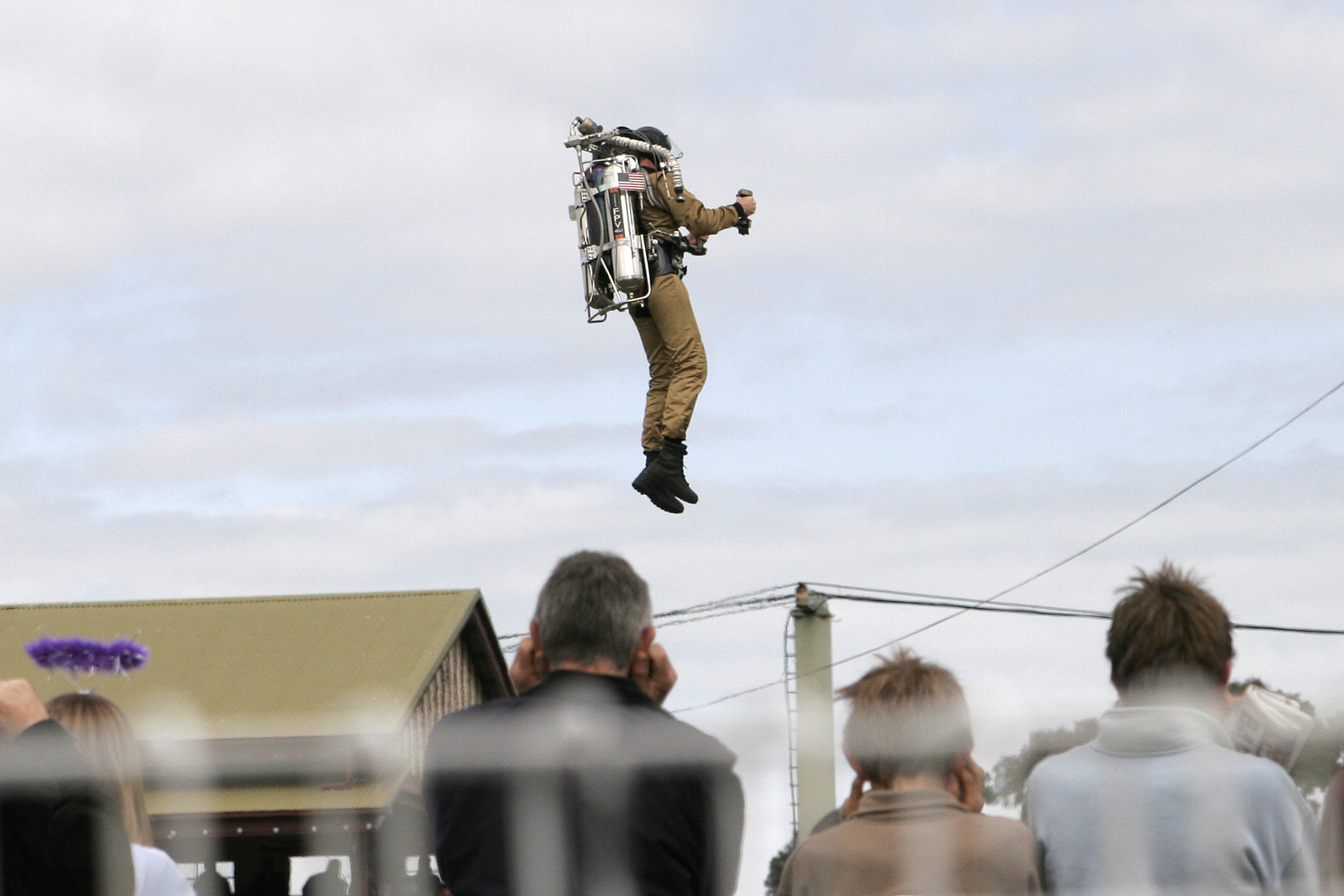
Dan Schlund flying in a jet pack (Rocketbelt) in 2005

A jet pack, rocket belt, rocket pack or flight pack is a device worn as a backpack which uses jets to propel the wearer through the air. The concept has been present in science fiction for almost a century and the first working experimental devices were demonstrated in the 1960s.

Jet packs have been developed using a variety of mechanisms, but their uses are limited because of factors including the Earth's atmosphere, gravity, the low energy density of extreme fuels,[clarification needed] and the human body not being suited to flight, so they are principally used for stunts.

A practical use for the jet pack has been in extra-vehicular activities for astronauts because of the weightlessness and lack of friction-creating atmosphere in orbit. The term jet suit is used for a system incorporating a jet pack and associated jets attached to the arms to increase manoeuvrability (e.g. the Daedalus Flight Pack).

Overview

[edit]

In the most general terms, a jet pack is a wearable device which allows the user to fly by providing thrust. With the exception of use in a microgravity environment, this thrust must be upwards so as to overcome the force of gravity, and must be enough to overcome the weight of the user, the jet pack itself and its fuel. This necessarily requires the jet pack to continually push mass in a downwards direction.[1]

While some designs have power and/or mass supplied from an external, ground-based source, untethered flight requires all of a flight's fuel to be carried within the pack. This results in problems relating to the overall mass ratio, which limits the maximum flight time to a few minutes, rather than the sustained flight envisaged in science fiction.[1]

Rocket pack

[edit]

Liquid-fueled rocket pack

[edit]

Andreyev: oxygen-and-methane, with wings

[edit]

The first pack design was developed in 1919 by the Russian inventor Alexander Fedorovich Andreev.[2][3][4] The project was well regarded by Nikolai Rynin and technology historians Yu. V. Biryukov and S. V. Golotyuk. Later it was issued a patent but apparently was not built or tested. It was oxygen-and-methane-powered (likeliest a rocket) with wings each roughly 1 m (3 feet) long.[5]

Hydrogen peroxide–powered rocket packs

[edit]

A hydrogen peroxide–powered engine is based on the decomposition reaction of hydrogen peroxide. Nearly pure (90% in the Bell Rocket Belt) hydrogen peroxide is used. Pure hydrogen peroxide is relatively stable, but in contact with a catalyst (for example, silver) it decomposes into a mixture of superheated steam and oxygen in less than 1/10 millisecond, increasing in volume 5,000 times: 2 H2O2 → 2 H2O + O2. The reaction is exothermic, i.e., accompanied by the liberation of much heat (about 2,500 kJ/kg [1,100 BTU/lb]), forming in this case a steam-gas mixture at 740 °C [1,360 °F]. This hot gas is used exclusively as the reaction mass and is fed directly to one or more jet nozzles.

The great disadvantage is the limited operating time. The jet of steam and oxygen can provide significant thrust from advanced rockets, but the jet has a relatively low exhaust velocity and hence a poor specific impulse. Currently, such rocket belts can only fly for about 30 seconds (because of the limited amount of fuel the user can carry unassisted).

A more conventional bipropellant could more than double the specific impulse. However, although the exhaust gases from the peroxide-based engine are very hot, they are still significantly cooler than those generated by alternative propellants. Using a peroxide-based propellant greatly reduces the risk of a fire/explosion which would cause severe injury to the operator.

In contrast to, for example, turbojet engines, which mainly expel atmospheric air to produce thrust, rocket packs are far simpler to build than devices using turbojets. The classical rocket pack construction of Wendell Moore can be made under workshop conditions, given good engineering training and a high level of tool-making craftsmanship.

The main disadvantages of this type of rocket pack are:

  • Short duration of flight (a maximum of around 30 seconds).
  • The high expense of the peroxide propellant.
  • The inherent dangers of flying below minimum parachute altitude, and hence without any safety equipment to protect the operator if there is an accident or malfunction.
  • Safely learning how to fly it, given that there are no dual-control training versions.
  • The sheer difficulty of manually flying such a device.

These circumstances limit the sphere of the application of rocket packs to spectacular public demonstration flights, i.e., stunts; for example, a flight was arranged in the course of the opening ceremony of the 1984 Summer Olympic Games in Los Angeles, USA.[6]

Justin Capra's flying backpack

[edit]

Justin Capră claimed that he invented a "flying rucksack" (Romanian: rucsac zburator) in 1956[7] in Romania, and, without arousing any apparent interest, informed the American Embassy of his idea. However it was tested by Henri Coandă, a paratrooper who crashed it the first time but managed the second after he advised to change the fuel and improve on the design. In 1962 a backpack was created at Bell Laboratories, following Justin Capră's prototype. The backpack is now displayed in a museum.[8]

Jump Belt

[edit]

In 1958, Garry Burdett and Alexander Bohr, Thiokol Corporation engineers, created a Jump Belt which they named Project Grasshopper. Thrust was created by high-pressure compressed nitrogen. Two small nozzles were affixed to the belt and directed vertically downward. The wearer of the belt could open a valve, letting out nitrogen from the gas cylinder through the nozzles, which tossed him upward to a height of 7 m (23 ft). While leaning forward, it was possible with the aid of the jump belt's thrust to run at 45 to 50 km/h (28 to 31 mph). Later, Burdett and Bohr tested a hydrogen peroxide–powered version. The jump belt was demonstrated by a serviceman in action,[9][10] but as no financing was forthcoming, there was no further testing.

Aeropack

[edit]

In 1959 Aerojet General Corporation won a U.S. Army contract to devise a jet pack or rocket pack. At the start of 1960 Richard Peoples made his first tethered flight with his Aeropack.

U.S. Army interest

[edit]

Transport studies of the U.S. Army Transportation Research Command (TRECOM) determined that personal jet devices could have diverse uses: for reconnaissance, crossing rivers, amphibious landing, accessing steep mountain slopes, overcoming minefields, tactical maneuvering, etc. The concept was named "Small Rocket Lift Device", SRLD.

Within the framework of this concept, the administration concluded a contract with the Aerojet General company in 1959 to research the possibility of designing an SRLD suitable for army purposes. Aerojet came to the conclusion that the version with the engine running on hydrogen peroxide was most suitable. However, it soon became known to the military that engineer Wendell F. Moore of the Bell Aerosystems company had for several years been carrying out experiments to make a personal jet device. After becoming acquainted with his work, servicemen during August 1960 decided to commission Bell Aerosystems with developing an SRLD. Wendell Moore was appointed chief project engineer.

Bell Textron Rocket Belt

[edit]
Astrogeologist Gene Shoemaker wearing a Bell Rocket Belt while training astronauts

In 1960, the Bell Rocketbelt was presented to the public. The jet of gas was provided by a hydrogen peroxide–powered rocket, but the jet could also be powered by a turbojet engine, a ducted fan, or other kinds of rockets powered by solid fuel, liquid fuel or compressed gas (usually nitrogen).

This is the oldest known type of jet pack or rocket pack. One Bell Rocket Belt is on display at the Smithsonian Institution's National Air and Space Museum annex, the Steven F. Udvar-Hazy Center, located near Dulles Airport.

RB-2000 Rocket Belt

[edit]

This was a successor to the Bell Rocket Belt.[11]

Bell Pogo

[edit]

The Bell Pogo was a small rocket-powered platform that two people could ride on. Its design used features from the Bell Rocket Belt.

Powerhouse Productions Rocketbelt

[edit]
Rocketbelt pilot Dan Schlund at the 2007 Rose Parade

More commonly known as "The Rocketman", Powerhouse Productions, owned and operated by Kinnie Gibson, manufactures the 30-second flying Rocketbelt (June 1994) and organizes Rocketbelt performances. Since 1983 Powerhouse Productions has performed show flights in over 40 countries such as the Carnival in Rio de Janeiro, Super Bowls, the Rose Parade, Daytona 500, and the Michael Jackson Dangerous World Tour, as well as many television shows including Walker, Texas Ranger, The Fall Guy and NCIS. Powerhouse Rocketbelt pilots include stuntman Kinnie Gibson and Dan Schlund.[12]

Jetpack International

[edit]

Jetpack International made three models of wingless jet packs. The company stated that the Jet Pack H2O2 could fly 152 meters, using hydrogen peroxide fuel for its rocket engine. It was flown for 34 seconds in Central Park on the 9 April 2007 episode of the Today Show and sold for $150,000. Their H2O2 jet pack was for demonstration only, not for sale, but the company stated that it could fly 457 meters, also with the hydrogen peroxide rocket engine.[13] The T-73 was expected to fly up to 18 meters using Jet-A fuel and a jet engine, and to sell for $200,000.[citation needed]

Later technology

[edit]

At the TechCrunch Disrupt conference in 2014, Astro Teller, head of Google X (Google's research laboratory), said they investigated jet packs but found them too inefficient to be practical, with fuel consumption as high as 940 L/100 km (14 mpg‑US), and were as loud as a motorcycle, so they decided not to pursue developing them.[14][15]

In recent years, the rocket pack has become popular among enthusiasts, and some have built them for themselves. The pack's basic construction is rather simple, but its flying capability depends on two key parts: the gas generator, and the thrust control valve. The rocket packs being built today are largely based on the research and inventions of Wendell Moore at Bell Helicopter.

One of the largest stumbling blocks that would-be rocket pack builders have faced is the difficulty of obtaining concentrated hydrogen peroxide, which is no longer produced by many chemical companies. The few companies that produce high-concentration hydrogen peroxide only sell to large corporations or governments, forcing some amateurs and professionals to set up their own hydrogen peroxide distillation installations. High-concentration hydrogen peroxide for rocket belts was produced by Peroxide Propulsion (Gothenburg, Sweden) from 2004 to 2010,[16] but after a serious accident Peroxide Propulsion stopped making it.[14][failed verification]

Government

[edit]

Space

[edit]
Bruce McCandless II operating the Manned Maneuvering Unit

Rocket packs can be useful for spacewalks. One example is the Manned Maneuvering Unit (or MMU), which weighed approximately 300 pounds and was affixed with two propellant tanks that supplied 24 small thrusters with 40 pounds of high-pressured gaseous nitrogen.  It was first used by astronauts Bruce McCandless and Bob Stewart in February 1984.[17][18] While near Earth a jet pack has to produce a g-force of at least 1 g (a smaller g-force, providing only some deviation from free fall is of little use here), for excursions outside a free falling spaceship, a small g-force providing a small deviation from free fall is useful. Hence much less delta-v is consumed per unit time, and not during the whole EVA. With only small amounts of thrust needed, safety and temperature are more manageable than in the atmosphere in Earth's gravity field.

Nevertheless, it is currently worn to be used only in case of emergency: the Simplified Aid For EVA Rescue (SAFER).

Turbojet packs

[edit]

Packs with a turbojet engine are fueled with traditional kerosene-based jet fuel. They have higher efficiency, greater height and a duration of flight of many minutes, but they are complex in construction and very expensive. Only one working model of this pack was made; it underwent flight tests in the 1960s and at present it no longer flies. [citation needed]

Jet packs and rocket packs have much better flight time on a tankful of fuel if they have wings like an aeroplane's.

Bell Jet Flying Belt: wingless

[edit]

In 1965 Bell Aerosystems concluded a new contract with the Defense Advanced Research Projects Agency (DARPA) to develop a jet pack with a turbojet engine. This project was called the "Jet Flying Belt", or simply the "Jet Belt". Wendell Moore and John K. Hulbert, a specialist in gas turbines, worked to design a new turbojet pack. Williams Research Corporation (now Williams International) in Walled Lake, Michigan, designed and built a new turbojet engine to Bell's specifications in 1969. It was called the WR19, had a rated thrust of 1,900 newtons (430 lbf) and weighed 31 kg (68 lb). The Jet Belt first flew free on 7 April 1969 at the Niagara Falls Municipal Airport. Pilot Robert Courter flew about 100 m (330 ft) in a circle at an altitude of 7 m (23 ft), reaching a speed of 45 km/h (28 mph). The following flights were longer, up to 5 minutes. Theoretically, this new pack could fly for 25 minutes at velocities up to 135 km/h (84 mph).

In spite of successful tests, the U.S. Army lost interest. The pack was complex to maintain and too heavy. Landing with its weight on their back was hazardous to the pilot, and catastrophic loss of a turbine blade could have been lethal.

Thus, the Bell Jet Flying Belt remained an experimental model. On 29 May 1969, Wendell Moore died of complications from a heart attack he had suffered six months earlier, and work on the turbojet pack ended. Bell sold the sole version of the "Bell pack", together with the patents and technical documentation, to Williams Research Corporation. This pack is now in the Williams International company museum.

The "Jet Belt" used a small turbofan engine which was mounted vertically, with its air intake downward. Intake air was divided into two flows. One flow went into the combustion chamber, the other flow bypassed the engine, then mixed with the hot turbine gases, cooling them and protecting the pilot from the high temperatures generated. In the upper part of the engine the exhaust was divided and entered two pipes which led to jet nozzles. The construction of the nozzles made it possible to move the jet to any side. Kerosene fuel was stored in tanks beside the engine. Control of the turbojet pack was similar to the rocket pack, but the pilot could not tilt the entire engine. Maneuvering was by deflecting the nozzles. By inclining levers, the pilot could move the jets of both nozzles forward, back, or sideways. The pilot rotated left/right by turning the left handle. The right handle governed the engine thrust. The jet engine was started with the aid of a powder cartridge. While testing this starter, a mobile starter on a special cart was used. There were instruments to control the power of the engine, and a portable radio to connect and transmit telemetry data to ground-based engineers. On top of the pack was a standard auxiliary landing parachute; it was effective only when opened at altitudes above 20 m (66 ft). This engine was later the basis for the propulsion units of Tomahawk and other cruise missiles.

Visa Parviainen's jet-assisted wingsuit

[edit]

On 25 October 2005 in Lahti, Finland, Visa Parviainen jumped from a hot air balloon in a wingsuit with two small turbojet jet engines attached to his feet. Each turbojet provided approximately 160 N (16 kgf) of thrust and ran on kerosene (Jet A-1) fuel. Parviainen apparently achieved approximately 30 seconds of horizontal flight with no noticeable loss of altitude.[19][20]

Yves Rossy's jet wingpack

[edit]
Rossy's wing showing the four purple and silver jet-engines mounted close to the centre

Swiss ex-military and commercial pilot Yves Rossy developed and built a winged pack with rigid aeroplane-type carbon-fiber wings spanning about 2.4 m (8 ft) and four small kerosene-burning Jetcat P400 jet engines underneath; these engines are large versions of a type designed for model aeroplanes.[21] He wears a heat-resistant suit similar to that of a firefighter or racing driver to protect him from the hot jet exhaust.[22][23] Similarly, to further protect the wearer, the engines are modified by adding a carbon fiber heat shield extending the jet nozzle around the exhaust tail.

Rossy claims to be "the first person to gain altitude and maintain a stable horizontal flight thanks to aerodynamic carbon foldable wings", which are folded by hinges at their midpoint. After being lifted to altitude by a plane, he ignites the engines just before he exits the plane with the wings folded. The wings unfold while in free-fall, and he then can fly horizontally for several minutes, landing with the help of a parachute.[24] He achieves true controlled flight using his body and a hand throttle to maneuver.

Jet wingsuits use small turbojets, but differ from other aircraft in that the fuselage and flight control surfaces consist of a human.[25][26]

A jet-powered wingpack

The system is said by Rossy to be highly responsive and reactive in flight, to the point where he needs to closely control his head, arm and leg movements to avoid an uncontrolled spin. The engines on the wing must be aligned precisely during set-up, also to prevent instability. An electronic starter system ensures that all four engines ignite simultaneously. In the event of a spin, the wing unit can be detached from the pilot, and pilot and wing unit descend to Earth separately, each with a parachute.

Since 2007, Rossy has conducted some of his flight tests from a private airfield, Skydive Empuriabrava, in Empuriabrava (Girona, Costa Brava), Spain.[27][28] Rossy's jet pack was exhibited on 18 April 2008 on the opening day of the 35th Exhibition of Inventions at Geneva.[29] Rossy and his sponsors spent over $190,000 to build the device.[30] His first successful trial flight was on 24 June 2004 near Geneva, Switzerland. Rossy has made more than 30 powered flights since. In November 2006 he flew with a later version of his jet pack.[citation needed] On 14 May 2008 he made a successful 6-minute flight from the town of Bex near Lake Geneva. He exited a Pilatus Porter at 2,300 m (7,500 ft) with his jet pack. It was the first public demonstration before the world's press. He made seemingly effortless loops from one side of the Rhone valley to the other and rose 790 m (2,600 ft).

It has been claimed that the military was impressed and asked for prototypes for the powered wings, but that Rossy kindly refused the request stating that the device was only intended for aviation enthusiasts.[31][32]

On 26 September 2008, Rossy successfully flew across the English Channel from Calais, France, to Dover, England, in 9 minutes, 7 seconds.[33] His speed reached 300 km/h (190 mph) during the crossing[34] and was moving at 200 km/h (120 mph) when he deployed the parachute.[35] Since then he has—in several flights—managed to fly in a formation with three military jets and cross the Grand Canyon, but he failed to fly across the Strait of Gibraltar—he made an emergency landing in the water.

Rossy appeared in a February 2012 episode of Top Gear (S18 E5) where he raced against a Skoda rally car driven by Toni Gardemeister with Richard Hammond as a passenger. The race started with the rally car launching down the rally course while Rossy and his support helicopter climbed to reach altitude, upon which he dropped and ignited his engines and followed the course to race the car. Periodical smoke dashes (such as those used by sky-writers or air force display teams) were used to track his progress. In the onboard footage of Rossy flying the tight and twisty course, one can see how he uses his body parts as control surfaces to perform various maneuvers.

On 13 October 2015 a show flight was performed in Dubai. Two jet packs operated by Rossy and Vince Reffet flew in formation with an Airbus A380 jetliner.[36]

Troy Hartman: jet pack and parafoil

[edit]

In 2008 Troy Hartman started designing a wingless jet pack with two turbojet motors strapped to his back;[37] later he added a parafoil as a wing.

jetpack: jet pack with rigid wings

[edit]

As of 2013 Fritz Unger in Germany is developing a jet pack called Skyflash with rigid wings about 3.4 m (11 ft) wingspan and two turbojets designed to run on diesel fuel.[38][39] It is designed for takeoff from the ground using four undercarriage wheels on the front of his chest and abdomen.

JetPack Aviation: wingless jet pack

[edit]

On 3 November 2015, Jetpack Aviation[40] demonstrated the JB-9[41] in Upper New York Bay in front of the Statue of Liberty. The JB-9 carries 4.5 kilograms (10 lb) of kerosene fuel that burns through two vectored thrust AMT Nike jet engines[42][43] at a rate of 3.8 litres (1 US gallon) per minute for up to ten minutes of flying time, depending on pilot weight. Weight of fuel is a consideration, but it is reported to start with 150 m (500 ft) per minute climb rate that doubles as the fuel burns off. While this model has been limited to 102 km/h (55 knots), the prototype of the JB-10 is reported to fly at over 200 km/h (110 kn).

This is a true jet pack: a backpack that provides jet-powered flight. Most of the volume is the fuel tank, with twin turbine jet engines gimbal-mounted on each side. The control system is identical to the Bell Rocket Belt: tilting the handgrips vectors the thrust – left-right & forward-back – by moving the engines; twisting left hand moves two nozzle skirts for yaw; twisting the right hand counterclockwise increases throttle. Jetpack Aviation was started by Australian businessman David Mayman with the technical know-how coming from Nelson Tyler,[44] prolific inventor of helicopter-mounted camera stabilizers and one of the engineers that worked on the Bell Rocketbelt that was used in the 1984 Olympics.[45]

The company now makes two Jetpack models, the JB-10 and the JB-11. They are similar to the JB-9, with upgraded electronics. They both use kerosene/diesel turbojet engines. The JB-10 is designed with two large 200 lb. thrust engines and is described as having an 8-minute flight time, while the slightly longer duration JB-11 has a 10-minute flight time and uses eight smaller 90 lb. thrust engines.[46]

Flyboard Air

[edit]

Flyboard Air, invented by Franky Zapata, allows flight up to 3,000 metres (10,000 ft) and can reach 150 km/h (93 mph). It also has 10 minutes autonomy.[47] Zapata participated with his invention during the 2019 Bastille Day military parade. Three weeks later, he crossed the English Channel with his device in 22 minutes, including a shipboard refueling midway.[48]

Daedalus Flight Pack

[edit]
Richard Browning flying the "Daedalus" jet suit at Hurst Spit, Hampshire, England in 2019

This particular innovation saw two jets attached to the back of an exoskeleton, worn by the operator. At the same time, two additional jets were added to the arms, and could be moved with the arms to control movement. It was devised by Richard Browning of Gravity Industries.[49] In September 2020 it was reported that the Great North Air Ambulance (GNAA) service was considering using this jet suit to enable paramedics to reach casualties in the mountainous Lake District,[50] and by March 2022 the operational director of the GNAA, Andy Mawson, had been trained to fly and the service hoped to start using jet suits in summer 2022.[51]

iJETPACK Aeronautics: IJ6180 Jetsuit

[edit]

In 2021, Australian aerospace company, iJETPACK Aeronautics developed a six mini-turbojet wearable flight system ("Jetsuit") producing up to 180 kg thrust distributed across three units on the arms and back.[52] Its R&D and flight operations are supported by NSW Government, Dainese, Specialist Helicopters and Australian Motorsport Innovation Precinct.[53] iJETPACK's founder, Jennie Bewes is a commercially licensed helicopter pilot[54] that specialises in Safety & Regulatory Compliance and a former corporate innovation leader[55] known for introducing novel products and services such as the World's first big-data insights tool.[56] iJETPACK's engineer, David 'Dakka' Clarke is a former defence (RAAF) engineer who single-handedly built a hydrogen-peroxide fuelled "Rocketbelt" which he flew at Brisbane's EKKA show in 2013,[57] Royal Adelaide Show in 2014[58] and in China 2018.

Hydroflight

[edit]
A Flyboard with its distinctive configuration of having the nozzles located below the pilot's feet

The 21st century has seen a new approach to jet packs where water is used as a high-density propulsion fluid. This requires a very large mass of fluid that makes a self-contained jet pack infeasible. Instead, this approach separates the engine, fuel and fluid supply from the pilot's flying apparatus, using a long flexible hose to feed the water to the jet nozzle pack attached to the pilot's body. These inventions are known as "hydro jet packs", and successful designs have used jetski technology as the powerplant operating in a body of water (an ocean, lake, or pool) to provide the needed propulsion. Several hydro jet pack approaches have been successfully tested and put into production. Flow rate can be controlled by a throttle operator on the jetski, or by the pilot using a remote actuator.

Hydro jet packs can be operated below the water's surface as well as above it. As of 2013, many hydro jet pack rental businesses are operating in various locations around the world.

JetLev

[edit]

The JetLev was the first hydroflight jet pack on the market, and its makers were awarded the first patents, in 2008, for hydro jet packs. The JetLev has the appearance of a typical jet pack, with two nozzles on a backpack propelling the rider upwards. It has an umbilicus to the powering jetski that provides the water for the thrust used.[59][60][61]

Flyboard

[edit]

A Flyboard has water jets under each of the pilot's feet. An optional feature is a lower-thrust water jet for each arm for greater control. The powerplant is a regular jetski. Development for this approach was started in the spring of 2011.[62]

Firefighters

[edit]

Firefighters in some parts of the world use jet packs which help them to fight fires close to the sea or a water body. The jet packs use water and there is no need for a fire truck or water tank.[63]

Home-made versions

[edit]

Episode 32 of MythBusters investigates the urban legend of an affordable jet pack or rocket pack that can be built from plans purchased on the Internet. Extensive modifications were made by the MythBusters team due to vagueness in the plans and because of the infeasibility of the specified engine mounting system. The jet pack produced by MythBusters had two ducted fans powered by ultralight-type piston engines. They found it was not powerful enough to lift a person off the ground, and was expensive to build. The plans specified a Rotax 503 ultralight engine, but they intended to use the more powerful and lighter Rotax 583 engine before a similar lighter unnamed engine was substituted.[64]

In fiction

[edit]
A jet pack [disputeddiscuss] wearing hero on the cover of Amazing Stories, August 1928. The cover illustrates The Skylark of Space.

The concept of jet packs appeared in popular culture, particularly science fiction, long before the technology became practical. Perhaps the first appearance was in pulp magazines. The 1896 novel The Country of the Pointed Firs mentions a "fog-shaped" man hovering low with "the look of a pack on his back" who "flittered away out o' sight like a leaf the wind takes with it".[65] The 1928 cover of Amazing Stories featured a man flying with a jet pack.

When Republic Pictures planned to produce a superhero serial using its renowned "flying man" scenes as used in The Adventures of Captain Marvel, the character of Captain Marvel was tied up in litigation with the owners of the character of Superman. For its postwar superhero serial, Republic used a jet pack in King of the Rocket Men. The same stock special effects were used in other serials.

While several science fiction novels from the 1950s featured jet packs, it was not until the Bell Rocket Belt in the 1960s that the jet pack caught the imagination of the mainstream. Bell's demonstration flights in the U.S. and other countries created significant public enthusiasm.

Jet packs were featured in two episodes ("Turu the Terrible" and "The Invisible Monster"), of the original Jonny Quest (1964–1965) animated television series, and are seen at the end of the closing credits.[66]

In 1965 a Bell Rocket Belt appeared in the James Bond movie Thunderball when James Bond played by Sean Connery used a jet pack in the pre-title sequence to escape the villains and rendezvous with his French contact. The pack was piloted by Gordon Yaeger and Bill Suitor.

In 1966 the plot of the 21st book in the Rick Brant series titled Rocket Jumper was based on a hydrogen peroxide fueled jet pack. The book included a relatively detailed description of the design including the use of a platinum-metal screen catalyst.

The 1976 television series Ark II featured a jet pack called the Jet Jumper.

In the Star Wars original trilogy, the bounty hunter Boba Fett used a jet pack. In the prequel trilogy, Jango Fett also used a jet pack. The Mandalorian TV series from 2019 has multiple characters using jetpacks, as do various comics, video games, and other television shows in the franchise.

In the 1982–1995 comics book series, The Rocketeer, the protagonist, Cliff Secord, acquires a stolen Cirrus X-3 military jet pack and uses it to become the eponymous superhero. It was later adapted into a motion picture in 1991.

In the 1983 video game Jetpac, players had to rebuild a rocket while using a jet pack.

In 1988 Cinemaware created the Amiga computer game Rocket Ranger which was ported to several other platforms of the era. In 1991 and 1992 Malibu Comics published a Rocket Ranger comic series closely based on the computer game.

The 95 mm (3.75-inch) G.I. Joe action figure launch in 1982 included the JUMP (Jet Mobile Propulsion Unit) jet pack as an accessory.[67] It was also featured prominently in the related G.I. Joe comic book series and cartoon.

Super Mario Sunshine for the Nintendo GameCube, features Mario with an autonomous, water-powered jet pack named the Flash Liquidizing Ultra Dousing Device (or, F.L.U.D.D.) as a key element of navigation throughout the game; in addition to its default "hover nozzle", which allows the titular character to change trajectory or hover in mid-air, it can be upgraded/customized to allow Mario to make an immediate jump boost (the "rocket nozzle"), or allow Mario to increase his speed exponentially while running or swimming (the "turbo nozzle"). The device has also appeared in various remakes and/or ports of the game, as well as in brief cameos or references in other Nintendo and Mario games.

Jet packs appear in the popular video game Halo: Reach. The jet pack also appears in the 2012 video game Halo 4, developed by 343 Industries. Jet packs also appeared in other video games, including Duke Nukem 3D, Jetpack Joyride, BloodRayne (worn by Nazi troopers), Tribes, Giants: Citizen Kabuto, Armed and Dangerous, and the Pilotwings series, in which it is referred to as a "Rocket Belt". It is also accessible in the video game Grand Theft Auto: San Andreas. Fallout 4 also has a jet pack power armor feature. Grand Theft Auto Online added a jet pack called "Thruster" as a usable vehicle in a content update on December 12, 2017.[68] Rocketeer is an Allied flying infantry unit in Red Alert 2.

Many science fiction movies have included jet packs, most notably, The Rocketeer, Minority Report, RoboCop 3, Sky Captain and the World of Tomorrow, and Tomorrowland.

See also

[edit]

References

[edit]
[edit]
Revisions and contributorsEdit on WikipediaRead on Wikipedia
from Grokipedia
A jet pack, also known as a rocket belt or rocket pack, is a portable, wearable device typically strapped to a person's back that uses jet or to enable short-duration flight or hovering through the air. Jet packs employ various methods, such as engines using monopropellants like that decompose into high-velocity steam and oxygen via a catalyst, or engines that compress air, mix it with fuels such as , and expel the combusted gases from nozzles, often located at the wearer's shoulders and hips for directional control. Jetpack flight is described by developers as "human flying" rather than a human sitting on or piloting a separate machine, because the pilot's body forms an integral part of the flying system—serving as the flight structure with direct control through body movements—distinguishing it from conventional aircraft. It is powered by jet engines or turbines (not human-powered) and is often classified as a personal vertical takeoff and landing (VTOL) aircraft. While popularized in science fiction and media as a of futuristic personal mobility, real-world jet packs have historically been limited by short flight times—often under a minute—high consumption, and significant operational hazards, restricting their use primarily to demonstrations, tests, and specialized applications. The concept of the jet pack originated in 1919 when Russian inventor Alexander Andreev proposed a rocket pack design powered by a combination of oxygen and methane for thrust. Early development accelerated during the mid-20th century amid Cold War-era interest in personal flight technology, leading to the creation of the first functional prototype: the , developed by Bell Aerosystems in the late 1950s using concentrated as a monopropellant that decomposed into steam and oxygen for propulsion. This device achieved its first untethered flight on April 20, 1961, when test pilot Harold "Hal" Graham covered approximately 112 feet (34 meters) in 13 seconds near , marking the first true manned jet pack flight. Subsequent advancements diversified jet pack designs, including water-jet variants like the Jet Lev, which uses a hose connected to a to propel the rider upward with high-pressure water streams rather than onboard fuel. In space exploration, pioneered the (MMU) in the , a nitrogen-gas thruster that allowed astronauts like to perform untethered spacewalks during missions, achieving stable propulsion in microgravity for up to 90 minutes per tank. Despite these milestones, jet packs have seen limited commercial adoption due to engineering challenges, but innovations as of 2025—such as turbine-powered models and electric ducted fans from companies like Jetpack Aviation—signal a resurgence, with prototypes demonstrating flights of several minutes and potential for applications. As of 2025, the wearable jetpack market is expanding, projected to reach $5.7 billion by 2033.

Definition and Principles

Overview

A is a personal propulsion device, typically worn on the back like a , that enables short-duration flight through the air or in space via directed jet or . Jetpack flight is regarded as "human flying" rather than machine flying, as the pilot's body forms an integral part of the flying system, enabling direct body-directed control unlike seated or mounted vehicles. It is powered by jet engines or turbines rather than human power and is frequently classified as a personal VTOL aircraft. This allows an individual user to achieve vertical takeoff, hovering, and controlled movement without reliance on external structures or vehicles. The core components of a jet pack include a system—such as engines, thrusters, or ducted fans—that generates the necessary ; or tanks to supply the system; control mechanisms like hand-held throttles, gyroscopic stabilizers, or arm-mounted gestures for directing flight; and a structural frame with harnesses to secure it to the user's body. These elements work together to provide stability and maneuverability during operation, though flight times are generally limited to minutes due to constraints and considerations. Jet packs differ from related aerial devices such as wingsuits, which enable unpowered from , or drones, which offer remote-controlled flight without an onboard human pilot; instead, jet packs emphasize autonomous, powered personal locomotion.

Physics of Flight

The operation of a jet pack relies on Newton's third law of motion, which states that for every action, there is an equal and opposite reaction. In jet packs, is generated by expelling a high-velocity stream of exhaust gases—typically from a or engine—downward, producing an upward reaction force that propels the user. This principle applies universally to jet pack propulsion systems, whether rocket-powered or turbine-based, enabling vertical takeoff and sustained flight. The magnitude of the thrust force FF is given by the equation F=m˙ve,F = \dot{m} v_e, where m˙\dot{m} is the mass flow rate of the exhaust and vev_e is the exhaust velocity relative to the jet pack. For stable hovering, this thrust must balance the user's weight, such that F=mgF = mg, where mm is the total mass (user plus jet pack) and gg is gravitational acceleration (approximately 9.81 m/s²). Achieving this balance requires precise control of exhaust flow and velocity, as any imbalance results in acceleration or descent. Maintaining stability during flight presents significant challenges, as the user must control orientation in three axes: pitch, yaw, and roll. Without stabilization, the jet pack is prone to tumbling due to from uneven or external disturbances like wind. Solutions include gimbaled thrusters, which vector the exhaust direction to counteract rotations, or proposed advanced gyroscopic controls, such as control-moment gyroscopes (CMGs) in research concepts, that provide through for . These systems demand rapid response times to ensure the center of mass remains aligned with the vector. Energy efficiency in jet packs is quantified by specific impulse (IspI_{sp}), which measures per unit of consumed per second, typically around 150 seconds for monopropellant systems used in early rocket-powered jet packs, with variations depending on the and . A high IspI_{sp} indicates better fuel economy, allowing longer flight durations, but jet packs require a minimum of at least 1:1 for takeoff and hovering, often exceeding 1.5:1 for maneuverability. Additionally, aerodynamic drag opposes motion, modeled by the equation Fd=12ρv2CdA,F_d = \frac{1}{2} \rho v^2 C_d A, where ρ\rho is air , vv is , CdC_d is the , and AA is the reference area; at low speeds typical of jet pack flight, drag is relatively minor compared to but increases quadratically with , influencing demands.

History

Early Concepts

The earliest conceptual designs for personal jet packs emerged in the early amid advancing rocketry and experiments. In , Russian inventor Fedorovich Andreev patented the first known rocket pack, consisting of a backpack-mounted fueled by and to generate for short flights. The design incorporated small stabilizing wings to aid control and balance, though it was never constructed due to technological constraints of the era. Andreev's was praised by contemporary expert Nikolai Rynin for its potential in military applications, such as enabling soldiers to leap over obstacles. During the and , significantly amplified interest in jet pack concepts, bridging fiction and engineering aspirations. Pulp magazines, particularly Hugo Gernsback's Amazing Stories, featured rocket backpacks in serialized adventures, most notably in the debut of in the August 1928 issue, where the character used a similar device for . These stories inspired real-world inventors by portraying jet packs as practical tools for personal mobility, fueling patents and sketches despite the lack of viable materials or propulsion systems at the time. Gernsback's publications, as the founder of modern , played a pivotal role in disseminating these ideas to engineers and the public. In the during the 1930s, engineers built on early liquid-fueled rocket concepts like Andreev's, exploring applications for personal flight amid broader rocketry advancements. The establishment of the Reactive Scientific Research Institute (RNII) in 1933 marked a key effort in developing liquid-propellant engines using oxygen-methane mixtures, with stabilizing features such as wings considered for manned devices to enhance stability during ascent. These experiments, though focused primarily on larger rockets, laid foundational work for individual propulsion systems but remained theoretical due to fuel instability and material limitations. Pre-World War II, the U.S. Navy expressed interest in personal flight devices for naval operations, such as rapid troop deployment from ships, leading to exploratory patents in the late . However, these efforts were unrealized owing to inadequate lightweight materials and reliable thrust control, shifting focus to conventional until postwar developments. This conceptual phase highlighted jet packs' allure for utility despite persistent engineering hurdles.

20th Century Prototypes

The development of functional jet pack prototypes in the 20th century began in the 1950s with early experiments leveraging hydrogen peroxide as a monopropellant for short-duration lifts. These initial efforts built on wartime rocket technologies but were limited by rudimentary control systems and fuel efficiency. In the 1960s, Bell Aerosystems advanced the field with the Rocket Belt (RB-2000), a hydrogen peroxide-powered device designed for short hops. The system used pressurized nitrogen to feed 90% pure peroxide into a catalytic chamber, generating steam thrust up to 1,000 pounds for brief flights. The first untethered flight occurred in 1961 by test pilot Harold Graham, covering 113 feet at 10 mph over 13 seconds. Bill Suitor, hired as chief test pilot in 1964, conducted the first public demonstration in 1965 at the Niagara Falls Air Show, achieving flights of about 30 seconds duration and reaching altitudes of up to 10 meters. Over his tenure until 1970, Suitor completed more than 200 flights with the Rocket Belt, showcasing its potential for controlled maneuvers despite the need for a support crew to handle the 125-pound unit and its fuel. A tethered variant, the Bell Pogo, emerged in 1964 specifically for U.S. Army evaluation. This single-person lift device, also peroxide-fueled, allowed sustained hovers and reached heights of 15 meters during tests at , , demonstrating feasibility for rapid vertical mobility. The Army conducted trials to assess its utility for crossing obstacles or short , but interest waned due to safety concerns and operational complexity. By the 1970s and , private ventures like Powerhouse Productions continued peroxide-based rocket belt development for and limited applications, performing over 100 flights in shows and trials. These devices retained the core Bell design but emphasized reliability for public demos, such as those at air shows. Concurrently, Jetpack International introduced turbine-powered innovations, including the JB-7 variant in the late , which shifted to kerosene-fueled mini-turbines for potentially longer endurance while maintaining backpack portability. The U.S. Army explored these for roles during the era, conducting trials to evaluate soldier-borne flight for scouting in rugged terrain, though such programs were ultimately discontinued due to persistent challenges. A primary limitation across these prototypes was fuel constraints, restricting flight times to 20-30 seconds per tank, as or early turbine fuels burned rapidly—often at 2.5 pounds per second—without viable means for safe, extended storage or mid-air refueling. This curtailed practical applications, confining use to demonstrations and tests rather than sustained operations.

Post-2000 Developments

The post-2000 era marked a transition in jet pack development from experimental rocket-based systems to more reliable -powered and hybrid designs, building briefly on 20th-century rocket technology for improved endurance and control. In the 2000s, companies like Jetpack International advanced , culminating in the JB-9 jet pack, a backpack-style device with twin engines capable of 10-minute flights at speeds up to 80 mph. David Mayman, the company's founder and , demonstrated the JB-9's capabilities in a landmark 2015 flight over , circling the at altitudes of 300-500 feet while maintaining stable hover and directional control through body movements. The 2010s saw further innovation with wing-assisted systems, exemplified by Yves Rossy's Jetman project, which integrated four JetCat P200 turbine engines into a rigid carbon-fiber wing pack weighing 55 kg. Rossy achieved the first jet wing crossing of the on September 26, 2008, covering 35 km in 13 minutes at an average speed of 200 km/h after deploying from a Pilatus Porter at 2,500 meters. Later demonstrations, such as a 2015 formation flight alongside an Emirates over , highlighted the system's precision and safety features, including a for emergencies. These advancements incorporated lightweight composites for structural integrity and electronic stabilization to enhance pilot intuition and reduce fuel consumption. Entering the 2020s, arm-mounted turbine designs emerged as a focus for agility, with Richard Browning's Gravity Industries developing the Jet Suit featuring five micro- engines distributed across the body for intuitive . Browning set the Guinness World Record for the fastest speed in a body-controlled jet-engine-powered suit at 85.06 mph (136.89 km/h) on November 14, 2019, during a controlled run at an English lake, surpassing prior benchmarks through optimized arm-based controls. The suit's design emphasized human , allowing flights of up to 5 minutes with rapid directional changes. By 2024-2025, jet pack technology evolved toward scalable VTOL platforms, as seen in JetPack Aviation's Speeder, a one-person turbine-powered craft selected in 2021 for the U.S. Air Force's AFWERX High Speed VTOL Concept Challenge in collaboration with U.S. Command. The Speeder underwent flight trials, achieving tethered hovers and demonstrating potential for military applications like rapid insertion, with ongoing evaluations focusing on its 150 mph top speed and 30-minute . Market projections indicate the flying jetpacks sector will grow from USD 300 million in 2024 to USD 1.5 billion by 2033, driven by a of 18.3%, fueled by defense interest and recreational adoption. Throughout this period, a key technological shift involved the adoption of advanced carbon-fiber composites and integrated electronics, reducing overall weight by up to 40% compared to earlier metal frames while enabling real-time flight computers for automated stability and modulation. For instance, Rossy's carbon-fiber wings provided rigidity without excess mass, and modern suits like the Jet Suit incorporate gyroscopic sensors and systems for precise control, paving the way for safer, more accessible personal flight. In November 2025, a team at demonstrated a functional jetpack using micro-turbine engines, capable of stable flight and hovering.

Types of Jet Packs

Rocket-Powered Designs

Rocket-powered jet packs generate through chemical , relying on exothermic reactions to produce high-velocity exhaust gases. Monopropellant systems, such as those using high-concentration (H₂O₂), decompose the fuel over a to yield steam and oxygen, creating without requiring separate oxidizers. Bipropellant configurations, conversely, combine a fuel like with an oxidizer such as in a for higher energy release. A prominent historical example is the , developed by Bell Aerosystems in the early 1960s for the U.S. Army. This device employed a monopropellant system, delivering approximately 1,000 pounds-force (4,448 N) of from two arm-mounted nozzles, enabling short flights of up to 21 seconds over distances of about 120 meters at heights reaching 18 meters. These designs offer advantages including exceptionally high thrust-to-weight ratios, potentially up to 10:1 for the propulsion unit, allowing rapid vertical takeoff and maneuverability in short bursts. However, drawbacks include the use of toxic and corrosive fuels like , which pose handling and safety risks, and extremely limited operational durations typically under one minute due to rapid fuel consumption. One early conceptual example incorporating wings for extended gliding is the 1919 design patented by Russian inventor Alexander Fedorovich Andreev, which proposed a bipropellant pack using liquid oxygen and methane to power small attached wings, aiming to prolong flight beyond pure thrust phases—though it was never constructed. In modern times, rocket-powered jet packs have become rare, largely superseded by turbine-based alternatives owing to persistent challenges with fuel storage, toxicity, and the logistical complexities of managing volatile chemical propellants in portable systems.

Turbine-Powered Designs

Turbine-powered jet packs utilize gas turbine engines, often micro-turbines such as the JetCat P400, which generate through air intake, compression, , and exhaust acceleration. These engines typically run on or , enabling sustained operation by drawing in ambient air rather than carrying all oxidizer onboard. Some designs incorporate ducted fans driven by turbines for enhanced efficiency in low-speed maneuvers, though pure turbojets dominate for high- applications. These systems offer flight durations of 5 to 10 minutes, significantly longer than rocket-based alternatives due to efficient use, with top speeds reaching up to 100 mph (161 km/h). Control is achieved through body-mounted thrusters on arms and legs, allowing pilots to direct vectors by gesturing, which integrates balance with engine power for stability. A seminal example is Visa Parviainen's 2005 jet-assisted wingsuit, where two small turbojet engines mounted to the feet provided approximately 35 kg (77 lbs) of total thrust using fuel, enabling powered from a launch for short bursts of 30 seconds, with speeds up to approximately 193 km/h (120 mph) as planned. Another notable prototype is JetPack Aviation's JB-10, introduced in the mid-2010s, featuring twin engines mounted dorsally for untethered flight at up to 124 mph (200 km/h) and altitudes over 12,000 ft (3,658 m), though early commercial efforts faced delays. Advantages of turbine designs include relatively cleaner exhaust compared to chemical rockets, as they produce primarily hot gases without solid residues, and the use of readily available, reusable liquid fuels that support extended missions. However, challenges persist, including extreme noise levels exceeding 120 dB from exhaust , which can cause hearing damage without protection, and intense heat from turbine exhausts reaching 500-750°C (932-1,382°F), posing burn risks to the operator and bystanders. As of 2025, iJETPACK's IJ6180 Jetsuit represents a recent advancement, equipping the wearer with six engines for body-controlled flight lasting up to 7 minutes at altitudes up to 15,000 ft (4,572 m), emphasizing compact deployment for training and demonstration purposes.

Hydrojet Systems

Hydrojet systems represent a category of jet packs that rely on water as the propulsion medium, distinguishing them from air- or gas-based designs by their dependence on an aquatic environment. These devices generate through high-pressure water jets expelled from nozzles attached to a wearable or board, with the water pumped from a nearby source—typically a such as a —via a flexible . The of the watercraft powers a pump that draws in and pressurizes lake, river, or water, creating upward or directional force capable of lifting a user several meters above the surface for short flights or hovers. This mechanism allows for seamless transitions between water and air, often starting from a submerged or surface position on water skis or a board. A pioneering example is the JetLev, developed by Canadian inventor Raymond Li, who filed a patent for the concept in 2005 after initial sketches in 2000 and successful thrust testing that year at Canada's National Research Council Institute for Ocean Technology. The JetLev R200 model, for instance, uses a 200-horsepower engine to produce over 400 pounds of thrust, enabling users weighing up to 113 kg to reach altitudes of up to 10 meters at speeds around 40 km/h, with flight durations extending to 2-3 hours on a full of approximately 100 liters of fuel stored in the watercraft. This design separates the heavy and fuel from the user, reducing onboard weight to about 14 kg for the backpack and hose assembly, which enhances maneuverability but requires the tether to remain within 20 meters of the water source. Key variants include the , invented by French jet skier Franky Zapata in and commercially launched through his Zapata Racing. Unlike the backpack-style JetLev, the Flyboard attaches directly to the user's feet via a board resembling water skis, with five upward-facing jets channeling pressurized water from a tethered to propel the rider into flips, dives, and sustained hovers up to 10 meters high. This system gained rapid popularity in aquatic sports, with dedicated world championships established by 2012. Zapata's innovations extended to high-profile demonstrations, including a 2019 attempt to cross the using a hydrojet-derived platform, highlighting the technology's potential for extreme aquatic applications despite the initial failure due to refueling challenges. Hydrojet systems find primary use in recreational aquatic sports, such as flyboarding sessions at resorts and marinas, where participants perform over calm waters, often under guided instruction to build balance and control. Their limitations stem from the essential to a water-pumping , restricting operations to bodies of water and rendering them impractical for land-based or untethered flight, with effective ranges limited to the length of 15-20 meters. Safety profiles benefit from the absence of onboard flammable fuels, eliminating and explosion risks common in or designs; however, hazards include if users fall into deep water without immediate rescue, high-pressure jet impacts causing bruising or cuts, and physical strain from maintaining posture during flight. Proper use of life vests, helmets, and supervised training mitigates these risks, with manufacturers emphasizing swim proficiency as a prerequisite.

Electric and Hybrid Innovations

Electric and hybrid innovations in jet packs represent a shift toward sustainable, battery-assisted systems, leveraging advancements in electric motors and to reduce reliance on fossil fuels. These designs typically employ electric ducted fans (EDFs) or ducted propellers, where lithium-ion batteries power brushless DC (BLDC) motors to generate thrust through high-speed fan rotation. Unlike traditional turbine or systems, electric eliminates , enabling cleaner operation suitable for urban or environmentally sensitive applications. A key example is the Skypak V1 developed by Ascend Dynamics, which uses twelve 7-kW BLDC motors in EDF configuration for a total peak output of 84 kW, allowing short-duration flights while weighing just 80 lb (36 kg) for the pack itself. Hybrid variants combine electric elements with turbine assistance to extend flight times, bridging the gap between pure battery power and fuel-based systems. As of 2025, solid-state batteries approaching 400 Wh/kg in prototypes promise extended flight times of 15-20 minutes, though commercial jetpack integration remains developmental. In 2024, the U.S. Department of Defense advanced all-electric personal flight testing through , collaborating with contractors on backpack-style systems for military applications, emphasizing modularity and rapid deployment. These innovations offer zero emissions and significantly quieter operation compared to turbine-powered predecessors, with noise levels reduced by up to 20 dB due to enclosed fan designs, making them viable for recreation. Despite these benefits, challenges persist, primarily from battery limitations, currently around 250 Wh/kg for high-performance lithium-ion cells—far below jet fuel's 12,000 Wh/kg—resulting in weight penalties that restrict flights to 5-10 minutes. The U.S. Space Force's 2024 project by Starfish Space exemplifies adaptation to such constraints in a hybrid context, deploying a "jetpack" module to extend orbital maneuvering by up to two years, providing a brief analog for atmospheric systems through efficient electric augmentation. Electric systems achieve an effective equivalent exceeding 400 seconds through motor efficiencies over 90%, outperforming chemical rockets in sustained low-thrust scenarios without mass flow.

Notable Examples

Key Inventors and Prototypes

One of the earliest military-oriented prototypes was the Jump Belt developed under Project Grasshopper by Chemical Corporation engineers in the late 1950s for the U.S. Army, utilizing compressed gas to propel a wearer up to 10 feet for brief hops, marking an initial step toward personal aerial mobility despite its limited duration of 10-15 seconds. This non-peroxide design laid groundwork for subsequent innovations, though it was never deployed operationally due to stability concerns. Pioneering the use of as a , engineer Wendell F. Moore at Bell Aerosystems created the foundational Rocket Belt, with development beginning in the mid-1950s under U.S. Army contracts. The device, weighing about 125 pounds when fueled, decomposed 90% concentrated over silver-gauze catalysts to generate up to 1,050 pounds, enabling controlled flights. Its milestone came on April 20, 1961, when Hal Graham completed the first untethered flight, traveling approximately 112 feet (34 m) forward and 4 feet (1.2 m) high in 13 seconds, demonstrating viability for short-range tactical jumps despite fuel constraints limiting flights to around 21 seconds. Moore's RB-2000 iteration in later years refined the concept with modern materials, but the original established core principles for rocket-belt technology. In the mid-1950s, Romanian inventor Justin Capră advanced peroxide-based designs with his "flying backpack," an experimental device using decomposition for lift. Capră claimed his design predated and influenced the , though this is disputed and unsupported by evidence. Developed amid communist-era restrictions, the backpack featured a backpack-mounted engine and control vanes but remained a prototype, never commercialized due to funding shortages and political suppression of Capră's work. This effort highlighted peroxide's accessibility for personal flight in resource-limited settings, influencing later Eastern European aviation experiments. Shifting toward wing-assisted propulsion, Swiss pilot and inventor Yves Rossy introduced the Jetman in 2006, a rigid carbon-fiber wingspan of 2.5 equipped with four micro-turbine jet engines producing 200 Newtons of each. Rossy, drawing from his experience as a military jet pilot, controlled the craft through body movements, achieving sustained horizontal flight at speeds up to 200 km/h and altitudes over 1,500 after launching from a host aircraft. The prototype's debut in , , enabled bird-like for 13 minutes, proving the feasibility of fixed-wing jet packs for recreational and . British inventor Richard Browning revolutionized agility in 2017 with the Gravity Jet Suit from his company Gravity Industries, featuring five gas-turbine engines—two backpack-mounted and one on each arm and forearm—delivering over 1,050 horsepower total. The suit's innovation lies in arm-thruster control, where pilots gesture to vector thrust for precise maneuvers, allowing hovers, sideways flights, and speeds exceeding 80 km/h without wings. Browning's design, inspired by principles, achieved its first public demonstration at the , emphasizing intuitive human-piloted dynamics over automated stability. French inventor Franky Zapata evolved water-jet technology into aerial applications with the in 2010, a platform powered by redirected jetski exhaust for hovering over water. By 2016, he adapted this into the turbine-powered , a with five kerosene-fueled microturbines providing 200 horsepower for vertical takeoff and up to 10 minutes of flight at 150 km/h. The pinnacle came on August 4, 2019, when Zapata successfully crossed the from Sangatte, , to Dover, —a 36 km journey in 22 minutes—using mid-flight refueling from a , validating turbine s for extended-range personal propulsion.

Commercial Products

Commercial jet packs remain a niche market dominated by high-end, limited-production devices aimed at affluent enthusiasts, event performers, and specialized operators. These products emphasize through and , with flight durations typically ranging from minutes to enable controlled, short-range personal flight. Accessibility is limited by steep pricing, often exceeding $100,000 per unit, and requirements for professional instruction or . The JB-11 from JetPack Aviation (formerly associated with Jetpack International developments) is a turbine-powered jet pack featuring six modified engines, each delivering approximately 90 pounds of for vertical takeoff and hovering capabilities up to 10 minutes of flight time on a full load of . Priced at around $250,000, it has been utilized in public events and demonstrations since 2010, including aerial performances that showcase its stability and pilot control via hand throttles. Gravity Industries' Mark 5 jet suit employs five gas turbine engines—two on each arm and one in the backpack—generating over 1,050 horsepower for arm-controlled flight, with typical durations of 3-5 minutes per sortie depending on pilot weight and maneuvers. At $440,000 per unit, the suit is available to qualified buyers, complemented by the company's structured training programs that include tethered simulations and progressive untethered flights to build proficiency. These programs, offered at facilities in the UK and internationally, cost around $40,000 for full certification and emphasize balance and thrust management. The JetLev water-jet system, a tethered hydro-propelled pack connected to a , enables recreational flights up to 30 feet high and speeds of 20-25 mph, with effectively unlimited duration limited only by the watercraft's fuel. Launched for sales in at approximately $150,000 for complete units including the base boat, it targets water sports operators and private owners for leisure use over lakes or coastal areas. Flyboard Air, developed by Franky Zapata of Zapata Racing, is an electric-turbine hybrid hoverboard-style jet pack powered by five compact gas turbines for untethered flight up to 10 minutes and altitudes over 10,000 feet, demonstrated publicly since its 2016 debut with record-setting crossings like the . Priced at about $250,000, production has remained limited to prototypes and custom orders post-2016, primarily for promotional and experimental purposes rather than widespread commercial release. As of 2023, iJETPACK Aeronautics offers body-controlled jet suits for adventure , with portable designs capable of operations up to 15,000 feet, available through certified operators including a flight academy in . These suits, priced in the high six figures, facilitate short experiential flights in controlled environments, expanding access via packages.

Applications

Military and Government Use

The U.S. military's interest in jet packs dates back to the , when the contracted General Corporation to develop the Aeropack, a hydrogen peroxide-powered pack designed to enhance mobility for urban assault and obstacle navigation. The device enabled short-duration flights, with early tethered tests in 1960 demonstrating potential for leaping over trenches or fortifications, but the program was ultimately discontinued due to severe limitations in range and fuel efficiency, typically allowing only 20-30 seconds of powered flight covering about 100 meters. By the 2020s, renewed efforts focused on more advanced designs for . In , the U.S. Air Force and U.S. Special Operations Command selected JetPack Aviation's Speeder, a turbine-powered vertical takeoff and landing (VTOL) jet pack, for evaluation under the AFWERX High-Speed VTOL Concept Challenge, with evaluations and planned delivery for testing in rapid troop insertion and extraction by early 2025. Similarly, the UK conducted trials in using Gravity Industries' jet suits—turbine-driven exoskeletons—for maritime ship-boarding operations, demonstrating the ability to fly from patrol vessels to target ships over water, enhancing speed and surprise in opposed boardings. Jet pack concepts have also extended to space applications, drawing inspiration from NASA's (MMU), a nitrogen-gas thruster backpack used for astronaut in the 1980s, which influenced subsequent designs for personal propulsion in microgravity. In 2024, the U.S. awarded a $37.5 million contract to Starfish Space for an "" satellite jet pack system, adapting ion thrusters to attach to aging , providing extended maneuverability for deorbiting and collision avoidance to mitigate orbital . Government agencies have provided substantial funding to advance these technologies, with the Defense Advanced Research Projects Agency (DARPA) investing through programs like the Portable Personal Air Mobility Systems (PPAMS), supporting prototypes for quiet, electric-powered flight to improve agility in contested environments. These initiatives often adapt commercial and hybrid systems for military needs, prioritizing stealth and endurance over recreational variants.

Civilian and Recreational Applications

Jet packs have gained popularity in adventure sports, particularly as assists for wingsuit jumping, allowing participants to achieve sustained horizontal flight and extended glide times. In 2007, Finnish athlete Visa Parviainen conducted the first successful powered wingsuit flight using two small engines attached to his boots, reaching horizontal speeds exceeding 255 km/h (160 mph) without significant altitude loss. This innovation built on traditional wingsuit by adding propulsion, enabling greater distances and control, and has inspired subsequent developments in personal flight gear for extreme sports enthusiasts. In tourism, jet packs offer exhilarating aerial experiences over scenic landmarks, attracting thrill-seekers seeking Iron Man-like flights. In Dubai, Jetman Dubai provides guided jet wing flights soaring above the , with sessions typically lasting several minutes and priced around $5,000, combining professional piloting with passenger participation for a premium adventure. These offerings cater to high-end tourists, emphasizing safety briefings and tandem formats to make the technology accessible without prior aviation experience. Jet packs have also featured prominently in entertainment events, enhancing spectacles at major gatherings. JetPack Aviation's JB-10 performed demonstration flights at the 2018 Air Race in , captivating audiences with high-speed maneuvers alongside aerobatic aircraft and showcasing the device's potential for dynamic displays. Similar integrations occur in air shows and promotional events, where jet packs add a futuristic element to crowd entertainment without competing directly with core competitions. Accessibility to recreational jet pack use has improved through certified training programs, making the activity viable for hobbyists. JetPack Aviation offers a two-day pilot training course that includes ground briefings, simulator sessions, and supervised flights on the JB-10, requiring no prior background and culminating in FAA-recognized proficiency for recreational operation. By 2025, the integration of jet pack experiences in adventure parks is projected to grow alongside the broader market, with the global jet pack sector expanding from $0.8 billion in 2024 to $2.2 billion by 2033 at a CAGR of 11.9%, driven by demand for novel attractions in hubs. Recreational jet pack users are predominantly affluent individuals aged 25-45, often and Gen Z adventure enthusiasts who prioritize unique, high-adrenaline activities and possess the disposable income for premium equipment and sessions. This demographic favors experiences like those from commercial products such as the JB-10 or jet suits, reflecting a blend of technological curiosity and financial means.

Emergency and Professional Uses

In the realm of , hydrojet-powered jet packs have been trialed for accessing high-rise structures and delivering water directly to blazes. In 2017, Dubai's Civil Defence introduced a system called , utilizing a modified —a water-jet device—to elevate firefighters up to 20 meters while connected to a supplying unlimited water via hose. This allowed rapid deployment to coastal or urban fires, bypassing traffic delays and enabling hose positioning at elevated angles for more effective suppression. The technology, adapted from recreational hydrojet systems, demonstrated potential for high-rise scenarios where traditional ladders or helicopters face limitations. Search and rescue operations have explored turbine-powered jet suits to reach remote or rugged terrains swiftly. In 2022, the Great North Air Ambulance Service in the UK conducted trials with Gravity Industries' Jet Suit, a turbine-driven device providing 1,050 horsepower for short flights. A paramedic used it to ascend Helvellyn mountain—a 90-minute hike—in just 3.5 minutes, enabling faster medical stabilization in adverse weather where helicopters struggle. These evaluations highlighted jet packs' maneuverability for precise landings near casualties, potentially reducing response times in mountainous or disaster zones. In industrial settings, jet packs facilitate offshore inspections and access to hazardous structures, minimizing reliance on helicopters. Such applications extend to broader professional uses, like Maverick Aviation's VTOL jet pack for construction site inspections, enabling hands-free flight to evaluate high or confined areas. Professional training for jet pack operators emphasizes safety and certification to support emergency roles. By 2025, the (FAA) has certified programs for powered-lift devices, including JetPack Aviation's JB-10 turbine pack, requiring pilots to complete structured flight instruction covering propulsion, balance, and emergency procedures. These FAA-approved courses, lasting several days, prepare operators for professional duties like or industrial ops, with certified pilots trained globally. A notable case involved wildfire response in Australia during the 2023 season, amid widespread blazes burning over 84 million hectares in northern Australia. This built on earlier Dubai-style hydrojet adaptations for fire proximity, prioritizing evacuations in remote savannah areas.

Challenges and Limitations

Technical and Safety Challenges

One of the primary technical challenges in jet pack design involves fuel volatility, particularly in rocket-based systems that rely on propellants like . This substance, used in early prototypes such as the , is highly reactive and prone to rapid decomposition, which can lead to uncontrolled explosions or fires if not handled precisely under varying temperatures and pressures. Such instability has historically complicated storage, transport, and ignition processes, limiting operational reliability. In electric and hybrid jet packs, battery overheating poses a significant due to the potential for in lithium-ion cells, where internal short circuits generate escalating heat that can ignite surrounding materials. This hazard is exacerbated during high-power demands, such as sustained , and has been a key concern in aviation-grade battery systems analogous to those in emerging personal flight devices. Engineers must incorporate advanced cooling and monitoring to prevent cascading failures, though the compact form factor of jet packs restricts implementation. Stability remains a core engineering hurdle, as jet packs lack the inherent aerodynamic surfaces of , placing the full burden of balance on human pilot input or rudimentary controls. Without automated stabilizers, operators struggle to maintain orientation amid thrust imbalances and gusts, often resulting in uncontrolled spins or falls during maneuvers. This human balance limitation underscores the need for intuitive control interfaces, yet cognitive and physical demands frequently overwhelm users in dynamic flight environments. Safety records highlight the inherent risks, with documented fatalities linked to operational errors, such as the 2020 training crash of Jetman pilot Vince Reffet, who fell from 800 feet due to a loss of control during a backflip maneuver. Most incidents stem from fuel mishandling or stability failures rather than structural defects, though comprehensive injury statistics are limited due to the technology's experimental status. To mitigate these dangers, modern designs incorporate gyroscopes for attitude correction, as seen in NASA's , which uses them to stabilize against unintended rotations. Redundant thrusters provide vectors, while mandatory safety gear—including helmets, fire-resistant suits, and harnesses—offers protection against impacts and thermal events. Human factors further compound risks, with acceleration forces reaching up to during rapid ascents or turns, inducing disorientation, reduced , or even temporary loss of akin to G-induced effects in high-performance . These physiological stresses demand rigorous pilot training to counteract vestibular illusions and maintain .

Regulatory and Economic Barriers

The adoption of personal jetpacks faces significant regulatory hurdles, particularly in airspace management and certification. In the United States, devices meeting the criteria of Federal Aviation Regulation (FAR) Part 103 for ultralight vehicles—such as an empty weight of no more than 254 pounds, fuel capacity limited to 5 U.S. gallons, maximum speed of 55 knots, and single-occupant operation—are exempt from FAA pilot certification, airworthiness requirements, and registration. However, ultralights, including qualifying jetpacks, are prohibited from operating in controlled airspace without prior authorization, effectively restricting use near airports and urban areas classified under Class B, C, or D airspace. More advanced jetpacks, like those in the experimental category, require at least a Light Sport Aircraft pilot certificate and compliance with FAA experimental aircraft rules, complicating recreational access. Globally, the absence of standardized licensing persists as a barrier, with no unified framework for personal jetpacks as of 2025. The (ICAO) has advanced guidelines for Advanced Air Mobility (AAM) operations, emphasizing integration of electric vertical takeoff and landing () vehicles into , but these do not yet address turbine-powered personal devices like jetpacks specifically, leaving certification to national authorities. This patchwork approach hinders international travel and commercial scaling, as operators must navigate varying rules, such as Europe's EASA requirements treating powered-lift devices under drone or categories. Environmental concerns further impede widespread use, primarily due to emissions and from engines. Jetpacks powered by small turbojets, such as those in the Gravity Industries Jet Suit, consume kerosene-based fuels, generating significant CO2 emissions from . levels often exceed 105 decibels at close range, surpassing urban limits set by bodies like the (typically 65-70 dB daytime averages), potentially violating community noise ordinances and restricting operations in populated zones. Electric or hybrid prototypes aim to mitigate this, but current models remain non-compliant with stringent emission standards for non-road mobile machinery. Economic barriers are pronounced, with high upfront costs limiting accessibility to affluent individuals or institutions. Commercial models like the Jetpack Aviation JB-12 retail for approximately $380,000 per unit, while the Gravity Industries Jet Suit commands around $440,000, driven by specialized engines and materials. Insurance premiums add to the burden, often significantly higher for experimental category operations due to elevated liability risks from unproven technology and potential third-party damage, far surpassing those for standard ultralights. constraints exacerbate scalability, as small-scale production relies on limited suppliers for aviation-grade fuels and components, increasing costs by 20-30% amid global shortages. Progress toward overcoming these barriers includes U.S. exemptions for recreational ultralight operations in , allowing low-altitude flights in rural or designated zones without full certification as of 2025. In the , while no specific jetpack bans exist, 2024 updates to drone and rules under EASA permit experimental personal flying devices in open categories if under 25 kg, fostering limited testing but not broad adoption.

Future Outlook

The global jet pack market, encompassing wearable and flying propulsion devices, is projected to reach approximately USD 450 million in 2025, up from USD 199.8 million in 2021, reflecting a (CAGR) of approximately 22.5% during this period. This growth aligns with broader trends in , where jet packs are positioned as niche tools for recreational flight experiences, though the market remains small compared to larger sectors. Another estimate places the flying jetpacks segment at USD 0.5 billion in 2025, following USD 0.4 billion in 2024, underscoring steady expansion driven by safety improvements and experiential tourism demand. Key players dominate the landscape, with JetPack Aviation having secured military contracts as of 2022 for tactical applications, such as short-range troop mobility, while Gravity Industries leads in jet suit development for both civilian and defense uses. Emerging Chinese firms are gaining traction with electric wearable jet packs. In November 2025, a team from successfully tested a jetpack capable of speeds up to 100 km/h, highlighting advancements in electric propulsion. Investments in the sector have surged, alongside partnerships between jet pack manufacturers and drone companies to enhance features. Regionally, the Asia-Pacific holds a 22.64% market share in 2025, propelled by tourism hotspots in countries like China and Japan, whereas the United States maintains leadership in military applications, supported by defense funding and testing facilities.

Emerging Technologies

Advancements in battery technology are poised to significantly enhance the performance of jet packs, with solid-state batteries emerging as a key focus for future designs. These batteries promise higher energy densities compared to current lithium-ion systems, potentially reaching 500 Wh/kg or more by the early 2030s, enabling extended flight durations of up to 30 minutes for personal aerial devices. Developers like JetPack Aviation are actively pursuing solid-state integration to overcome the limitations of existing packs, which currently offer low energy density relative to turbine fuels. In aviation applications, solid-state cells could reduce weight while improving safety through elimination of liquid electrolytes, making them suitable for compact jet pack propulsion systems. Integration of is expected to transform jet pack usability by providing autonomous stability and control features. algorithms can analyze real-time flight data to adjust and balance, minimizing the risk of during maneuvers and potentially reducing required pilot training from weeks to as little as 5 hours. This AI-assisted approach, already prototyped in wearable devices, enhances hover reliability and enables smoother transitions between takeoff and cruising, drawing from broader advancements in AI for aerial stability. Such systems could democratize access to personal flight by automating complex piloting tasks, similar to enhancements in larger . Hybrid vertical takeoff and landing (VTOL) designs, exemplified by JetPack Aviation's Speeder, represent a shift toward more versatile personal flight vehicles that blur the line between jet packs and solutions. The Speeder, a turbine-powered micro-VTOL resembling a flying , is evolving with modular configurations for manned and unmanned operations, aiming to serve as precursors to urban air taxis with speeds exceeding 200 mph. Incorporation of 3D-printed components in these designs is projected to cut costs by up to 50% through lightweight, customized parts that reduce material waste and assembly time. This additive manufacturing technique allows for complex geometries unattainable with traditional methods, further optimizing weight and performance for extended-range flights. Sustainability efforts in jet pack technology are centering on cells to achieve zero-emission , addressing environmental concerns in personal aviation. These systems convert into electricity via electrochemical reactions, offering three times the of conventional without carbon outputs, and are being explored for compact aerial devices to enable cleaner, longer-duration flights. Prototypes in related sectors demonstrate feasibility, with integration potentially extending operational ranges while maintaining the portability essential for jet packs. Additionally, concepts for orbital "jet packs"—small modules attached to for on-orbit mobility and servicing—are expanding toward personal applications, where low-thrust or electric systems could facilitate extravehicular activities or maintenance. Looking ahead, the integration of (AR) for navigation holds promise to enhance in jet pack operations, overlaying real-time flight paths, obstacles, and waypoints onto a pilot's heads-up display. This technology, adapted from AR systems in broader , could improve precision in urban environments by providing intuitive guidance without diverting attention from flight controls. Market analysts project significant growth for personal flight technologies, including jet packs, with the sector alone forecasted to reach $3.2 billion by 2040, driven by regulatory approvals and infrastructure developments. These innovations collectively position jet packs as viable tools for both recreational and professional use in a sustainable aerial ecosystem.

Cultural Impact

In Fiction and Media

Jet packs have long been a staple in science fiction literature, symbolizing personal flight and futuristic adventure. The concept gained early prominence in the 1928 novella Armageddon 2419 A.D. by , which introduced the character in a post-apocalyptic world; the subsequent 1929 comic strip adaptation featured rocket-based propulsion devices such as backpack rockets for combat and exploration, influencing later media. In the 1950s, Robert A. Heinlein's juvenile novels, such as (1959), depicted soldiers using rocket-assisted power suits for rapid aerial maneuvers during interstellar conflicts, portraying jet packs as essential tools for mobile infantry in space wars. These literary works established jet packs as symbols of heroism and technological empowerment, blending adventure with speculative engineering. In film and television, jet packs often serve as plot devices for dramatic escapes and high-stakes action. The 1965 James Bond film Thunderball featured the real Bell Rocket Belt in its pre-title sequence, where agent 007 uses the device to evade pursuers in a brief but iconic flight from a chateau rooftop, highlighting its potential for covert operations. Similarly, the 1991 Disney film The Rocketeer centers on a young pilot who discovers a prototype rocket pack, using it for animated aerial chases and rescues, including thwarting Nazi spies during daring flights over 1930s Los Angeles. These portrayals romanticized jet packs as accessible gadgets for ordinary individuals thrust into extraordinary circumstances, emphasizing visual spectacle over technical realism. Video games have integrated jet packs as gameplay mechanics, enhancing mobility in diverse settings. In the Fallout series, particularly Fallout 4 (2015) and Fallout 76 (2018), players equip jet packs to power armor for vertical propulsion and traversal in post-apocalyptic wastelands, allowing strategic jumps and escapes during combat. The sports-racing game Rocket League (2015) incorporates jet pack toppers as cosmetic items on vehicles, evoking the trope while tying into its rocket-boosted mechanics for aerial soccer matches. These implementations make jet packs interactive tools for player agency, reinforcing their role in immersive, action-oriented narratives. Common tropes in portray jet packs as enablers of heroic escapes and seamless futuristic , often exaggerating their endurance and ease of use. Characters frequently deploy them for last-second getaways from villains or collapsing structures, as seen in pulp serials and modern blockbusters, where the device's sudden turns the tide of peril. In utopian visions, jet packs facilitate effortless urban travel, zipping protagonists between skyscrapers without traffic woes, though stories typically overlook fuel limits and stability issues, leading to an overestimation of flight duration compared to real prototypes. Such fictional depictions have inspired real-world innovators, bridging imagination and invention. Swiss aviator Yves Rossy, known as Jetman, cited early comic influences in developing his rigid-wing jet suit for sustained flight, crediting these stories for sparking his pursuit of human aerial feats. This cultural resonance underscores how media portrayals have fueled enthusiasm among engineers and adventurers, perpetuating the jet pack's allure despite practical hurdles. In October 2025, Legendary Pictures announced a new film adaptation of based on , written by , which may further revive interest in the franchise's jet pack imagery.

Societal Influence

Jetpacks have inspired advancements in personal flight research, catalyzing developments in drone technology and electric vertical takeoff and landing () aircraft. The historical pursuit of jetpack-like propulsion systems, dating back to early 20th-century concepts, has influenced modern VTOL designs by emphasizing compact, individual aerial mobility solutions. For instance, companies like JetPack Aviation trace the evolution of personal VTOL from early rocket packs to contemporary electric variants, which share foundational principles with eVTOL efforts by firms such as , where battery-powered lift systems enable urban prototypes. In education, jetpack models serve as practical tools in STEM programs to illustrate physics concepts like and rocket propulsion. Curricula such as those from the include jetpack design challenges, where students model low-gravity flight scenarios to explore , balance, and . Similarly, resources like STEM Learning's jetpack rocket science modules use simplified simulations to demonstrate and reaction, fostering hands-on understanding of principles among K-12 learners. Culturally, jetpacks symbolize and , embodying aspirations for personal and technological liberation from ground-based constraints. This iconic status, rooted in mid-20th-century visions of effortless flight, persists in contemporary discourse as a for and . Globally, perceptions in and have evolved from viewing jetpacks as mere novelties to recognizing them as emerging transport realities, fueled by rapid market expansion—Europe holds about 28.71% share, while accounts for 22.64% amid demonstrations like China's 2025 university prototypes achieving 100 km/h speeds. Ethical debates highlight jetpacks' potential to widen gaps, positioning them as elite recreational devices rather than equitable mobility aids for the disabled or underserved, given costs exceeding hundreds of thousands of dollars per unit. Privacy concerns also arise, as personal urban flights could facilitate unintended or intrusions, akin to issues in broader systems where low-altitude operations risk violating individual seclusion without robust regulations.

References

Add your contribution
Related Hubs
Contribute something
User Avatar
No comments yet.