


Community hub
Recent from talks
Contribute something
Nothing was collected or created yet.
Epcot
View on Wikipedia
Key Information


| Walt Disney World |
|---|
| Theme parks |
| Water parks |
| Other attractions and areas |
| Resorts |
| Affiliated services |
| Transport |
Epcot (stylized in capital letters as EPCOT) is a theme park at the Walt Disney World Resort in Bay Lake, Florida. It is owned and operated by the Walt Disney Company through its Disney Experiences division. The park opened on October 1, 1982, as EPCOT Center—the second of four theme parks built at the resort. Often referred to as a "permanent world's fair",[3] Epcot is dedicated to the celebration of human achievement, particularly technological innovation and international culture and is known for its iconic landmark Spaceship Earth, a geodesic sphere.
During early development of the Florida property, Walt Disney wanted to build an experimental planned community showcasing modern innovation, known as "EPCOT". After Disney's death in 1966, the company felt his grand vision was impractical. However, it laid the groundwork for EPCOT Center, a theme park that retained the core spirit of Disney's vision. The park was divided into two distinct areas: Future World reprises the idea of showcasing modern innovation through educational entertainment attractions within avant-garde pavilions, while World Showcase highlights the diversity of human cultures from various nations. From the late 2010s to the early 2020s, the park underwent a major overhaul, adding new attractions and Future World was restructured into three areas: World Celebration, World Discovery and World Nature.
The park spans 305 acres (123 hectares), more than twice the size of Magic Kingdom Park. In 2024, the park attracted 12.1 million guests, making it the eighth-most visited theme park in the world.[4]
History
[edit]1960s: Experimental concept
[edit].jpg)
The genesis for Epcot was originally conceived as a utopian city of the future by Walt Disney in the 1960s. The concept was an acronym for Experimental Prototype Community of Tomorrow, often interchanging "city" and "community."[5] In Walt Disney's words in 1966: "EPCOT will take its cue from the new ideas and new technologies that are now emerging from the creative centers of American industry. It will be a community of tomorrow that will never be completed but will always be introducing and testing, and demonstrating new materials and new systems. And EPCOT will always be a showcase to the world of the ingenuity and imagination of American free enterprise."
Walt Disney's original vision, sometimes called Progress City, would have been home to 20,000 residents and would be a living laboratory showcasing cutting-edge technology and urban planning. It was to be built in the shape of a circle with an urban city center in the center with community buildings, schools, and recreational complexes. It would be surrounded by rings of residential areas and industrial areas, all connected by monorail and PeopleMover lines. Automobile traffic would be kept underground, leaving pedestrians safe above ground. This radial plan concept is strongly influenced by British planner Ebenezer Howard and his Garden Cities of To-morrow.
Disney went as far as petitioning the Florida State Legislature for the creation of the Reedy Creek Improvement District (RCID), with the authority of a governmental body over the Walt Disney World land. The RCID was established in 1967. However, Walt Disney was not able to obtain funding and permission to start work on his Florida property until he agreed to first build the Magic Kingdom theme park. He died in 1966, nearly five years before Magic Kingdom opened.[6]
1970s: Concept evolves into park
[edit]After Walt Disney's death, the company decided that it did not want to be in the business of running a city without Walt's guidance. The original plans for the park showed indecision over the park's purpose. Some Imagineers wanted it to represent the cutting edge of emerging technologies, while others wanted it to showcase international cultures and customs. At one point, a model of the futuristic park was pushed together against a model of a World's Fair international theme, and the two were combined.
The park was originally named EPCOT Center to reflect the ideals and values of the city. It was constructed for an estimated $800 million to $1.4 billion and took three years to build, at the time the largest construction project on Earth.[7] The park spans 305 acres (123 hectares), more than twice the size of Magic Kingdom.[8][9] The parking lot serving the park is 141 acres (57 ha) (including bus area) and can accommodate 11,211 vehicles.
1980s: Opening and operation
[edit]The grand opening festivities for EPCOT Center took place over three weeks in October 1982—supervised and directed by Disney Legend Bob Jani. The park officially opened to the public on October 1, with a dedication ceremony in front of Spaceship Earth that served as both the kick-off ceremony as well as the dedication of the Spaceship Earth attraction itself. Presiding over the ceremony was Walt Disney Productions chairman and CEO Card Walker, Florida Governor Bob Graham, and president of AT&T (the sponsor of Spaceship Earth at opening) William Ellinghaus.[10]
On opening day, Future World featured six pavilions: Spaceship Earth, CommuniCore, Journey Into Imagination, The Land, Universe of Energy, and World of Motion. World Showcase featured nine pavilions: Mexico, China, Germany, Italy, The American Adventure, Japan, France, United Kingdom, and Canada.
Each pavilion had its own custom opening ceremony throughout the next three weeks—culminating in the three-day grand opening event.[11] On October 24, 1982, EPCOT Center was officially dedicated by Walt Disney Productions executive chairman Donn Tatum and Card Walker.[12] A 450-piece marching band made up of players from college bands all over the country performed several songs including "We've Just Begun to Dream" and "The World Showcase March"—the latter written exclusively for the opening events by the Sherman Brothers.[13][14] Water was gathered from major rivers, lakes, and seas from across the globe and emptied into the park's Fountain of Nations to mark the opening.[12]
During the 1980s, several additional pavilions opened: Horizons in 1983, Morocco in 1984, The Living Seas in 1986, Norway in 1988, and Wonders of Life in 1989.
1990s–2000s: Change in vision
[edit].jpg)
Despite its initial success, Epcot was constantly faced with the challenges of evolving with worldwide progress, an issue that caused the park to lose relevance and become outdated in the 1990s.[15] To maintain attendance levels, Disney introduced seasonal events such as the International Flower & Garden Festival and the International Food & Wine Festival in 1994 and 1995, respectively.[16][17]
It was during this era that Disney sought to differentiate the Epcot theme park from Walt Disney's EPCOT concept by making the park's name a word rather than an acronym—spelling it in lowercase as a proper noun: "Epcot". Walt Disney World then added the current year to the park's name, emulating the naming scheme for expos and world's fairs like Expo 67.[18] The park became Epcot '94 and Epcot '95 before Disney quietly abandoned the naming concept in 1996 and the park simply became Epcot.[19]
In 1994, Captain EO performed its last show of its original run, being directly replaced by Honey, I Shrunk the Audience that year.[20] In the mid-1990s, Disney also began to gradually phase out the park's edutainment attractions in favor of more modern and thrilling attractions.[21] As a result, many of the attractions within the Future World pavilions, were either overhauled or replaced entirely. The Land pavilion saw its attractions replaced under new sponsor Nestlé between late 1993 and January 1995, and Spaceship Earth was updated with music by Edo Guidotti and narration from Jeremy Irons in 1994. Universe of Energy was reconfigured as Ellen's Energy Adventure in 1996. Journey Into Imagination closed in 1998 and was replaced with Journey into YOUR Imagination the following year, World of Motion was replaced with Test Track, and Horizons was demolished in 1999 and replaced with Mission: SPACE in 2003.[22][23]
In 2000, Walt Disney World held the Millennium Celebration with the central focus of the event at Epcot, and a 25-story "magic wand" structure was built next to Spaceship Earth. Millennium Village was closed on January 1, 2001, and was turned into the World Showplace festival center, which is frequently used for Epcot festivals.
Attraction changes continued into the new millennium. Journey into YOUR Imagination closed in 2001 due to strong negative reception and was replaced with Journey into Imagination with Figment in 2002. The Living Seas was closed in 2005, and rethemed with the introduction of characters from Finding Nemo, as The Seas with Nemo & Friends. That same year, Soarin', a flight simulator ride originally developed for Disney California Adventure Park, was added to The Land (replacing Food Rocks) following its massive popularity in California. The Wonders of Life pavilion closed in 2007, with the pavilion being occasionally used for the park's annual festivals until permanent closure. The Mexico pavilion's El Rio del Tiempo attraction closed on January 2, and Gran Fiesta Tour Starring The Three Caballeros opened in its space a few months later. After the "magic wand" structure was removed from Spaceship Earth, the attraction's fourth version, narrated by Judi Dench, soft-opened on December 8. Kim Possible World Showcase Adventure, an interactive scavenger hunt, opened at Epcot in 2009.
2010s–present: Transformation and redesign
[edit]
In 2012, Test Track was refurbished into a new version presented by Chevrolet, and Kim Possible World Showcase Adventure was rethemed to Agent P's World Showcase Adventure the same year.[24][25] The Norway pavilion's Maelstrom attraction closed in 2014 and replaced two years later by Frozen Ever After. Soarin' was also temporarily closed while a new film was added to the attraction. In 2017, Mission: SPACE was divided into a new green/Earth mission, and the original orange/Mars mission.
In November 2016, Disney revealed that Epcot would be receiving “a major transformation” that would help transition the park into being “more Disney, timeless, relevant, family-friendly”.[26] In July 2017, the formal announcement came that Epcot would undergo a multi-year redesign and expansion plan that would introduce Guardians of the Galaxy and Ratatouille attractions to Future World and World Showcase, respectively, as well as maintaining the original vision and spirit for the park.[27] As part of the announcement, Ellen's Energy Adventure closed the following month, and the pavilion's show building was reused for Guardians of the Galaxy: Cosmic Rewind,[28] while the Epcot 35 Legacy Showcase exhibition opened in the Odyssey Pavilion. That same year, the park reported the first drop in overall attendance ranking among the four Walt Disney World Resort parks, dropping from second to third place, the first in its history.[29]
On August 25, 2019, at the 2019 D23 Expo, Disney expanded on the plans for the improvements to Epcot.[30] One of the most significant changes announced was the creation of four distinct "neighborhoods"; the subdivision of Future World into three areas (World Celebration, World Discovery, and World Nature).[30] Journey of Water—Inspired by Moana, a walkthrough attraction, was also announced.[31] At the same expo, Disney also announced that Pinar Toprak would be composing a new musical anthem for the park. Toprak's "Epcot Anthem" was eventually used in various nighttime shows, such as Harmonious and Luminous, as well as featured in ambient music within the entrance plaza and throughout World Celebration.
On October 1, 2019, it was announced that a new nighttime fireworks show, Epcot Forever, and The Epcot Experience Center, a preview space for the park's expansion project, would replace IllumiNations: Reflections of Earth and Epcot 35 Legacy Showcase. In late 2019, Epcot installed new directory signage in Seabase Alpha, restoring the former Living Seas logo, as the pavilion was renamed to The Seas Pavilion.[32] Agent P's World Showcase Adventure closed on February 23, 2020; it was slated to be replaced with DuckTales World Showcase Adventure, which did not open until 2022.
In early 2020, Disney officially announced that the park would be rebranded in all-uppercase letters (from Epcot to EPCOT) as an homage to both the park's original name and Walt Disney's original concept—although the name is still not an acronym.[19][21]
Epcot was closed from March 16 to July 15, 2020, due to the COVID-19 pandemic in Florida.[33][34] Modified operations were established, including a pause on concerts and fireworks, in order to promote sufficient physical distancing. Spaceship Earth: Our Shared Story, the attraction's fifth update, the Wondrous China film, the PLAY! pavilion in World Discovery, and the United Kingdom pavilion's Cherry Tree Lane expansion were indefinitely delayed due to the COVID-19 pandemic, and the CommuniCore Hall exhibit space and the CommuniCore Plaza festival stage was built instead of a three-level festival pavilion.
On September 29, 2021, the nighttime spectacular Harmonious replaced Epcot Forever as part of the resort's 50th anniversary celebration.[35] The show ended its run on March 31, 2023, in preparation for Luminous: The Symphony of Us which debuted later that year; Epcot Forever returned during the interim period. Remy's Ratatouille Adventure (duplicated from Disneyland Paris) opened in the France pavilion on October 1 as part of the same celebrations.[36] The Epcot Experience Center closed in 2022, and Guardians of the Galaxy: Cosmic Rewind opened on May 27.[37]
Journey of Water: Inspired by Moana opened in World Nature opened on October 16, 2023, and World Celebration Gardens, divided into five sections (Inspiration Gardens, CommuniCore Gardens, Connections Gardens, Creations Gardens, and Dreamers Point) opened on December 5 of that year. On March 31, 2024, it was announced that a new live show, "Forces of Nature" by AntiGravity,[38] which ran until the final performance on June 5, 2025, in Inspiration Gardens near the locations of World Nature, and featured aerial acrobatic performers representing Mother Nature and different elements.[39] CommuniCore Hall and Plaza, named after the former Future World pavilion, opened to the general public on June 10, 2024. Test Track, closed for refurbishment on June 17 to make way for the attraction's third iteration, is expected to open on July 22, 2025, with the return of the old sponsorship, General Motors.[40][41] At D23 2024, it was announced that a new lounge, Geo–82 and Geo–82 Fireworks Experience, which will take the place of the former Siemens lounge attached to Spaceship Earth and will open on June 4, with reservations, which will opening on May 6, 2025,[42][43][44] and it was reserved for adults only.[45]
On November 21, 2024, it was announced that the second stage has been installed in the CommuniCore Plaza Stage, and the stage will be the home of "Joyful! A Celebration of the Season", as a seasonal entertainment offering during the 2024 annual Epcot International Festival of the Holidays. On March 23, 2025, a fire broke out near the area.[46]
In late spring of 2025, Epcot debuted GEO‑82, a 21-and‑over cocktail lounge hidden behind the Spaceship Earth geodesic sphere. The adults-only venue features craft cocktails, small plates, and reservation-only fireworks‑viewing experiences.[47] On July 22, 2025, it was announced that Diver Look-Out Chambers would return in the Seas Pavilion, which was became part of the section of World Nature at Epcot, since the demonstration was being temporarily closed and the Future World area was permanently closed due to the COVID-19 pandemic five years ago.[48]
On October 5, 2025, it was announced that the attraction in the Norway Pavilion at Epcot will receive upgrades, including the audio-animatronic figures, using updated technology currently in use on the newer World of Frozen attraction at Hong Kong Disneyland, when the upgrades could be completed as early as next year.[49][50] On October 20, 2025, it was announced that two different versions of the attraction as Soarin' Around the World will be temporarily closed soon to make way for a new film, Soarin' Across America, which will both be premiere on Summer 2026 in Grizzly Peak at Disney California Adventure and in The Land Pavilion at EPCOT's World Nature, for the 250th anniversary celebration of United States.[51]
Park layout and attractions
[edit].jpg)
Epcot is divided into four themed areas, known as "neighborhoods": World Celebration, World Discovery, World Nature, and World Showcase.
World Celebration, Discovery, and Nature house a variety of avant-garde pavilions that explore innovative aspects and applications including technology and science, with each pavilion featuring self-contained attractions and distinct architecture in its design. Currently, the park features nine major pavilions: Galaxy, Imagination, Journey, Land, Motion, Odyssey, Seas, Space, and Spaceship Earth. World Showcase has eleven individual nation pavilions.[52]
World Celebration, Discovery, and Nature were originally grouped as one area called Future World, which debuted with six pavilions: Spaceship Earth, CommuniCore, Imagination!, The Land, Universe of Energy, and World of Motion. The Horizons pavilion opened the following year, and The Living Seas and Wonders of Life pavilions were added in 1986 and 1989, respectively, bringing the lineup to nine. CommuniCore, World of Motion, Horizons, Wonders of Life, Universe of Energy, and Innoventions closed in 1994, 1996, 1999, 2007, 2017, and 2019, respectively. The Fountain of Nations, a large circular musical fountain which debuted with the park, was removed in 2019 as well. Each pavilion was initially sponsored by a corporation which helped fund its construction and maintenance in return for the corporation's logos and some marketing elements appearing throughout the pavilion.
Additionally, each pavilion of Future World featured a unique circular logo designed by Norm Inouye (except for the Wonders of Life logo due to its later introduction), which was featured on park signage and throughout the attractions themselves.[53] The pavilion logos were gradually phased out in the early 2000s, as the pavilions instead were identified by name and recognized by the main attraction(s) housed inside. Several homages remained scattered throughout the park, including merchandising. However, in 2019, the circular pavilion logos were revived as part of the park's transformation, with both classic logos reprised and refreshed and newer logos introduced.[54]
World Celebration
[edit]-

-
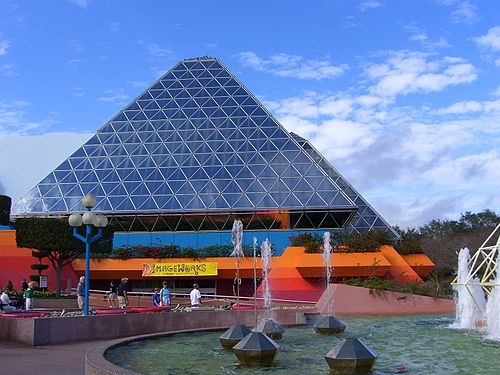 Imagination!
(formerly Journey Into Imagination) -
 Odyssey


World Celebration serves as the park's main entrance and a central hub that honors global human interaction and connection, including communication, imagination, creativity, and the visual and culinary arts.[55] The neighborhood features four major pavilions—Spaceship Earth, Imagination, Odyssey, and CommuniCore—as well as additional attractions, shops, and restaurants.[52]
Guests enter through the main entrance and walk underneath Spaceship Earth, an eighteen-story-tall geodesic sphere structure and the anchor pavilion, which also houses an eponymous dark ride attraction that depicts the history of communication.[56] Directly behind Spaceship Earth are the World Celebration Gardens and Dreamers Point, featuring lush interactive gardens, lighting fixtures and Walt the Dreamer—a bronze statue commemorating Walt Disney. The Imagination! pavilion celebrates the concept of imagination and features Journey into Imagination with Figment, a dark ride starring Figment that explores the senses. CommuniCore Hall and Plaza is a multi-use pavilion used for exhibitions, gallery space, a mixology bar, a demonstration kitchen, and music performances, as well as meet-and-greets with Disney characters.[57] The Odyssey Pavilion is an exhibition space during the park's annual festivals.
World Celebration is also home to Creations Shop, the park's main gift shop; Connections Eatery & Cafe, a quick-service restaurant and Starbucks themed to global food history; and Club Cool, a Coca-Cola-themed attraction and shop featuring complimentary samples of Coca-Cola soft drinks from around the world.
World Discovery
[edit]

.jpg)
World Discovery centers on space, science, transportation, and intergalactic exploration. Lying on the east side of World Celebration, the Discovery neighborhood currently features three major pavilions in clockwise layout.[52]
Guardians of the Galaxy: Cosmic Rewind, an enclosed spinning roller coaster based on the superhero team of the same name. The building originally opened as Universe of Energy.
Mission: SPACE is a centrifugal motion simulator thrill ride that replicates a space flight experience to Mars and a low orbit tour over the surface of Earth. Next to it is Space 220, a themed restaurant simulating dining aboard a space station located 220 miles above Earth.[30][58] The building is located on the original plot site of Horizons.
Test Track is a high-speed slot car ride inspired by the automobile testing procedures that General Motors uses to evaluate concept cars. The Motion Pavilion was one of the original pavilions of Epcot and has always housed an attraction sponsored by General Motors.
In between Guardians of the Galaxy: Cosmic Rewind and Mission: SPACE is one standing but unused pavilion that once housed Wonders of Life.
World Nature
[edit]-
 The Seas with Nemo & Friends
(former The Living Seas) -

-


.jpg)

World Nature focuses on understanding and preserving the beauty, awe and balance of the natural world.[30] Located on the west side of World Celebration, the Nature neighborhood features three major pavilions in counterclockwise layout—inspired by human interaction with the Earth, specifically themes of ocean exploration, hydrology, agriculture, horticulture, ecology, ecotourism, and travel.[52]
Based on ocean exploration and inspired by the Finding Nemo series, The Seas pavilion features the sixth-largest aquarium in the world with marine life exhibits; an Omnimover attraction inspired by Finding Nemo; and Turtle Talk with Crush, an interactive show hosted by Crush from Finding Nemo. Connected to the building is the Coral Reef Restaurant, a themed seafood restaurant that provides views into the aquarium. Nearby is Journey of Water, an outdoor walkthrough water attraction depicting the Earth's water cycle, inspired by Moana.[57] Finally, the Land pavilion features three attractions; Soarin' Around the World, an attraction that simulates a hang gliding flight over various regions of the world; Living with the Land, a narrated boat tour through Audio-Animatronics scenes, a greenhouse and hydroponics lab; and Awesome Planet, a short documentary film presented in the pavilion's Harvest Theater about the Earth's biomes and the perils of climate change.
World Showcase
[edit].jpg)
.jpg)
.jpg)
.jpg)

.jpg)
.JPG)
.jpg)


.jpg)

World Showcase is the park's largest neighborhood, dedicated to representing the culture, history, cuisine, architecture, and traditions of 11 nations from across four continents—North America, Europe, Asia, and Africa. Each nation pavilion features attractions, shops, restaurants, and landscaping that celebrate or portray authentic settings from each country—several pavilions also contain recreations inspired by existing buildings and landmarks, such as the Eiffel Tower, Itsukushima Shrine, Hampton Court Palace, Château Laurier, Gol Stave Church, St Mark's Campanile, and the Kutubiyya Mosque. Of the 11 pavilions, only Morocco and Norway were not present at the park's opening, as they were added in 1984 and 1988 respectively.[59]
The nation pavilions surround the World Showcase Lagoon, a man-made lake located in the center of World Showcase with a perimeter of 1.2 miles (1.9 km), which is the site of the park's nighttime fireworks display, Luminous: The Symphony of Us. In counter-clockwise order, the 11 pavilions are:


The American Adventure is the host pavilion of World Showcase, sharing its name with its marquee attraction: Liberty Theater, as a stage show detailing American history and hosted by Audio-Animatronics versions of Benjamin Franklin and Mark Twain. The pavilion also includes the American Heritage Gallery, a changing exhibition space. On the shores of the lagoon is the America Gardens Theatre, an outdoor amphitheater that hosts the park's festival concerts.
The France Pavilion hosts Impressions de France in Palais du Cinéma, an 18-minute Cinerama-style film depicting the culture of France, and along with Beauty and the Beast: Sing-Along. Tucked behind the lagoon-facing portion of the pavilion is Remy's Ratatouille Adventure, a 3D dark ride inspired by Pixar’s Ratatouille.
The Canada and China Pavilions each host Circle-Vision 360° films—Canada Far and Wide and Reflections of China—that depict the diverse cultures and countrysides of their respective countries. Two dark boat rides reside within the Norway and Mexico Pavilions—Frozen Ever After and Gran Fiesta Tour Starring The Three Caballeros, respectively—inspired by Frozen and The Three Caballeros.
A secondary park gate is located between the France and United Kingdom pavilions of World Showcase and is known as the International Gateway. The International Gateway is directly accessible to guests arriving from the Disney Skyliner and from watercraft transport, and by walkways from the nearby Epcot Area Resorts and Disney's Hollywood Studios.[60]
Each pavilion contains themed architecture, landscapes, streetscapes, attractions, shops and restaurants representing the respective country's culture and cuisine. In an effort to maintain the authenticity of the represented countries, the pavilions are primarily staffed by citizens of the respective countries as part of Disney's Cultural Representative Program through Q1 visa agreements. Some pavilions also contain themed rides, shows, and live entertainment representative of the respective country. The Morocco pavilion was directly sponsored by the Moroccan government until 2020, when Disney took ownership of the pavilion.[61] The remaining pavilions are primarily sponsored by private companies with affiliations to the represented countries.
Originally, the showcase was to include partnerships with the governments of the different countries. According to Disney's 1975 Annual Report, the Showcase would:
...offer participating countries a permanent installation for such features as themed restaurants and shops, product exhibits, industrial displays, cultural presentations, a trade center, and even special facilities for business meetings.
Major sponsorships for each participating nation will be asked to provide the capital to cover the cost of designing, developing and constructing its attraction and/or ride and all exhibits, as well as the Pavilion itself. It will also have the responsibility for funding the housing for its employees in the International Village. Its land lease will cover the cost of maintaining the attraction for a minimum of ten years.
The Disney organization will be responsible for area development, including the construction of transportation systems and utilities. We will also build and operate the internal people moving system, the Courtyard of Nations and central theater facility.[59]
Proposed pavilions and unused locations
[edit]There are currently seven undeveloped spots for countries around the World Showcase in between the locations of the current countries. Two sites are located on either side of the United Kingdom, one between France and Morocco, one between Morocco and Japan, one between Italy and Germany, and two between Germany and China.[59]
In 1982, Disney announced three pavilions were "coming soon": Israel, Spain and Equatorial Africa, blending elements of the cultures of countries such as Kenya and Zaire.[62] A model of the Equatorial Africa pavilions was also shown on the opening day telecast. However, the pavilions were never built. Instead, a small African themed refreshment shop known as the "Outpost" currently resides in the area between China and Germany, where the Equatorial Africa pavilion was to be located.[59][63]
More than 50 nations, among them, Brazil, Chile, India, Indonesia, Israel, New Zealand, Saudi Arabia, Sweden and five African countries (Eritrea, Ethiopia, Kenya, Namibia, and South Africa), took part in the Millennium Village, a project that took place in Epcot during Millennium Celebration from 1999 to 2001.[64] The Millennium Village was located inside a temporary structure built behind the United Kingdom pavilions that remains in use as World ShowPlace.
Alcohol policy
[edit]Unlike Magic Kingdom, which up until 2012 did not serve alcohol,[65][66] most stores and restaurants at Epcot, especially in the World Showcase, serve and sell a variety of alcoholic beverages including specialty drinks, craft beers, wines, and spirits reflective of the respective countries. The park also hosts the Epcot International Food & Wine Festival, an annual event featuring food and drink samplings from all over the world, along with live entertainment and special exhibits.
In June 2025, Disney World introduced GEO-82, an exclusive adult-only lounge at Epcot. GEO-82 offers an elevated experience with premium cocktails, small plates, and unique views of the park’s nightly fireworks shows. This new space was designed to provide adult guests with a sophisticated area for relaxation and entertainment, expanding Disney's offerings for grown-up visitors. The lounge represents Disney’s focus on diversifying guest experiences and catering to adult audiences.[67]
Solar Energy
As part of Disney's ongoing sustainability initiatives, Epcot has expanded its solar array[68], which is a crucial part of Disney’s commitment to achieving net-zero emissions by 2030. The solar panels, which power parts of the park, significantly reduce the resort’s carbon footprint. This effort reflects Disney’s broader goal of incorporating renewable energy sources across its parks worldwide.
Sustainability
Disney is actively engaged in water conservation across its parks and resorts, aiming to reduce potable water consumption through various initiatives.[69] At Epcot in Walt Disney World Resort, the irrigation system has been switched to reclaimed water, enhancing water efficiency. These efforts are part of Disney's broader environmental strategy, which includes implementing site-specific watershed stewardship strategies at key locations. By focusing on both operational water conservation and investments to protect local natural water systems, Disney aims to contribute to the sustainable management of water resources.
Annual events
[edit].jpg)
Epcot hosts a number of special events during the year:
- The Epcot International Flower & Garden Festival, inaugurated in 1994, uses specially-themed floral displays throughout the park, including topiary sculptures of Disney characters. Each event takes more than a full year to plan and more than 20,000 cast member hours.[70]
- The Epcot International Food & Wine Festival, inaugurated in 1995, draws amateur and professional gourmets to sample delicacies from all around the world, including nations that do not have a permanent presence in World Showcase. Celebrity chefs are often on-hand to host the events. In 2008, the festival featured the Bocuse d'Or USA, the American semifinal of the biennial Bocuse d'Or cooking competition.[71]
- The Epcot International Festival of the Arts, inaugurated in 2017, is a festival showcasing visual, culinary, and performing arts. The first annual event took place on weekends from January 13 through February 20, 2017.[72][73]
- The Epcot International Festival of the Holidays (previously known as Epcot Holidays Around the World from 1996 to 2016), inaugurated in 2017, is the park's annual holiday celebration. The World Showcase pavilions feature storytellers describing their nation's holiday traditions, and three nightly performances of the Candlelight Processional featuring an auditioned mass choir and a celebrity guest narrating the story of Christmas. Kiosks throughout the World Showcase feature holiday dishes. On New Year's Eve, the park offers a variety of additional entertainment including live DJ dance areas throughout the park.
Attendance
[edit]The Walt Disney Company generally does not publish attendance figures for its theme parks,[74] so industry groups such as the Themed Entertainment Association estimate these figures.
| Year | Attendance (millions) |
Ref |
|---|---|---|
| 2011 | 10.8 | [75] |
| 2012 | 11.0 | [76] |
| 2013 | 11.2 | [77] |
| 2014 | 11.4 | [78] |
| 2015 | 11.7 | [79] |
| 2016 | 11.7 | [80] |
| 2017 | 12.2 | [81] |
| 2018 | 12.4 | [82] |
| 2019 | 12.4 | [83] |
| 2020 | 4.04 | [84] |
| 2021 | 7.75 | [84] |
| 2022 | 10.0 | [85] |
| 2023 | 11.98 | [86] |
| 2024 | 12.13 | [87] |
See also
[edit]References
[edit]- ^ Slater, Laurel (March 26, 2021). "Meet the Women Behind the Magic Leading and Protecting Walt Disney World Theme Parks". Disney Parks Blog. Archived from the original on December 1, 2023. Retrieved April 12, 2024.
- ^ Antoldi, Maryanna (October 14, 2021). "Creating a Positive and Inclusive Environment for All". Disney Parks Blog. Archived from the original on December 1, 2023. Retrieved April 12, 2024.
- ^ "35 incredible facts about Disney's EPCOT theme park". ABC. Retrieved April 8, 2025.
- ^ "TEA/AECOM 2024 Theme Index and Museum Index". Themed Entertainment Association. 2024. Retrieved October 24, 2025.
- ^ Patches, Matt (May 20, 2015). "Inside Walt Disney's Ambitious, Failed Plan to Build the City of Tomorrow". esquire.com. Retrieved May 12, 2020.
- ^ "35 incredible facts about Disney's EPCOT theme park". ABC13 Houston. October 1, 2017. Retrieved March 14, 2022.
- ^ Kurtti, Jeff (1996). Since the World Began: Walt Disney World, The First 25 Years. New York, New York: Hyperion. p. 89. ISBN 0-7868-6248-3.
- ^ "Epcot Fact Sheet". wdwnews.com. Archived from the original on June 16, 2018. Retrieved January 8, 2018.
- ^ "Epcot Theme Park | Walt Disney World Resort". Walt Disney World Resort. Archived from the original on January 23, 2013. Retrieved October 4, 2014.
- ^ "The Opening of EPCOT: Part One". Sparkcatcher. October 1, 2022. Retrieved October 25, 2024.
- ^ "Opening Ceremonies Set for October". E82 | The Epcot Legacy. September 10, 1982. Retrieved October 25, 2024.
- ^ a b "The Opening of EPCOT: Part Five". Sparkcatcher. October 29, 2022. Retrieved October 25, 2024.
- ^ Veness, Susan (2015). The Hidden Magic of Walt Disney World: Over 600 Secrets of the Magic Kingdom, Epcot, Disney's Hollywood Studios, and Disney's Animal Kingdom. Adams Media. p. 143. ISBN 978-1-4405-8781-8. Retrieved May 11, 2020.
- ^ "Official Grand Opening Ceremonies for EPCOT Center at Walt Disney World". d23.com. D23. October 22, 1982. Retrieved May 11, 2020.
- ^ Martens, Todd (August 25, 2019). "D23 Expo: Is Disney's intellectual property squeezing the theme out of our theme parks?". Los Angeles Times. Retrieved September 5, 2019.
- ^ Craig, Dezern (April 23, 1994). "Disney Flower Power". orlandosentinel.com. Retrieved May 12, 2020.
- ^ Friend, Samantha (December 6, 2016). "Photos of People Getting Happily Drunk in Disney World". vice.com. Vice. Retrieved May 12, 2020.
- ^ "A Look Back at the EPCOT '94 Guidemap". TouringPlans.com Blog. April 28, 2020. Retrieved November 26, 2024.
- ^ a b Figueroa, Jessica (February 20, 2020). "Walt Disney World Officially Confirms Epcot Name Change to EPCOT as Part of Park's Transformation". WDW News Today. Retrieved November 26, 2024.
- ^ "'Captain Eo's' Audience Is Shrunk by Disney". Tucson Citizen. February 26, 1994. Archived from the original on August 6, 2021. Retrieved August 31, 2020 – via Newspapers.com.
- ^ a b Martin, Garrett (August 29, 2019). "Epcot's Midlife Crisis: Disney Reveals a Huge Makeover for the Park's 40th Birthday". Paste Magazine. Retrieved September 9, 2019.
- ^ Berry, Zachary (March 16, 2018). "How Epcot's World of Motion Became Test Track". The News Wheel. Retrieved May 11, 2020.
- ^ "Horizons". extinctdisney.com. January 6, 2020. Retrieved May 11, 2020.
- ^ "Our in-depth look at the new Test Track Presented by Chevrolet". December 11, 2012. Archived from the original on December 13, 2012. Retrieved September 10, 2025.
- ^ "Phineas and Ferb: Agent P's World Showcase Adventure Epcot". AllEars.Net. Retrieved September 10, 2025.
- ^ Storey, Ken (November 22, 2016). "Disney confirms major transformation at Epcot and rumors are flying". Orlando Weekly. Archived from the original on March 14, 2017. Retrieved March 14, 2017.
- ^ Barnes, Brooks (July 15, 2017). "Disney Vows to Give Epcot a Magical, Long-Overdue Makeover". The New York Times. Archived from the original on July 15, 2017. Retrieved July 16, 2017.
- ^ Bevil, Dewayne (August 1, 2018). "Disney World: Look at latest Epcot construction". Orlando Sentinel. Retrieved March 21, 2019.
- ^ Munarriz, Rick (August 24, 2019). "Disney World Needs to Fix Its Fading Theme Park". The Motley Fool. Retrieved September 9, 2019.
- ^ a b c d "Major changes, new attractions coming to Epcot, Disney announces". fox13news.com. New World Communications of Tampa, Inc. August 25, 2019. Archived from the original on August 27, 2019.
- ^ Haller, Sonja. "Disney World is getting a 'Moana' attraction and there's no telling how far we'll go to get there". USA Today. Retrieved December 12, 2022.
- ^ Figueroa, Jessica (October 11, 2019). "Photos: The Living Seas Pavilion Logo Returns on Sleek New..." WDW News Today. Retrieved October 24, 2019.
- ^ Frank Pallotta (March 12, 2020). "Walt Disney World closes, paralyzing the company's tourism empire". CNN. Retrieved July 17, 2020.
- ^ Laughing Place Staff (May 27, 2020). "Live Blog: Walt Disney World Presents Reopening Plans to Orange County Economic Recovery Taskforce". Laughing Place. Retrieved May 27, 2020.
- ^ "'Harmonious' Will Tell a Story of Global Connection When it Debuts October 1 at EPCOT as Part of 'The World's Most Magical Celebration'". Disney Parks Blog. Archived from the original on September 9, 2021. Retrieved December 12, 2022.
- ^ "Just Announced! Remy's Ratatouille Adventure Grand Opening at EPCOT Set for Oct. 1, 2021, in Honor of Walt Disney World Resort's 50th Anniversary". Disney Parks Blog. Archived from the original on March 10, 2021. Retrieved December 12, 2022.
- ^ "Guardians of the Galaxy: Cosmic Rewind Opens May 27 at EPCOT!". Disney Parks Blog. Archived from the original on April 4, 2022. Retrieved December 12, 2022.
- ^ Ace, Shannen (March 31, 2024). "Photos, Video: New Forces of Nature by AntiGravity Acrobatics Show at EPCOT - WDWNT". WDW News Today. Retrieved June 5, 2025.
- ^ Tuttle, Brit (June 4, 2025). "'Forces of Nature by AntiGravity' Show Closing This Week at EPCOT - WDWNT". WDW News Today. Retrieved June 5, 2025.
- ^ "First look at EPCOT's new Test Track". Theme Park Insider. Retrieved April 5, 2024.
- ^ Peyton (June 16, 2025). "Test Track Reopening Date Announced for July 2025". Disney Parks Blog. Retrieved June 17, 2025.
- ^ "New Spaceship Earth Lounge Coming to EPCOT - WDW News Today". wdwnt.com. August 10, 2024. Retrieved August 17, 2024.
- ^ Taylor (December 3, 2024). "New Details About What's Coming to Walt Disney World in 2025". Disney Parks Blog. Retrieved December 3, 2024.
- ^ "Breaking: Spaceship Earth Lounge GEO-82 Opening Date and Menu Revealed". WDW News Today. April 28, 2025. Retrieved April 28, 2025.
- ^ "Breaking: New Spaceship Earth Lounge Name Announced, Reserved for Adults Only". WDW News Today. March 17, 2025. Retrieved March 17, 2025.
- ^ Mike (November 21, 2024). "A Second Stage Has Arrived in CommuniCore Plaza at EPCOT". BlogMickey.com. Retrieved November 26, 2024.
- ^ McDonald, Lauren (June 11, 2025). "Disney World opens adults-only lounge GEO-82 at Epcot". Orlando Business Journal. Retrieved July 21, 2025.
- ^ Ace, Shannen (July 22, 2025). "Photos, Video: Diver Lock-Out Chamber Demonstration Returns After 5 Years to The Seas at EPCOT - WDWNT". WDW News Today. Retrieved July 22, 2025.
- ^ Maura (October 8, 2025). "First Look: New and Updated Audio-Animatronics at Disney World". Disney Parks Blog. Retrieved October 8, 2025.
- ^ Corless, Tom (October 8, 2025). "BREAKING: Projection-Face Audio Animatronics Being Replaced on Frozen Ever After at EPCOT". WDW News Today. Retrieved October 8, 2025.
- ^ Ace, Shannen (October 20, 2025). "BREAKING: New Soarin' Across America Coming to Disneyland and Walt Disney World". WDW News Today. Retrieved October 20, 2025.
- ^ a b c d Besand, Catherine (September 15, 2023). "First Look: 11 Must-Have Items in New EPCOT Reimagined Merch Collection". disneyparksblog.com. Archived from the original on February 8, 2024. Retrieved December 7, 2023.
- ^ Crawford, Michael (October 30, 2017). "The Symbolism Behind Epcot's Symbols". D23. Retrieved April 23, 2023.
- ^ Figueroa, Jessica (August 24, 2019). "PHOTOS: New Epcot Pavilion Logos Revealed as Part of Exclusive Merchandise Line at D23 Expo 2019". WDW News Today. Retrieved October 5, 2019.
- ^ "Major changes, new attractions coming to Epcot, Disney announces". fox13news.com. New World Communications of Tampa, Inc. August 25, 2019. Archived from the original on August 27, 2019.
- ^ Pedersen, R. A. (2011). The Epcot Explorer's Encyclopedia. R. A. Pedersen. p. 16. ISBN 978-1-4565-8966-0. Retrieved May 12, 2020.
- ^ a b Haring, Bruce (August 25, 2019). "New Disney Theme Park Attractions, Restaurants And Parade Outlined At D23". Deadline Hollywood. Retrieved September 6, 2019.
- ^ "Space-Themed Restaurant Lands in Future World at Epcot". Disney Parks Blog. Archived from the original on May 15, 2019. Retrieved February 24, 2019.
- ^ a b c d Weiss, Werner. "Two Myths about World Showcase at Epcot". Yesterland.com. Yesterland. Retrieved October 3, 2014.
- ^ "Disney History – D23". The Walt Disney Corporation. Archived from the original on March 4, 2016. Retrieved December 21, 2015.
- ^ "Breaking: Disney Officially Taking Ownership of All Morocco Pavilion Businesses at EPCOT – WDW News Today". wdwnt.com. October 21, 2020. Retrieved December 12, 2022.
- ^ Alarcon, Daniel (January 20, 1982). "Disney to offer liquor at new EPCOT center". Tampa Times. p. 11.
- ^ Kristin (June 13, 2014). "The Outpost in Epcot". couponingtodisney.com. Retrieved May 11, 2020.
- ^ "Millennium Village". WDWmagic.com. Retrieved March 2, 2020.
- ^ Brown, Genevieve Shaw (September 14, 2012). "Magic Kingdom Now Offers Beer". ABC News. Archived from the original on June 21, 2017. Retrieved January 21, 2017.
- ^ Nall, McGee. "Disney's Magic Kingdom Adds Alcohol to Menus". pastemagazine.com. Archived from the original on February 2, 2017. Retrieved January 21, 2017.
- ^ Cantore, Nicole (April 28, 2025). "Disney Eats: GEO-82 Menu and Opening Date". Disney Parks Blog. Archived from the original on May 20, 2025. Retrieved August 4, 2025.
- ^ SEIA Comms Team (2025). "Solar Is Powering the Happiest Place on Earth". SEIA Blog. Retrieved August 4, 2025.
- ^ The Walt Disney Company. "Environmental Goals". Disney Impact. Retrieved August 4, 2025.
- ^ "Mouseinfo.com". Archived from the original on October 6, 2014. Retrieved October 4, 2014.
- ^ Joseph, Scott (July 17, 2008). "Prestigious [sic] Bocuse d'Or competition [sic] to be part of Epcot Food & Wine Festival". Orlando Sentinel. Archived from the original on October 14, 2008. Retrieved July 17, 2008.
- ^ Lim, Victoria (November 21, 2016). "All-New Epcot International Festival of the Arts Coming to Walt Disney World Resort in January 2017". Walt Disney World Resort Blog. The Walt Disney Company. Archived from the original on December 1, 2016. Retrieved November 30, 2016.
- ^ Bevil, Dewayne (November 21, 2016). "Disney: New Epcot arts show will start in January". Orlando Sentinel. Retrieved January 30, 2016.
- ^ Jason Cochran (July 13, 2023). "Disney World Attendance Is Way Down, but Don't Blame Politics". FrommerMedia LLC. Retrieved March 19, 2024.
- ^ "TEA/AECOM 2011 Global Attractions Report" (PDF). Themed Entertainment Association. 2011. Archived from the original (PDF) on October 18, 2015. Retrieved November 20, 2012.
- ^ "TEA/AECOM 2012 Global Attractions Report" (PDF). Themed Entertainment Association. 2012. Archived from the original (PDF) on December 24, 2015. Retrieved April 18, 2014.
- ^ "TEA/AECOM 2013 Global Attractions Report" (PDF). Themed Entertainment Association. 2014. Archived from the original (PDF) on June 6, 2014. Retrieved June 6, 2014.
- ^ "TEA/AECOM 2014 Theme Index and Museum Index" (PDF). Themed Entertainment Association. 2015. Archived from the original (PDF) on June 26, 2015. Retrieved June 3, 2015.
- ^ "TEA/AECOM 2017 Global Attractions Attendance Report Report" (PDF). Themed Entertainment Association. 2017. Archived from the original (PDF) on May 19, 2018. Retrieved June 17, 2018.
- ^ Au, Tsz Yin (Gigi); Chang, Bet; Chen, Bryan; Cheu, Linda; Fischer, Lucia; Hoffman, Marina; Kondaurova, Olga; LaClair, Kathleen; Li, Shaojin; Linford, Sarah; Marling, George; Miller, Erik; Nevin, Jennie; Papamichael, Margreet; Robinett, John; Rubin, Judith; Sands, Brian; Selby, William; Timmins, Matt; Ventura, Feliz; Yoshii, Chris (June 1, 2017). "TEA/AECOM 2016 Theme Index & Museum Index: Global Attractions Attendance Report" (PDF). aecom.com. Themed Entertainment Association. Archived (PDF) from the original on October 9, 2022. Retrieved July 26, 2017.
- ^ Au, Tsz Yin (Gigi); Chang, Bet; Chen, Bryan; Cheu, Linda; Fischer, Lucia; Hoffman, Marina; Kondaurova, Olga; LaClair, Kathleen; Li, Shaojin; Linford, Sarah; Marling, George; Miller, Erik; Nevin, Jennie; Papamichael, Margreet; Robinett, John; Rubin, Judith; Sands, Brian; Selby, William; Timmins, Matt; Ventura, Feliz; Yoshii, Chris (May 17, 2018). "TEA/AECOM 2017 Theme Index & Museum Index: Global Attractions Attendance Report" (PDF). teaconnect.org. Themed Entertainment Association. Archived from the original (PDF) on May 19, 2018. Retrieved May 17, 2018.
- ^ Au, Tsz Yin (Gigi); Chang, Bet; Chen, Bryan; Cheu, Linda; Fischer, Lucia; Hoffman, Marina; Kondaurova, Olga; LaClair, Kathleen; Li, Shaojin; Linford, Sarah; Marling, George; Miller, Erik; Nevin, Jennie; Papamichael, Margreet; Robinett, John; Rubin, Judith; Sands, Brian; Selby, William; Timmins, Matt; Ventura, Feliz; Yoshii, Chris (May 21, 2019). "TEA/AECOM 2018 Theme Index & Museum Index: Global Attractions Attendance Report" (PDF). teaconnect.org. Themed Entertainment Association. Archived from the original (PDF) on May 23, 2019. Retrieved May 24, 2019.
- ^ Au, Tsz Yin (Gigi); Chang, Bet; Chen, Bryan; Cheu, Linda; Fischer, Lucia; Hoffman, Marina; Kondaurova, Olga; LaClair, Kathleen; Li, Shaojin; Linford, Sarah; Marling, George; Miller, Erik; Nevin, Jennie; Papamichael, Margreet; Robinett, John; Rubin, Judith; Sands, Brian; Selby, William; Timmins, Matt; Ventura, Feliz; Yoshii, Chris (July 16, 2020). "TEA/AECOM 2019 Theme Index & Museum Index: Global Attractions Attendance Report" (PDF). teaconnect.org. Themed Entertainment Association. Archived from the original (PDF) on July 17, 2020. Retrieved July 19, 2020.
- ^ a b "TEA/AECOM 2021 Theme Index & Museum Index: Global Attractions Attendance Report". Themed Entertainment Association. Retrieved March 19, 2024.
- ^ "TEA/AECOM 2022 Theme Index & Museum Index: Global Attractions Attendance Report". Themed Entertainment Association. June 13, 2023. Retrieved March 19, 2024.
- ^ "TEA/AECOM 2023 Theme Index & Museum Index: Global Attractions Attendance Report". Themed Entertainment Association. June 13, 2023. Retrieved August 15, 2024.
- ^ "TEA/AECOM 2024 Theme Index and Museum Index". Themed Entertainment Association. 2024. Retrieved October 24, 2025.
Further reading
[edit]- Alcorn, Steve and David Green. Building a Better Mouse: The Story of the Electronic Imagineers Who Designed Epcot. Themeperks Press, 2007, ISBN 0-9729777-3-2.
- Mannheim, Steve (2002). Walt Disney and the Quest for Community. Routledge. ISBN 0754619745.
External links
[edit]
| Preceding station | Walt Disney World Monorail | Following station | ||
|---|---|---|---|---|
| Transportation and Ticket Center Terminus
|
Epcot Line | Terminus | ||
| World Celebration |  | |
|---|---|---|
| World Discovery | ||
| World Showcase | ||
| World Nature | ||
| Annual events | ||
| Other | ||
| Related | ||

| Disney Parks |
|    | ||||||||||||||
|---|---|---|---|---|---|---|---|---|---|---|---|---|---|---|---|---|
| Signature Experiences |
| |||||||||||||||
| Disney Consumer Products |
| |||||||||||||||
| Other | ||||||||||||||||
| Cancelled and former parks | ||||||||||||||||
.svg)


| International | |
|---|---|
| National | |
| Other | |
Epcot
View on GrokipediaConceptual Origins
Walt Disney's Vision for an Experimental Community
Walt Disney articulated his vision for EPCOT through a 25-minute film recorded on October 27, 1966, just weeks before his death.[5] In this presentation, he described EPCOT as the core of his broader Florida Project, intended to demonstrate forward-thinking urban solutions on undeveloped land.[5] The concept emerged from Disney's observations of urban challenges, including sprawl and inefficiency, drawing on principles akin to New Urbanism to create a controlled, innovative environment.[6] EPCOT, an acronym for Experimental Prototype Community of Tomorrow, was planned as a self-sustaining city for approximately 20,000 residents, serving as a perpetual laboratory for testing new technologies, materials, and city-planning ideas sponsored by industry partners.[5] Situated on a 43-square-mile parcel about 16 miles southwest of Orlando, it would function as a "living blueprint of the future," continuously evolving without ever being fully "completed."[5] Residents would live, work, and recreate within the community, with private home ownership restricted to maintain experimental control and adaptability.[7] The proposed layout featured a radial design centered on a transportation interchange hub, flanked by commercial districts including offices, hotels, and a convention center.[6] Residential areas would radiate outward, buffered by greenbelts to separate living spaces from an outer industrial park, promoting orderly growth and environmental integration.[6] Transportation emphasized efficiency through elevated monorails, automated peoplemovers, and underground electric vehicles, banning personal automobiles from surface streets to eliminate congestion and pollution.[6] This system aimed to foster a harmonious, technology-driven lifestyle, positioning EPCOT as a model for addressing mid-20th-century urban decay.[6]
Influences from Urban Planning and Futurism
Walt Disney's EPCOT concept integrated principles from modernist urban planning and futurist ideals, aiming to create a scalable prototype for tomorrow's cities. The design featured a radial layout with a central transportation hub, surrounded by commercial districts, residential spokes, and green belts, drawing from Ebenezer Howard's Garden City model of 1898, which promoted decentralized, self-sufficient communities to counter industrial urban sprawl.[6] This structure sought to foster efficient land use and communal living while incorporating advanced infrastructure like elevated monorails and underground utilities to eliminate surface congestion.[8] Influences from Le Corbusier's Radiant City visions shaped EPCOT's zoning separations, designating distinct areas for living, working, and recreation to optimize functionality and reduce urban dysfunctions such as traffic and pollution.[6] Disney adapted these ideas into a mixed-use core under a climate-controlled dome, prioritizing pedestrian mobility and automated transit systems inspired by Victor Gruen's post-war mall concepts, which emphasized controlled environments for commerce and leisure.[6] These elements reflected a belief in technology-driven urban renewal, testable in EPCOT's planned 20,000-residency scale.[2] Futurism permeated the vision through inspirations from World's Fairs, particularly the 1964-1965 New York World's Fair, where Disney exhibits like "It's a Small World" and the Carousel of Progress showcased optimistic technological progress and innovative architecture.[9] The 1967 Progress City model, displayed at Disneyland's Carousel of Progress Theater, visualized EPCOT's blueprint with animated depictions of electric-powered vehicles, solar energy experiments, and modular housing, serving as a direct precursor to the Florida project.[10] This model encapsulated Disney's commitment to empirical urban experimentation, free from private land ownership to enable rapid innovation.[11]Development and Transformation into a Theme Park
Post-Disney Death Challenges and Corporate Decisions
Walt Disney's death on December 15, 1966, left the Experimental Prototype Community of Tomorrow (EPCOT) concept without its primary visionary and detailed blueprints, prompting immediate reevaluation by Disney executives.[12] His brother Roy O. Disney, who assumed leadership, prioritized completing the Magic Kingdom phase of Walt Disney World, explicitly rejecting further pursuit of the residential city by stating "Walt is dead," reflecting a corporate shift away from unproven urban experimentation.[13] The ambitious scope—encompassing a self-sustaining city for up to 20,000 residents with centralized utilities, no private automobiles in core areas, and Disney-controlled governance—posed insurmountable practical hurdles, including potential liabilities from residential operations, zoning conflicts under the Reedy Creek Improvement District, and the company's inexperience in municipal management beyond theme park operations.[12][13] Financial viability emerged as a core challenge, with the city model offering uncertain revenue streams compared to the proven profitability of attraction-based parks like Disneyland and the forthcoming Magic Kingdom, which opened in 1971.[14] Roy's death in December 1971 further delayed progress, as incoming president E. Cardon Walker inherited a project lacking sponsor commitments essential for funding innovative pavilions without excessive internal capital outlay.[14] Walker, serving as president from 1971 and CEO from 1976 to 1983, recognized that experimenting with human lives in a controlled urban environment exceeded Disney's core competencies in entertainment and risked reputational and legal exposure from resident disputes or infrastructure failures.[14] In 1974, he directed creative leader Marty Sklar to reconceptualize EPCOT, emphasizing corporate partnerships over residential development.[14] Corporate decisions crystallized in July 1975 when Disney publicly announced EPCOT Center as a "permanent world's fair" showcasing technological innovation and international pavilions, designed to attract sponsors like General Motors and Exxon for shared costs and marketing exposure.[15] This pivot ensured financial feasibility by leveraging the Reedy Creek district's infrastructure advantages for a non-residential attraction, though sponsor shortages caused a temporary halt in 1976 until renewed commitments allowed groundbreaking in 1979.[15] The resulting theme park, opened on October 1, 1982, retained thematic elements of futurism and global showcase but abandoned governance and residency, aligning with Disney's entertainment-focused business model amid post-1966 economic pressures.[14]Construction Phase and Initial Design Choices
Construction of EPCOT Center commenced with a groundbreaking ceremony on October 1, 1979, marking the official start of site preparation on approximately 300 acres adjacent to Walt Disney World.[16] The project, initially envisioned as an experimental city but reoriented into a permanent world's fair-style theme park following Walt Disney's 1966 death, involved over 10,000 workers at peak and was completed in three years at a cost exceeding $1 billion, making it the largest private construction undertaking in U.S. history at the time.[15] Initial design choices emphasized a bifurcated layout dividing the park into Future World, focused on technological innovation and human progress, and World Showcase, highlighting international cultures through pavilion replicas.[15] Future World pavilions were themed around specific advancements—such as communications in Spaceship Earth, energy in Universe of Energy, and transportation in World of Motion—with corporate sponsors funding construction in exchange for 10-year operational commitments and promotional rights, typically ranging from $10 million to $50 million per participant.[15] Notable early sponsors included AT&T for Spaceship Earth, Exxon for Universe of Energy, General Motors for World of Motion, and Kodak for Journey into Imagination, enabling Disney to offset costs while integrating sponsor technologies into attractions.[15] The park's entrance featured the geodesic sphere of Spaceship Earth, a 165-foot-diameter steel-framed structure designed by WED Enterprises (later Walt Disney Imagineering) to evoke global interconnectedness and futuristic optimism, with its aluminum panels and internal ride system completed by mid-1982.[17] Supporting infrastructure included extensive landscaping with 12,500 trees, 100,000 shrubs, and 3.5 acres of annual flowers to create immersive environments, alongside utility corridors and the CommuniCore hub linking Future World pavilions.[15] World Showcase pavilions drew from authentic architectural motifs, such as the Mayan pyramid for Mexico and Norwegian stave church elements, with construction prioritizing sponsor and governmental partnerships for cultural accuracy.[18] These choices prioritized experiential education over residential functionality, adapting the original urban prototype concept into a scalable, revenue-generating attraction model.[15]Opening and Early Operations
1982 Debut and Initial Attractions
EPCOT Center opened to the public on October 1, 1982, as the second theme park at Walt Disney World Resort, spanning approximately 300 acres and costing $800 million to construct.[19][20] The park featured two primary areas: Future World, focused on technological innovation and human achievement, and World Showcase, a permanent international exposition highlighting global cultures. Initial operations emphasized controlled attendance, opening on a weekday during the off-season with about 10,000 visitors on the debut day to test systems and manage crowds.[21] In Future World, key opening attractions included Spaceship Earth, a dark ride narrating the history of human communication housed within the park's signature geodesic sphere; Universe of Energy, an exhibit sponsored by Exxon exploring energy sources through films and animatronics; World of Motion, a General Motors-sponsored ride tracing the evolution of transportation; and The Land pavilion, featuring agricultural demonstrations, the Listen to the Land boat tour, and entertainment like Kitchen Kabaret. CommuniCore provided interactive computer exhibits and demonstrations of emerging technologies. These attractions aimed to educate visitors on future possibilities through optimistic portrayals of progress.[22][23][24] World Showcase debuted with nine pavilions representing Canada, the United Kingdom, France, the United States (via The American Adventure), Italy, Germany, China, Japan, and Mexico, each offering cultural artifacts, films, boat rides or shows, and dining reflective of their nations. For instance, Mexico's pyramid housed the El Rio del Tiempo boat ride through history, while China's Circle-Vision 360 theater presented panoramic views. Pavilions opened progressively in October, with dedicated ceremonies, such as Mexico's on October 21.[24][25] The park's formal dedication occurred on October 24, 1982, led by Disney Chairman E. Cardon Walker, who proclaimed: "To all who come to this place of dreams and magic... EPCOT is dedicated to the partnership of creative minds and human aspirations." Future World was dedicated on October 22 and World Showcase on October 23, marking the culmination of phased openings amid ongoing construction for future expansions.[24][26]Reception and Operational Realities
Upon its opening on October 1, 1982, EPCOT Center received generally positive initial reception for its ambitious scale and innovative attractions, drawing large crowds despite technical glitches during the debut weekend. Visitors and early reviewers described the park as dazzling, with the geodesic dome of Spaceship Earth and the World Showcase's cultural pavilions evoking a sense of wonder about global progress and future technologies.[27] The Washington Post characterized it as a "World of Tomorrow," highlighting the fanfare and Disney's entertainment prowess in realizing a vision of international harmony and technological optimism.[28] Attendance surged rapidly, contributing to Walt Disney World's overall figures exceeding 14 million visitors in fiscal 1982, as the park's novelty attracted families seeking educational yet entertaining experiences distinct from the Magic Kingdom's fantasy focus.[29] However, critics noted that EPCOT deviated significantly from Walt Disney's original 1966 conception of a self-sustaining experimental community, transforming instead into a static theme park reliant on corporate sponsorships for pavilion operations and content. This shift, driven by post-Disney corporate risk aversion, resulted in exhibits that functioned more as promotional showcases for multinational sponsors like Exxon and General Motors rather than prototypes for real-world urban innovation.[30] Attendance projections were met, but some observers critiqued the park's sterile, sponsor-driven futurism as lacking genuine experimentation, with pavilions emphasizing commercial optimism over addressing practical challenges like urban density or resource scarcity.[31] Operationally, the park faced substantial challenges from its $1 billion construction costs and the complexity of its advanced systems, leading to frequent breakdowns and maintenance demands in the early years. Opening-day glitches, including malfunctioning rides and audio-animatronics failures, underscored the difficulties of integrating cutting-edge technologies across vast pavilions, resulting in operational chaos and elevated downtime risks.[27][32] Sponsor dependencies complicated upkeep, as pavilions required ongoing corporate funding for repairs and updates, while the park's scale strained Disney's infrastructure, contributing to broader financial pressures amid high development debts.[33] These realities highlighted causal trade-offs: the pursuit of inspirational exhibits prioritized spectacle over reliability, necessitating adaptive management to sustain visitor throughput amid evolving technological maintenance needs.Historical Evolution
1980s-1990s Expansions and Shifts
Following its 1982 opening, Epcot underwent phased expansions in Future World during the 1980s to complete its core pavilion lineup. Journey into Imagination, sponsored by Kodak, debuted on March 5, 1983, featuring an indoor dark ride exploring creativity with characters Dreamfinder and Figment.[34] The Living Seas pavilion, presented by United Technologies, opened on January 15, 1986, housing a 5.7 million-gallon saltwater aquarium and exhibits on oceanography.[35] In World Showcase, the Norway pavilion added Maelstrom, a boat ride through Viking folklore and fjords, on July 5, 1988.[36] The late 1980s brought further diversification with the Wonders of Life pavilion, sponsored by Metropolitan Life Insurance, which soft-opened on October 19, 1989, introducing Epcot's first thrill ride, Body Wars, alongside health-themed attractions like Cranium Command.[37] These additions emphasized interactive education and sponsorship-driven content, aligning with Epcot's experimental ethos while attracting broader audiences through novel experiences.[38] In the 1990s, expansions reflected operational shifts toward entertainment and thrill elements amid competitive pressures. Innoventions, a technology showcase in Future World, evolved from CommuniCore with permanent exhibits starting in 1994, featuring interactive displays on emerging innovations.[39] Test Track, sponsored by General Motors, replaced the World of Motion on March 17, 1999, offering a high-speed slot-car simulation reaching 65 mph, marking a pivot from narrative-driven rides to adrenaline-focused attractions. Concurrently, IllumiNations: Reflections of Earth premiered on October 1, 1999, as a millennium spectacle with fireworks, lasers, and a rotating Earth globe, enhancing nighttime draw and signaling increased emphasis on spectacle over solely didactic programming.[40] These developments, while expanding capacity and attendance—Epcot drew over 10 million visitors annually by decade's end—highlighted tensions between original futurist ideals and commercial viability, with sponsorships funding innovations but occasionally prioritizing brand integration over pure experimentation.[41]2000s Commercial Pressures and Compromises
In the early 2000s, Epcot encountered significant commercial pressures amid broader challenges at Walt Disney World, including a post-September 11, 2001, tourism downturn that reduced overall resort attendance by 7.4% in 2001 compared to 2000.[42] Epcot, in particular, struggled with perceptions of outdated attractions as rapid technological advancements rendered its futurist themes less compelling, contributing to its slide from second to third in attendance among the resort's four parks. These factors, coupled with intensifying competition from Universal Orlando's thrill-focused offerings like Islands of Adventure (opened 1999), prompted Disney to prioritize revenue-generating updates over maintaining the park's original educational and experimental ethos.[43] Key compromises included the permanent closure of Horizons in January 1999, driven by the loss of sponsor General Electric, escalating maintenance costs, and structural concerns, leaving the site vacant until its demolition for Mission: SPACE, which debuted in October 2003 as a $140 million centrifuge-based simulator sponsored by Hewlett-Packard.[44][45] This replacement shifted from Horizons' serene, optimistic vision of future living to a high-intensity space training experience, reflecting a strategic pivot toward adrenaline-driven appeals to younger demographics and thrill-seekers to counteract Epcot's lagging draw. Similarly, the Universe of Energy pavilion's original exhibit ended in 1996, giving way to Ellen's Energy Adventure in 2002, which incorporated comedian Ellen DeGeneres and celebrity guests to infuse humor and broad entertainment into energy education, prioritizing mass appeal over specialized corporate sponsorship content.[46] Further adaptations underscored the commercial focus: Soarin', a hang-glider simulator, opened in The Land pavilion in 2005 to inject thrill elements into an agriculture-themed area, while the Submarine Voyage closed in 1994 and reopened as The Seas with Nemo & Friends in 2007, leveraging Pixar's Finding Nemo for immersive IP storytelling and merchandise synergy.[47] World Showcase saw incremental IP integrations, such as the 2009 launch of the interactive Kim Possible World Showcase Adventure, transforming cultural pavilions into branded adventure games to engage families and boost repeat visits. These changes, enacted under CEO Michael Eisner until 2005 and continued by successor Bob Iger, addressed short-term financial imperatives—evident in Disney's parks segment operating income fluctuations—but deviated from Epcot's founding emphasis on innovation and global humanism, favoring entertainment-driven revenue streams like festivals (e.g., expanded Food & Wine events) amid ongoing budget constraints that marked the late 2000s as a low point for Walt Disney World maintenance and investment.[48][49]2010s-2020s Redesigns and Entertainment Pivot
In August 2019, at the D23 Expo, Disney Parks chairman Bob Chapek unveiled plans for a multi-year overhaul of Epcot, restructuring Future World into three themed neighborhoods—World Celebration, World Discovery, and World Nature—while expanding World Showcase, with an emphasis on integrating Disney storytelling to celebrate human aspiration and innovation.[50] This initiative addressed longstanding challenges, including the departure of corporate sponsors from aging pavilions and stagnant attendance relative to other Walt Disney World parks, by pivoting toward entertainment-driven attractions leveraging Disney intellectual properties to enhance guest engagement and revenue potential.[51] The redesign aimed to retain Epcot's foundational ethos of progress while introducing family-oriented experiences, marking a departure from the park's original sponsor-reliant, educational model toward one sustained by Disney's branded content ecosystem.[52] Key implementations included the October 2021 opening of Remy's Ratatouille Adventure, a trackless dark ride in the France pavilion adapting the 2007 Pixar film Ratatouille, which drew on Ratatouille-themed land in Paris Disneyland for its technology.[53] In May 2022, Guardians of the Galaxy: Cosmic Rewind debuted in World Discovery as Epcot's first roller coaster, replacing the Universe of Energy pavilion and featuring Marvel Cinematic Universe elements with a 360-degree rotating ride vehicle, costing an estimated $300-500 million amid supply chain delays.[54] The October 2023 launch of Journey of Water, Inspired by Moana in World Nature introduced an interactive water play area emphasizing environmental themes from the 2016 film, complementing retained attractions like Soarin' and Living with the Land.[53] World Celebration opened in December 2023 with the Connections Cafe and Eatery, a plant-based dining venue, alongside Luminous The Symphony of Us, a nighttime spectacular succeeding Harmonious (2021-2023) and the long-running IllumiNations: Reflections of Earth, incorporating drones, lasers, and fountains to narrate global unity.[55] These additions prioritized thrill rides and character immersion over didactic exhibits, reflecting Disney's broader strategy to combat post-pandemic attendance recovery through IP familiarity. The pivot correlated with measurable gains: Epcot's attendance rose 19.8% to 11.98 million visitors in 2023, the largest year-over-year increase among North American theme parks, attributed to high-profile openings and extended festivals like the EPCOT International Food and Wine Festival, which now spans much of the year to drive repeat visits and per-capita spending.[56] Domestic parks revenue, including Epcot contributions, increased 10% in fiscal Q2 2025, supporting operating income growth despite inflationary pressures and competition from Universal's Epic Universe.[57] However, the emphasis on franchise-based entertainment has drawn critique from observers noting the erosion of Epcot's sponsor-funded futurism—evident in closures like Innoventions (2015) and the unbuilt Project Tomorrow pavilion—prioritizing short-term profitability over the park's initial experimental community blueprint, as corporate partnerships dwindled in the 2010s.[58] By late 2023, Disney declared the core transformation complete, though additional World Showcase expansions, such as a Brazil pavilion, remain in conceptual stages without firm timelines.[55]Physical Layout and Infrastructure
Iconic Entrance and Central Structures
The entrance to EPCOT is defined by Spaceship Earth, a prominent geodesic sphere standing 180 feet tall and measuring 165 feet in diameter, serving as the park's most recognizable landmark and gateway to its core areas.[59] Constructed with a steel-framed structure engineered by Simpson Gumpertz & Heger, the sphere features an eight-frequency geodesic dome supported by six columns and an internal tower, with its frame fabricated in Tampa, Florida.[17] The exterior comprises approximately 150,000 square feet of surface area enclosing 2,200,000 cubic feet of volume, anchored by six legs with pylons extending 120 to 185 feet into the ground for stability.[60] This dual-dome design forms a sphere-within-a-sphere configuration, where the outer shell exceeds the inner by about two feet in radius, allowing for the integrated dark ride system that traces human communication history.[61] The structure's innovative engineering, including a utility framework resembling a six-legged table, supports the ride track and omnimover vehicles within, emphasizing EPCOT's original vision of technological progress.[62] Fronting the sphere, the entrance plaza centers on a redesigned fountain installation, incorporating prismatic pylons that direct visitor sightlines toward Spaceship Earth and create a dynamic visual entry point.[63] These elements frame the transition from the parking area to the park's interior pathways, which converge toward the World Showcase Lagoon—a 40-acre, man-made central waterway up to 25 feet deep that anchors the international pavilions encircling it.[64] This layout reinforces the park's dual focus on innovation and global culture, with the lagoon's perimeter spanning 1.2 miles.[65]Reorganized Neighborhoods: World Celebration, Discovery, Nature
In 2019, Walt Disney Imagineering announced a multi-year transformation of EPCOT's Future World section, dividing it into three themed neighborhoods—World Celebration, World Discovery, and World Nature—to enhance thematic cohesion and visitor flow while preserving core attractions.[66] This restructuring, completed in phases through 2024, replaced the east-west layout with distinct areas emphasizing celebration of human achievement, scientific exploration, and environmental stewardship, respectively.[67] World Celebration centers on Spaceship Earth and serves as the park's entry hub, featuring landscaped gardens, interactive elements, and festival spaces to foster communal experiences. Key additions include World Celebration Gardens and Dreamers Point, which opened on December 5, 2023, honoring Walt Disney's birthplace date with a statue and reflective pathways.[68] CommuniCore Hall and Plaza, multifunctional venues for live performances and seasonal events, debuted on June 10, 2024, marking the neighborhood's full operational status.[69] The area integrates retail like Connections Eatery and emphasizes storytelling through daily character meet-and-greets and projections on Spaceship Earth.[70] World Discovery highlights innovation in space, motion, and cosmology, incorporating high-thrill rides and dining with futuristic themes. Attractions include Guardians of the Galaxy: Cosmic Rewind, a Marvel-themed indoor coaster that opened on May 27, 2022, as EPCOT's first "other-world" showcase with a 360-degree rotating vehicle.[71] Test Track, reimagined in versions since 1999, simulates vehicle testing at speeds up to 65 mph, while Mission: SPACE offers centrifuge-based astronaut training since 2003.[72] Space 220 Restaurant, elevated 220 miles above Earth for simulated orbital views, launched in September 2021.[73] The neighborhood's layout promotes adjacency between space and automotive experiences, with ongoing updates like Test Track's 2025 refurbishment.[74] World Nature focuses on ecology and marine life, retheming former pavilions to underscore sustainability and biodiversity. The Land pavilion, operational since 1982, houses Living with the Land—a greenhouse boat tour of hydroponic farming yielding over 30 crop varieties annually—and Soarin' Around the World, a hang-glider simulator projecting global landscapes.[75] The Seas complex features The Seas with Nemo & Friends submarine ride and Turtle Talk interactive show, drawing from Finding Nemo since 2007 updates.[76] Journey of Water, Inspired by Moana, an outdoor walk-through exhibit with interactive water elements and Polynesian lore, opened on October 16, 2023, emphasizing conservation through sensory play.[67] These elements collectively promote educational messaging on human-nature interdependence, with pavilion sponsorships like Chiquita for The Land influencing exhibit evolutions.[77]World Showcase and Global Representations
Established Pavilions and Cultural Exhibits
The established pavilions in Epcot's World Showcase comprise eleven permanent cultural exhibits encircling the 40-acre World Showcase Lagoon in a 1.2-mile loop, representing Mexico (Mexico Pavilion at Epcot), Norway (Norway Pavilion at Epcot), China (China Pavilion at Epcot), Germany (Germany Pavilion at Epcot), Italy (Italy Pavilion at Epcot), The American Adventure (The American Adventure (Epcot)), Japan (Japan Pavilion at Epcot), Morocco (Morocco Pavilion at Epcot), France (France Pavilion at Epcot), the United Kingdom (United Kingdom Pavilion at Epcot), and Canada (Canada Pavilion at Epcot). Nine pavilions debuted on October 1, 1982, with Epcot's opening, followed by Morocco on September 7, 1984, and Norway on June 3, 1988.[78][79] These structures, owned by The Walt Disney Company, incorporate authentic architectural elements, landscaping, and artifacts developed with input from representatives of the respective nations to promote cultural exchange and tourism, often staffed by citizens from those countries to enhance immersion.[80][81] The Mexico Pavilion evokes pre-Columbian and colonial eras through its central Mayan pyramid replica modeled after the Temple of Quetzalcoatl at Teotihuacán, featuring tiered stone architecture, a reflecting pool, and interior spaces with Aztec murals, mariachi performances, and exhibits of folk art alongside dining venues serving traditional cuisine.[82] Adjacent, the Norway Pavilion replicates medieval Nordic villages with a stave church from Gol, Norway, intricate wood carvings, and Viking-era artifacts, originally highlighting maritime history via the Maelstrom boat ride before its 2016 replacement with a Frozen-themed attraction, complemented by fjord-inspired gardens and a bakery offering lefse and krumkake.[83][84] The China Pavilion centers on a half-scale replica of Beijing's Temple of Heaven, a UNESCO World Heritage site, encircled by willow trees, rock gardens, and lotus ponds symbolizing imperial serenity, with cultural exhibits including Ming Dynasty porcelain, calligraphy demonstrations, and the 12-minute "Reflections of China" Circle-Vision 360° film depicting landscapes from the Great Wall to the Yangtze River.[85][86] Germany's pavilion recreates a Bavarian marketplace with half-timbered fachwerk houses, a clock tower, and floral displays, housing a vast model train layout depicting regional routes, beer gardens serving Oktoberfest-style fare, and oompah band performances amid exhibits of cuckoo clocks and nutcrackers.[65] Italy presents Renaissance grandeur via a replica of Venice's Doge's Palace, Neptune Fountain, and gondola waterways, with street scenes from the 16th century, gelato stands, and displays of Venetian glass and marble craftsmanship. The American Adventure pavilion, housed in a 130,000-square-foot Georgian-style structure modeled after Independence Hall, features a 45-minute Audio-Animatronics presentation narrated by Mark Twain and Benjamin Franklin, chronicling U.S. history from colonial settlement to the Space Age through 12 large-scale tableaus with over 160 figures, supported by period artifacts and a Liberty Tree garden.[87] Japan's pavilion unfolds as a circular Imperial Palace gate leading to a tiered pagoda, Zen rock garden, and torii bridge over koi ponds, showcasing 17th-century toro lanterns, bonsai trees, and cultural demonstrations like tea ceremonies, ikebana flower arranging, and taiko drumming, with shops offering samurai armor and pearls. Morocco's exhibit, funded and designed with direct involvement from King Hassan II's government including artisans from Fez, replicates Fez medina alleys with geometric tilework, minarets, and brass lamps, featuring a replica of the Koutoubia Minaret, belly dancing, and spice market scents amid exhibits of Berber rugs and pottery.[88] France captures Parisian elegance with a scaled-down Eiffel Tower, Haussmann boulevards, and Belle Époque facades, including a replica of the Seine riverfront, patisserie displays, and the 18-minute "Impressions de France" film showcasing chateaus and lavender fields, enhanced by crepe stands and accordion music.[65] The United Kingdom pavilion blends Tudor, Georgian, and Victorian architecture around a central green, with elements like a Royal Shakespeare Theatre replica, thatched cottages, and a hedge maze inspired by Hampton Court Palace, offering fish and chips pubs, Beatles tribute performances, and exhibits of double-decker buses and red phone booths. Canada concludes the circuit with a rocky mountain facade mimicking the Banff Springs Hotel, Northwest Mercantile trading post, and Les Celliers wine cellar, featuring a First Nations totem pole collection, French-Canadian fiddling, and the "O Canada!" 360° film highlighting natural wonders from Niagara Falls to the Rockies.[65]Unused Concepts and Expansion Proposals
The Phase II expansion for World Showcase, conceptualized in the early 1980s shortly after Epcot's 1982 opening, aimed to add five new country pavilions to the existing nine, enhancing global representation through cultural exhibits, dining, and entertainment.[20] These proposals relied on sponsorships from governments or corporations, a model that had succeeded for initial pavilions but faltered amid economic pressures and geopolitical sensitivities by the mid-1980s.[89] Despite advertising and preliminary designs, including site preparations and signage, none of the Phase II pavilions were constructed, leaving designated plots—such as between China and Germany—underutilized as outposts or event spaces.[78] Israel was among the earliest proposed additions, with a $30-35 million sponsorship agreement signed in 1980 to fund a pavilion featuring an ancient Jerusalem courtyard with a menorah landmark, market-style shops under olive and cypress trees, and an outdoor amphitheater for musical performances blending traditional and modern elements.[20] Plans emphasized contrasts between old and new Jerusalem architecture, with native cuisine offered in shaded outdoor settings.[89] Development halted in the mid-1980s primarily due to heightened security concerns stemming from regional conflicts, though pavilion elements later appeared in temporary exhibits like the 2000 Millennium Village.[78] Equatorial Africa represented one of the most detailed unbuilt concepts, targeted for the site between the China and Germany pavilions, with promises of completion within a year of the park's opening.[89] The pavilion would incorporate treehouse-style architecture in a jungle motif, including a 60-foot central treehouse, rear-projected animal films at a water hole, and attractions such as "The Heartbeat of Africa"—a multimedia show tracing the continent's past, present, and future with drum preshows, jazz concerts, and laser imagery—and "Africa Rediscovered," hosted by author Alex Haley, featuring a relief map preshow and exhibits on natural wonders, heritage villages, live performances, and an art museum.[78] Cancellation resulted from funding shortages, sponsorship difficulties, and political backlash related to apartheid-era sensitivities, with the site repurposed as the minor Africa Outpost shop.[20] Spain's proposed pavilion, with construction signs posted by 1986, was envisioned between Morocco and France, highlighting the country's countryside and historical Eden-like landscapes through a heritage film, an arts-focused ride, bustling marketplaces, and a waterside restaurant serving tapas and regional wines.[89] Lack of committed sponsorship derailed progress, despite initial advertising in park materials.[78] Other floated ideas, such as pavilions for Switzerland, Russia, and Venezuela, advanced to preliminary discussions or contracts—Venezuela signing a design agreement in 1981—but were abandoned without detailed development due to similar financial and logistical hurdles.[20] These unbuilt expansions reflected broader challenges in securing international partnerships, contrasting with the self-funded model later adopted for additions like Norway in 1988.[89]Attractions and Experiences
Ride Innovations and Technological Features
Epcot's attractions incorporate pioneering ride systems designed to simulate real-world experiences through advanced engineering. Guardians of the Galaxy: Cosmic Rewind, opened on May 27, 2022, introduced Disney's first Omnicoaster technology, enabling vehicles to rotate 360 degrees for immersive storytelling aligned with on-track action.[90] This coaster also features a reverse launch and ranks among the world's largest fully enclosed roller coasters, enhancing thrill while maintaining narrative focus.[91] Test Track, reimagined and reopened on July 22, 2025, simulates automotive testing with high-speed exteriors reaching up to 65 mph on a banked oval.[92] The updated version integrates demonstrations of technologies like LiDAR scanning and inductive charging in pre-show scenes, reflecting contemporary mobility advancements.[93] Guests design virtual vehicles via interactive kiosks, which influence ride performance data displayed during the experience.[94] Mission: SPACE, operational since 2003, employs a multi-arm centrifuge system to replicate spacecraft launch G-forces, akin to NASA astronaut training protocols.[95] The "Orange" variant spins and tilts capsules to generate up to 2.5 G's, providing physiological feedback of acceleration and reentry.[96] This marks one of the first theme park uses of such motion simulation for space travel emulation.[95] Remy's Ratatouille Adventure, debuted in 2021, utilizes trackless ride vehicles powered by laser positioning systems (LPS), allowing free-roaming paths through scaled Parisian environments.[97] Vehicles shrink riders to rat perspective via 4D effects and projections, with recent 2025 updates enhancing digital visuals for sharper imagery.[98] Spaceship Earth employs an Omnimover system for a continuous dark ride narrating communication history, with 2007 upgrades adding per-vehicle LED screens for personalized media content.[99] A 2025 refurbishment refreshed projectors and on-ride screens to modernize scenes without altering core mechanics.[100] These features underscore Epcot's emphasis on experiential technology, evolving from original 1982 openings with animatronics and simulators to current integrations of AI-driven personalization and motion control.[101]Dining, Entertainment, and Immersive Elements
EPCOT's dining landscape emphasizes international cuisines, with World Showcase pavilions housing over 30 restaurants offering table-service, quick-service, and snack options reflective of their represented nations. In the Canada Pavilion, Le Cellier Steakhouse serves Canadian-inspired steaks and poutines, while the France Pavilion's Chefs de France provides classic French dishes like boeuf bourguignon. Quick-service venues, such as the UK's Yorkshire County Fish Shop, feature fish and chips, and Japan's Yakitori House specializes in grilled skewers and ramen. These establishments incorporate authentic ingredients and recipes, often overseen by cultural consultants to maintain fidelity to traditions.[102][103] Seasonal festivals amplify dining variety through temporary marketplace booths; the EPCOT International Food & Wine Festival, held from August 29 to November 23, 2025, includes more than 30 global kiosks serving items like lump crab cakes from Coastal Eats and Osakana Karaage from the Japan booth, drawing over 1.5 million attendees annually for tastings paired with seminars and chef demonstrations. Similarly, the International Flower & Garden Festival from March 5 to June 2, 2025, offers garden-inspired eats such as floral-infused desserts alongside topiary displays. These events, which generate significant revenue through merchandise and extended stays, prioritize diverse, small-plate samplings over full meals.[104][105] Entertainment at EPCOT features pavilion-specific cultural performances, including the Canada Far and Square drummers and the Morocco Fez House acrobats, alongside roaming "Streetmosphere" actors portraying historical figures in period attire across World Showcase. The Eat to the Beat concert series, integral to the Food & Wine Festival from August 28 to November 17, 2025, hosts nightly shows at America Gardens Theatre with acts such as Joey Fatone & Friends and MercyMe, each performing three sets to crowds of up to 1,800. The park's nighttime spectacle, Luminous The Symphony of Us, combines fireworks, fountains, and lasers with a score highlighting global unity, debuting in December 2023 as a replacement for Illuminations: Reflections of Earth.[106][107] Immersive elements extend beyond attractions into interactive cultural engagements, such as hands-on workshops in the Germany Pavilion's Karamell-Küche for caramel-making and film screenings like Reflections of China in the China Pavilion's theater. World Showcase fosters immersion through cast members often hailing from the depicted countries, who share personal stories and customs, enhancing authenticity amid architecture replicated from landmarks like Morocco's medina. Festivals deepen this with experiential additions, including the Remy’s Ratatouille Hide & Squeak scavenger hunt during Food & Wine, where participants use apps to locate figurines, and art installations during the Festival of the Arts, promoting sensory engagement with global heritage.[3][108]Annual Events and Seasonal Programming
Festivals and Their Economic Role
Epcot hosts several annual festivals that emphasize culinary, artistic, horticultural, and holiday themes, including the International Flower & Garden Festival from early March to late May or early June, the International Festival of the Arts from mid-January to mid-February, the International Food & Wine Festival from late August to late November, and the Holidays Around the World celebration from mid-November through December.[109][110] These events feature temporary food and beverage kiosks, live performances, merchandise, and interactive exhibits spread across the World Showcase and other areas, drawing visitors beyond standard park attractions. Attendance to these festivals is included with Epcot admission, encouraging extended stays and repeat visits during traditionally slower seasons.[111] These festivals play a pivotal role in bolstering Epcot's economic performance by significantly increasing attendance and per capita spending, particularly on food, beverages, and related merchandise. Epcot's overall attendance grew by nearly 20% in 2023 and continued to rise in 2024, largely attributed to the sustained popularity of food-focused festivals that attract local day-trippers and extend guest vacations into off-peak periods like spring and fall.[112][113] The International Food & Wine Festival, in particular, serves as a major revenue driver through its global cuisine booths, where small plates typically range from $4 to $12, prompting higher on-site consumption compared to non-festival days; this model has proven effective in filling capacity gaps when other Walt Disney World parks experience softer demand.[114][113] Economically, the festivals contribute to broader Walt Disney World revenue streams, with the parks segment achieving record Q3 2025 earnings partly fueled by strong festival-season bookings that overlap with high-occupancy hotel and dining periods.[115] While Disney does not publicly disclose festival-specific figures, industry analyses link these events to Epcot's outsized attendance gains relative to competitors, where food festivals have boosted park revenues by incentivizing impulse purchases and cross-promotions with sponsorships from brands like Remy Martin and Alaska Airlines.[112][111] This strategy mitigates seasonal fluctuations, as evidenced by Epcot's role in the Domestic Parks & Experiences segment's $1.8 billion operating income for Q2 fiscal year periods encompassing festival overlaps.[116] The festivals' emphasis on accessible, themed consumables also amplifies indirect economic effects, such as increased off-site spending by visitors extending trips for events like the Flower & Garden Festival's topiary displays and concerts.[109]Evolution of Event Formats
Epcot's event formats originated in the mid-1990s as targeted seasonal initiatives to extend visitor interest beyond core attractions, beginning with the inaugural International Food & Wine Festival on September 28, 1995, which featured limited kiosks and tastings centered on global cuisines and beverages to counter off-peak attendance dips following Hurricane Andrew's regional impact.[117] This format emphasized pavilion-based demonstrations and sponsor partnerships, such as with wineries, lasting initially just weeks rather than months. Similarly, the Flower & Garden Festival emerged in 1994 from earlier ad-hoc topiary displays, focusing on horticultural exhibits and butterfly gardens in The Land pavilion to highlight agricultural innovation.[118] By the late 1990s and early 2000s, formats evolved to incorporate broader entertainment elements, with the addition of Holidays Around the World in 1996, which overlaid World Showcase pavilions with cultural holiday traditions, storytelling, and the Candlelight Processional narrated by celebrities.[119] Festival durations expanded incrementally; for instance, the Food & Wine Festival grew from 30 days in 2000 to over 60 days by 2016, introducing marketplace booths encircling the Showcase Lagoon for sample-sized global dishes, live concerts via Eat to the Beat series, and culinary workshops.[120] This shift marked a transition from static exhibits to dynamic, interactive programming, leveraging sponsor integrations like Remy’s Ratatouille-themed elements to blend education with commerce. In the 2010s, event formats further diversified and overlapped to minimize seasonal gaps, establishing Epcot as a de facto "festival park." The International Festival of the Arts debuted in 2017, fusing visual installations, performing arts stages, and food booths inspired by artistic movements, running January through February with multimedia collaborations.[119] Subsequent iterations standardized modular kiosks for scalability, extended run times—such as Flower & Garden spanning March to June by 2023—and added hybrid elements like virtual tastings during the COVID-19 pandemic in 2020-2021, while maintaining core themes of cultural immersion.[121] By 2025, four principal festivals (Arts, Flower & Garden, Food & Wine, and Holidays) cover nearly the entire year with brief transitions, emphasizing experiential variety through roaming performers, artisan demos, and data-driven menu rotations to sustain repeat visitation and revenue.[122]Economic and Attendance Metrics
Visitor Trends and Revenue Contributions
Epcot's annual attendance reached a pre-pandemic peak of approximately 12.4 million visitors in 2019, reflecting steady growth from its 1982 opening but consistently trailing Magic Kingdom's figures within Walt Disney World.[123] The COVID-19 pandemic caused a sharp decline to 4.0 million in 2020 due to closures and restrictions, followed by partial recovery to 7.8 million in 2021 amid capacity limits and health protocols.[123] Attendance rebounded to nearly 10 million in 2022, surged 19.8% to 11.98 million in 2023 driven by new attractions like Guardians of the Galaxy: Cosmic Rewind, and edged up 1.3% to 12.1 million in 2024, surpassing Disney's Hollywood Studios to become the second-most visited Walt Disney World park.[124][125][126] Through October 2025, monthly crowd levels have averaged moderate to high, with festivals sustaining visitation despite broader Walt Disney World softening from 2023 peaks.[127]| Year | Attendance (millions) | Change from Prior Year |
|---|---|---|
| 2019 | 12.4 | - |
| 2020 | 4.0 | -67.7% |
| 2021 | 7.8 | +92.6% |
| 2022 | ~10.0 | +28.2% (est.) |
| 2023 | 11.98 | +19.8% |
| 2024 | 12.1 | +1.3% |
Disney's Strategic Positioning
Disney strategically positions Epcot within its Walt Disney World portfolio as a destination emphasizing global cultures, human innovation, and immersive storytelling, differentiating it from the fantasy focus of Magic Kingdom, the cinematic emphasis of Hollywood Studios, and the natural themes of Animal Kingdom. This positioning leverages Epcot's World Showcase for authentic international exhibits and festivals that encourage repeat visits, while the former Future World—reorganized into World Celebration, World Discovery, World Nature, and World Showcase neighborhoods—highlights technological advancements and human achievement through updated attractions.[51][130] To revitalize Epcot amid lagging attendance relative to other parks in the late 2010s, Disney launched a multi-year transformation in 2019, investing in new intellectual property-based rides such as Guardians of the Galaxy: Cosmic Rewind (opened May 2022) and Remy’s Ratatouille Adventure (opened October 2021), alongside reimagined spaces like CommuniCore Hall and Plaza (completed June 2024). These additions aimed to broaden appeal to families and thrill-seekers, incorporating Disney-owned franchises to drive higher per-capita spending on tickets, merchandise, and dining, while preserving core elements like Spaceship Earth to maintain brand continuity. The overhaul, overseen by Walt Disney Imagineering executives including Zach Riddley (promoted to Global Creative Strategy Executive in 2023), sought to align Epcot with competitive pressures from rivals like Universal Orlando's Epic Universe.[51][130][131] Post-transformation outcomes reflect this strategy's efficacy, with Epcot surpassing Disney's Hollywood Studios in attendance by 2023—achieving second place among Walt Disney World parks—and contributing to the Disney Experiences segment's $34 billion revenue in fiscal 2024, bolstered by increased guest spending on events and premium experiences. Disney's broader $60 billion theme park investment plan through 2033 underscores Epcot's role in sustaining long-term growth, positioning it as a flexible venue for seasonal programming and IP expansions to counter market saturation and economic headwinds.[127][132][133]Legacy and Impact
Educational and Innovative Aspirations vs Outcomes
Walt Disney's 1966 vision for EPCOT emphasized an experimental prototype community of tomorrow, intended as a living laboratory for up to 20,000 residents to test innovative urban planning, advanced transportation systems like monorails and peoplemovers, and corporate-sponsored technologies addressing real-world challenges such as pollution and housing.[2] This blueprint prioritized practical experimentation over recreation, aiming to demonstrate scalable solutions for future cities through ongoing innovation and resident participation.[30] Following Disney's death in December 1966, the Walt Disney Company abandoned the residential city concept due to logistical hurdles including governance, resident recruitment, and regulatory conflicts with Florida authorities, opting instead for a static theme park model.[134] EPCOT Center opened on October 1, 1982, as a permanent world's fair divided into Future World—focusing on technological progress through corporate pavilions—and World Showcase, highlighting international cultures, thereby shifting from dynamic urban experimentation to spectator-based education and entertainment.[135] In terms of educational outcomes, the park initially supported school field trips with supplementary materials and quizzes reinforcing themes of science, history, and global awareness, fostering visitor interest in STEM fields via interactive exhibits like those in The Land pavilion demonstrating hydroponics and sustainable agriculture.[136] However, empirical assessments indicate mixed results; while some studies note positive influences on perceptions of innovation, learning outcomes often depend heavily on visitors' prior identities and motivations rather than consistent educational depth, with "Disneyfication"—simplified, optimistic narratives—potentially distorting complex scientific and historical realities.[137] Innovative aspirations centered on showcasing cutting-edge technologies, as seen in 1982 openings like the omnimover system in Spaceship Earth and large-scale audio-animatronics in The American Adventure, which represented advancements in ride engineering and robotics at the time.[135] Over decades, however, many pioneering elements stagnated or were supplanted: Innoventions, introduced in 1994 to display emerging tech via rotating corporate exhibits, closed permanently in 2019 amid declining sponsorships, replaced by dining and festival spaces rather than experimental prototypes.[138] Recent transformations, including the 2023-2025 reimagining with IP-driven attractions like Guardians of the Galaxy: Cosmic Rewind, prioritize thrill experiences over original R&D showcases, yielding commercial success—EPCOT drew over 11 million visitors in 2023—but diverging from aspirational technological testing grounds.[139] This evolution reflects causal pressures from market demands for repeatable entertainment over risky, evolving innovation, resulting in a legacy of inspirational but non-experimental futurism.[140]Broader Influence on Theme Parks and Urban Ideas
Walt Disney's original EPCOT concept, unveiled in a 1966 film, envisioned a radial urban layout centered on transportation hubs with enclosed pedestrian zones, elevated people-movers for personal vehicles, and climate-controlled environments to address urban congestion and pollution.[6] This design drew from mid-20th-century planners like Victor Gruen's mall concepts and Ebenezer Howard's garden cities, promoting mixed-use development where residences ringed commercial cores serviced by efficient transit.[6] Although the full city was never constructed following Disney's death in 1966, elements such as integrated mass transit and pedestrian-priority designs have echoed in modern urban projects, including Disney's own Celebration, Florida community established in 1994, which incorporated planned neighborhoods and walkable amenities.[141][19] The theme park iteration of Epcot, opened in 1982, popularized edutainment by blending corporate-sponsored exhibits on innovation with cultural pavilions, setting a precedent for theme parks to incorporate substantive educational content amid entertainment. Attractions like Spaceship Earth demonstrated how ride systems could narrate technological history, influencing subsequent parks to adopt similar narrative-driven experiences that educate on science and progress without relying solely on fantasy IP. This model encouraged competitors, such as Universal Orlando's incorporation of future-oriented zones in Islands of Adventure (opened 1999), to experiment with informative yet immersive attractions, though often diluted by thrill elements.[19] Epcot's World Showcase further advanced global cultural representation in theme parks through authentic architectural replicas and international partnerships, fostering a template for experiential diplomacy that has been emulated in venues like Dubai's Global Village (established 2001), which features country pavilions for cultural exchange.[19] However, critiques note that while Epcot aspired to showcase real-world advancements, its influence has sometimes prioritized spectacle over depth, contributing to a broader industry shift toward branded entertainment rather than unadulterated futurism.[141]Criticisms and Debates
Deviation from Original Ambitious Blueprint
 in a 25-minute film recorded on October 27, 1966, just weeks before his death, proposing a self-contained, planned community for up to 20,000 residents on 27,000 acres adjacent to Walt Disney World.[142] The design featured a radial layout with a central core for hotels, entertainment, and offices, surrounded by residential neighborhoods connected via electrified PeopleMovers and monorails, minimizing automobile use and emphasizing efficient mass transit, green spaces, and experimental urban technologies.[143] Disney intended EPCOT as a living laboratory for innovative city planning, where corporations would sponsor infrastructure advancements in housing, transportation, and energy, free from traditional zoning or political interference, with residents required to contribute to its ongoing development.[2] Following Disney's death on December 15, 1966, Walt Disney Productions shelved the full city concept due to uncertainties in managing a municipal entity, including legal challenges from Florida's Reedy Creek Improvement District legislation, which granted development rights but not full governance autonomy, and the absence of Disney's personal commitment to enforce resident compliance and corporate participation.[13] Internal debates among executives and Imagineers shifted focus toward feasibility, as constructing and operating a experimental city risked financial liabilities from unproven systems, potential resident disputes, and regulatory hurdles, leading to a pivot by the late 1970s to a theme park model emphasizing educational pavilions over residential experimentation.[30] EPCOT Center opened on October 1, 1982, as a 300-acre permanent world's fair rather than a functional community, divided into Future World for technological exhibits sponsored by corporations like General Motors and Exxon, and World Showcase for international pavilions representing 11 nations without authentic residential integration.[13] This deviation eliminated core elements like private housing, industrial zones, and resident governance, transforming Disney's blueprint for causal urban innovation into a commercial entertainment venue reliant on ticketed visitors rather than self-sustaining experimentation, a change critics attribute to prioritizing profitability over the original's ambitious, controlled societal model.[30]Commercial Dilution and Fan Backlash
Epcot's commercialization intensified in the 2010s and 2020s with the integration of Disney intellectual properties into core attractions, replacing sponsor-backed educational exhibits with entertainment-oriented rides designed to leverage popular franchises for higher attendance and revenue. Notable examples include the 2021 opening of Remy's Ratatouille Adventure in the France pavilion, overlaying a Pixar film onto a dedicated cultural space, and the 2022 debut of Guardians of the Galaxy: Cosmic Rewind, which supplanted the Universe of Energy pavilion focused on alternative energy sources.[144] These shifts prioritized thrill elements and familiar characters over Epcot's founding emphasis on human achievement and innovation, as evidenced by the closure of non-IP pavilions like Horizons in 1999 and Wonders of Life in 2007, which fans cite as early indicators of dilution.[145] The expansion of seasonal festivals further exemplified commercial priorities, transforming temporary events into near-permanent fixtures that emphasize consumable goods over substantive cultural exchange. The International Food & Wine Festival, originally a fall event, extended operations from August to November by 2024, featuring marketplace booths that generated significant ancillary spending on food, beverages, and merchandise, but drew criticism for overcrowding and superficiality.[146] Similarly, the Festival of the Holidays faced backlash in 2024 for a 36% price hike on offerings, perceived as extracting value without enhancing experiential depth.[147] These formats, while boosting per-capita spending, have been faulted for commodifying Epcot's global showcase into a gastronomic marketplace, eroding its aspirational roots.[148] Fan backlash has been vocal among enthusiasts committed to Epcot's original ethos, manifesting in online forums, blogs, and petitions decrying the park's evolution into a "generic Disney experience" indistinguishable from siblings like Hollywood Studios. Critics argue that IP infusions undermine the park's unique non-commercial flavor, with commentators on platforms like Reddit and Disney Tourist Blog labeling it "IP creep" that favors short-term profits over long-term inspirational value.[149] [150] This sentiment peaked during the 2019-2025 transformation, where new areas like CommuniCore Hall were derided as corporate blandness lacking thematic cohesion.[151] However, attendance data tempers the narrative of universal discontent: Epcot recorded a 19.8% increase to approximately 11.98 million visitors in 2023, per AECOM/TEA reports, directly linked to IP-driven attractions amid broader Disney park investments.[124] This commercial success underscores a causal tension—dilution of purity has empirically driven growth, appealing to broader demographics while alienating a purist minority whose views, though amplified online, do not reflect aggregate guest satisfaction metrics.[152]Policy and Operational Controversies
In 2025, food and beverage workers at Epcot's Italy Pavilion, employed by contractor Patina Group and represented by Unite Here Local 737, engaged in contentious contract negotiations over wages, benefits, and working conditions, culminating in a planned strike vote on August 27.[153] The union alleged violations including inadequate pay raises amid rising living costs in central Florida and insufficient scheduling flexibility, prompting threats of action as early as September 30 if unresolved.[154] Tensions escalated on September 2 when the union claimed a Patina manager physically pushed an organizer during an internal meeting, an incident described by Local 737 as intimidation tactics amid stalled talks.[155] An arbitrator ruled against the strike on October 15, citing a no-strike clause in the union's agreement with Patina, thereby averting disruption to pavilion operations during peak fall visitation.[156] Disney maintained that such labor actions by contractors could violate broader resort agreements, while the union continued negotiations without interruption, highlighting ongoing friction between third-party operators and organized labor at the park.[157] These disputes reflect systemic challenges in Disney's reliance on subcontractors for World Showcase services, where workers report lower compensation compared to direct Disney employees, exacerbating turnover and service inconsistencies.[158] Epcot's alcohol service policies, centered in the World Showcase with over 30 pavilions offering beverages, have drawn operational scrutiny for enabling excessive consumption and related disruptions. The informal "Drinking Around the World" challenge—sampling one drink per country—has led to documented instances of guest intoxication, including public disturbances and medical interventions, straining cast member resources for monitoring and enforcement.[159] Park guidelines prohibit removing alcoholic drinks from premises and limit service to those appearing sober, yet enforcement relies on subjective cast assessments, resulting in criticisms of inconsistent application and overburdened security during festivals like the International Food & Wine, which extends drinking access park-wide from September through November.[160] Operational fallout includes heightened ejection rates for disorderly conduct, with incidents such as a August 7, 2025, police standoff involving an allegedly intoxicated annual passholder cursing officers in front of children, underscoring policy gaps in balancing adult-oriented features with family demographics.[161] Critics argue the emphasis on alcohol revenue—bolstered by expanded outdoor serving areas—prioritizes profits over original educational aims, fostering a "barified" environment that deters families and amplifies cleanup and safety demands on operations staff.[162] Disney has not altered core policies but increased security patrols during high-alcohol events, though data on intoxication-related closures or lawsuits remains limited to general Walt Disney World trends showing annual injury claims partly tied to impaired guests.[144]Recent and Future Developments
2023-2025 Transformations and Updates
In 2023, Epcot introduced Journey of Water, Inspired by Moana, a walk-through water attraction in the World Nature neighborhood, which opened on October 16 as the park's first major addition inspired by a Walt Disney Animation Studios film, featuring interactive water elements and environmental themes.[67] Later that year, on December 5, the park debuted Luminous: The Symphony of Us, a new nighttime spectacular replacing EPCOT Forever, incorporating drones, fireworks, fountains, and projections across the World Lagoon to celebrate human stories and connections.[163] The multi-year reimagining of Epcot's front-of-park area advanced significantly in 2024 with the completion of World Celebration on June 10, including the opening of CommuniCore Hall and CommuniCore Plaza, which serve as flexible event spaces and festival hubs with stages, gardens, and character meet-and-greet areas featuring Mickey Mouse and friends.[67] [139] These additions marked the substantial conclusion of the park's entrance transformations, which included new pathways, green spaces, and enhanced connectivity between neighborhoods, though some original plans like a large festival pavilion were scaled back or altered.[164]In 2025, Test Track underwent a major reimagining, closing for refurbishment before reopening on July 22 with updated visuals, redesigned vehicles, and a narrative emphasizing innovation and progress, aligning with Epcot's foundational themes while incorporating modern technology for the high-speed outdoor track portion.[165] [166] Spaceship Earth also entered a routine refurbishment starting August 25, potentially including enhancements like a new lounge, as part of ongoing maintenance to preserve the iconic geodesic sphere attraction.[167] These updates reflect Disney's continued investment in blending legacy elements with contemporary experiences, amid reports of further ride lineup changes projected to affect nearly half of Epcot's attractions by 2026.[168]