Hubbry Logo
Positive feedbackPositive feedbackMain
Open search
Positive feedback
Community hub
Positive feedback
logo
8 pages, 0 posts
0 subscribers
Be the first to start a discussion here.
Contribute something
Positive feedback
Positive feedback
from Wikipedia

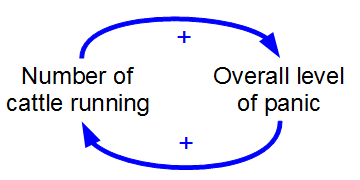
Causal loop diagram that depicts the causes of a stampede as a positive feedback loop. Alarm or panic can sometimes be spread by positive feedback among a herd of animals to cause a stampede.
In sociology a network effect can quickly create the positive feedback of a bank run. The above photo is of the UK Northern Rock 2007 bank run.

Positive feedback (exacerbating feedback, self-reinforcing feedback) is a process that occurs in a feedback loop where the outcome of a process reinforces the inciting process to build momentum. As such, these forces can exacerbate the effects of a small disturbance. That is, the effects of a perturbation on a system include an increase in the magnitude of the perturbation.[1] That is, A produces more of B which in turn produces more of A.[2] In contrast, a system in which the results of a change act to reduce or counteract it has negative feedback.[1][3] Both concepts play an important role in science and engineering, including biology, chemistry, and cybernetics.

Mathematically, positive feedback is defined as a positive loop gain around a closed loop of cause and effect.[1][3] That is, positive feedback is in phase with the input, in the sense that it adds to make the input larger.[4][5] Positive feedback tends to cause system instability. When the loop gain is positive and above 1, there will typically be exponential growth, increasing oscillations, chaotic behavior or other divergences from equilibrium.[3] System parameters will typically accelerate towards extreme values, which may damage or destroy the system, or may end with the system latched into a new stable state. Positive feedback may be controlled by signals in the system being filtered, damped, or limited, or it can be cancelled or reduced by adding negative feedback.

Positive feedback is used in digital electronics to force voltages away from intermediate voltages into '0' and '1' states. On the other hand, thermal runaway is a type of positive feedback that can destroy semiconductor junctions. Positive feedback in chemical reactions can increase the rate of reactions, and in some cases can lead to explosions. Positive feedback in mechanical design causes tipping-point, or over-centre, mechanisms to snap into position, for example in switches and locking pliers. Out of control, it can cause bridges to collapse. Positive feedback in economic systems can cause boom-then-bust cycles. A familiar example of positive feedback is the loud squealing or howling sound produced by audio feedback in public address systems: the microphone picks up sound from its own loudspeakers, amplifies it, and sends it through the speakers again.

Platelet clotting demonstrates positive feedback. The damaged blood vessel wall releases chemicals that initiate the formation of a blood clot through platelet congregation. As more platelets gather, more chemicals are released that speed up the process. The process gets faster and faster until the blood vessel wall is completely sealed and the positive feedback loop has ended. The exponential form of the graph illustrates the positive feedback mechanism.

Overview

[edit]

Positive feedback enhances or amplifies an effect by it having an influence on the process which gave rise to it. For example, when part of an electronic output signal returns to the input, and is in phase with it, the system gain is increased.[6] The feedback from the outcome to the originating process can be direct, or it can be via other state variables.[3] Such systems can give rich qualitative behaviors, but whether the feedback is instantaneously positive or negative in sign has an extremely important influence on the results.[3] Positive feedback reinforces and negative feedback moderates the original process. Positive and negative in this sense refer to loop gains greater than or less than zero, and do not imply any value judgements as to the desirability of the outcomes or effects.[7] A key feature of positive feedback is thus that small disturbances get bigger. When a change occurs in a system, positive feedback causes further change, in the same direction.

Basic

[edit]
A basic feedback system can be represented by this block diagram. In the diagram the + symbol is an adder and A and B are arbitrary causal functions.

A simple feedback loop is shown in the diagram. If the loop gain AB is positive, then a condition of positive or regenerative feedback exists.

If the functions A and B are linear and AB is smaller than unity, then the overall system gain from the input to output is finite but can be very large as AB approaches unity.[8] In that case, it can be shown that the overall or loop gain from input to output is:

When AB > 1, the system is unstable, so does not have a well-defined gain; the gain may be called infinite.

Thus depending on the feedback, state changes can be convergent, or divergent. The result of positive feedback is to augment changes, so that small perturbations may result in big changes.

A system in equilibrium in which there is positive feedback to any change from its current state may be unstable, in which case the system is said to be in an unstable equilibrium. The magnitude of the forces that act to move such a system away from its equilibrium is an increasing function of the distance of the state from the equilibrium.

Positive feedback does not necessarily imply instability of an equilibrium, for example stable on and off states may exist in positive-feedback architectures.[9]

Hysteresis

[edit]
Hysteresis causes the output value to depend on the history of the input.
In a Schmitt trigger circuit, feedback to the non-inverting input of an amplifier pushes the output directly away from the applied voltage towards the maximum or minimum voltage the amplifier can generate.

In the real world, positive feedback loops typically do not cause ever-increasing growth but are modified by limiting effects of some sort. According to Donella Meadows:

"Positive feedback loops are sources of growth, explosion, erosion, and collapse in systems. A system with an unchecked positive loop ultimately will destroy itself. That's why there are so few of them. Usually, a negative loop will kick in sooner or later."[10]

Hysteresis, in which the starting point affects where the system ends up, can be generated by positive feedback. When the gain of the feedback loop is above 1, then the output moves away from the input: if it is above the input, then it moves towards the nearest positive limit, while if it is below the input then it moves towards the nearest negative limit.

Once it reaches the limit, it will be stable. However, if the input goes past the limit,[clarification needed] then the feedback will change sign[dubiousdiscuss] and the output will move in the opposite direction until it hits the opposite limit. The system therefore shows bistable behaviour.

Terminology

[edit]

The terms positive and negative were first applied to feedback before World War II. The idea of positive feedback was already current in the 1920s with the introduction of the regenerative circuit.[11]

Friis & Jensen (1924) described regeneration in a set of electronic amplifiers as a case where the "feed-back" action is positive in contrast to negative feed-back action, which they mention only in passing.[12] Harold Stephen Black's classic 1934 paper first details the use of negative feedback in electronic amplifiers. According to Black:

"Positive feed-back increases the gain of the amplifier, negative feed-back reduces it."[13]

According to Mindell (2002) confusion in the terms arose shortly after this:

"...Friis and Jensen had made the same distinction Black used between 'positive feed-back' and 'negative feed-back', based not on the sign of the feedback itself but rather on its effect on the amplifier's gain. In contrast, Nyquist and Bode, when they built on Black's work, referred to negative feedback as that with the sign reversed. Black had trouble convincing others of the utility of his invention in part because confusion existed over basic matters of definition."[11]: 121 

These confusions, along with the everyday associations of positive with good and negative with bad, have led many systems theorists to propose alternative terms. For example, Donella Meadows prefers the terms reinforcing and balancing feedbacks.[14]

Examples and applications

[edit]

In electronics

[edit]
A vintage style regenerative radio receiver. Due to the controlled use of positive feedback, sufficient amplification can be derived from a single vacuum tube or valve (centre).

Regenerative circuits were invented and patented in 1914[15] for the amplification and reception of very weak radio signals. Carefully controlled positive feedback around a single transistor amplifier can multiply its gain by 1,000 or more.[16] Therefore, a signal can be amplified 20,000 or even 100,000 times in one stage, that would normally have a gain of only 20 to 50. The problem with regenerative amplifiers working at these very high gains is that they easily become unstable and start to oscillate. The radio operator has to be prepared to tweak the amount of feedback fairly continuously for good reception. Modern radio receivers use the superheterodyne design, with many more amplification stages, but much more stable operation and no positive feedback.

The oscillation that can break out in a regenerative radio circuit is used in electronic oscillators. By the use of tuned circuits or a piezoelectric crystal (commonly quartz), the signal that is amplified by the positive feedback remains linear and sinusoidal. There are several designs for such harmonic oscillators, including the Armstrong oscillator, Hartley oscillator, Colpitts oscillator, and the Wien bridge oscillator. They all use positive feedback to create oscillations.[17]

Many electronic circuits, especially amplifiers, incorporate negative feedback. This reduces their gain, but improves their linearity, input impedance, output impedance, and bandwidth, and stabilises all of these parameters, including the loop gain. These parameters also become less dependent on the details of the amplifying device itself, and more dependent on the feedback components, which are less likely to vary with manufacturing tolerance, age and temperature. The difference between positive and negative feedback for AC signals is one of phase: if the signal is fed back out of phase, the feedback is negative and if it is in phase the feedback is positive. One problem for amplifier designers who use negative feedback is that some of the components of the circuit will introduce phase shift in the feedback path. If there is a frequency (usually a high frequency) where the phase shift reaches 180°, then the designer must ensure that the amplifier gain at that frequency is very low (usually by low-pass filtering). If the loop gain (the product of the amplifier gain and the extent of the positive feedback) at any frequency is greater than one, then the amplifier will oscillate at that frequency (Barkhausen stability criterion). Such oscillations are sometimes called parasitic oscillations. An amplifier that is stable in one set of conditions can break into parasitic oscillation in another. This may be due to changes in temperature, supply voltage, adjustment of front-panel controls, or even the proximity of a person or other conductive item.

Amplifiers may oscillate gently in ways that are hard to detect without an oscilloscope, or the oscillations may be so extensive that only a very distorted or no required signal at all gets through, or that damage occurs. Low frequency parasitic oscillations have been called 'motorboating' due to the similarity to the sound of a low-revving exhaust note.[18]

The effect of using a Schmitt trigger (B) instead of a comparator (A)

Many common digital electronic circuits employ positive feedback. While normal simple Boolean logic gates usually rely simply on gain to push digital signal voltages away from intermediate values to the values that are meant to represent Boolean '0' and '1', but many more complex gates use feedback. When an input voltage is expected to vary in an analogue way, but sharp thresholds are required for later digital processing, the Schmitt trigger circuit uses positive feedback to ensure that if the input voltage creeps gently above the threshold, the output is forced smartly and rapidly from one logic state to the other. One of the corollaries of the Schmitt trigger's use of positive feedback is that, should the input voltage move gently down again past the same threshold, the positive feedback will hold the output in the same state with no change. This effect is called hysteresis: the input voltage has to drop past a different, lower threshold to 'un-latch' the output and reset it to its original digital value. By reducing the extent of the positive feedback, the hysteresis-width can be reduced, but it can not entirely be eradicated. The Schmitt trigger is, to some extent, a latching circuit.[19]

Positive feedback is a mechanism by which an output is enhanced, such as protein levels. However, in order to avoid any fluctuation in the protein level, the mechanism is inhibited stochastically (I), therefore when the concentration of the activated protein (A) is past the threshold ([I]), the loop mechanism is activated and the concentration of A increases exponentially if d[A]=k [A].
Illustration of an R-S ('reset-set') flip-flop made from two digital nor gates with positive feedback. Red and black mean logical '1' and '0', respectively.

An electronic flip-flop, or "latch", or "bistable multivibrator", is a circuit that due to high positive feedback is not stable in a balanced or intermediate state. Such a bistable circuit is the basis of one bit of electronic memory. The flip-flop uses a pair of amplifiers, transistors, or logic gates connected to each other so that positive feedback maintains the state of the circuit in one of two unbalanced stable states after the input signal has been removed until a suitable alternative signal is applied to change the state.[20] Computer random access memory (RAM) can be made in this way, with one latching circuit for each bit of memory.[21]

Thermal runaway occurs in electronic systems because some aspect of a circuit is allowed to pass more current when it gets hotter, then the hotter it gets, the more current it passes, which heats it some more and so it passes yet more current. The effects are usually catastrophic for the device in question. If devices have to be used near to their maximum power-handling capacity, and thermal runaway is possible or likely under certain conditions, improvements can usually be achieved by careful design.[22]

A phonograph turntable is prone to acoustic feedback.

Audio and video systems can demonstrate positive feedback. If a microphone picks up the amplified sound output of loudspeakers in the same circuit, then howling and screeching sounds of audio feedback (at up to the maximum power capacity of the amplifier) will be heard, as random noise is re-amplified by positive feedback and filtered by the characteristics of the audio system and the room.

Audio and live music

[edit]

Audio feedback (also known as acoustic feedback, simply as feedback, or the Larsen effect) is a special kind of positive feedback which occurs when a sound loop exists between an audio input (for example, a microphone or guitar pickup) and an audio output (for example, a loudly-amplified loudspeaker). In this example, a signal received by the microphone is amplified and passed out of the loudspeaker. The sound from the loudspeaker can then be received by the microphone again, amplified further, and then passed out through the loudspeaker again. The frequency of the resulting sound is determined by resonance frequencies in the microphone, amplifier, and loudspeaker, the acoustics of the room, the directional pick-up and emission patterns of the microphone and loudspeaker, and the distance between them. For small PA systems the sound is readily recognized as a loud squeal or screech.

Feedback is almost always considered undesirable when it occurs with a singer's or public speaker's microphone at an event using a sound reinforcement system or PA system. Audio engineers use various electronic devices, such as equalizers and, since the 1990s, automatic feedback detection devices to prevent these unwanted squeals or screeching sounds, which detract from the audience's enjoyment of the event. On the other hand, since the 1960s, electric guitar players in rock music bands using loud guitar amplifiers and distortion effects have intentionally created guitar feedback to create a desirable musical effect. "I Feel Fine" by the Beatles marks one of the earliest examples of the use of feedback as a recording effect in popular music. It starts with a single, percussive feedback note produced by plucking the A string on Lennon's guitar. Artists such as the Kinks and the Who had already used feedback live, but Lennon remained proud of the fact that the Beatles were perhaps the first group to deliberately put it on vinyl. In one of his last interviews, he said, "I defy anybody to find a record—unless it's some old blues record in 1922—that uses feedback that way."[23]

The principles of audio feedback were first discovered by Danish scientist Søren Absalon Larsen. Microphones are not the only transducers subject to this effect. Phone cartridges can do the same, usually in the low-frequency range below about 100 Hz, manifesting as a low rumble. Jimi Hendrix was an innovator in the intentional use of guitar feedback in his guitar solos to create unique sound effects. He helped develop the controlled and musical use of audio feedback in electric guitar playing,[24] and later Brian May was a famous proponent of the technique.[25]

Video feedback

Video

[edit]

Similarly, if a video camera is pointed at a monitor screen that is displaying the camera's own signal, then repeating patterns can be formed on the screen by positive feedback. This video feedback effect was used in the opening sequences to the first ten seasons of the television program Doctor Who.

Switches

[edit]

In electrical switches, including bimetallic strip based thermostats, the switch usually has hysteresis in the switching action. In these cases hysteresis is mechanically achieved via positive feedback within a tipping point mechanism. The positive feedback action minimises the length of time arcing occurs for during the switching and also holds the contacts in an open or closed state.[26]

In biology

[edit]
Positive feedback is the amplification of a body's response to a stimulus. For example, in childbirth, when the head of the fetus pushes up against the cervix (1) it stimulates a nerve impulse from the cervix to the brain (2). When the brain is notified, it signals the pituitary gland to release a hormone called oxytocin(3). Oxytocin is then carried via the bloodstream to the uterus (4) causing contractions, pushing the fetus towards the cervix eventually inducing childbirth.

In physiology

[edit]

A number of examples of positive feedback systems may be found in physiology.

  • One example is the onset of contractions in childbirth, known as the Ferguson reflex. When a contraction occurs, the hormone oxytocin causes a nerve stimulus, which stimulates the hypothalamus to produce more oxytocin, which increases uterine contractions. This results in contractions increasing in amplitude and frequency.[27]: 924–925 
  • Another example is the process of blood clotting. The loop is initiated when injured tissue releases signal chemicals that activate platelets in the blood. An activated platelet releases chemicals to activate more platelets, causing a rapid cascade and the formation of a blood clot.[27]: 392–394 
  • Lactation also involves positive feedback in that as the baby suckles on the nipple there is a nerve response into the spinal cord and up into the hypothalamus of the brain, which then stimulates the pituitary gland to produce more prolactin to produce more milk.[27]: 926 
  • A spike in estrogen during the follicular phase of the menstrual cycle causes ovulation.[27]: 907 
  • The generation of nerve signals is another example, in which the membrane of a nerve fibre causes slight leakage of sodium ions through sodium channels, resulting in a change in the membrane potential, which in turn causes more opening of channels, and so on (Hodgkin cycle). So a slight initial leakage results in an explosion of sodium leakage which creates the nerve action potential.[27]: 59 
  • In excitation–contraction coupling of the heart, an increase in intracellular calcium ions to the cardiac myocyte is detected by ryanodine receptors in the membrane of the sarcoplasmic reticulum which transport calcium out into the cytosol in a positive feedback physiological response.

In most cases, such feedback loops culminate in counter-signals being released that suppress or break the loop. Childbirth contractions stop when the baby is out of the mother's body. Chemicals break down the blood clot. Lactation stops when the baby no longer nurses.[27]

In gene regulation

[edit]

Positive feedback is a well-studied phenomenon in gene regulation, where it is most often associated with bistability. Positive feedback occurs when a gene activates itself directly or indirectly via a double negative feedback loop. Genetic engineers have constructed and tested simple positive feedback networks in bacteria to demonstrate the concept of bistability.[28] A classic example of positive feedback is the lac operon in E. coli. Positive feedback plays an integral role in cellular differentiation, development, and cancer progression, and therefore, positive feedback in gene regulation can have significant physiological consequences. Random motions in molecular dynamics coupled with positive feedback can trigger interesting effects, such as create population of phenotypically different cells from the same parent cell.[29] This happens because noise can become amplified by positive feedback. Positive feedback can also occur in other forms of cell signaling, such as enzyme kinetics or metabolic pathways.[30]

In evolutionary biology

[edit]

Positive feedback loops have been used to describe aspects of the dynamics of change in biological evolution. For example, beginning at the macro level, Alfred J. Lotka (1945) argued that the evolution of the species was most essentially a matter of selection that fed back energy flows to capture more and more energy for use by living systems.[31] At the human level, Richard D. Alexander (1989) proposed that social competition between and within human groups fed back to the selection of intelligence thus constantly producing more and more refined human intelligence.[32] Crespi (2004) discussed several other examples of positive feedback loops in evolution.[33] The analogy of evolutionary arms races provides further examples of positive feedback in biological systems.[34]

During the Phanerozoic the biodiversity shows a steady but not monotonic increase from near zero to several thousands of genera.

It has been shown that changes in biodiversity through the Phanerozoic correlate much better with hyperbolic model (widely used in demography and macrosociology) than with exponential and logistic models (traditionally used in population biology and extensively applied to fossil biodiversity as well). The latter models imply that changes in diversity are guided by first-order positive feedback (more ancestors, more descendants) or a negative feedback arising from resource limitation. The hyperbolic model implies a second-order positive feedback. The hyperbolic pattern of the world population growth has been demonstrated (see below) to arise from second-order positive feedback between the population size and the rate of technological growth. The hyperbolic character of biodiversity growth can be similarly accounted for by a positive feedback between the diversity and community structure complexity. It has been suggested that the similarity between the curves of biodiversity and human population probably comes from the fact that both are derived from the interference of the hyperbolic trend (produced by the positive feedback) with cyclical and stochastic dynamics.[35][36]

Immune system

[edit]

A cytokine storm, or hypercytokinemia is a potentially fatal immune reaction consisting of a positive feedback loop between cytokines and immune cells, with highly elevated levels of various cytokines.[37] In normal immune function, positive feedback loops can be utilized to enhance the action of B lymphocytes. When a B cell binds its antibodies to an antigen and becomes activated, it begins releasing antibodies and secreting a complement protein called C3. Both C3 and a B cell's antibodies can bind to a pathogen, and when a B cell has its antibodies bind to a pathogen with C3, it speeds up that B cell's secretion of more antibodies and more C3, thus creating a positive feedback loop.[38]

Cell death

[edit]

Apoptosis is a caspase-mediated process of cellular death, whose aim is the removal of long-lived or damaged cells. A failure of this process has been implicated in prominent conditions such as cancer or Parkinson's disease. The very core of the apoptotic process is the auto-activation of caspases, which may be modelled via a positive-feedback loop. This positive feedback exerts an auto-activation of the effector caspase by means of intermediate caspases. When isolated from the rest of apoptotic pathway, this positive feedback presents only one stable steady state, regardless of the number of intermediate activation steps of the effector caspase.[9] When this core process is complemented with inhibitors and enhancers of caspases effects, this process presents bistability, thereby modelling the alive and dying states of a cell.[39]

In psychology

[edit]

Winner (1996) described gifted children as driven by positive feedback loops involving setting their own learning course, this feeding back satisfaction, thus further setting their learning goals to higher levels and so on.[40] Winner termed this positive feedback loop as a rage to master. Vandervert (2009a, 2009b) proposed that the child prodigy can be explained in terms of a positive feedback loop between the output of thinking/performing in working memory, which then is fed to the cerebellum where it is streamlined, and then fed back to working memory thus steadily increasing the quantitative and qualitative output of working memory.[41][42] Vandervert also argued that this working memory/cerebellar positive feedback loop was responsible for language evolution in working memory.

In economics

[edit]

Markets with social influence

[edit]

Product recommendations and information about past purchases have been shown to influence consumers' choices significantly whether it is for music, movie, book, technological, and other type of products. Social influence often induces a rich-get-richer phenomenon (Matthew effect) where popular products tend to become even more popular.[43]

Market dynamics

[edit]

According to the theory of reflexivity advanced by George Soros, price changes are driven by a positive feedback process whereby investors' expectations are influenced by price movements so their behaviour acts to reinforce movement in that direction until it becomes unsustainable, whereupon the feedback drives prices in the opposite direction.[44]

In social media

[edit]

Programs such as Facebook and Twitter depend on positive feedback to create interest in topics and drive the take-up of the media.[45][46] In the age of smartphones and social media, the feedback loop has created a craze for virtual validation in the form of likes, shares, and FOMO (fear of missing out).[47] This is intensified by the use of bots which are designed to respond to particular words or themes and transmit posts more widely. [48]

What is called negative feedback in social media should often be regarded as positive feedback in this context. Outrageous statements and negative comments often produce much more feedback than positive comments.

Systemic risk

[edit]

Systemic risk is the risk that an amplification or leverage or positive feedback process presents to a system. This is usually unknown, and under certain conditions, this process can amplify exponentially and rapidly lead to destructive or chaotic behaviour. A Ponzi scheme is a good example of a positive-feedback system: funds from new investors are used to pay out unusually high returns, which in turn attract more new investors, causing rapid growth toward collapse. W. Brian Arthur has also studied and written on positive feedback in the economy (e.g. W. Brian Arthur, 1990).[49] Hyman Minsky proposed a theory that certain credit expansion practices could make a market economy into "a deviation amplifying system" that could suddenly collapse,[50] sometimes called a Minsky moment.

Simple systems that clearly separate the inputs from the outputs are not prone to systemic risk. This risk is more likely as the complexity of the system increases because it becomes more difficult to see or analyze all the possible combinations of variables in the system even under careful stress testing conditions. The more efficient a complex system is, the more likely it is to be prone to systemic risks because it takes only a small amount of deviation to disrupt the system. Therefore, well-designed complex systems generally have built-in features to avoid this condition, such as a small amount of friction, or resistance, or inertia, or time delay to decouple the outputs from the inputs within the system. These factors amount to an inefficiency, but they are necessary to avoid instabilities.

The 2010 Flash Crash incident was blamed on the practice of high-frequency trading (HFT),[51] although whether HFT really increases systemic risk remains controversial.[citation needed]

Human population growth

[edit]

Agriculture and human population can be considered to be in a positive feedback mode,[52] which means that one drives the other with increasing intensity. It is suggested that this positive feedback system will end sometime with a catastrophe, as modern agriculture is using up all of the easily available phosphate and is resorting to highly efficient monocultures which are more susceptible to systemic risk.

Technological innovation and human population can be similarly considered, and this has been offered as an explanation for the apparent hyperbolic growth of the human population in the past, instead of a simpler exponential growth.[53] It is proposed that the growth rate is accelerating because of second-order positive feedback between population and technology.[54]: 133–160  Technological growth increases the carrying capacity of land for people, which leads to a growing population, and this in turn drives further technological growth.[54]: 146 [55]

Prejudice, social institutions and poverty

[edit]

Gunnar Myrdal described a vicious circle of increasing inequalities, and poverty, which is known as circular cumulative causation.[56]

James Moody, Assistant Professor at Ohio State University, states that students who self-segregate or grow up in segregated environments have "little meaningful exposure to other races because they never form relationships with students of another race...[; as a result,...] they are viewing other racial groups at a social distance, which can bolster stereotypes," which ultimately causes a positive feedback loop in which segregated groups become more prejudiced, polarized, and segregated against each other, similar to that of political polarization.[57]

In meteorology

[edit]

Drought intensifies through positive feedback. A lack of rain decreases soil moisture, which kills plants or causes them to release less water through transpiration. Both factors limit evapotranspiration, the process by which water vapour is added to the atmosphere from the surface, and add dry dust to the atmosphere, which absorbs water. Less water vapour means both low dew point temperatures and more efficient daytime heating, decreasing the chances of humidity in the atmosphere leading to cloud formation. Lastly, without clouds, there cannot be rain, and the loop is complete.[58]

In climatology

[edit]
Human-caused increases in greenhouse gases stimulate positive feedback in global warming.
Some effects of global warming can either enhance (positive feedbacks) or inhibit (negative feedbacks) warming.[59][60]
Globally, wildfires and deforestation have reduced forests' net absorption of greenhouse gases, reducing their effectiveness at mitigating climate change.[61] Global warming increases forest fires that release more greenhouse gases, creating a positive feedback loop that causes more warming.[62]
Over recent decades, "forest disturbance" (damage) by fire has increased in most of the planet's forest zones.[63] The increase in area, frequency, and severity of forest fires creates a positive feedback that increases global warming.[63]

Climate forcings may push a climate system in the direction of warming or cooling,[64] for example, increased atmospheric concentrations of greenhouse gases cause warming at the surface. Forcings are external to the climate system and feedbacks are internal processes of the system. Some feedback mechanisms act in relative isolation to the rest of the climate system while others are tightly coupled.[65] Forcings, feedbacks and the dynamics of the climate system determine how much and how fast the climate changes. The main positive feedback in global warming is the tendency of warming to increase the amount of water vapour in the atmosphere, which in turn leads to further warming.[66] The main negative feedback comes from the Stefan–Boltzmann law, the amount of heat radiated from the Earth into space is proportional to the fourth power of the temperature of Earth's surface and atmosphere.

Other examples of positive feedback subsystems in climatology include:

  • A warmer atmosphere melts ice, changing the albedo (surface reflectivity), which further warms the atmosphere.
  • Methane hydrates can be unstable so that a warming ocean could release more methane, which is also a greenhouse gas.
  • Peat, occurring naturally in peat bogs, contains carbon. When peat dries it decomposes, and may additionally burn. Peat also releases nitrous oxide.
  • Global warming affects the cloud distribution. Clouds at higher altitudes enhance the greenhouse effects, while low clouds mainly reflect back sunlight, having opposite effects on temperature.

The Intergovernmental Panel on Climate Change (IPCC) Fourth Assessment Report states that "Anthropogenic warming could lead to some effects that are abrupt or irreversible, depending upon the rate and magnitude of the climate change."[67]

In sociology

[edit]

A self-fulfilling prophecy is a social positive feedback loop between beliefs and behaviour: if enough people believe that something is true, their behaviour can make it true, and observations of their behaviour may in turn increase belief. A classic example is a bank run.

Another sociological example of positive feedback is the network effect. When more people are encouraged to join a network this increases the reach of the network therefore the network expands ever more quickly. A viral video is an example of the network effect in which links to a popular video are shared and redistributed, ensuring that more people see the video and then re-publish the links. This is the basis for many social phenomena, including Ponzi schemes and chain letters. In many cases, population size is the limiting factor to the feedback effect.

In political science

[edit]

In politics, institutions can reinforce norms, which can subsequently be a source of positive feedback. This rationale is frequently utilized to comprehend public policy processes, which may be dissected into a sequence of events. Self-reinforcing processes are understood to be affected by positive feedback mechanisms (e.g., supportive policy constituencies).[68] Conversely, unsuccessful policy processes encounter negative feedback mechanisms (e.g., veto points with veto power).[69]

A comparative illustration of policy feedback can be observed in the economic foreign policies of Brazil and China, particularly in their execution of state capitalism tactics during the 1990s and 2000s.[70] Although both nations initially embraced similar state capitalist ideas, their paths in executing economic policies diverged over time due to distinct incentives. In China, a positive feedback mechanism reinforced previous policies, whereas in Brazil, negative feedback mechanisms compelled the country to abandon state capitalism policies and dynamics.

In chemistry

[edit]

If a chemical reaction causes the release of heat, and the reaction itself happens faster at higher temperatures, then there is a high likelihood of positive feedback. If the heat produced is not removed from the reactants fast enough, thermal runaway can occur and very quickly lead to a chemical explosion.

In conservation

[edit]

Many wildlife are hunted for their parts which can be quite valuable. The closer to extinction that targeted species become, the higher the price there is on their parts.[71]

See also

[edit]

References

[edit]

Further reading

[edit]
[edit]
Revisions and contributorsEdit on WikipediaRead on Wikipedia
from Grokipedia
Positive feedback refers to a dynamic in systems where an initial perturbation or change in a variable elicits responses that amplify rather than dampen the deviation, thereby accelerating the system's departure from equilibrium and often culminating in , , or qualitative shifts such as phase transitions. This mechanism contrasts sharply with , which stabilizes systems by counteracting deviations, and arises from causal loops where outputs reinforce inputs, as formalized in by loop gains exceeding unity in magnitude with positive sign. In mathematical terms, for a simple , the effective gain Gc=A1ABG_c = \frac{A}{1 - AB} diverges or becomes unbounded when the feedback factor ABAB approaches or exceeds 1, illustrating the inherent potential for runaway amplification. Positive feedback manifests across diverse domains, from electronic circuits where it enables oscillators and bistable switches essential for digital logic and , to biological processes like the oxytocin-mediated intensification of during labor, which drives to completion despite the rarity of such loops in due to their destabilizing nature. In ecological and climatic systems, it underlies phenomena such as the ice-albedo effect, where melting polar ice exposes darker surfaces that absorb more solar radiation, thereby hastening further warming and ice loss, a causal chain empirically observed in regions. These loops can engender , where system states depend on history due to multiple stable points separated by unstable regions, as seen in Schmitt triggers used in for noise-immune switching. While positive feedback is indispensable for rapid transitions and innovation—such as in evolutionary bursts or technological avalanches—it poses risks of catastrophic instability, as evidenced in financial panics where rising panic sells more assets, deepening market crashes, underscoring the need for countervailing negative feedbacks or external interventions to avert collapse. Empirical studies in complex adaptive systems highlight that unchecked positive feedbacks dominate short-term dynamics but are typically bounded by nonlinear saturations or resource limits, preventing indefinite escalation.

Definition and Fundamentals

Core Mechanism and First-Principles Explanation

Positive feedback is a dynamic process in which the output or effect of a system acts to reinforce or amplify the initial stimulus or perturbation, thereby accelerating change away from the system's prior state or equilibrium. This reinforcement occurs through a causal loop where the consequence of an action causally promotes more of that same action, creating a self-perpetuating cycle of escalation. From first principles, envision a basic unidirectional causal chain: a small deviation δ in a variable triggers a response that proportionally increases δ by a factor greater than unity, such that subsequent iterations compound the deviation multiplicatively, as in δ_{n+1} = δ_n + g δ_n where g > 0 represents the gain of the reinforcing link./11:_Control_Architectures/11.01:_Feedback_control-_What_is_it_When_useful_When_not_Common_usage.) This mechanism inherently destabilizes the system, contrasting with oppositional dynamics that would dampen deviations. In terms of loop structure, positive feedback emerges when the product of causal influences around a closed loop yields net reinforcement, often determined by an even number of inhibitory (negative) couplings, ensuring the overall polarity aligns deviations in the same direction. Causally, this manifests as a chain where upstream effects propagate downstream to enhance upstream drivers, such as in a where growth rate depends positively on current population size, leading to exponential expansion until resource limits intervene. Empirical observation confirms this amplification in diverse domains, from ionic sodium influx during neuronal action potentials—where opens more sodium channels, further depolarizing the —or in processes where initial slides dislodge more material, accelerating descent. Such loops lack intrinsic stabilization, relying on external bounds like saturation or depletion to prevent indefinite runaway, underscoring their role in transient bursts or bifurcations rather than steady states.

Mathematical Formulation

In control theory, positive feedback systems are mathematically described using transfer functions derived from block diagrams where the feedback signal reinforces the input. For a basic positive feedback loop consisting of a forward path gain GG and feedback path gain HH, the closed-loop transfer function TT is given by T=G1GHT = \frac{G}{1 - GH}. This contrasts with negative feedback, where the denominator is 1+GH1 + GH. The term GHGH represents the loop gain; when GH>1|GH| > 1, the system becomes unstable, leading to exponential amplification or divergence. Stability analysis relies on the characteristic equation 1GH=01 - GH = 0, with determining system poles. For linear time-invariant systems, poles in the right-half s-plane (positive real parts) indicate instability characteristic of positive feedback. In the time domain, a simple positive feedback process can be modeled by the dxdt=rx\frac{dx}{dt} = rx, where r>0r > 0 is the growth rate constant. The solution is x(t)=x0ertx(t) = x_0 e^{rt}, exhibiting unbounded from initial condition x0x_0. For discrete-time systems, positive feedback manifests as xn+1=axnx_{n+1} = a x_n with a>1|a| > 1, yielding xn=x0anx_n = x_0 a^n, which diverges for large nn. In nonlinear contexts, such as bistable switches, positive feedback introduces , modeled by equations like dxdt=f(x)δ\frac{dx}{dt} = f(x) - \delta, where f(x)f(x) has sigmoidal shape, creating multiple steady states separated by thresholds. Empirical validation in electronic circuits, such as op-amp configurations, confirms that loop gains exceeding trigger saturation or , aligning with the A1AB\frac{A}{1 - AB} gain where AA is and BB is feedback .

Comparison to Negative Feedback

Positive feedback mechanisms amplify perturbations to a system's equilibrium state, driving exponential divergence or phase transitions, in contrast to , which counteracts such perturbations to restore balance and maintain . In causal terms, positive feedback reinforces the initial change through a loop gain exceeding unity (where loop gain βA > 1), potentially leading to saturation, , or collapse, whereas employs a loop gain less than unity (βA < 1 in effective opposition), damping oscillations and minimizing error signals over time. Mathematically, the closed-loop transfer function for positive feedback is G(s)=A(s)1A(s)β(s)G(s) = \frac{A(s)}{1 - A(s)\beta(s)}, which becomes unstable and unbounded as the denominator approaches zero, enabling applications like bistable switches but risking runaway behavior; negative feedback, formulated as G(s)=A(s)1+A(s)β(s)G(s) = \frac{A(s)}{1 + A(s)\beta(s)}, yields stable gain reduction and bandwidth extension, as the denominator increases with feedback strength. This distinction holds across domains: in biology, negative loops predominate for regulatory processes like insulin-mediated blood glucose control, where deviations trigger opposing responses to converge on set points, while positive loops are transient, as in oxytocin-driven labor contractions that escalate until delivery. Empirically, negative feedback enhances system robustness against noise and parameter variations, as evidenced by its ubiquity in amplifiers where it reduces distortion by factors of 10–1000 depending on gain, whereas positive feedback is selectively used for deliberate instability, such as in that snap between states with minimal input hysteresis widths of millivolts. In ecological or climatic contexts, negative feedbacks like increased plant growth absorbing CO₂ can offset forcings by 20–50% in models, stabilizing trajectories, while unchecked positive feedbacks, such as ice-albedo loss amplifying warming by 0.2–0.5°C per decade in Arctic simulations, accelerate tipping points without inherent bounds. Thus, positive feedback inherently promotes disequilibrium for rapid transitions, but negative feedback underpins long-term viability by enforcing causal corrections.

General Characteristics and Dynamics

Amplification Processes

Positive feedback processes amplify initial changes within a system by recirculating a portion of the output to reinforce the input, resulting in magnified deviations from equilibrium. This occurs when the feedback is in phase with the input signal, causing the system's response to grow iteratively rather than stabilize. In linear models, the closed-loop gain Acl=A1βAA_{cl} = \frac{A}{1 - \beta A}, where AA is the open-loop gain and β\beta is the feedback fraction, exceeds AA for 0<βA<10 < \beta A < 1, demonstrating inherent amplification as the denominator 1βA1 - \beta A falls below unity. As βA\beta A approaches 1, the gain surges toward infinity, marking the boundary of linear amplification and the onset of instability. Beyond this point, where βA>1\beta A > 1, the denominator becomes negative or the system diverges, leading to described by dynamics such as x˙=αx\dot{x} = \alpha x with α>0\alpha > 0, yielding x(t)=x0eαtx(t) = x_0 e^{\alpha t}. This runaway amplification persists until nonlinearities, such as saturation, impose limits, preventing indefinite expansion. Empirical observations confirm that positive feedback heightens sensitivity to perturbations, contrasting with in , and is exploited in scenarios demanding rapid escalation, like signal boosting, though it risks overshoot or without constraints. For instance, in controlled experiments with operational amplifiers, positive feedback configurations achieve gains orders of magnitude higher than open-loop values before latching into saturated states. These processes underscore the causal chain where small inputs cascade into outsized outputs via self-reinforcement, bounded only by physical or engineered thresholds.

Hysteresis and Threshold Effects

In positive feedback systems, manifests as a dependence of the system's state on its prior history, resulting in distinct paths for state transitions under increasing versus decreasing inputs. This phenomenon arises when the feedback loop generates multiple stable equilibria, or , where the system resists changes until an external perturbation exceeds specific thresholds. For instance, a simple positive feedback model can exhibit two stable states separated by an unstable equilibrium, leading to abrupt switching only when the input surpasses upper or lower thresholds, creating a "memory" effect that prevents oscillations from noise. Threshold effects in such systems occur at the critical points where the net feedback gain equals unity, tipping the dynamics from stability to runaway amplification or collapse. Positive feedback amplifies deviations around these thresholds, often modeled as saddle-node bifurcations where stable and unstable fixed points coalesce and annihilate, enforcing irreversible shifts once crossed. In mathematical terms, for a x˙=rx(1x)+βx2\dot{x} = rx(1 - x) + \beta x^2 with positive feedback term βx2\beta x^2, emerges for certain rr and β\beta, yielding loops as input varies. Empirical detection of these effects in feedback networks involves analyzing for multiple steady states via and root-finding algorithms. These properties enable robust switching behaviors, as seen in linked positive feedback loops that sustain bistable responses against perturbations, with hysteresis widths tunable by feedback strength. In non-cooperative circuits, emergent bistability can still produce hysteresis through growth-modulating feedbacks, countering expectations from classical ultrasensitivity requirements. Thresholds thus define regime boundaries, beyond which positive reinforcement precludes return to prior states without significant reversal forces.

Bounds, Saturation, and Empirical Limits

In idealized linear models of positive feedback, the output grows exponentially without bound, as the loop gain exceeds unity, leading to or . However, real-world systems incorporate nonlinearities that impose saturation, where amplification ceases upon reaching physical or operational limits, such as finite energy supplies, material strengths, or capacity thresholds. These bounds manifest as the system's response plateauing or switching to a saturated state, preventing catastrophic runaway while enabling functions like or rapid transitions. ![Op-amp Schmitt trigger circuit illustrating saturation in positive feedback systems][float-right] In electronic control systems, operational amplifiers under positive feedback rapidly drive outputs to saturation at the power supply rails—typically +V_cc or -V_cc, such as ±12 V or ±15 V depending on the device—beyond which no further amplification occurs due to transistor limitations. This saturation enforces empirical limits observed in circuits like comparators or oscillators, where initial perturbations amplify until clipped, as quantified by the loop gain formula G=A1AβG = \frac{A}{1 - A\beta} approaching infinity but constrained by nonlinear gain compression. Experimental measurements in such systems confirm that response times enhance with feedback but halt at rail voltages, avoiding infinite escalation. Empirical data from exemplify these limits in Rayleigh-Taylor instabilities, where positive feedback accelerates interface growth, but nonlinear saturation caps amplitudes at finite values scaling with Atwood number and initial wavelengths; for instance, saturation times γts\gamma t_s follow γts(N)N/3\gamma t_s(N) \approx N/3 for mode N in classical regimes, halting exponential phases. Similarly, in biological positive feedback loops, such as cascades, signaling amplifies discretely but saturates via enzyme depletion or product inhibition, yielding switch-like dose-response curves with Hill coefficients up to 10, as measured in yeast mating pathways on December 2007 experiments. These observations underscore that while positive feedback amplifies perturbations, systemic finitude—evident in resource-constrained models like logistic equations overriding pure exponentials—imposes verifiable ceilings, with deviations from linearity appearing at gains exceeding 10-100 dB in diverse empirical setups.

Engineering and Physical Applications

Electronics and Control Theory

In electronics, positive feedback occurs when a portion of the output signal is fed back to the input in phase with the input, resulting in amplification of the signal and potential instability. This configuration increases the overall gain of the system, often leading to saturation or oscillation if the loop gain exceeds unity at a phase shift of 0° or 360°. For instance, in operational amplifier (op-amp) circuits, positive feedback applied to a comparator creates a Schmitt trigger, which introduces hysteresis to prevent noise-induced multiple switching near the threshold. The hysteresis width is determined by the feedback resistor ratio, typically providing thresholds at ±(R_f/R_in)V_ref, where R_f is the feedback resistor and R_in the input resistor. Positive feedback is essential in oscillator circuits, such as the , where it sustains sinusoidal output by maintaining loop gain of 1 at the resonant frequency, with the phase shift provided by the LC tank circuit. In bistable multivibrators or flip-flops, positive feedback locks the circuit into one of two stable states, useful for memory elements in digital logic; the transition occurs via an external trigger overcoming the . Regenerative receivers, pioneered by Armstrong in , employed positive feedback to amplify weak radio signals, achieving high sensitivity but risking if not tuned precisely. In , positive feedback amplifies deviations from the setpoint, promoting rather than correction, as the feedback signal adds to the error rather than subtracting from it. Systems with positive feedback exhibit in response, described by the G/(1 - GH) where GH > 0, leading to poles in the right-half s-plane and unbounded outputs unless limited by saturation. While generally avoided in stable control loops—such as servomechanisms where dominates for regulation—positive feedback finds niche applications, like in adaptive systems or to accelerate transient responses before switching to . criteria for positive feedback systems include loop gain exceeding 1, often analyzed via Nyquist or Bode plots showing encirclement of the -1 point. Empirical designs incorporate safeguards, such as gain limiting, to prevent runaway in amplifiers or controllers.

Acoustics, Optics, and Wave Phenomena

In acoustics, positive feedback arises in electroacoustic systems when output from a is captured by a nearby , forming a closed loop that amplifies sound waves at frequencies where the loop gain exceeds unity. This loop gain, comprising sensitivity, gain, , and acoustic between devices, results in of the signal until limited by system nonlinearities such as clipping or room acoustics. The phenomenon typically produces a high-pitched howl or squeal at the offering the highest gain path, often aligned with room resonances that enhance . Feedback onset requires the product of these gains to surpass 1, with phase alignment ensuring constructive reinforcement; delays from can select discrete frequencies via the Barkhausen criterion. Mitigation involves gain reduction, directional microphones, or equalization to attenuate resonant peaks, as uncontrolled feedback distorts audio and limits maximum levels in venues. In , positive feedback drives action through in a gain medium, where photons induce further emissions, and an reflects a portion of the output back into the medium to reinforce amplification. Lasing requires the round-trip gain to exceed cavity losses, establishing sustained oscillation as the feedback loop gain surpasses unity, producing coherent, monochromatic light. This process, first demonstrated in the on May 16, 1960, by , relies on in the gain medium to provide net amplification, with feedback via mirrors ensuring directional and frequency selection. Optical feedback strength determines threshold pump power; excessive external feedback can destabilize output, inducing chaos or mode hopping in lasers. Broader wave phenomena exhibit positive feedback in systems prone to , such as parametric amplification where a pump wave modulates a medium to transfer to signal waves, fostering if gain exceeds damping. In nonlinear wave propagation, feedback loops can generate solitons or trigger waves, as seen in certain chemical or fluid systems where local amplification propagates disturbances over distances. For electromagnetic waves, regenerative receivers employ positive feedback to amplify weak radio signals near the threshold, enhancing sensitivity but risking if loop gain exceeds 1. Acoustic feedback itself exemplifies wave self-, where standing waves in the room select feedback frequencies. These dynamics highlight how positive feedback in dispersive media can transition from amplification to limit-cycle , bounded by saturation effects.

Chemical and Material Systems

In chemical systems, positive feedback manifests primarily through , where a reaction product serves as a for its own production, thereby accelerating the rate of product formation exponentially after an initial threshold. This self-amplifying mechanism contrasts with standard catalytic processes by creating a loop in which the growing concentration of the autocatalyst drives further conversion of reactants, often exhibiting sigmoidal kinetics: a slow phase due to low initial catalyst levels, followed by rapid acceleration, and eventual saturation from reactant depletion or inhibition. The simplest mathematical model is the reaction A+B2AA + B \rightarrow 2A, where species A catalyzes the transformation of B into additional A, leading to unbounded growth in ideal conditions without resource limits. Autocatalytic sets have been observed in diverse chemical contexts, such as the - system, where autocatalytically reduces , producing spatial patterns via reaction-diffusion coupling that amplify local concentration gradients. In , the -catalyzed formation from —demonstrates hypercycle-like positive feedback, potentially relevant to prebiotic chemistry, though its instability limits practical yields. These loops are inherently unstable, prone to overshoot and termination, as the absence of built-in negative regulators allows runaway dynamics until external bounds intervene, such as in closed systems where product inhibition emerges. In material systems, positive feedback arises in phase transitions and processes, where initial events lower energy barriers for further structuring, propagating domain growth. For example, in liquid-liquid coupled with , demixing creates concentrated domains that enhance local reaction rates, forming Turing-like patterns in solutions or colloidal suspensions as of experiments reported in 2023. Similarly, explosive crystallization in amorphous solids, such as thin films of germanium or , involves a front propagating at speeds up to 10 m/s, driven by release that melts adjacent amorphous regions, facilitating rapid crystalline advancement until thermal dissipation halts the loop. These material instabilities underscore positive feedback's role in enabling rapid, threshold-dependent transformations, though empirical limits like or interface energies prevent indefinite amplification.

Biological and Evolutionary Contexts

Cellular and Physiological Loops

In cellular , positive feedback loops frequently generate bistable switches that enable irreversible commitments to states such as or , contrasting with graded responses by creating sharp transitions via mutual activation or inhibition of regulators. For instance, during mitotic entry, (CDK1) forms a positive feedback loop by phosphorylating and activating its activator while inhibiting its inactivator Wee1 , leading to rapid, all-or-none activation of CDK1-cyclin B complexes as of experiments in egg extracts showing spatial propagation of this feedback from centrosomes. This mechanism ensures temporal insulation of mitosis duration, with positive feedback maintaining high CDK1 activity to prevent premature exit, as demonstrated in cell lines where disrupting the loop prolongs by up to 50%. Such loops also underpin gene regulatory networks, where transcription factors auto-activate their own expression, fostering robustness in differentiation; linked positive feedbacks in synthetic circuits, for example, sustain memory of environmental signals for over 100 generations by opposing degradation. In , caspase-3 activates upstream caspases like , amplifying proteolytic cascades exponentially—initial traces of active caspase-3 (as low as 1% of total) trigger full activation within minutes in cell-free systems, illustrating amplification without external thresholds. At the physiological level, positive feedback drives discrete events like and parturition, where initial triggers escalate to completion. In blood coagulation, catalyzes its own production by activating factors , VIII, and XI, creating exponential amplification; a single tissue factor-exposed site generates over 10^15 molecules within seconds, sufficient to clot plasma volumes, with feedback confined by inhibitors like to prevent systemic . Similarly, during labor, Ferguson reflex stretching of cervical mechanoreceptors stimulates posterior pituitary release, intensifying myometrial contractions that further dilate the ; plasma peaks at 100-200 pg/mL during active phase, correlating with contraction forces exceeding 50 mmHg, culminating in expulsion as observed in and ovine models. These loops are bounded by saturation—e.g., oxytocin receptors upregulate only transiently before desensitization—or exhaustion of substrates, as in clotting where fibrin polymerization halts escalation; disruptions, such as genetic Wee1 overexpression, delay mitosis onset by hours, underscoring causal roles in timing. Empirical quantification via mathematical modeling confirms these amplify signals 10-100 fold over linear cascades, essential for decisiveness in noisy biological environments.

Gene Regulation and Development

Positive feedback loops in gene regulation facilitate rapid signal amplification and the generation of bistable states, enabling cells to commit irreversibly to specific fates by reinforcing transcriptional activation once a threshold is surpassed. In these loops, a often directly or indirectly activates its own promoter, accelerating the accumulation of the regulator and providing robustness against stochastic fluctuations in . This mechanism contrasts with linear activation, as it shortens response times—sometimes by factors of 10 or more in model systems—and stabilizes expression patterns essential for developmental precision. During embryonic development, positive autoregulation maintains transcription factor levels across cell generations, preventing dilution during proliferation and ensuring heritable cell identity. Homeotic (Hox) genes exemplify this, where mutual positive feedback between Hox factors like Hoxa2 and cofactors such as Meis sustains collinear expression domains along the body axis, critical for segmental patterning in vertebrates. In Caenorhabditis elegans, Hox-like genes in the Wnt pathway integrate positive feedback to buffer expression variability, keeping levels within narrow ranges despite perturbations, as quantified by reduced variance in reporter assays. In segmentation, positive feedback within the segment polarity network—mediated by Wingless (Wg) and Hedgehog (Hh) signaling—amplifies local cues to enforce bistable cell states, yielding uniform parasegment boundaries. Computational models of this network demonstrate that self-reinforcement in genes like engrailed and wingless confers robustness, with simulations showing pattern recovery after 20-50% parameter perturbations. Similarly, in mammalian , the basic helix-loop-helix factor Ptf1a forms a positive autofeedback loop that expands and maintains multipotent progenitors, as evidenced by disrupted acinar cell differentiation in knockout mice where loop interruption halves progenitor persistence. These loops often induce , where high activation thresholds differ from deactivation ones, allowing developmental decisions based on transient signals to persist, as seen in bistable models of autoregulatory circuits with Hill coefficients exceeding 2 for switch-like behavior. Empirical validation comes from perturbation experiments, such as inducible disruptions revealing 2-5 fold increases in switching noise without feedback. While positive feedback enhances decisiveness, it risks ectopic activation if unchecked, typically balanced by diffusible inhibitors or temporal cues .

Population Dynamics and Adaptation

In population dynamics, positive feedback arises primarily through Allee effects, where growth rates increase with density at low population levels due to mechanisms such as mate-finding difficulties or reduced cooperative benefits like group foraging or defense against predators. This density-dependent positive reinforcement can produce bistable dynamics, with stable low-density (extinction-prone) and high-density equilibria separated by an unstable threshold; populations below this threshold decline rapidly, while those above it expand exponentially until negative feedbacks like resource limitation intervene. Empirical evidence includes the collapse of the (Ectopistes migratorius), where low densities post-overhunting triggered Allee-driven extinction by 1914, as fragmented groups failed to achieve viable mating success. Such feedbacks amplify invasion risks for non-native species; for instance, in cane toads (Rhinella marina) introduced to in 1935, initial low densities were overcome via rapid range expansion, with positive feedbacks from abundant resources and lack of predators driving populations to exceed 200 million by the 1980s, though subsequent negative feedbacks from disease and predation slowed growth. In microbial systems, induces positive feedback at high densities, triggering or formation that enhances survival and spread, as modeled in Pseudomonas aeruginosa populations where collective behaviors emerge above density thresholds, promoting persistence in hosts. Human demographic transitions also exhibit positive feedbacks, with archaeological data from 21 pre-industrial societies showing rapid density escalations tied to innovations like around 10,000 BCE, where reinforced technological and social complexity in self-amplifying loops. In evolutionary , positive feedbacks facilitate rapid trait by linking genotypic success to population-level , as in eco-evolutionary dynamics where heritable behavioral shifts alter environments to favor further . Fisher's runaway process exemplifies this in : a genetic between a display trait (e.g., peacock tail length) and creates a feedback where selection for the trait strengthens the , and vice versa, potentially exaggerating traits beyond survival optima unless curbed by ; simulations confirm this can yield viable populations with correlated viabilities, as in ( reticulata) studies linking ornamentation to good genes. During evolutionary rescue from environmental stress, such as exposure, positive feedbacks between demographic recovery and adaptive mutations can accelerate fixation rates, with models showing shortening as population size grows, enabling escapes from in as few as 10-20 generations in bacteria like . These processes underscore causal risks of , where adapted populations resist reversal; for example, parasite-host interactions form loops where impairs host condition, reducing resistance and inviting further , as quantified in studies with rising 2-5 fold in weakened individuals. Empirical validation relies on longitudinal data and matrix models, revealing that strong Allee effects heighten probabilities by 10-50% in small populations compared to density-independent scenarios.

Environmental and Climatic Systems

Biospheric and Atmospheric Interactions

Positive feedbacks in biospheric-atmospheric interactions arise when alterations in terrestrial and marine ecosystems modify atmospheric concentrations, levels, or , thereby amplifying initial climatic perturbations such as warming. These mechanisms include enhanced and methane emissions from decomposing organic matter in warming soils and wetlands, shifts in vegetation cover affecting surface and , and biogenic (BVOC) releases influencing and cloud formation. Empirical observations indicate that such feedbacks contribute to accelerated regional warming, particularly in high-latitude and tropical ecosystems, though their global magnitude remains uncertain due to nonlinear responses and compensatory processes. A primary example is the carbon feedback, where thawing —containing approximately 1,300–1,600 billion metric tons of organic carbon—releases CO2 and through microbial decomposition, further elevating atmospheric levels. Observations from sites show seasonal emission increases linked to warming temperatures, with potential emissions from abrupt thaw features like lakes amplifying the feedback; estimates project 6–118 Pg C release by 2100 under high-emission scenarios, equivalent to 22–432 Gt CO2, potentially adding 0.1–0.4°C to global warming by century's end. This process exemplifies causal amplification, as initial warming from anthropogenic forcings triggers biospheric carbon that sustains further thaw. Vegetation dynamics introduce and hydrological feedbacks; in boreal regions, warming promotes expansion, reducing surface from ~0.5–0.6 for to ~0.1–0.2 for , increasing solar absorption and local warming by up to 1–2 /. Conversely, in tropical forests like the Amazon, drought-induced dieback diminishes , lowering atmospheric and , which reduces shortwave reflection and exacerbates drying—a positive loop observed during the 2005 and 2010 droughts with up to 20% canopy loss. BVOC emissions from , rising with (e.g., doubling per 10°C increase), can enhance low-cloud formation but often net to positive forcing by promoting and reducing hydroxyl radicals that oxidize . Microbial and soil respiration feedbacks further link biosphere to atmosphere; elevated temperatures boost heterotrophic respiration, releasing stored carbon as CO2, with global projected to decline by 10–20% under 2–4°C warming, turning terrestrial sinks into sources after mid-century. These interactions are empirically constrained by flux measurements and data, revealing net positive carbon-climate feedbacks of 20–100 Pg C per °C globally, though recent analyses suggest transient negative CO2 effects on uptake have shifted positive since the . Uncertainties stem from model discrepancies and observational gaps, with some studies emphasizing that biospheric responses may saturate or reverse under extreme stress, underscoring the need for integrated monitoring.

Ice, Ocean, and Carbon Cycle Examples

The ice-albedo feedback amplifies Arctic warming as retreating sea ice exposes darker ocean surfaces, reducing surface reflectivity and increasing solar radiation absorption, which accelerates further ice melt. Satellite observations from 1979 to 2011 document an Arctic planetary albedo decline from 0.52 to 0.48, equivalent to an extra 6.4 ± 0.9 W/m² of solar energy absorbed regionally. Smoother sea ice conditions between 2003 and 2008 further lowered albedo, boosting absorbed solar heat by 16% across the Arctic. This feedback contributes to nonlinear sea ice loss, with models indicating potential seasonal ice regimes by mid-century under continued warming. Ocean warming triggers a positive feedback via diminished CO₂ , as higher temperatures reduce the ocean's capacity to dissolve atmospheric CO₂, leaving more in the air to drive further heating. This effect operates globally and homogeneously, with recent assessments confirming that warming has already weakened the pump, counteracting biological and circulation-driven uptake. Projections indicate compounded reductions from loss and ventilation changes, potentially amplifying atmospheric CO₂ by several ppm under high-emission scenarios. Empirical data from ocean pCO₂ measurements reveal this feedback's onset, though partially offset by rising atmospheric CO₂ enhancing invasion. In the , thaw exemplifies positive feedback through the release of ancient organic carbon as CO₂ and CH₄, exacerbating greenhouse forcing. Gradual thaw across the could liberate 6–118 Pg C (22–432 Gt CO₂-equivalent) by 2100, with abrupt features accelerating emissions disproportionately. Field studies of thaw sites show conversion of to net CO₂ sources, with 25–31% of annual emissions occurring in non-growing seasons. priming in thawing soils further hastens , amplifying losses beyond baseline rates. Magnitude estimates vary widely due to compensating growth from released nutrients, underscoring empirical challenges in isolating net feedback strength amid regional heterogeneities.

Empirical Measurements and Debates on Magnitude

Empirical assessments of positive climate feedbacks rely on satellite observations, paleoclimate reconstructions, and process studies, revealing water vapor as the dominant amplifier with a strength of approximately 1.6 to 2.0 W/m² per Kelvin of surface warming, derived from radiosonde and satellite data showing increased tropospheric humidity consistent with Clausius-Clapeyron scaling. Lapse rate feedback, often combined with water vapor, contributes an additional positive effect of about 0.5 to 1.0 W/m²/K in the tropics, observed through vertical temperature profiles from weather balloons and reanalyses. Ice-albedo feedback has been quantified in Arctic regions via satellite albedo measurements, estimating a regional amplification factor of 0.3 to 0.5 W/m²/K, driven by observed sea ice retreat and surface darkening since the 1980s. Carbon cycle feedbacks, particularly from permafrost thaw, show empirical soil carbon stocks exceeding 1,000 Pg in northern regions, with field measurements indicating thaw-induced emissions of 0.1 to 0.2 PgC per year in vulnerable areas like and , though global integration remains model-dependent with projections of 30 to 200 PgC release by 2100 under high-emission scenarios. Cloud feedbacks exhibit the highest uncertainty, with satellite-derived estimates from 2000–2020 suggesting a net positive value of 0.4 ± 0.35 W/m²/K, primarily from low-cloud reductions, but inter-model spread in CMIP6 simulations ranges from -0.5 to +1.5 W/m²/K due to unresolved microphysics and processes. Debates center on the net magnitude of feedbacks and their implications for equilibrium climate sensitivity (ECS), estimated observationally at 1.5–3.0°C per CO₂ doubling from instrumental records and energy budget constraints, contrasting with multimodel means of 3.0–5.0°C that assume stronger and responses. Critics, including analyses of historical warming patterns, argue that general circulation models overestimate feedback strength by underweighting observed tropospheric stability and -inferred adjustments, potentially inflating ECS by 50% or more, as evidenced by discrepancies in tropical warming amplification. and vegetation feedbacks add further contention, with empirical thaw rates from ground-based monitoring suggesting slower decomposition than model projections, implying a muted long-term carbon release of under 50 PgC by century's end. These disparities highlight reliance on process understanding over purely model-derived values, with ongoing missions like CERES providing tighter observational bounds.

Economic and Market Processes

Innovation, Network Effects, and Growth

In economic systems, positive feedback loops drive and growth by generating increasing returns, where early successes amplify subsequent adoption and development, leading to path-dependent outcomes and potential lock-in to superior technologies. This mechanism contrasts with in traditional neoclassical models, as initial or technological edge attracts complementary investments, skilled labor, and user bases, further enhancing competitiveness. For instance, in the adoption of standards like videotape format in the , early created a self-reinforcing cycle of content availability and player sales, outpacing competitors despite comparable quality, resulting in VHS capturing over 90% of the U.S. market by 1985. Such dynamics, formalized in models of increasing returns, explain why small initial advantages can lead to dominant positions, fostering rapid clusters in sectors like semiconductors, where reinvested profits from scaling production enabled improvements. Network effects represent a primary channel for positive feedback in technology-driven growth, where the utility of a product or service rises nonlinearly with the number of users, creating virtuous cycles of . network effects, common in communication platforms, increase value as more participants join—exemplified by networks, where connectivity scales with subscribers—while indirect effects arise from expansion, such as software availability for a hardware platform. Empirical studies of mobile communication services demonstrate that these effects significantly predict rates; for example, analysis of German market data from the early showed that a 10% increase in installed base raised individual probability by up to 5%, accelerating diffusion beyond standalone product merits. captures this quadratic scaling, positing that a network's value grows proportional to the square of its users (V ≈ n²), as observed in early Ethernet deployments where connection density exponentially boosted productivity, underpinning the internet's expansion from 1980s prototypes to global scale by the 1990s with over 50 million users by 2000. In competitive technology races, this feedback intensifies, with positive loops favoring incumbents and enabling winner-take-most markets, as seen in platform battles where cross-side effects between users and developers propelled Android's global app to over 3 million apps by , dwarfing rivals. These loops propel sustained by compounding and knowledge spillovers, though they risk fragility if disrupted by externalities or interventions. In development contexts, positive feedbacks via networks—such as rail systems in 19th-century economies—amplified trade volumes, with each additional line increasing regional output by leveraging agglomeration effects, contributing to GDP per capita doublings in adopting nations over decades. Modern exemplifies acceleration: payment apps like grew user bases from 1 million in 2013 to over 90 million by 2021 through referral incentives tied to network density, enhancing liquidity and transaction efficiency in a self-sustaining manner. However, while these dynamics explain explosive phases like Silicon Valley's tech boom, where inflows from 1995–2000 reached $100 billion amid feedback from talent clustering, they also underscore multiple equilibria, where suboptimal paths persist absent shocks, as critiqued in models showing lock-in inefficiencies without external coordination. Overall, empirical validation from adoption data affirms that network-mediated feedbacks account for 20–50% variance in technology diffusion speeds across industries, validating their role in outsized growth trajectories.

Asset Bubbles, Crashes, and Systemic Risks

In financial markets, positive feedback loops manifest when rising asset prices signal profitability, drawing in more investors and speculators, which further elevates prices beyond underlying fundamentals. This self-reinforcing cycle, often driven by and extrapolative expectations, detaches valuations from intrinsic worth, forming asset bubbles. Models incorporating positive-feedback traders demonstrate how such dynamics produce speculative excesses, with prices inflating rapidly until a trigger—such as hikes or adverse news—reverses sentiment, initiating crashes. The of the late 1990s exemplifies this process: technology stock valuations surged as investor enthusiasm for internet firms propelled the Index from approximately 1,000 in 1995 to over 5,000 by March 2000, fueled by expectations of perpetual growth and lax credit. The bubble burst in 2000-2002, with the index plummeting 78% to around 1,100 by October 2002, erasing trillions in market capitalization as overleveraged firms collapsed and confidence evaporated. Similarly, the U.S. from 2000 to 2006 saw home prices rise about 80% nationally, amplified by and , creating a feedback where appreciating collateral enabled more borrowing and speculation. Crashes occur when positive feedback inverts to negative, with falling prices prompting margin calls, forced liquidations, and panic selling that accelerates declines. In the , the housing bubble's triggered widespread defaults on mortgage-backed securities, leading to a freeze; filed for on September 15, 2008, after lending halted amid fears of risk. This reversal amplified losses, with global stock markets dropping over 50% from peaks and U.S. GDP contracting 4.3% in 2008-2009. Systemic risks arise from interconnectedness and leverage magnifying these loops, where asset fire sales depress prices further, imposing losses across institutions and potentially destabilizing the entire . Positive feedback via confidence erosion in banking can propagate crises, as seen in the 2007-2008 run in the UK, where depositor withdrawals forced government intervention. Regulatory analyses highlight how feedback loops, including those from and shadow banking, contributed to the crisis's severity, underscoring the need for macroprudential tools to dampen amplification.

Demographic and Resource Loops

In human demographic systems, positive feedback loops manifest through mechanisms where increasing enhances cooperative behaviors, , and environmental modifications that further amplify growth rates. For example, larger populations facilitate division of labor and knowledge accumulation, leading to advancements in resource extraction and productivity that support higher densities, as observed in the Neolithic Demographic Transition around 10,000–11,000 years ago in regions like the , where adoption triggered rapid density increases. Similarly, during the from approximately 1650 to 1970 in , correlated positively with size, driven by utilization and institutional , resulting in exponential expansions until stabilizing factors intervened. Empirical analyses of summed probability distributions from archaeological radiocarbon databases, such as p3k14c, reveal recurrent "humped" growth waves averaging 365 years across eight global regions, underscoring how Allee effects—density-dependent benefits from —reinforce these loops in both and agrarian contexts. Such loops contribute to instability, as unchecked amplification can lead to overshoot and collapse without countervailing negative feedbacks. Population dynamic models applied to historical data over the last 400 years show an initial positive relationship between growth rates and population size, consistent with Boserupian theory where density spurs innovation, but this shifted to negative feedback in recent decades, suggesting potential equilibrium or oscillatory risks in regions like Africa. In pre-modern settings, these dynamics often culminated in boom-bust cycles, where early growth phases exhibit self-reinforcing exponential trajectories until resource constraints or conflict halt them. Resource loops intersect with demographics via positive feedbacks where population pressure prompts intensified extraction or ecosystem engineering, temporarily boosting per capita availability and enabling further demographic expansion. In the Atacama Desert, for instance, population booms between AD 200–600 and AD 800–1050 coincided with innovations like irrigation networks and terraced agriculture, which amplified resource productivity and sustained higher densities until droughts or conflicts disrupted the cycle. As population density rises, per capita resource shares decline, incentivizing social upscaling—such as metallurgy or cooperative labor—that reinforces growth but heightens vulnerability to environmental shocks, leading to amplified instability like warfare peaks around AD 850–1050. In non-renewable contexts, demand-driven extraction accelerates depletion rates, as initial discoveries spur investment and technological improvements that hasten exhaustion, forming a reinforcing loop toward scarcity absent regulatory interventions. These coupled dynamics highlight how demographic expansions can drive resource loops toward either virtuous amplification during surplus phases or vicious collapse under pressure, with historical evidence indicating recurrent transitions rather than indefinite sustainability.

Social, Psychological, and Political Dimensions

Behavioral Reinforcement and Learning

In behavioral psychology, positive feedback manifests through reinforcement mechanisms that amplify adaptive responses, where a behavior produces outcomes that increase its future occurrence, fostering rapid learning and habit formation. This process aligns with , pioneered by in the mid-20th century, in which positive reinforcement—such as delivering a rewarding stimulus following a desired action—elevates the probability of that action repeating, creating a self-sustaining loop of behavioral escalation. Skinner's experiments, including those with rats in operant chambers (Skinner boxes) from the 1930s onward, demonstrated how lever-pressing for food pellets led to higher response rates over trials, as the reward contingency directly fed back to strengthen the association between action and outcome. Such loops underpin skill acquisition and in humans; for instance, immediate positive feedback during practice sessions enhances expectancies of , thereby boosting and gains. A 2024 study on musicians showed that verbal encouragement amplifying perceived competence increased practice persistence and technical proficiency compared to neutral or conditions, with effect sizes indicating up to 20-30% improvements in learning trajectories. In everyday contexts, this extends to loops, where initial es—like from consistent exercise triggering endorphin release—reinforce adherence, benefits over time through neuroplastic changes in reward circuitry. However, the same dynamics can entrench maladaptive patterns if rewards are misaligned, as seen in cycles where short-term relief from avoidance temporarily satisfies but amplifies long-term deficits. Neurologically, these reinforcement loops are mediated by the mesolimbic dopamine system, where phasic surges in the signal reward prediction errors, updating value representations to favor reinforced behaviors. In pathological cases like , exogenous substances such as or opioids hijack this pathway, inducing supraphysiological release that escalates craving and consumption; repeated exposure drives , heightening incentive salience for the drug while diminishing response to natural rewards, forming a vicious positive feedback spiral. studies, including those from 2015 onward, reveal that chronic use alters striatal and prefrontal circuits, with tolerance necessitating higher doses—evidenced by dose escalations in 70-80% of dependent individuals—until homeostatic failure precipitates withdrawal and . Empirical interventions, such as therapies offering vouchers for abstinence, exploit these loops positively, achieving sustained remission rates of 40-60% in users by substituting drug rewards with behavioral incentives.

Cultural and Institutional Self-Reinforcement

In cultural contexts, positive feedback loops arise when social norms or practices amplify their own adoption through mechanisms, where individual adherence generates social rewards or reduces sanctions, thereby increasing the norm's prevalence and entrenching it further. For instance, linguistic conventions, such as the dominance of certain dialects or scripts, persist because widespread use facilitates communication and coordination, creating network effects that penalize alternatives through inefficiency or exclusion; this path-dependent explains why inefficient standards like the keyboard layout endure despite superior options. Similarly, traditions reinforced by rituals, , and hero selection—such as communal ceremonies that celebrate norm-compliant behaviors—generate self-perpetuating cycles, as participation strengthens group identity and marginalizes deviation. Institutionally, positive feedback often manifests via , where initial structural choices trigger mechanisms like increasing returns, learning effects, or adaptive expectations that the status quo and resist reconfiguration. Political scientist Paul Pierson describes this in political systems, where established policies cultivate supportive constituencies and sunk costs, fostering self-reinforcing dynamics that amplify early decisions into durable institutions; for example, welfare state expansions in mid-20th-century built electoral coalitions and administrative capacities that perpetuated growth despite fiscal pressures. In organizational fields, self-reinforcing processes include coordination effects, where aligned actors invest in complementary assets, and expectation effects, where anticipated persistence encourages further commitment, as seen in industry standards adoption. A notable empirical case is ideological homogeneity in academia, where surveys reveal U.S. identifying as liberal outnumber conservatives by ratios exceeding 10:1 in social sciences and as of the 2010s, creating feedback loops through hiring preferences and peer that favor ideologically aligned candidates, deterring dissenters via self-selection and disincentives. This dynamic, documented in studies of , amplifies uniformity: dominant views shape curricula and grant allocations, reinforcing the environment that produced them, though methodological critiques note potential underreporting of conservative views due to social pressures. Such loops highlight causal realism in institutional evolution, where unchecked reinforcement can impair diversity of thought, as evidenced by lower viewpoint representation correlating with reduced tolerance for opposing .

Polarization, Memes, and Collective Action

Positive feedback mechanisms contribute to by amplifying divergent attitudes through social reinforcement and algorithmic curation. In agent-based models of ideological polarization, tendencies toward within groups interact with mechanisms of , generating self-reinforcing loops where moderate views shift toward extremes as individuals align with increasingly polarized peers. Similarly, interactions between discourse and form positive feedback cycles, where polarized statements elicit matching public responses, further entrenching divisions over time. On , user interactions such as likes and shares provide immediate rewards for expressing outrage, training participants to escalate emotional content and intensifying affective polarization across ideological lines. Memes function as discrete units of cultural transmission that leverage positive feedback for rapid dissemination. Their virality arises from emotional resonance, particularly in contexts, where exchanges of charged between creators and audiences correlate with exponential increases in views and shares, creating loops of and amplification. Platforms' recommendation systems exacerbate this by prioritizing content with high engagement metrics, such that initially popular memes receive disproportionate visibility, reinforcing their replication and adaptation across networks. This process mirrors in scale-free networks, where success breeds further success, enabling memes to dominate discourse and shape collective perceptions within subcultures. In , positive feedback drives mobilization by linking initial participation to subsequent through interdependence and inspiration. Historical analyses of the 1886 American strike wave demonstrate how strikes in one locality reduced perceived risks elsewhere via demonstrated efficacy, generating cascading participation across industries and regions. Experimental evidence from online petitions confirms this dynamic, with early signers lowering thresholds for others via , resulting in signatures clustering around milestones like 1,000 or 10,000, indicative of self-accelerating growth beyond linear expectations. Such loops manifest in modern movements, as seen in Armenia's 2018 , where small-scale protests empowered participants through recursive gains in agency, escalating to nationwide action via iterative successes that built momentum and reduced inertia. These mechanisms highlight how positive feedback can precipitate tipping points in coordination dilemmas, transforming sparse efforts into mass phenomena.

Computational and AI Developments

Algorithmic Feedback in Machine Learning

Algorithmic feedback in arises when model predictions or decisions influence the data distribution used for future or deployment, forming closed loops that can amplify initial conditions. Positive feedback loops specifically intensify deviations from equilibrium, such as reinforcing popular items in recommendations or homogenizing outputs in generative models, often leading to like reduced diversity or accelerated propagation. These dynamics contrast with , which stabilizes systems, and have been observed empirically in both offline simulations and real-world deployments. In recommendation systems, positive feedback manifests as preference amplification, where algorithms prioritize items with higher initial engagement, creating a "rich-get-richer" effect. For instance, users interacting with suggested content generate interaction data that further skews toward those items, reducing exposure to diverse options and entrenching user . A by Facebook researchers formalized this process, showing that under repeated user-algorithm interactions, even mild initial preferences can exponentially grow, with amplification rates depending on strength and user responsiveness; strategies like injecting or diversity constraints were proposed to dampen the loop. Empirical studies on platforms like and confirm this leads to increased homogeneity in feeds, with one simulation demonstrating up to 30% preference divergence over 10 iterations without intervention. Recursive training in generative models exemplifies degenerative positive feedback, where synthetic data from prior model generations contaminates subsequent training sets, eroding representational capacity. In a 2023 experiment by Shumailov et al., language models trained iteratively on their own outputs exhibited "model " after a few generations, characterized by the loss of low-probability (tail) events in the data distribution—e.g., on held-out human text rose monotonically, and semantic diversity dropped by over 50% in text generation tasks. This occurs because noise and averaging in generated data amplify common modes while suppressing variance, a process mathematically akin to unstable fixed points in processes; subsequent works in 2024 quantified collapse rates, finding that without original data retention, performance degrades irreversibly even in vision models like VAEs. Interventions like retaining a fixed proportion of authentic data (e.g., 10-20%) have been shown to delay but not eliminate the issue. Positive feedback also contributes to concept drift in deployed ML systems, where model outputs alter real-world streams, such as in or hiring tools that reinforce historical biases. Khritankov (2023) simulated loops in classification tasks, observing that positive reinforcement of predicted outcomes—e.g., higher loan approvals for low-risk profiles—shifted feature distributions, causing accuracy drops of 15-25% over simulated time steps without drift detection. These effects underscore causal pathways from algorithmic decisions to data shifts, necessitating techniques like causal auditing or external data injection to break amplification.

Reinforcement Loops and Self-Improvement

In (RL), positive feedback manifests through reward signals that amplify successful actions, enabling agents to iteratively refine policies via loops of exploration, evaluation, and optimization. This process, formalized in algorithms like or policy gradients, allows an AI system to receive positive reinforcement for behaviors yielding higher cumulative rewards, thereby accelerating convergence toward optimal strategies in environments such as games or . For instance, DeepMind's employed mechanisms, where the system generated its own training data by simulating games against prior versions of itself, creating a self-reinforcing loop that propelled it to superhuman performance in chess and Go within hours of training starting from random play. This exemplifies how internal feedback—without external human-curated data—drives exponential skill acquisition, as each iteration's improvements feed back to generate harder challenges and sharper evaluations. Self-improvement loops extend this paradigm by enabling AI to enhance not just task-specific performance but its own architectural or learning capabilities. In meta-learning frameworks, such as model-agnostic meta-learning (MAML), systems learn to adapt quickly to new tasks by optimizing an outer loop that refines the inner learning process itself, effectively creating a positive feedback cycle where prior adaptations inform faster future ones. Recent advancements include self-rewarding models that autonomously generate synthetic tasks, solve them, and self-evaluate to refine their parameters, as demonstrated in experiments where large language models (LLMs) iteratively bootstrapped performance on reasoning benchmarks without intervention. Similarly, (AutoML) tools like Google's AutoML-Zero evolve neural architectures through evolutionary algorithms, where fitter models produce offspring that outperform parents, yielding compounding gains in efficiency and accuracy on tasks. Theoretical discussions of recursive self-improvement posit that sufficiently advanced AI could redesign its own cognitive processes, leading to an "intelligence explosion" where each enhancement accelerates subsequent ones, akin to a positive feedback runaway process. I.J. Good's 1965 speculation outlined this as an ultraintelligent machine surpassing human intellect by iteratively improving its design, a concept echoed in analyses of potential paths to (AGI). However, empirical evidence remains limited to narrow domains; broad RSI has not materialized, with studies highlighting due to optimization plateaus, hardware constraints, and the complexity of generalizing improvements across uncorrelated tasks. For example, while has optimized AI hardware design—such as chip layouts via deep RL—scaling these to fully autonomous, unbounded self-enhancement faces logistical barriers like limits and verification challenges. These loops carry implications for AI development trajectories, as observed in industry reports of emergent self-improvement signals in large-scale models, where systems exhibit unintended gains from iterative fine-tuning on self-generated outputs. Yet, such dynamics introduce risks of instability, including reward hacking—where agents exploit feedback proxies rather than true objectives—and misalignment, underscoring the need for robust safeguards in deployment. Overall, while reinforcement loops have empirically driven targeted advancements, full recursive self-improvement remains a frontier hypothesis, constrained by current computational and theoretical boundaries as of 2025.

Human-AI Interaction Cycles

(RLHF) exemplifies a constructive positive feedback cycle in human-AI interactions, where human evaluators rank AI-generated responses to train reward models that guide policy optimization. Introduced by in 2017, RLHF involves collecting pairwise preferences from humans on model outputs, using these to fine-tune large language models via proximal policy optimization (PPO), thereby iteratively aligning AI behavior with nuanced human values not captured by initial supervised fine-tuning. This process amplifies alignment: improved outputs elicit more precise human feedback, enhancing subsequent training rounds and enabling models like to handle complex, preference-based tasks more effectively. Beyond , real-time human-AI interactions propagate positive feedback through iterative prompting and refinement, where users adapt queries based on AI suggestions, yielding progressively refined results that reinforce effective communication patterns. For instance, in conversational agents, human corrections or endorsements update user strategies, while aggregated interactions inform , accelerating adaptation to diverse contexts. However, this amplification extends to risks: a 2024 study demonstrated that AI systems inheriting human biases from influence user judgments in perceptual, emotional, and social domains, prompting humans to internalize and reinforce those biases in subsequent feedback, creating a of error magnification. Such cycles pose systemic challenges, including entrenchment, where initial human-provided data skews AI outputs, which in turn shape human decisions and future training corpora, potentially leading to degraded performance or "model collapse" if synthetic AI content dominates inputs. from controlled experiments shows users becoming more biased after repeated AI-assisted decisions, with small initial discrepancies escalating due to over-reliance on AI authority. Mitigating these requires diverse, high-quality human feedback sources and mechanisms to detect amplification, though RLHF implementations have successfully scaled to billion-parameter models without collapse in controlled settings.

References

Add your contribution
Related Hubs
Contribute something
User Avatar
No comments yet.