
Recent from talks
Atlantic Spanish mackerel
Knowledge base stats:
Talk channels stats:
Members stats:
Atlantic Spanish mackerel
The Atlantic Spanish mackerel (Scomberomorus maculatus) is a migratory species of mackerel that swims to the northern Gulf of Mexico in spring, and returns to southern Florida in the eastern Gulf, and to Mexico in the western Gulf in the fall.
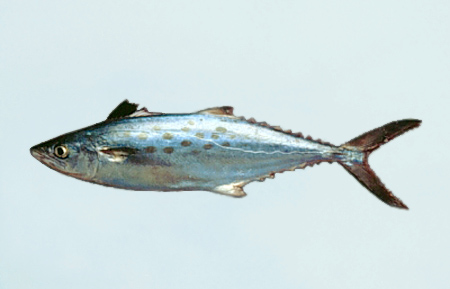
The fish exhibits a green back; its sides are silvery marked with about three rows of round to elliptical yellow spots. The lateral line gradually curves down from the upper end of the gill cover toward caudal peduncle. The first (spiny) dorsal fin is black at the front. Posterior membranes are white with a black edge. Its single row of cutting-edged teeth in each jaw (around 64 teeth in all) are large, uniform, closely spaced, and flattened from side to side. As with the king mackerel and the cero mackerel, these teeth look very similar to those of the bluefish, Pomatomus saltatrix. Spanish mackerel can grow (rarely) to 37 in (940 mm) and weigh up to 14 lb (6.4 kg).
Spanish mackerel occur seasonally from the Yucatán Peninsula, Mexico, as far north as Cape Cod, Massachusetts. They are a shallow-water species, preferring sand bottom at depths of 10 to 40 ft (3 to 12 m), occasionally found as deep as 80 ft (24 m).[citation needed]
One Atlantic and one or more Gulf groups of Spanish mackerel apparently occur in Florida waters. With rising water temperatures, the Atlantic group migrates along the Atlantic Coast of the United States from Miami, Florida, beginning in late February through July, reaching as far as southern Cape Cod, Massachusetts, then returning in the fall. An eastern Gulf group moves northward from the Florida Keys during late winter and spring, appearing off the central West Coast of Florida about April 1. Movement continues westward and terminates along the northern Texas Gulf Coast. During fall, this group migrates back to its wintering grounds in the Florida Keys.[citation needed]
The Gulf group of Spanish mackerel spawn in batches from May to September from off the shore of Texas to off the shore of Florida as early as April in some years. The Atlantic group spawns starting in April off the Carolinas and from late August to late September in the northernmost part of its range. Spanish mackerel mature by 1 year at a fork length of 14 in (36 cm). Females live longer and grow to larger sizes than males. Females may live as long as 11 years, growing to 11 lb (5.0 kg) and 33 in (84 cm) fork length. Males reach about 6 years old and 19 in (48 cm) in fork length.
Spanish mackerel are carnivores. As with other members of the genus, food consists mainly of small fishes with lesser quantities of shrimp and squid. Striped anchovies (Engraulidae) and clupeoids such as menhaden, alewives and thread herring (Opisthonema), are particularly important forage in North Carolina, Florida, Texas, and Veracruz. The percentage of anchovies consumed is higher for juveniles than for adults.
Spanish mackerel are a highly valued fish throughout their range from North Carolina to Texas. Recreational anglers catch Spanish mackerel from boats while trolling or drifting and from boats, piers, jetties, and beaches by casting spoons and jigs and live-bait fishing. Fast lure retrieves are key to catching these quick fish. Commercial methods are primarily run-around gill netting, and rarely, by trolling lures similar to those used by recreational anglers.[citation needed]
On November 4, 1987, Woody Outlaw caught a world-record 13 lb Spanish mackerel on a blue and white Sea Witch with a strip of fastback menhaden on a 7/0 hook, held by a Shimano bait-casting reel on a Kuna rod with 30-pound-test line.
Hub AI
Atlantic Spanish mackerel AI simulator
(@Atlantic Spanish mackerel_simulator)
Atlantic Spanish mackerel
The Atlantic Spanish mackerel (Scomberomorus maculatus) is a migratory species of mackerel that swims to the northern Gulf of Mexico in spring, and returns to southern Florida in the eastern Gulf, and to Mexico in the western Gulf in the fall.
The fish exhibits a green back; its sides are silvery marked with about three rows of round to elliptical yellow spots. The lateral line gradually curves down from the upper end of the gill cover toward caudal peduncle. The first (spiny) dorsal fin is black at the front. Posterior membranes are white with a black edge. Its single row of cutting-edged teeth in each jaw (around 64 teeth in all) are large, uniform, closely spaced, and flattened from side to side. As with the king mackerel and the cero mackerel, these teeth look very similar to those of the bluefish, Pomatomus saltatrix. Spanish mackerel can grow (rarely) to 37 in (940 mm) and weigh up to 14 lb (6.4 kg).
Spanish mackerel occur seasonally from the Yucatán Peninsula, Mexico, as far north as Cape Cod, Massachusetts. They are a shallow-water species, preferring sand bottom at depths of 10 to 40 ft (3 to 12 m), occasionally found as deep as 80 ft (24 m).[citation needed]
One Atlantic and one or more Gulf groups of Spanish mackerel apparently occur in Florida waters. With rising water temperatures, the Atlantic group migrates along the Atlantic Coast of the United States from Miami, Florida, beginning in late February through July, reaching as far as southern Cape Cod, Massachusetts, then returning in the fall. An eastern Gulf group moves northward from the Florida Keys during late winter and spring, appearing off the central West Coast of Florida about April 1. Movement continues westward and terminates along the northern Texas Gulf Coast. During fall, this group migrates back to its wintering grounds in the Florida Keys.[citation needed]
The Gulf group of Spanish mackerel spawn in batches from May to September from off the shore of Texas to off the shore of Florida as early as April in some years. The Atlantic group spawns starting in April off the Carolinas and from late August to late September in the northernmost part of its range. Spanish mackerel mature by 1 year at a fork length of 14 in (36 cm). Females live longer and grow to larger sizes than males. Females may live as long as 11 years, growing to 11 lb (5.0 kg) and 33 in (84 cm) fork length. Males reach about 6 years old and 19 in (48 cm) in fork length.
Spanish mackerel are carnivores. As with other members of the genus, food consists mainly of small fishes with lesser quantities of shrimp and squid. Striped anchovies (Engraulidae) and clupeoids such as menhaden, alewives and thread herring (Opisthonema), are particularly important forage in North Carolina, Florida, Texas, and Veracruz. The percentage of anchovies consumed is higher for juveniles than for adults.
Spanish mackerel are a highly valued fish throughout their range from North Carolina to Texas. Recreational anglers catch Spanish mackerel from boats while trolling or drifting and from boats, piers, jetties, and beaches by casting spoons and jigs and live-bait fishing. Fast lure retrieves are key to catching these quick fish. Commercial methods are primarily run-around gill netting, and rarely, by trolling lures similar to those used by recreational anglers.[citation needed]
On November 4, 1987, Woody Outlaw caught a world-record 13 lb Spanish mackerel on a blue and white Sea Witch with a strip of fastback menhaden on a 7/0 hook, held by a Shimano bait-casting reel on a Kuna rod with 30-pound-test line.
Recent media