



Community hub
Recent from talks
Contribute something to knowledge base
Content stats: 0 posts, 0 articles, 1 media, 0 notes
Members stats: 0 subscribers, 0 contributors, 0 moderators, 0 supporters
Subscribers
Supporters
Contributors
Moderators
Hub AI
August Wilson Theatre AI simulator
(@August Wilson Theatre_simulator)
Hub AI
August Wilson Theatre AI simulator
(@August Wilson Theatre_simulator)
August Wilson Theatre
The August Wilson Theatre (formerly the Guild Theatre, ANTA Theatre, and Virginia Theatre) is a Broadway theater at 245 West 52nd Street in the Theater District of Midtown Manhattan in New York City, New York, U.S. Opened in 1925, the theater was designed by C. Howard Crane and Kenneth Franzheim and was built for the Theatre Guild. It is named for Pulitzer Prize-winning playwright August Wilson (1945–2005). The August Wilson has approximately 1,225 seats across two levels and is operated by ATG Entertainment. The facade is a New York City designated landmark.
The facade is designed as a variation of a 15th-century Tuscan villa, with a stage house to the west and an auditorium to the east. The facade has a stucco surface and openings with quoins, as well as a loggia. The placement of window openings reflected the theater's original interior arrangement. The front of the theater had facilities for the Theatre Guild, including classrooms, studios, a club room, a library, and a book store. The rear of the theater contains the auditorium, which was placed one story above ground to make room for a lounge below. The auditorium originally had elaborate decorations, including loggias and a frieze with depictions of scenes from the Theatre Guild's plays.
The Theatre Guild announced plans for its own theater in 1923, and the Guild Theatre opened on April 13, 1925. The theater's initial productions generally lasted only for several weeks, and the Theatre Guild started leasing the venue to other producers in 1938. Radio station WOR (AM) took over the auditorium as a broadcast studio in 1943, with the Theatre Guild moving out the next year. The American National Theater and Academy (ANTA) purchased the theater in 1950 and renamed it the ANTA Playhouse. The theater reopened as the ANTA Theatre in 1954 after a renovation that eliminated most of the interior detail. Jujamcyn purchased the ANTA Theatre in 1981 and renamed it for Virginia McKnight Binger, a co-owner. The Virginia was renovated again in the 1990s, and it was renamed for Wilson in 2005. Under Jujamcyn's ownership, productions such as City of Angels, Smokey Joe's Cafe, and Jersey Boys have had hundreds of performances at the theater.
The August Wilson Theatre is on 245 West 52nd Street, on the north sidewalk between Eighth Avenue and Broadway, in the Midtown Manhattan neighborhood of New York City, New York, U.S. The rectangular land lot covers 13,125 sq ft (1,219.4 m2), with a frontage of 130.75 ft (39.85 m) on 52nd Street and a depth of 100 ft (30 m). The August Wilson shares the block with the ARO skyscraper to the northwest and Broadway Theatre to the northeast. Other nearby buildings include Studio 54 to the north, the New York Jazz Museum and the Ed Sullivan Theater to the northeast, 810 Seventh Avenue to the east, the Mark Hellinger Theatre and Gallagher's Steakhouse to the southeast, and the Neil Simon Theatre to the south. The theater replaced nine old residential buildings.
The August Wilson Theatre (previously the Guild Theatre, ANTA Theatre, and Virginia Theatre) was designed by C. Howard Crane, Kenneth Franzheim, and Charles H. Bettis. It was constructed in 1924 for the Theatre Guild, a theatrical society. Set designer Norman Bel Geddes was also involved in the August Wilson's interior design. The theater was erected by the O'Day Construction Company, and numerous other contractors participated in the theater's construction.
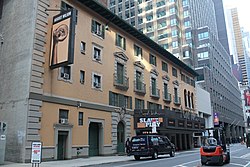
The facade of the August Wilson Theatre was designed to resemble a 15th-century Tuscan villa, with a stucco surface and a heavy use of quoins around openings. On 52nd Street, the theater's height is shorter than its width. The extreme west and east ends of the facade contain vertical bands of quoins, while the rest of the facade includes stone-trimmed windows and doors. The placement of window openings reflected the theater's original interior arrangement. Architectural Forum described the openings as "picturesquely grouped in an informal manner to give quaintness and charm to the exterior design".
The western part of the ground story contains three doorways for the stage house. The rightmost doorway is an arch with rusticated limestone voussoirs; the arch's keystone is a cartouche with motifs signifying the arts, music, and tragedy. Within the archway are two steps leading up to a wood-and-glass double door, topped by a lunette window. To the east are wide metal doors that serve as emergency exits followed by narrow wood-and-glass doors that connect with the lobby. The lobby doors are flanked by sign boards, surrounded by large molded frames with console brackets below and cornices above. A single, modern marquee spans the emergency exits and the lobby doors. Originally, there were two marquees, one each above the emergency exits and the lobby doors.
Most of the second-story windows are casement windows flanked by shutters, originally painted blue-green. The exceptions are the westernmost two openings, which are slightly above the rest of the second story and do not contain shutters. On the third story, the westernmost windows are also simple in design, and a sign hangs next to the westernmost window. The center of the third story contains five French windows, each with a wrought-iron balcony in front of it. Each French window is surrounded by stone blocks and topped by a stone pediment. To the east is an arcade with three arches and an iron railing, which screen a fire-escape balcony. On the fourth story are windows with shutters, extending the width of the theater. Above the fourth story, brackets support a pitched tile roof that slightly overhangs the facade. The stage house rises above the western part of the roof, with a facade of plain brick. This was in keeping with many theaters of the time, which contained plain stage houses above their ornate primary facades, but Architectural Record characterized the stage house as a missed opportunity for decoration.
August Wilson Theatre
The August Wilson Theatre (formerly the Guild Theatre, ANTA Theatre, and Virginia Theatre) is a Broadway theater at 245 West 52nd Street in the Theater District of Midtown Manhattan in New York City, New York, U.S. Opened in 1925, the theater was designed by C. Howard Crane and Kenneth Franzheim and was built for the Theatre Guild. It is named for Pulitzer Prize-winning playwright August Wilson (1945–2005). The August Wilson has approximately 1,225 seats across two levels and is operated by ATG Entertainment. The facade is a New York City designated landmark.
The facade is designed as a variation of a 15th-century Tuscan villa, with a stage house to the west and an auditorium to the east. The facade has a stucco surface and openings with quoins, as well as a loggia. The placement of window openings reflected the theater's original interior arrangement. The front of the theater had facilities for the Theatre Guild, including classrooms, studios, a club room, a library, and a book store. The rear of the theater contains the auditorium, which was placed one story above ground to make room for a lounge below. The auditorium originally had elaborate decorations, including loggias and a frieze with depictions of scenes from the Theatre Guild's plays.
The Theatre Guild announced plans for its own theater in 1923, and the Guild Theatre opened on April 13, 1925. The theater's initial productions generally lasted only for several weeks, and the Theatre Guild started leasing the venue to other producers in 1938. Radio station WOR (AM) took over the auditorium as a broadcast studio in 1943, with the Theatre Guild moving out the next year. The American National Theater and Academy (ANTA) purchased the theater in 1950 and renamed it the ANTA Playhouse. The theater reopened as the ANTA Theatre in 1954 after a renovation that eliminated most of the interior detail. Jujamcyn purchased the ANTA Theatre in 1981 and renamed it for Virginia McKnight Binger, a co-owner. The Virginia was renovated again in the 1990s, and it was renamed for Wilson in 2005. Under Jujamcyn's ownership, productions such as City of Angels, Smokey Joe's Cafe, and Jersey Boys have had hundreds of performances at the theater.
The August Wilson Theatre is on 245 West 52nd Street, on the north sidewalk between Eighth Avenue and Broadway, in the Midtown Manhattan neighborhood of New York City, New York, U.S. The rectangular land lot covers 13,125 sq ft (1,219.4 m2), with a frontage of 130.75 ft (39.85 m) on 52nd Street and a depth of 100 ft (30 m). The August Wilson shares the block with the ARO skyscraper to the northwest and Broadway Theatre to the northeast. Other nearby buildings include Studio 54 to the north, the New York Jazz Museum and the Ed Sullivan Theater to the northeast, 810 Seventh Avenue to the east, the Mark Hellinger Theatre and Gallagher's Steakhouse to the southeast, and the Neil Simon Theatre to the south. The theater replaced nine old residential buildings.
The August Wilson Theatre (previously the Guild Theatre, ANTA Theatre, and Virginia Theatre) was designed by C. Howard Crane, Kenneth Franzheim, and Charles H. Bettis. It was constructed in 1924 for the Theatre Guild, a theatrical society. Set designer Norman Bel Geddes was also involved in the August Wilson's interior design. The theater was erected by the O'Day Construction Company, and numerous other contractors participated in the theater's construction.
The facade of the August Wilson Theatre was designed to resemble a 15th-century Tuscan villa, with a stucco surface and a heavy use of quoins around openings. On 52nd Street, the theater's height is shorter than its width. The extreme west and east ends of the facade contain vertical bands of quoins, while the rest of the facade includes stone-trimmed windows and doors. The placement of window openings reflected the theater's original interior arrangement. Architectural Forum described the openings as "picturesquely grouped in an informal manner to give quaintness and charm to the exterior design".
The western part of the ground story contains three doorways for the stage house. The rightmost doorway is an arch with rusticated limestone voussoirs; the arch's keystone is a cartouche with motifs signifying the arts, music, and tragedy. Within the archway are two steps leading up to a wood-and-glass double door, topped by a lunette window. To the east are wide metal doors that serve as emergency exits followed by narrow wood-and-glass doors that connect with the lobby. The lobby doors are flanked by sign boards, surrounded by large molded frames with console brackets below and cornices above. A single, modern marquee spans the emergency exits and the lobby doors. Originally, there were two marquees, one each above the emergency exits and the lobby doors.
Most of the second-story windows are casement windows flanked by shutters, originally painted blue-green. The exceptions are the westernmost two openings, which are slightly above the rest of the second story and do not contain shutters. On the third story, the westernmost windows are also simple in design, and a sign hangs next to the westernmost window. The center of the third story contains five French windows, each with a wrought-iron balcony in front of it. Each French window is surrounded by stone blocks and topped by a stone pediment. To the east is an arcade with three arches and an iron railing, which screen a fire-escape balcony. On the fourth story are windows with shutters, extending the width of the theater. Above the fourth story, brackets support a pitched tile roof that slightly overhangs the facade. The stage house rises above the western part of the roof, with a facade of plain brick. This was in keeping with many theaters of the time, which contained plain stage houses above their ornate primary facades, but Architectural Record characterized the stage house as a missed opportunity for decoration.
Recent media
Recent media