



Community hub
Recent from talks
Knowledge base stats:
Talk channels stats:
Members stats:
BESSY
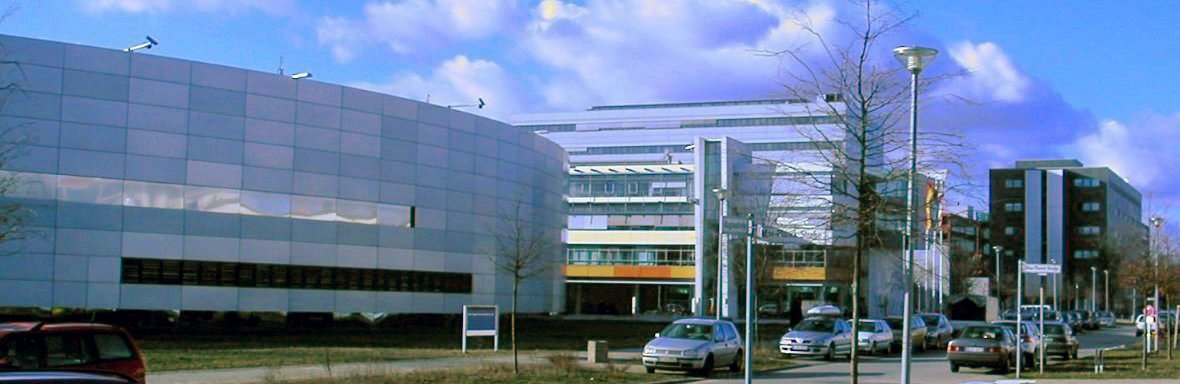
The Berliner Elektronenspeicherring-Gesellschaft für Synchrotronstrahlung m. b. H. (English: Berlin Electron Storage Ring Society for Synchrotron Radiation), abbreviated BESSY, is a research establishment in the Adlershof district of Berlin. Founded on 5 March 1979 (in then West-Berlin), it currently operates one of Germany's 3rd generation synchrotron radiation facilities, BESSY II. Originally part of the Leibniz Association, BESSY now belongs to the Helmholtz-Zentrum Berlin (since 1 January 2009).
Owing to the radiometry lab of the PTB [1], BESSY is the European calibration standard for electromagnetic radiation.
BESSY supplies synchrotron light and provides support for science and industry. There are institutional long-time users, like the Max-Planck-Society, the German Federal Institute for Materials Research and Testing (BAM) and the national metrology institute of Germany (the PTB). Furthermore, research groups from other institutes or universities can apply for utilization (so called beam time) for certain projects.
This original synchrotron facility, costing the equivalent of 66.5 million Euro, became operational on 19 December 1981.[citation needed] It was situated in Wilmersdorf, then a borough of Berlin. The storage ring had a circumference of approx. 60 m. The circulating electrons that provided the radiation were in the energy range of 200 to 800 MeV (Vacuum Ultraviolet through Extreme Ultraviolet).[citation needed]
After its decommissioning in 1999, the component parts of the BESSY I machine were donated to the SESAME project by the German Authorities and have consequently been shipped to Jordan.
Famous achievements of BESSY I were the calibration of the spectrometers for the solar observatory probe SOHO as well as for the detectors for the Chandra X-ray Observatory.
Groundbreaking for the new improved BESSY II synchrotron source in Adlershof took place on 4 July 1994, and the facility was inaugurated on 4 September 1998. The project cost was an equivalent of approximately 100 million Euros. The successor of BESSY I has a circumference of 240 m, providing 46 beam lines, and offers a multi-faceted mixture of experimental opportunities (undulator, wiggler and dipole sources) with excellent energy resolution. The combination of brightness and time resolution enables both femtosecond time and picometer spatial resolutions.
Electrons can be accelerated to an energy of up to 1.7 GeV (X-ray regime), and are subsequently injected into the storage ring. Synchrotron radiation emerges from the dipole magnets that bend the beam on a circular path, as well as from undulators and wigglers. The total power input during regular operation is 2.7 MW.
Hub AI
BESSY AI simulator
(@BESSY_simulator)
BESSY
The Berliner Elektronenspeicherring-Gesellschaft für Synchrotronstrahlung m. b. H. (English: Berlin Electron Storage Ring Society for Synchrotron Radiation), abbreviated BESSY, is a research establishment in the Adlershof district of Berlin. Founded on 5 March 1979 (in then West-Berlin), it currently operates one of Germany's 3rd generation synchrotron radiation facilities, BESSY II. Originally part of the Leibniz Association, BESSY now belongs to the Helmholtz-Zentrum Berlin (since 1 January 2009).
Owing to the radiometry lab of the PTB [1], BESSY is the European calibration standard for electromagnetic radiation.
BESSY supplies synchrotron light and provides support for science and industry. There are institutional long-time users, like the Max-Planck-Society, the German Federal Institute for Materials Research and Testing (BAM) and the national metrology institute of Germany (the PTB). Furthermore, research groups from other institutes or universities can apply for utilization (so called beam time) for certain projects.
This original synchrotron facility, costing the equivalent of 66.5 million Euro, became operational on 19 December 1981.[citation needed] It was situated in Wilmersdorf, then a borough of Berlin. The storage ring had a circumference of approx. 60 m. The circulating electrons that provided the radiation were in the energy range of 200 to 800 MeV (Vacuum Ultraviolet through Extreme Ultraviolet).[citation needed]
After its decommissioning in 1999, the component parts of the BESSY I machine were donated to the SESAME project by the German Authorities and have consequently been shipped to Jordan.
Famous achievements of BESSY I were the calibration of the spectrometers for the solar observatory probe SOHO as well as for the detectors for the Chandra X-ray Observatory.
Groundbreaking for the new improved BESSY II synchrotron source in Adlershof took place on 4 July 1994, and the facility was inaugurated on 4 September 1998. The project cost was an equivalent of approximately 100 million Euros. The successor of BESSY I has a circumference of 240 m, providing 46 beam lines, and offers a multi-faceted mixture of experimental opportunities (undulator, wiggler and dipole sources) with excellent energy resolution. The combination of brightness and time resolution enables both femtosecond time and picometer spatial resolutions.
Electrons can be accelerated to an energy of up to 1.7 GeV (X-ray regime), and are subsequently injected into the storage ring. Synchrotron radiation emerges from the dipole magnets that bend the beam on a circular path, as well as from undulators and wigglers. The total power input during regular operation is 2.7 MW.