Hubbry Logo
BLS AGBLS AGMain
Open search
BLS AG
Community hub
BLS AG
logo
8 pages, 0 posts
0 subscribers
Be the first to start a discussion here.
BLS AG
BLS AG
from Wikipedia
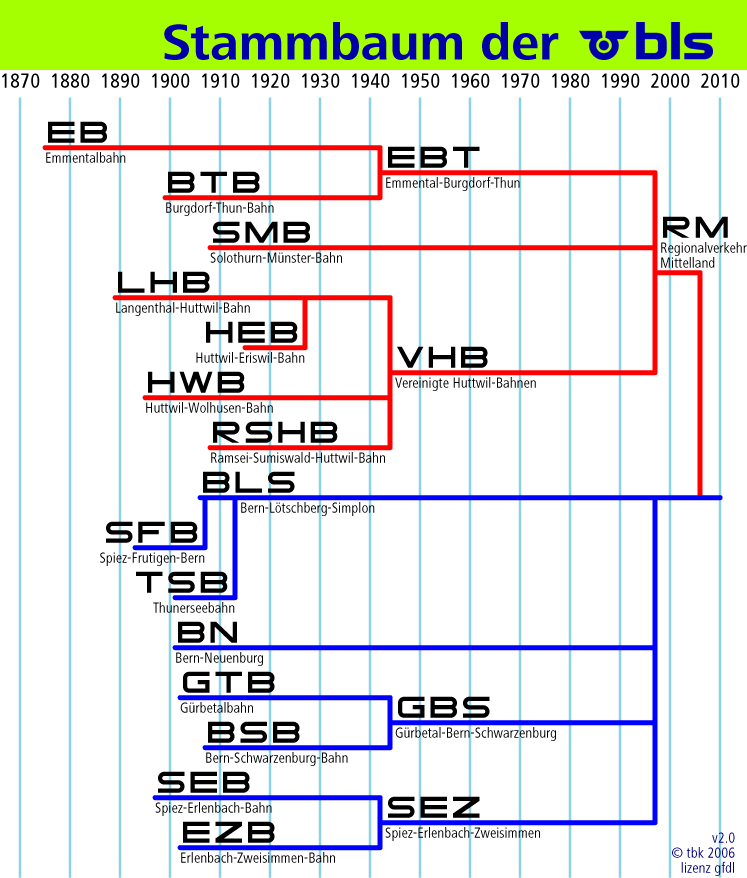
BLS AG family tree
Rail network (infrastructure) after merger: blue lines belonged to BLS Lötschbergbahn, red lines to Regionalverkehr Mittelland

BLS AG is a Swiss railway company created by the 2006 merger of BLS Lötschbergbahn and Regionalverkehr Mittelland AG. Its ownership is divided, with 55.8% of it owned by the canton of Berne, and 21.7% by the Swiss Confederation. It has two main business fields: passenger traffic and infrastructure.

BLS has a subsidiary—BLS Cargo—which is responsible for all freight operations. BLS Cargo works in cooperation with the freight subsidiary of Deutsche Bahn, Railion. However, the staff, apart from management and sales, is employed by BLS AG. Part of the BLS locomotive fleet is owned by BLS Cargo.

Another subsidiary, BLS Fernverkehr AG, is responsible for long-distance passenger transport. BLS Fernverkehr AG is wholly owned by BLS AG.

Infrastructure

[edit]

In 2007 the new, 34.6-kilometre-long (21.5 mi) Lötschberg Base Tunnel opened, which is part of the 449 km of infrastructure owned and operated by BLS AG. The Lötschberg base tunnel was built by a wholly owned subsidiary, BLS AlpTransit AG. By mid-2007 this company handed over the base tunnel to BLS AG. In 2009 this company was renamed BLS Netz AG and the entire BLS infrastructure passed over to this company which is mainly owned by the Swiss Confederation, which has paid for most of the recent investments.

BLS AG owns the following railway lines:[1]

Rolling stock

[edit]

Also see Bern–Lötschberg–Simplon railway#Locomotives and multiple units

BLS Re 425 in Spiez (2010)
BLS Re 485 014-5 in Spiez, 18 February 2006.
BLS RABe 528 (right) in Neuchâtel, 28 May 2021

BLS Cargo has the following rolling stock.

In 2010, 28 Stadler KISS EMUs were ordered; the first was delivered in March 2012. As of 2012, BLS was planning to spend around 1·2bn SFr on new rolling stock by 2025, building a more standardised fleet with fewer different types of train.[2] In 2017, 58 Stadler FLIRT EMUs were ordered, expected to enter service between 2021 and 2026.[3]

Passenger train services

[edit]

Since the merger, BLS has been the exclusive operator of the standard gauge part of the S-Bahn Bern. This includes open access services over Swiss Federal Railways (SBB) and STB Sensetalbahn tracks. Since December 2007 BLS offers a new RegioExpress (RE) service over the old Lötschberg route while the SBB-operated InterCity (IC), and EuroCity (EC) trains use the new Lötschberg tunnel. As of the December 2024 timetable change, BLS operates the following services:

S-Bahn Bern[4]


S-Bahn Luzern


RegioExpress (RE)


Regional trains (R)


InterRegio (IR)


Car Shuttle Train (AV)

BLS Busland

[edit]

BLS Busland operates a fleet of 36 buses over a network that complements the passenger train services.[5] The bus fleet consists of[citation needed]

BLS Navigation

[edit]
MS Jungfrau on Brienzersee at Brienz

BLS owns and operates steamers on Lake Brienz and Lake Thun under the BLS Navigation brand. These steamers utilise the Interlaken and Thun ship canals.[citation needed]

See also

[edit]

References

[edit]
[edit]
Revisions and contributorsEdit on WikipediaRead on Wikipedia
from Grokipedia
BLS AG is a major Swiss transport company headquartered in , specializing in rail, bus, boat, and automobile transport services across . Founded on July 27, 1906, as the Berner Alpenbahngesellschaft Bern–Lötschberg–Simplon, it pioneered key Alpine rail infrastructure, including the , which opened in 1913 and revolutionized cross-Alpine travel. The company operates an extensive network that connects people, regions, and economic centers, serving approximately 70 million passengers annually (as of 2023) through regional trains, the Bern S-Bahn (acquired in 2004), buses, lake boats on Lake Thun and Lake Brienz, and car shuttle services via the Lötschberg and Simplon tunnels. It also provides freight transport, making it one of Switzerland's largest integrated mobility providers with 3,847 employees and annual revenue of 1.281 billion Swiss francs (as of 2023). Significant milestones include the 2006 merger forming the modern BLS AG, with ownership primarily held by the (55.8%) and the Swiss Confederation (21.7%), and the 2007 opening of the 34.6 km , which enhanced high-speed connectivity between northern and . Today, BLS AG emphasizes sustainable transport solutions, including electrification and multimodal integration, positioning it as a key player in Switzerland's public mobility landscape.

History

Formation and Predecessors

BLS AG traces its origins to two primary predecessor companies: BLS Lötschbergbahn AG and Regionalverkehr Mittelland AG (RM). The BLS Lötschbergbahn was established on July 27, 1906, as the Berner Alpenbahngesellschaft Bern–Lötschberg–Simplon, with the primary goal of constructing and operating the strategic Lötschberg railway line across the to connect with the region and beyond to via the . This private initiative complemented the (SBB) network by providing an alternative north-south route through the , emphasizing regional connectivity in the Mittelland and alpine areas. A pivotal milestone for BLS Lötschbergbahn was the completion and opening of the on June 19, 1913, following its breakthrough on March 31, 1911; this 14.6 km engineering feat, electrified at 15,000 V and 16⅔ Hz, revolutionized cross-alpine transport by enabling faster and more reliable passage under the Lötschberg massif. Post-World War II, the company faced financial pressures amid Switzerland's economic recovery and growing rail demands, leading to increased federal involvement; in 1976, the Swiss government approved a CHF 620 million loan to support double-track expansion of the Lötschberg line, which was completed on May 8, 1992, enhancing capacity without full . On January 1, 1997, BLS Lötschbergbahn underwent a restructuring merger with the Bern-Neuenburg-Bahn (BN), Gürbetal-Bern-Shaftenau-Bahn (GBS), and Spiez-Eyholz-Zollikofen-Bahn (SEZ), solidifying its focus on the core Lötschberg route while retaining its private status. The other key predecessor, Regionalverkehr Mittelland AG, was formed on January 1, 1997, through the consolidation of three regional operators: the Emmental-Burgdorf-Thun-Bahn (EBT), (SMB), and Vereinigte Huttwil-Bahnen (VHB), aiming to streamline local passenger and freight services in the Swiss Mittelland region around , , and Jura. This merger created a unified entity for regional transport, integrating over 200 km of tracks and emphasizing commuter rail links to urban centers like and , thereby addressing fragmented operations in non-federal lines. The formation of BLS AG culminated in the merger of BLS Lötschbergbahn and RM, approved by shareholders and finalized on –23, 2006, following the official company founding on April 24, 2006; this integration combined their operations, including approximately 450 km of rail network, diverse , and over 2,000 employees, to create a stronger provider in western . Post-merger ownership was structured with the holding 55.8%, the Swiss Confederation 21.7%, and the remainder shared among other cantons, municipalities, and private investors.

Key Developments and Expansions

A pivotal development for BLS AG was the opening of the on December 9, 2007, following its official inauguration in June of that year. This 34.6-kilometer engineering feat, the longest land tunnel at the time, forms a core component of the (NRLA) project aimed at enhancing transalpine freight and passenger capacity. The tunnel significantly reduced journey times, shortening the to route from 96 minutes to 64 minutes and enabling speeds up to 200 km/h in sections, thereby improving connectivity between northern and the region. In parallel with advancements, BLS AG has pursued extensive fleet modernization to support growing demand and goals. As part of a long-term , the company committed to investments totaling approximately 1.2 billion CHF by 2025 for acquiring new electric multiple units (EMUs) and upgrading existing , including the 2010 order of 28 double-deck EMUs from Stadler valued at 493.7 million CHF to bolster services. Recent operational enhancements underscore BLS AG's adaptation to regional needs. The December 2024 timetable revision, effective from December 15, introduced improved frequencies and integrations that strengthened connectivity, aligning with broader Swiss rail expansions. In June 2025, BLS Netz AG signed a framework agreement worth over 110 million EUR with for ETCS Level 2 upgrades on key lines, including the -Schwarzenburg route, with initial implementations targeted for 2029 to enhance safety and capacity. Additionally, in November 2024, BLS Cargo restructured its management into a centralized group model to streamline operations across its international freight network. BLS AG's car shuttle services have seen substantial growth since their inception in 1926, when initial operations used open freight wagons attached to passenger trains on the Lötschberg line. Evolving into a dedicated auto-transport system through the Lötschberg and Simplon tunnels, these services now handle over 1.3 million vehicles annually, positioning BLS as Switzerland's largest provider of such facilities between Kandersteg-Goppenstein and Brig-Iselle. This expansion has reinforced BLS's role in , reducing road congestion on alpine passes.

Ownership and Organization

Ownership Structure

BLS AG's ownership structure reflects its roots as a regional railway operator with strong involvement, ensuring alignment with Swiss transport policy priorities. The equity is primarily held by governmental entities, with the owning 55.8%, the Swiss Confederation 21.7%, and the remaining shares distributed among other public entities, private investors, and employee staff funds. This distribution, established during the merger of BLS Lötschbergbahn and Regionalverkehr Mittelland AG, provides stability and facilitates coordination with federal and cantonal initiatives. The company's governance is led by a comprising 9 members as of 2025, including representatives nominated by major shareholders such as the and the Swiss Confederation to ensure balanced oversight. Chaired by Kurt Bobst, a and federal diploma accountant, the board oversees strategic decisions and compliance with regulatory standards. The CEO, Daniel Schafer, has served in the role since 2021, managing day-to-day operations and reporting to the board. BLS AG operates under the regulatory oversight of the Swiss Federal Office of Transport (BAV), which enforces safety, infrastructure, and standards for all Swiss railways. Financially, BLS AG generated total revenues of 1,117 million CHF in , supported by subsidies and contributions from its cantons that underscore the impact of regional funding on maintaining affordable and extensive passenger services. This public-private blend allows the company to balance commercial operations with subsidized regional connectivity, particularly in the and areas.

Corporate Subsidiaries

BLS AG operates through several specialized subsidiaries that handle distinct aspects of its transportation and activities, all integrated under the parent company's umbrella to ensure coordinated operations across rail, bus, freight, and services. These entities allow for focused management while leveraging shared resources and cross-functional teams for efficiency. BLS Netz AG, the infrastructure arm, is responsible for managing approximately 440 km of railway network, including the 34.6 km , as the largest private railway infrastructure operator in . It oversees operations, maintenance, signaling systems, and construction projects to support both BLS's own services and third-party access. BLS Fernverkehr AG, established in December 2019, specializes in long-distance passenger rail services under an operating agreement with (SBB), managing revenue, quality, and costs using BLS's and personnel. It operates key lines such as IR 65 (–Biel/Bienne since December 2019), IR 17 (–Olten since December 2020), IR 66 (–Neuchâtel–La Chaux-de-Fonds since December 2020), and IR 56 (Biel/Bienne– SBB from December 2025). BLS Cargo AG focuses on , acting as a lean corridor operator for sustainable and reliable goods movement, including block trains from the to the Mediterranean and customized solutions across European axes. As of November 1, 2024, it implemented a centralized group management structure to streamline operations and enhance overall leadership efficiency, supported by over 400 employees. BLS Busland AG, founded in 2006 and headquartered in Burgdorf, provides regional and local public bus transport in the and Oberaargau areas, operating 18 lines with over 600 stops, 37 modern vehicles, and services like shuttle buses during rail disruptions and night lines. It employs around 120 staff and includes a vehicle service center. BLS Schifffahrt AG, formed as an independent subsidiary on January 1, 2022, manages navigation services on (year-round) and (seasonal from early December), operating a fleet of 12 vessels, including three historic steamboats, to support tourism and leisure connectivity in the . Collectively, these subsidiaries employ over 3,100 staff within the BLS Group, fostering cross-functional collaboration to integrate passenger, freight, and multimodal services effectively.

Infrastructure

Railway Network

BLS AG operates a railway network totaling 440 km of standard-gauge tracks (1,435 mm), primarily serving the cantons of Bern, Lucerne, and Valais in central and western Switzerland. This infrastructure supports both passenger and freight transport, emphasizing regional connectivity and alpine crossings. Central to the network is the Bern–Lötschberg–Simplon line, the BLS mainline that provides a direct north-south axis from through the to in and onward to the . Complementary regional services are delivered via the Bern, a 220 km network covering the greater Bern agglomeration, and the Luzern, spanning 73 km around for commuter and suburban travel. These routes integrate urban, interurban, and tourist-oriented operations, with the overall system handling significant daily passenger volumes in densely populated areas. The network is fully electrified at 15 kV 16.7 Hz AC, aligning with Switzerland's national standard for efficient and reliable operations. Seamless integration with the (SBB) occurs at key interchanges like and , enabling coordinated timetables and cross-network routing. Major tunnels, such as the , enhance connectivity but are detailed separately in infrastructure overviews.

Key Facilities and Tunnels

The , a cornerstone of BLS AG's infrastructure, spans 34.6 kilometers through the , connecting Frutigen in the to Visp in the . Constructed as part of the New Rail Link through the (NRLA) initiative, it features twin single-track bores separated by 40 meters, enabling travel at up to 250 km/h and significantly reducing transit times across the compared to the original 1913 . The tunnel entered full commercial operation on December 15, 2007, following breakthrough in 2005 and extensive testing, and it handles a capacity of up to 220-260 trains per day, supporting both passenger and freight services while alleviating congestion on older alpine routes. With a maximum exceeding 2,000 meters in its southern sections, the tunnel presented significant engineering challenges, including rockburst risks in crystalline formations, managed through advanced tunneling techniques like tunnel boring machines and exploratory adits. BLS AG is upgrading the to provide twin tracks along its entire 35 km length, with construction scheduled to begin in 2026 at a cost of CHF 1.7 billion (2014 price base, excluding VAT and inflation). As of 2025, approximately 14 km has twin tracks, another 14 km has a second tube excavated but unequipped, and 7 km remains to be excavated. The project will enable half-hourly long-distance services between and , increase freight capacity, improve timetable reliability, and support the modal shift from road to rail. Complementing the Lötschberg Base Tunnel, BLS AG operates key support facilities that enhance operational efficiency and multimodal connectivity. The Spiez maintenance depot serves as a primary hub for vehicle servicing, including repairs, cleaning, and inspections for BLS's fleet of electric multiple units and locomotives, with ongoing renovations to consolidate activities and integrate modern diagnostic tools. Additionally, car shuttle terminals at and Iselle facilitate automobile transport services through the Lötschberg and Simplon tunnels, respectively, allowing vehicles to be loaded onto specialized shuttle trains for direct passage to Goppenstein and Italy's Iselle di Trasquera, operating up to every 30 minutes during peak periods to support and . BLS AG is advancing its infrastructure reliability through targeted upgrades, including the 2025 European Train Control System (ETCS) project in collaboration with . This over €110 million framework agreement focuses on transitioning select lines, such as the 17-kilometer Bern-Schwarzenburg route, from ETCS Level 1 to signal-less Level 2, enabling automatic train protection, optimized spacing, and future scalability across BLS's 440-kilometer network for improved safety and capacity, with first commissioning planned for 2029. Parallel to these enhancements, BLS Netz AG, the infrastructure subsidiary, invests annually in track renewal and maintenance to sustain high standards, encompassing ballast replacement, rail grinding, and vegetation control along key routes to minimize disruptions and extend asset life. These efforts underscore BLS AG's commitment to resilient, integrated facilities that support Switzerland's alpine rail corridor.

Rolling Stock

Electric Multiple Units

BLS AG's electric multiple units (EMUs) form the backbone of its passenger rail operations, emphasizing energy efficiency and passenger comfort through modern designs from . These self-propelled trains enable flexible deployment on regional and interregional routes, incorporating features like to recover energy during deceleration and reduce overall power consumption. The double-deck EMUs, classified as RABe 515 and nicknamed "MUTZ," were introduced in 2012 following an initial 2008 order for 28 four-car units, with additional orders bringing the total to 39 units (34 four-car and 5 six-car) tailored for the and broader network. Each unit measures approximately 100 meters in length (four-car) or 150 meters (six-car), accommodates around 335 to 546 s with 61 seats in and 274 in second class plus additional folding seats (varying by configuration), and reaches a maximum speed of 160 km/h. These bilevel trains feature aluminum construction for lightweight efficiency, wide doors for rapid boarding, and interiors optimized for high-capacity commuter flows, including spaces for bicycles and wheelchairs. Complementing the KISS fleet, BLS AG ordered 52 single-level EMUs, designated RABe 528 or "MIKA," with deliveries spanning 2021 to 2025 to modernize and expand regional services. These six-car, 105-meter-long units adopt a allowing configuration for varying route demands, with each providing 275 seats (46 in first class, 196 in second class, and 33 tip-up seats) alongside two wheelchair-accessible spaces, step-free entry, panoramic windows, and onboard refreshment areas with power outlets. Capable of speeds up to 160 km/h, the FLIRTs incorporate advanced accessibility features such as low-floor sections and tactile guidance systems, enhancing inclusivity for diverse passengers. As of 2025, BLS AG's modern fleet totals over 140 units, with approximately 91 being these Stadler models, which collectively support high-frequency services through their systems that feed recovered energy back into the traction supply. These trains are deployed primarily on RegioExpress and lines within the region and beyond.

Locomotives and Freight Vehicles

BLS , the freight of BLS AG, operates a diverse fleet of locomotives suitable for both freight hauling and occasional passenger services, emphasizing multi-system capabilities for cross-border operations. The primary modern locomotives are the Vectron MS series, classified as Re 475, with 40 units in service as of 2025 and an additional 10 on order for delivery by 2026, bringing the total to 50. These 6.4 MW electric locomotives, with a top speed of 160 km/h, were acquired in phases: an initial batch of 15 ordered in 2015, followed by 25 ordered in October 2019 for delivery between 2020 and 2025. Designed for the north-south corridor, they enable seamless operations across , , , , the , and , supporting mixed freight and passenger duties. Complementing the Vectron fleet are 18 Re 465 class locomotives, built by SLM and ABB between 1994 and 1997, each delivering 6.4 MW of power and capable of speeds up to 230 km/h. These Bo'Bo' electric units, similar in design to the SBB Re 460 but with enhancements, handle heavy freight loads over transalpine routes like the Lötschberg–Simplon line and support passenger services such as the GoldenPass Express. Modernization efforts began in 2020, involving upgrades to propulsion systems and multiple-unit control for compatibility with Vectron and Traxx locomotives, extending their operational life by approximately 15 years. Older Re 4/4 II class locomotives, including 12 units acquired from SBB in 2004–2005 and numbered 501–512, are progressively being phased out from regular service, particularly for car shuttle operations, with replacements by Vectron models implemented from 2023 onward. This transition aligns with fleet renewal to improve efficiency and reliability on demanding routes. BLS Cargo maintains a comprehensive inventory of freight vehicles, including for transport, such as and chemicals, and specialized double-deck car shuttle cars. The company manages wagon procurement and leasing through partnerships with rental providers, optimizing availability for block train services. Notably, BLS operates Switzerland's largest car shuttle network via the Lötschberg (–Goppenstein) and Simplon (–Iselle) routes, transporting over 1.3 million vehicles annually and modernizing its shuttle wagons using principles to enhance sustainability. In , following a restructuring effective November 1 that centralized operations under a new group structure, BLS Cargo optimized its fleet deployment to prioritize cross-border efficiency on key axes to and . This included expanded use of Vectron locomotives for international block trains, resulting in nearly 10,000 freight operations—a 46% increase from prior levels—while maintaining focus on lean corridor without owning a fixed fleet. These enhancements support integrated freight services, including intermodal and automotive transport. Crossrail was renamed BLS Cargo Nord in September 2025.

Services

Passenger Train Services

BLS AG operates a range of services across its 424 km railway network in , focusing on regional and inter-regional connectivity in the Bernese Mittelland, the , and the Lötschberg axis. These services are integrated into the national public transport system, providing seamless connections with (SBB) operations and utilizing the SwissPass for unified ticketing and fare management. The company's passenger rail offerings are structured into three primary tiers: for urban and suburban commuting, RegioExpress for hourly inter-city links, and for longer regional routes. The services, particularly in the Bern network, deliver high-frequency urban and regional transport with intervals as frequent as 15 minutes on core lines such as those connecting Bern to surrounding suburbs and Thun. These services cater to daily commuters, utilizing modern electric multiple units to ensure reliable, short-interval operations across the densely populated Bern area. RegioExpress (RE) trains provide efficient hourly connections for inter-city travel, exemplified by the Bern-Luzern route, which traverses the scenic valley in approximately 1 hour and 30 minutes. A flagship RE service is the Lötschberger, operating along the historic Lötschberg mountain line from to , covering 114 km in about 2 hours while navigating viaducts, spirals, and alpine landscapes between , , and Goppenstein. This route emphasizes leisure and commuter travel, linking the Bernese Mittelland with . InterRegio (IR) services extend to longer distances, such as the Bern-Interlaken route, which serves tourists and regional passengers heading to the via and in under 1 hour. These trains offer comfortable seating and onboard facilities, supporting 's tourism-driven mobility. In the 2024 timetable, effective from December 15, 2024, to December 13, 2025, BLS enhanced connectivity with SBB through coordinated schedules, improving transfer times at key junctions like and . This integration facilitates broader network access, with BLS rail services carrying over 23 million passengers as of 2023, contributing to the company's role in sustainable regional transport. Ticketing is streamlined via SwissPass, allowing seamless multi-modal journeys that briefly complement bus and navigation options for comprehensive mobility.

Bus Services

BLS Busland AG, established in 2006 as a wholly owned of BLS AG and headquartered in , specializes in regional and local public bus transport within the and Oberaargau areas of the . The company employs 148 staff and operates from four depots in Burgdorf, Langnau, Sumiswald, and Huttwil, ensuring coverage of rural zones without direct rail access. Busland AG maintains a fleet of 37 modern buses, all featuring the distinctive BLS for brand consistency with rail services. Among these, models form a key component, including seven hybrid variants introduced in 2018 to replace older diesel units and enhance environmental performance. These hybrids combine electric and diesel propulsion, recovering energy during braking to achieve up to 8% lower fuel consumption and an annual CO2 savings of about 18 tons per bus compared to standard diesel equivalents. The fleet supports operations across a network of 18 lines encompassing over 600 stops, spanning more than 200 kilometers and facilitating daily connectivity for commuters in underserved areas. Core services include feeder routes linking to rail stations, dedicated school transportation, rail replacement during track works or closures, and flexible on-demand extensions to meet peak capacity needs. Night-time Moonliner services operate on select weekends, while seasonal buses in summer cater to tourists exploring the Emmental's trails. These offerings prioritize , with features like spaces in many vehicles. Integration with BLS rail services is central to Busland's model, enabling seamless multimodal travel through shared planning and a unified ticketing system under the Libero tariff alliance. This allows passengers to transfer effortlessly between bus and using a single ticket, boosting overall network efficiency and supporting the Bern's role in regional mobility. Such coordination has driven post-pandemic expansions in sustainable operations, including the hybrid fleet additions, to align with broader goals of reducing emissions in . BLS Schifffahrt AG, a subsidiary of BLS AG, manages navigation services on Lakes Brienz and Thun in Switzerland's Bernese Oberland, focusing on scenic lake cruises that highlight the region's natural beauty and historical sites. Established over 180 years ago, the company provides year-round operations on Lake Thun and seasonal services on Lake Brienz, emphasizing tourism and leisure travel. The fleet comprises 12 vessels, including three historic steamboats that preserve early 20th-century maritime heritage: the Blümlisalp (built in 1906), the Spiez, and the Lötschberg on . These steamers, restored in line with standards—such as the Blümlisalp's refurbishment that earned the ICOMOS Special Award in 2008—operate alongside modern motor vessels to offer nostalgic experiences. The fleet is divided with eight boats on and four on , enabling diverse cruise options past picturesque villages, castles, and Alpine vistas. Scheduled cruises form the core of operations, with examples including the roughly 2-hour route from West to on and a 1-hour 15-minute trip from Interlaken Ost to on , alongside shorter round-trip excursions. These services run seasonally from spring to autumn, prioritizing tourist appeal with departures from key ports integrated briefly with BLS rail connections for combined tickets. The cruises accommodate groups on spacious decks, fostering relaxation amid the lakes' waters and surrounding mountains.

Freight Services

BLS Cargo AG, a wholly owned of BLS AG established in 2001, manages the group's rail freight operations with a focus on sustainable and efficient transport solutions across . Specializing in traffic and RoLa (rollende Landstraße) services, the company facilitates the modal shift from road to rail, particularly through the , which enables direct trans-Alpine connections without the need for time-consuming vehicle loading. These services support the transport of goods in containers and unaccompanied trailers, emphasizing reliability and environmental benefits in challenging Alpine terrain. The company's core operations revolve around key trans-Alpine routes, including the vital corridor from to and onward to Iselle di Trasquera in , linking Switzerland's network to the (SBB) and extending to broader European corridors in , , and beyond. This route, leveraging the , handles a significant portion of north-south freight flows, connecting to Mediterranean destinations. In 2024, BLS Cargo centralized its management structure to streamline operations, including the rebranding and integration of as BLS Cargo Nord in September 2025, enhancing coordination across borders and boosting capacity in northern markets. The fleet supports these routes with modern electric locomotives, as detailed in the rolling stock section. In May 2025, BLS Cargo announced plans to discontinue its RoLa RAlpin services at the end of 2025 due to low utilization, with around 10% of scheduled trains cancelled in 2024 and 22% year-on-year increase in cancellations in the first quarter of 2025; the company intends to refocus on unaccompanied combined transport. As of November 2025, these services continue to operate. Innovations in green freight are central to BLS Cargo's strategy, with a full electric locomotive fleet minimizing CO₂ emissions and promoting eco-friendly logistics. The company operates approximately 20,000 freight trains annually, underscoring its scale in corridor haulage. Strategic partnerships, including with shareholders Captrain Holding (45%) and Ambrogio Trasporti (3%), enable expanded RoLa services for truck-on-train transport, fostering collaborative solutions for sustainable intermodal logistics and reducing road congestion in the Alps.

References

Add your contribution
Related Hubs
User Avatar
No comments yet.