Hubbry Logo
BMW M62BMW M62Main
Open search
BMW M62
Community hub
BMW M62
logo
8 pages, 0 posts
0 subscribers
Be the first to start a discussion here.
BMW M62
BMW M62
from Wikipedia
BMW M62 engine
Overview
Production1995–2005
Layout
Configuration90° V8
Displacement3.5 L (3,498 cc)
4.4 L (4,398 cc)
4.6 L (4,619 cc)
4.8 L (4,837 cc)
Cylinder bore84 mm (3.31 in)
92 mm (3.62 in)
93 mm (3.66 in)
Piston stroke78.9 mm (3.11 in)
82.7 mm (3.26 in)
85 mm (3.35 in)
89 mm (3.50 in)
Cylinder block materialAluminium
Cylinder head materialAluminium
ValvetrainDOHC, with VVT on
M62TU versions
Valvetrain drive systemChain
Combustion
Fuel typePetrol
Chronology
PredecessorBMW M60
SuccessorBMW N62

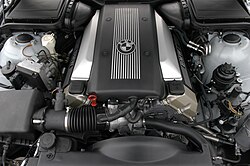
BMW M62 is a naturally aspirated V8 petrol engine which was produced from 1995 to 2005.[1] A successor to the BMW M60, the M62 features an aluminium engine block[2] and a single row timing chain.[3]

In 1998, a technical update included VANOS (variable valve timing) for the intake camshafts.

A BMW M high performance version of the M62, called the S62 engine, was fitted to BMW's E39 M5 and BMW Z8, and both the Ascari KZ1 and Ascari A10.

Design

[edit]

Like the BMW M60 engine it replaced, the M62 is a DOHC engine with four valves per cylinder, an aluminum block and aluminum heads. The M62 has fracture-split forged connecting rods,[4] hypereutectic pistons with ferrous coated side skirts. Most of the M62 engines used Alusil for the block material,[5] however some early M62 engines used Nikasil cylinder coating instead.[6][7]

Alusil technology integrates silicon throughout the aluminum cast so that liners or treated bores within this block family are not needed.

The M62 uses a Bosch Motronic 5.2 engine control unit (also called "DME")[8] and a hot wire MAF.[9]

Technical Update

[edit]

In 1998, a "Technical Update" was applied to the M62, resulting in the M62TU variants. New features include single-VANOS (variable valve timing for the intake camshaft) and electronic throttle control. The engine management was updated to Motronic ME7.2.[10][11]

Versions

[edit]

Figures specified are for European models.[12][13][14][15][16][17]

Version Displacement Power Torque Redline Year
M62B35 3,498 cc 173 kW (232 hp)
at 5,700 rpm
320 N⋅m (236 lb⋅ft)
at 3,300 rpm
6,200 1996
M62TUB35 180 kW (241 hp)
at 5,800 rpm[a]
345 N⋅m (254 lb⋅ft)
at 3,800 rpm
1998
M62B44 4,398 cc 210 kW (282 hp)
at 5,700 rpm
420 N⋅m (310 lb⋅ft)
at 3,900 rpm
6,100 1996
M62TUB44 210 kW (280 hp)
at 5,400 rpm[b]
440 N⋅m (325 lb⋅ft)
at 3,600 rpm
1998
M62TUB46 4,619 cc 255 kW (342 hp)
at 5,700 rpm
480 N⋅m (354 lb⋅ft)
at 3,700 rpm
6,500 2001
Alpina F3 250 kW (335 hp)
at 6,000 rpm
470 N⋅m (347 lb⋅ft)
at 3,700 rpm
1996
Alpina F4 255 kW (342 hp)
at 6,000 rpm
480 N⋅m (354 lb⋅ft)
at 3,700 rpm
2000
Alpina F5 4,837 cc 276 kW (370 hp)
at 6,000 rpm
510 N⋅m (376 lb⋅ft)
at 3,700 rpm
2002
S62B50 4,941 cc 294 kW (394 hp)
at 6,600 rpm
500 N⋅m (369 lb⋅ft)
at 3,800 rpm
7,000 1998
Racing Dynamics R52 5,161 cc 306 kW (410 hp)
at 6,400 rpm
514 N⋅m (379 lb⋅ft)
at 3,900 rpm
7,200 2001
  1. ^ 175 kW (235 hp) for E38 7 Series models
  2. ^ 216 kW (290 hp) for 2001-2003 540i models sold in the U.S.

M62B35

[edit]

The M62B35 has a bore of 84 mm (3.3 in) and a stroke of 78.9 mm (3.1 in).[3]

Applications:[18]

M62TUB35

[edit]

In 1998, the Technical Update was applied, resulting in the M62TUB35.[3] Versions used in the E39 5 Series application have slightly more power than versions used in the E38 7 Series.

Applications:[18]

M62B44

[edit]

The M62B44 has a bore of 92 mm (3.6 in) and a stroke of 82.7 mm (3.26 in).

Applications:[18]

M62TUB44

[edit]
Technical Update version (M62TUB44)

In 1998, the Technical Update was applied, resulting in the M62TUB44. In the United States, power for TU models was increased to 216 kW (290 hp).[27][28]

Applications:[18]

M62TUB46

[edit]

The M62TUB46 is based on the M62TUB44. Revisions include full metal vanos hubs. 10.5mm lift intake and exhaust camshafts. Stronger valve springs. Bore of 93 mm (3.7 in) and stroke of 85 mm (3.3 in). Underdriven crank shaft drive pulley. Two-piece oil scraper ring instead of three-pieces. 93 mm pistons with reduced height due to the increased stroke.

Applications:[18]

Alpina F3

[edit]

The Alpina F3 was developed by Alpina and based on the M62B44 engine. Released late in 1996 it used a modified M62B44 block supplied to Alpina from BMW featuring a bore of 93mm. It also featured a modified cylinder head, different intake camshafts, a crankshaft with increased stroke along with different pistons, a different air intake manifold and exhaust manifolds as well as custom engine programming.[30] It has a bore of 93 mm (3.7 in) and a stroke of 85 mm (3.3 in).

Applications:[18]

Alpina F4

[edit]

Following with updates to the regular production M62B44 the F4 was a revised version of the Alpina F3 engine and featured variable valve timing on the intake camshafts, an electronically controlled throttle body and a slight increase in power. The Alpina F4 received a revision into the F4/1 in late 2000 which slightly increased fuel efficiency while decreasing its emissions output although power output remained the same.[30] It has a bore of 93 mm (3.7 in) and a stroke of 85 mm (3.3 in).

Applications:[18]

Alpina F5

[edit]

The F5 was Alpina's final iteration of the M62B44 engine, it featured all the same technology as the F4/1 but with an increased displacement due to an increased stroke thanks to a modified crankshaft. The increased stroke necessitated an oil pan with additional clearance as well as revised intake camshafts and exhaust camshafts from the M62B46 production engine.[31][32][33] It has a bore of 93 mm (3.7 in) and a stroke of 89 mm (3.5 in).

Applications:[18]

Racing Dynamics R52

[edit]

Based on the production M62B44 the Racing Dynamics R52 engine featured a billet crankshaft, special pistons with stock connecting rods and a modified cylinder head which work together to raise the compression ratio to 11.3:1. It also features custom tubular exhaust manifolds, different camshafts and a modified engine computer which lets the engine spin to its 7,200 rpm redline.[34] It has a bore of 94 mm (3.7 in) and a stroke of 93.0 mm (3.7 in).

Applications:[18]

S62

[edit]
BMW S62 Engine
Overview
Production1998–2003
Layout
Configuration90° V8
Displacement4.9 L (4,941 cc)
Cylinder bore94 mm (3.7 in)
Piston stroke89 mm (3.50 in)
Cylinder block materialAluminium
Cylinder head materialAluminium
ValvetrainDOHC w/ VVT
Compression ratio11.0:1
Combustion
Fuel systemManifold injection
Fuel typePetrol
Oil systemDry sump
Output
Power output294–466 kW (400–634 PS; 394–625 hp)
Torque output500–600 N⋅m (369–443 lb⋅ft)
Chronology
SuccessorBMW S65

The BMW S62 engine (full model code S62B50) is the high-performance variant of the M62, which is fitted to the E39 M5 and the E52 Z8. The S62 was BMW's first V8 engine to have double-VANOS (variable valve timing on the intake and exhaust camshafts).[35]

The S62 engine produces 294 kW (400 PS; 394 hp) at 6600 rpm and 500 N⋅m (369 lb⋅ft) at 3800 rpm.[36] The redline is 7000 rpm.[37][38] The bore and stroke are 94 mm (3.7 in) and 89 mm (3.5 in) respectively. This results in a displacement of 4,941 cc (301.5 cu in), compared with the 4,398 cc (268.4 cu in) of the largest M62 engine at the time.[35]

Other differences compared to the M62 include:

Like the M62, the S62 has an aluminium block and head. The S62 was assembled at BMW's Dingolfing plant.[39]

Applications:

Bentley Arnage

[edit]

The 1998-2000 Bentley Arnage (Green Label) is powered by a Cosworth-developed twin-turbo version of the M62B44.[46] This engine produces 260 kW (349 hp) and 569 N⋅m (420 lb⋅ft).[47]

References

[edit]
Revisions and contributorsEdit on WikipediaRead on Wikipedia
from Grokipedia
The BMW M62 is a naturally aspirated, DOHC V8 family produced by from 1995 to 2005, succeeding the M60 V8 and featuring aluminum engine blocks with displacements of 3.5 liters and 4.4 liters in its primary variants. It was designed for smooth performance in luxury vehicles, incorporating single in early models and double in later Technical Update (TU) versions introduced around 1998–1999, which improved power delivery and efficiency. Key variants include the M62B35 (3.5 L, 3,498 cc) producing 235 hp (173 kW) at 5,700 rpm and 236 lb-ft (320 Nm) of torque at 3,900 rpm, used in models like the E38 728i and E39 535i from 1996 to 1998; and the M62B44 (4.4 L, 4,398 cc) delivering 282–286 hp (210 kW) at 5,700 rpm and 310 lb-ft (420 Nm) at 3,900 rpm, fitted to the E38 740i, E39 540i, and E31 840Ci during 1996–1999. The TU updates, such as the M62TUB35 and M62TUB44, refined these with all-aluminum oil pans, updated intake manifolds, and enhanced electronics, boosting output to 241 hp (177 kW) for the 3.5 L while maintaining 282–286 hp (210 kW) but increasing torque to 325 lb-ft (440 Nm) at 3,600 rpm for the 4.4 L in applications like the 2000–2003 E38 740i and E39 540i. A higher-output 4.6 L variant (M62B46) was also produced briefly for select markets, though less common. The M62 debuted in the E31 8 Series and E38 7 Series in 1996, later expanding to the E39 5 Series and early X5 SUVs, emphasizing refined power and torque for executive driving while addressing some M60 issues like cylinder liner wear through improved coatings ( or Alusil depending on fuel content). Its legacy includes a balance of reliability for its era, though common maintenance needs involve seals, coolant gaskets, and oil leaks.

Design

Core Architecture

The BMW M62 is a family of naturally aspirated V8 petrol engines with a 90-degree bank , constructed from an aluminum block and aluminum heads, and produced from 1995 to 2005 as the direct successor to the M60 V8. This design emphasized lightweight construction while maintaining durability, with the aluminum components cast using advanced processes to ensure structural integrity under high loads. The core valvetrain features a double overhead (DOHC) setup with four valves per , totaling 32 valves across the V8 configuration, enabling efficient gas flow and high-revving performance. Bore and stroke dimensions vary across variants—for instance, 84 mm × 78.9 mm in the base model—yielding total displacements from 3.5 L to 4.6 L. The is 10.0:1 across variants, while the engine maintains a of approximately 6500 rpm and employs a conventional lubrication system for reliable oil distribution. Early M62 blocks utilized cylinder lining, a nickel-silicon applied directly to the aluminum bores for low friction and superior wear resistance, but this was later replaced with Alusil—a silicon-infused aluminum —due to issues from high-sulfur fuels in certain markets. sleeves may be incorporated in aftermarket modifications to enhance durability and allow for boring in high-mileage or performance applications.

Key Components and Systems

The BMW M62 engine incorporates (Variable Nockenwellen Steuerung), a system applied to the intake s starting with the 1998 technical update, allowing stepless adjustment of timing to optimize valve overlap across engine speeds. This adjustment advances or retards the intake relative to the , enhancing low-end delivery by up to 10% while reducing emissions through improved efficiency. The system uses hydraulic pressure from engine oil, controlled by solenoids monitored by the engine management unit, to shift the by approximately 40 degrees of angle. Engine management for the M62 is handled by Bosch systems, with the original versions from 1995 to 1998 employing the M5.2 unit for sequential multi-point and distributorless ignition. The M5.2 processes inputs from sensors including position, position, and oxygen levels to deliver precise fuel metering via eight injectors and spark timing through individual coil packs per cylinder. From 1999, the technical update adopted the ME7.2 system, introducing coil-on-plug ignition for more reliable spark distribution and integrating . The intake system features a composite plastic manifold designed for smooth airflow, paired with a single 80 mm throttle body in pre-update models operated by a cable linkage for responsive acceleration. In technical update variants, the throttle body shifts to electronic drive-by-wire control, enabling precise modulation by the ME7.2 ECU to support VANOS operation and emissions compliance. The exhaust setup includes dual catalytic converters positioned close to the engine for rapid light-off, integrated with manifolds to meet stringent emission standards while maintaining backpressure for torque. Cooling is managed by a water-cooled circuit with a capacity of approximately 12 liters, circulated by a belt-driven and regulated by a map-controlled integrated into the water pump housing. The , electronically monitored by the DME, opens at around 105°C under normal conditions but can adjust earlier based on load to prevent overheating, with an auxiliary electric fan and viscous clutch fan providing . An integrated engine oil cooler is fitted in select variants for high-ambient or performance applications, routing oil through the circuit to maintain . Introduced in 1995, the M62 features an aluminum oil pan to reduce weight and improve thermal dissipation, contributing to the engine's overall curb weight savings compared to the predecessor M60. Accessories such as the alternator, pump, compressor, and water pump are driven by a single with automatic tensioner, ensuring synchronized operation and ease of maintenance. The engine's of 10.0:1 necessitates premium unleaded (minimum 91 AKI) to prevent under load, aligning with BMW's recommendations for optimal performance and longevity.

Technical Updates

Pre-Update Versions

The BMW M62 engine entered production in 1995 as BMW's second-generation all-aluminum V8, succeeding the M60, with initial versions manufactured until 1998 before the technical update (TU) revisions. These pre-update models utilized a cable-operated throttle system for precise driver input without electronic intervention, and featured Nikasil-plated liners to reduce and improve . Unlike later iterations, they lacked , relying instead on fixed timing to deliver reliable performance across a broad range of operating conditions. Assembly occurred at BMW's primary engine plant in , , where the focus was on integrating the V8 into luxury sedans and coupes for smooth power delivery. Designed for baseline emissions compliance, the pre-TU M62 met Euro 2 standards in European markets and Transitional Low Emission Vehicle (TLEV) or federal requirements in the United States, achieved through optimized fuel injection and catalytic converter tuning without advanced electronic throttle control. The engine's torque curve emphasized mid-range output, peaking around 3,500-4,000 rpm to provide robust acceleration for daily driving and highway merging, typically yielding 20-25 mpg on highway cycles in applications like the E39 540i. This optimization prioritized usability over peak power, contributing to the M62's reputation for refined operation in BMW's executive vehicles. Early production runs of the M62 encountered reliability concerns, including oil leaks from valve cover gaskets and timing cover seals, which could lead to external contamination and potential fire hazards if unaddressed. BMW issued service bulletins and conducted targeted repairs for affected units, often involving gasket replacements during routine maintenance. These issues were more prevalent in the first few years due to material settling and thermal cycling, but proper servicing mitigated long-term effects. The Nikasil liners, while beneficial for performance, also posed challenges in regions with high-sulfur fuels, prompting the earlier shift to Alusil in subsequent production for those markets.

TU Updates

The 1999 Technical Update (TU) to the BMW M62 engine introduced key enhancements focused on performance, emissions compliance, and durability, particularly in response to operational challenges observed in earlier variants. TU-equipped M62 engines entered production in September 1998 for the 1999 model year. A primary change was the implementation of single VANOS variable valve timing on the intake camshafts, which optimized valve timing for improved torque delivery and fuel efficiency across the operating range. Additionally, the TU adopted fully electronic throttle control (drive-by-wire), replacing the previous cable-operated system to enable more precise throttle response and integration with advanced engine management features. To address cylinder bore wear issues prevalent in high-sulfur fuel markets, Alusil alloy bores were used, a silicon-enriched aluminum material that provided greater resistance to corrosive degradation without sacrificing heat transfer properties. The intake manifold was revised with shorter runners to enhance mid-range airflow and torque, complementing the system's effects for smoother power delivery. Engine management transitioned to the Bosch ME7.2 ECU, which supported the new system and allowed for refined mapping to meet updated regulatory requirements. Improvements to the pump and scavenge system, including better oil return pathways, helped mitigate oil aeration under high lateral loads and reduced overall consumption. These modifications yielded power gains of 3-10 hp depending on the variant and market—such as from 282 hp to 290 hp for the 4.4 L version in the United States—while achieving better emissions performance aligned with Euro 3 standards in Europe and Ultra Low Emissions Vehicle (ULEV) certification in North America through optimized combustion and exhaust gas recirculation. Noise, vibration, and harshness (NVH) were further mitigated via updated engine mounts and refined component damping. TU-equipped M62 engines remained in use until 2005, successfully resolving the Nikasil-related durability concerns in sulfur-sensitive regions.

Engine Variants

3.5 L Variants

The 3.5 L variants of the BMW M62 engine served as the entry-level options within the V8 lineup, providing a compact displacement for models prioritizing efficiency alongside smooth power delivery. The initial M62B35, produced from 1995 to 1998, featured a displacement of 3,498 cc achieved through a bore of 84 mm and a stroke of 78.9 mm. It generated 235 hp at 5,700 rpm and 236 lb-ft of torque at 3,300 rpm, equipped with single VANOS for variable valve timing on the intake side. In 1999, BMW introduced the technical update (TU) version, the M62TUB35, which continued production through 2003 while retaining the same 3,498 cc displacement, bore, and stroke. This iteration incorporated double for variable timing on both intake and exhaust camshafts, along with a raised of 10.5:1, yielding 238 hp at 5,800 rpm and 254 lb-ft of at 3,800 rpm. The dry weight for both 3.5 L variants was approximately 220 kg. The TU refinements, particularly the double system, broadened the peak band compared to the pre-update M62B35, enhancing low-end response and drivability in entry-level V8 applications without altering the core architecture.

4.4 L Variants

The 4.4 L variants of the BMW M62 engine provided substantial and refined performance suited to luxury sedans and SUVs, emphasizing smooth power delivery over peak output. The initial M62B44, produced from 1996 to 1998, featured a displacement of 4,398 cc achieved with a bore of 92 mm and a of 82.7 mm, along with a of 10.0:1. It generated 282 hp at 5,700 rpm and 310 lb-ft of at 3,900 rpm, incorporating single on the intake camshafts for optimized low-end response. The M62TUB44, introduced in 1999 as part of the technical update and continuing production until 2005, retained the same displacement and dimensions but included double on both intake and exhaust camshafts, an electronic throttle body, and a raised of 10.5:1. These changes enhanced mid-range and emissions compliance, with US-market versions meeting Ultra Low Emissions Vehicle (ULEV) standards through refined fuel mapping and . Power output was 286 hp at 5,700 rpm and 325 lb-ft of at 3,500 rpm, though some configurations reached 290 hp in select US applications post-2001; the engine's broad curve contributed to its favor among drivers of high-end models for effortless . Real-world fuel economy for the M62B44 averaged around 18 combined, while the M62TUB44 improved this by 1-2 to approximately 19-20 combined, benefiting from the TU's more efficient and throttle control.

4.6 L Variants

The BMW M62 4.6 L variant, known as the M62TUB46, represents a late-production iteration of the engine , introduced in 2000 and manufactured until 2003. With a displacement of 4,616 cc achieved through a bore of 93 mm and a stroke of 85 mm, this version was designed exclusively as a technical update (TU) model, incorporating double on both intake and exhaust camshafts, along with an Alusil aluminum alloy block for enhanced durability and heat dissipation. The M62TUB46 powered high-output applications such as the BMW X5 (E53) 4.6is and limited models from tuners like Alpina and Morgan, featuring revised camshaft profiles with increased valve lift to improve high-rpm breathing and power delivery, while maintaining the core 90-degree V8 architecture. Production was limited, with primary use in the performance-oriented X5 SUV from 2001 to 2003, and additional applications including the Morgan Aero 8 (2000–2004). The engine delivered 347 PS (255 kW; 342 hp) at 5,700 rpm and 480 Nm (354 lb⋅ft) of torque at 3,700 rpm, emphasizing a balance of refinement and acceleration. In its primary application, the 4.6is (E53) from 2001 to 2003, the M62TUB46 provided robust performance, achieving 0-60 mph in under 6.5 seconds while supporting the vehicle's all-wheel-drive system and sport-tuned suspension. This variant's enhancements over the 4.4 L models, including stronger valve springs and improved oil control via a two-piece scraper ring, contributed to its suitability for demanding luxury-performance roles. The engine also powered limited-run models like the Alpina B10 V8, where similar output figures supported top speeds exceeding 155 mph.

Tuned Variants

The tuned variants of the BMW M62 engine were developed by specialized tuners, primarily , to enhance performance while retaining the core V8 architecture. These hand-built engines, produced in limited quantities during the late and early , featured bespoke components such as optimized cylinder heads, custom camshafts, and revised intake systems, often at a premium price point reflecting their exclusivity. Alpina's F3 engine, introduced in late 1996 for the E39-based B10 V8, was derived from the M62B44 with key modifications including an increased bore to 93 mm and stroke to 85 mm via a custom , boosting displacement to 4,619 cc. It incorporated flow-optimized and exhaust ports in the cylinder heads, four chain-driven camshafts with higher lift, a carbon airbox for improved air , and a four-pipe sports . These changes yielded 340 hp (250 kW) at 5,700 rpm and 470 N⋅m (347 lb⋅ft) at 3,800 rpm. The F4 variant, launched in late 1998, built on the technical update (TU) version of the M62B44, incorporating double while maintaining the 4,619 cc displacement with 93 mm bore and 85 mm . Modifications included larger throttle bodies and a custom exhaust, resulting in 347 hp (255 kW) at 5,700 rpm and 480 N⋅m (354 lb⋅ft) at 3,700 rpm. A further revision, the F4/1 in late 2000, refined and emissions without altering peak output. Alpina's F5 , debuted in late for the B10 V8 S, extended the stroke to 89 mm on a 4.6 L base (similar to the M62TUB44 with prior modifications), achieving 4,837 cc displacement through a reinforced block and other internals. It delivered 375 hp (276 kW) at 5,800 rpm and 510 N⋅m (376 lb⋅ft) at 3,800 rpm, emphasizing refined power delivery. Dynamics' R52, offered as an aftermarket conversion for E39 models in the early , started from the M62B44 and enlarged displacement to 5.2 L via a , custom connecting rods, pistons with increased bore, special valves, and four sports camshafts. Additional enhancements comprised optimized ports for better flow, tubular exhaust manifolds, and recalibrated software enabling a 7,000 rpm , producing over 300 hp.

Applications

BMW Models

The BMW M62 engine family powered several luxury and performance-oriented models across 's lineup during the late and early , marking a significant expansion of V8 applications in the brand's sedans, coupes, and SUVs. Debuting in the 1996 model year with the 7 Series (E38), the M62 provided smooth power delivery and refined performance suitable for executive vehicles, contributing to over 300,000 units produced across its variants. In the 7 Series (E38, produced from 1994 to 2001), the M62 debuted in the 735i equipped with the 3.5-liter M62B35 variant, offering a balance of efficiency and luxury for markets seeking a V8 without the larger displacement. The 740i and long-wheelbase 740iL models followed suit with the 4.4-liter M62B44, becoming staples in the lineup from 1996 onward and emphasizing the engine's role in elevating the E38's flagship status. These applications were particularly popular in export markets, including Japan and Australia, where V8 options were often specified for premium buyers. The 5 Series (E39, 1995–2003) integrated the M62 starting with the 535i with the M62B35 from 1996 to 1998 and the M62TUB35 from 1998 to 2003, providing a sportier alternative to inline-six models in mid-size executive sedans and wagons. The 540i, introduced in 1997, utilized the M62B44 and later the updated M62TUB44, delivering enhanced torque for dynamic driving while maintaining the E39's renowned handling balance. This pairing helped the 540i become a benchmark for V8-powered midsize luxury cars during its production run. For the 8 Series (E31, 1989–1999), the M62B44 powered the 840Ci from 1996 to 1999, replacing the earlier M70 V12 in the grand tourer to offer improved efficiency without sacrificing the model's grand touring poise. This late-production update extended the E31's lifespan as a high-end , appealing to enthusiasts valuing aluminum V8 smoothness over the V12's complexity. The M62 also found application in BMW's first , the X5 (E53, 1999–2003), where the 4.4i model employed the M62TUB44 for robust all-wheel-drive capability from 1999. The sportier 4.6is , introduced in 2002, featured the larger M62TUB46, enhancing for off-road and on-road versatility in this pioneering luxury crossover. These integrations broadened the M62's reach beyond sedans, powering a significant portion of E53 production.

Non-BMW Vehicles

The BMW M62 engine was supplied to Motors for use in the Arnage luxury sedan, particularly in the initial Green Label models produced from to 2000. This variant featured a Cosworth-developed twin-turbocharged iteration of the 4.4 L M62B44, tuned to produce 349 horsepower at 5,500 rpm and 420 lb-ft of torque at 2,500 rpm for enhanced luxury performance. The engine was integrated with a ZF 5HP30 5-speed , maintaining the M62's aluminum block and double overhead design with minimal structural changes beyond the turbocharging system. As part of BMW's ownership of during this period (–2002), the engines were provided directly from BMW's production facilities without significant redesign, facilitating a smooth transition from the previous L-series V8. The M62 also powered select models from , notably the third-generation from 2002 to 2005. In this application, the naturally aspirated 4.4 L M62TUB44 variant delivered 286 horsepower at 5,400 rpm and 325 lb-ft of torque at 3,600 rpm, optimized for the SUV's blend of on-road refinement and off-road capability. BMW supplied complete M62TUB units to following the 2000 divestiture of the to Ford, with adaptations including a revised oil sump for improved ground clearance and traversal. This integration ended with the model's shift to the Jaguar-sourced AJ-V8 in 2006, marking the conclusion of M62 use in non- production vehicles. Additionally, the M62TUB44 and M62TUB46 variants were used in the Morgan Aero 8 sports car from 2000 to 2004, providing a lightweight grand tourer with the engine's smooth V8 character.

S62 Variant

The BMW S62 is a high-performance variant of the M62 V8 engine, developed specifically for the E39 M5 sedan to deliver enhanced power and responsiveness for dynamic driving. Introduced in 1998, it features a displacement of 4,941 cc achieved through a bore of 94 mm and a stroke of 89 mm, compared to the standard M62's dimensions. This configuration, combined with an aluminum block featuring Alusil cylinder bores, allows for a compression ratio of 11.0:1 and supports higher engine speeds. The S62 produces 400 PS (394 hp) at 6,600 rpm and 500 Nm (369 lb-ft) of torque at 3,800 rpm, with a redline of 7,000 rpm. Key enhancements in the S62 focus on improving throttle response and high-revving character, including individual electronic bodies for each cylinder, larger intake and exhaust valves, and a reinforced crankshaft assembly to handle increased stresses. The engine also incorporates dual variable valve timing on both intake and exhaust cams for optimized power delivery across the rev range. Production of the S62 ran from 1998 to 2003, exclusively powering the E39 M5, with approximately 20,482 units built worldwide. These modifications emphasize peak power at higher rpms rather than low-end torque, aligning with M's performance philosophy. In terms of , the S62 enables the E39 M5 to accelerate from 0-60 mph in 4.9 seconds, showcasing its rev-happy nature and precise powerband that rewards spirited driving. The engine's design prioritizes linear power buildup toward the , providing a distinctive high-revving experience typical of naturally aspirated M engines of the era.

Successor Engines

The BMW M62 engine family saw a late evolution in the form of the M62B48 variant, a 4.8-liter V8 developed specifically for the B10 V8S model based on the E39 5 Series, producing 370 horsepower at 6,000 rpm and 376 pound-feet of torque at 3,500 rpm. This displacement increase from 85 mm to 89 mm raised capacity to 4,837 cc while retaining the core M62 architecture, but its production was limited to this high-performance application and proved short-lived as BMW transitioned to next-generation designs. The primary successor to the M62 was the N62, a naturally aspirated produced from 2001 to 2010 in 4.4-liter (N62B44) and 4.8-liter (N62B48) displacements, featuring innovations like variable valve lift, double on both and exhaust camshafts to enhance and performance. These advancements addressed the M62's limitations in meeting evolving emissions standards, particularly Euro 4 requirements introduced in 2005, through improved mixture formation and reduced throttling losses. The N62 also incorporated weight-saving measures, such as a magnesium-aluminum composite manifold, contributing to overall gains over the predecessor. The N62 directly replaced the M62 in key BMW models, debuting in the E65 7 Series in 2001 and later powering the E60 5 Series from 2003, with production overlapping the M62's run until the latter's phase-out in 2005 amid stricter global regulations that the older design struggled to satisfy without major redesign. This transition marked the end of the M62 era, as the N62's advanced technologies enabled compliance with tightening environmental norms while maintaining V8 character, though no direct diesel equivalent emerged from the M62 lineage.

Reliability and Maintenance

Common Issues

The BMW M62 engine, while praised for its performance, is prone to several mechanical issues that owners frequently encounter, particularly as mileage accumulates beyond miles. These problems often stem from material wear in components exposed to heat, oil, and operational stress, leading to costly repairs if not addressed proactively. Based on service reports and owner experiences documented in automotive resources, the most prevalent concerns include failures in the timing system, , cylinder liners, oil sealing, and cooling components. One of the most notorious issues with the M62 is the degradation of its timing chain guides, which typically wear out between 100,000 and 150,000 miles due to constant friction and heat exposure. This failure manifests as a distinctive rattling from the front of the , especially during startup or idle, and can progress to chain slack, mis-timing, and severe engine damage if ignored. Replacement involves labor-intensive disassembly of the front engine assembly, with costs ranging from $2,000 to $4,000 depending on labor rates and whether additional components like the chain or tensioners are replaced. The system, in technical update (TU) variants, suffers from seal degradation over time, leading to oil leaks within that cause rough idling, reduced low-end power, and during acceleration. Symptoms often include a with codes related to position, exacerbated by hardened or cracked seals that fail to maintain proper oil pressure. Maintenance typically requires the solenoids or a full rebuild with updated seals, a process that can restore performance but demands precision to avoid further complications. Early M62 models equipped with cylinder liners are susceptible to excessive wear in regions with high- fuel, where sulfur reacts chemically with the nickel-silicon coating, resulting in bore scoring, pitting, and increased oil consumption. This issue primarily affected non-TU engines produced before 1999, leading to misfires, compression loss, and blue smoke from the exhaust as the bores degrade. The technical update (TU) variants switched to Alusil liners to mitigate sulfur sensitivity, though some residual oil burning persists due to the softer aluminum-silicon composition, often requiring closer monitoring of oil levels. Oil leaks from valve covers and are commonplace after approximately miles, as the rubber components harden and crack under prolonged exposure to engine heat and oil pressure. These leaks can contaminate spark plugs, ignition coils, and exhaust manifolds, potentially causing misfires or damage if oil drips onto hot surfaces. Replacing the valve cover gaskets on the M62 is generally more complex and time-consuming than on inline-six engines like the M54 due to the V8 layout requiring work on two separate valve covers (one per bank), involving removal of ignition coils, electrical harnesses, fuel injector clips, and other components, with particular challenges on the driver's side due to tight access and proximity to fuel lines. While the procedure is straightforward for experienced mechanics, it can be frustrating due to difficult-to-release clips and limited space, often taking longer for DIY mechanics compared to the M54's simpler single valve cover replacement with better accessibility. Routine inspection and replacement of , often using reinforced aftermarket materials, is recommended during major services to prevent escalation. Cooling system failures, including thermostat and water pump breakdowns, commonly occur around 100,000 miles, with the plastic in the water pump prone to cracking and the sticking in a closed position. These malfunctions disrupt flow, risking overheating that can warp heads or blow in the aluminum block. Early detection through gauge monitoring or level checks is crucial, as repairs involve draining the system and replacing both components simultaneously to avoid repeat failures.

Longevity and Modifications

The BMW M62 engine demonstrates strong when subjected to diligent , routinely surpassing 200,000 miles in well-cared-for examples, with some owners reporting up to 226,000 miles of service. Regular oil changes every 5,000 to 7,500 miles using a high-quality , such as 5W-30 meeting BMW Longlife-01 specifications, are critical to achieving this lifespan by minimizing wear on internal components. Non-technical update (non-TU) variants tend to exhibit greater reliability due to their simpler construction without (), whereas TU models provide enhanced low-end torque but introduce potential failure points in the system. Among popular aftermarket modifications, ECU remapping stands out for its straightforward implementation and modest power increases of 18 to 20 horsepower, improving response without compromising drivability. kits, notably from VF Engineering, offer substantial upgrades by delivering up to 410 horsepower and 395 lb-ft of on a stock 4.4-liter M62TU, representing gains of over 120 horsepower through centrifugal forcing at 6 psi boost. enhancements, such as cat-back replacements from Supersprint, promote better exhaust flow, reducing backpressure and yielding incremental improvements across the rev range. The M62's widespread availability has fueled its popularity for engine swaps into non-BMW vehicles, particularly Range Rovers where it serves as a reliable upgrade over the original V8, as evidenced by numerous documented conversions in early models. Aftermarket parts support for the M62 remains robust in 2025, with specialized suppliers like Beisan Systems offering comprehensive seals repair kits that address common wear issues without full engine disassembly. For long-term preservation, proactive measures include inspecting the timing chain and tensioners around 100,000 miles to preempt guide failures, alongside annual checks to ensure proper tension and lubrication. Emerging hybrid electric conversion kits for classic BMWs equipped with the M62 enable owners to integrate electric assistance, blending vintage aesthetics with modern efficiency and reduced emissions.

References

Add your contribution
Related Hubs
User Avatar
No comments yet.