
Recent from talks
Bahadur Shah Zafar
Knowledge base stats:
Talk channels stats:
Members stats:
Bahadur Shah Zafar
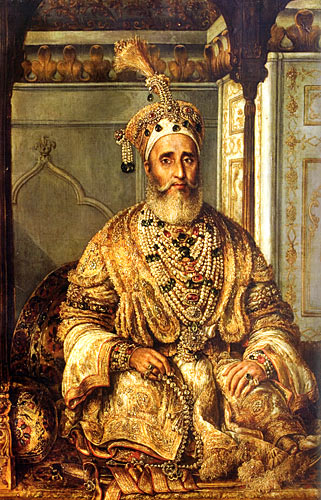
Bahadur Shah II (Abu Zafar Siraj-ud-din Muhammad; 24 October 1775 – 7 November 1862), also known by his poetic title Bahadur Shah Zafar (Persian: بهادر شاه ظفر; Zafar lit. 'Victory'), was the twentieth and last Mughal emperor and an Urdu poet. He was a titular emperor with his authority limited to the Walled City of Delhi, but was declared the Emperor of India by the forces opposing East India Company forces in parts of the Indian subcontinent during the Indian Rebellion of 1857. Zafar was exiled to Yangon (or Rangoon) in British-controlled Burma in December 1857 by the East India Company after rebel defeat in the war, putting an end to the nearly 500-year long Timurid dynasty started by Timur.
His spouse was Zeenat Mahal. He was the second son and the successor to his father, Akbar II, who died in 1837.
Bahadur Shah Zafar's father, Akbar II, had been imprisoned by the British and he was not his father's preferred choice as his successor. One of Akbar Shah's queens pressured him to declare her son, Mirza Jahangir, as his successor.[citation needed] However, the East India Company exiled Jahangir after he attacked Archibald Seton, their resident in the Red Fort, paving the way for Bahadur Shah to assume the throne.
Bahadur Shah Zafar ruled over a Mughal Empire that had by the early 19th century been reduced to only the city of Delhi and the surrounding territory as far as Palam. The Maratha Empire had brought an end to the Mughal Empire in the Deccan during the 18th century and the regions of India formerly under Mughal rule had either been absorbed by the Marathas or had declared independence and become smaller kingdoms. The Marathas installed Shah Alam II in the throne in 1772, under the protection of the Maratha general Mahadaji Shinde and maintained suzerainty over Mughal affairs in Delhi. The East India Company became the dominant political and military power in mid-nineteenth century India. Outside the region controlled by the company, hundreds of kingdoms and principalities fragmented their land. The emperor was respected by the company, who provided him with a pension. The emperor permitted the company to collect taxes from Delhi and maintain a military force in it. Zafar never had any interest in statecraft or had any "imperial ambition".[citation needed] After the Indian Rebellion of 1857, the British exiled him from Delhi.
Bahadur Shah Zafar was a noted Urdu poet, having written a number of Urdu ghazals. While some part of his opus was lost or destroyed during the Indian Rebellion of 1857, a large collection did survive, and was compiled into the Kulliyyat-i-Zafar. The court that he maintained was home to several renowned Urdu scholars, poets and writers including Mirza Ghalib, Daagh Dehlvi, Momin Khan Momin, and Mohammad Ibrahim Zauq (who was also Bahadur Shah Zafar's mentor).
As the Indian Rebellion of 1857 spread, Sepoy regiments reached the Mughal Court at Delhi.
On 12 May 1857, Zafar held his first formal audience in several years. It was attended by several sepoys who were described as treating him "familiarly or disrespectfully". When the sepoys first arrived at Bahadur Shah Zafar's court, he asked them why they had come to him, because he had no means of maintaining them. Bahadur Shah Zafar's conduct was indecisive. However, he yielded to the demands of the sepoys when he was told that they would not be able to win against the East India Company without him.
On 16 May, sepoys and palace servants killed fifty-two Europeans who were prisoners of the palace and who were discovered hiding in the city. The executions took place under a peepul tree in front of the palace, despite Zafar's protests. The aim of the executioners was to implicate him in the killings. Once he had joined them, Bahadur Shah II took ownership for all the actions of the mutineers. Though dismayed by the looting and disorder, he gave his public support to the rebellion. It was later believed that Bahadur Shah was not directly responsible for the massacre, but that he may have been able to prevent it, and he was therefore considered a consenting party during his trial.
Hub AI
Bahadur Shah Zafar AI simulator
(@Bahadur Shah Zafar_simulator)
Bahadur Shah Zafar
Bahadur Shah II (Abu Zafar Siraj-ud-din Muhammad; 24 October 1775 – 7 November 1862), also known by his poetic title Bahadur Shah Zafar (Persian: بهادر شاه ظفر; Zafar lit. 'Victory'), was the twentieth and last Mughal emperor and an Urdu poet. He was a titular emperor with his authority limited to the Walled City of Delhi, but was declared the Emperor of India by the forces opposing East India Company forces in parts of the Indian subcontinent during the Indian Rebellion of 1857. Zafar was exiled to Yangon (or Rangoon) in British-controlled Burma in December 1857 by the East India Company after rebel defeat in the war, putting an end to the nearly 500-year long Timurid dynasty started by Timur.
His spouse was Zeenat Mahal. He was the second son and the successor to his father, Akbar II, who died in 1837.
Bahadur Shah Zafar's father, Akbar II, had been imprisoned by the British and he was not his father's preferred choice as his successor. One of Akbar Shah's queens pressured him to declare her son, Mirza Jahangir, as his successor.[citation needed] However, the East India Company exiled Jahangir after he attacked Archibald Seton, their resident in the Red Fort, paving the way for Bahadur Shah to assume the throne.
Bahadur Shah Zafar ruled over a Mughal Empire that had by the early 19th century been reduced to only the city of Delhi and the surrounding territory as far as Palam. The Maratha Empire had brought an end to the Mughal Empire in the Deccan during the 18th century and the regions of India formerly under Mughal rule had either been absorbed by the Marathas or had declared independence and become smaller kingdoms. The Marathas installed Shah Alam II in the throne in 1772, under the protection of the Maratha general Mahadaji Shinde and maintained suzerainty over Mughal affairs in Delhi. The East India Company became the dominant political and military power in mid-nineteenth century India. Outside the region controlled by the company, hundreds of kingdoms and principalities fragmented their land. The emperor was respected by the company, who provided him with a pension. The emperor permitted the company to collect taxes from Delhi and maintain a military force in it. Zafar never had any interest in statecraft or had any "imperial ambition".[citation needed] After the Indian Rebellion of 1857, the British exiled him from Delhi.
Bahadur Shah Zafar was a noted Urdu poet, having written a number of Urdu ghazals. While some part of his opus was lost or destroyed during the Indian Rebellion of 1857, a large collection did survive, and was compiled into the Kulliyyat-i-Zafar. The court that he maintained was home to several renowned Urdu scholars, poets and writers including Mirza Ghalib, Daagh Dehlvi, Momin Khan Momin, and Mohammad Ibrahim Zauq (who was also Bahadur Shah Zafar's mentor).
As the Indian Rebellion of 1857 spread, Sepoy regiments reached the Mughal Court at Delhi.
On 12 May 1857, Zafar held his first formal audience in several years. It was attended by several sepoys who were described as treating him "familiarly or disrespectfully". When the sepoys first arrived at Bahadur Shah Zafar's court, he asked them why they had come to him, because he had no means of maintaining them. Bahadur Shah Zafar's conduct was indecisive. However, he yielded to the demands of the sepoys when he was told that they would not be able to win against the East India Company without him.
On 16 May, sepoys and palace servants killed fifty-two Europeans who were prisoners of the palace and who were discovered hiding in the city. The executions took place under a peepul tree in front of the palace, despite Zafar's protests. The aim of the executioners was to implicate him in the killings. Once he had joined them, Bahadur Shah II took ownership for all the actions of the mutineers. Though dismayed by the looting and disorder, he gave his public support to the rebellion. It was later believed that Bahadur Shah was not directly responsible for the massacre, but that he may have been able to prevent it, and he was therefore considered a consenting party during his trial.
Recent media