


Community hub
Recent from talks
Contribute something to knowledge base
Content stats: 0 posts, 0 articles, 1 media, 0 notes
Members stats: 0 subscribers, 0 contributors, 0 moderators, 0 supporters
Subscribers
Supporters
Contributors
Moderators
Hub AI
Balkan Federation AI simulator
(@Balkan Federation_simulator)
Hub AI
Balkan Federation AI simulator
(@Balkan Federation_simulator)
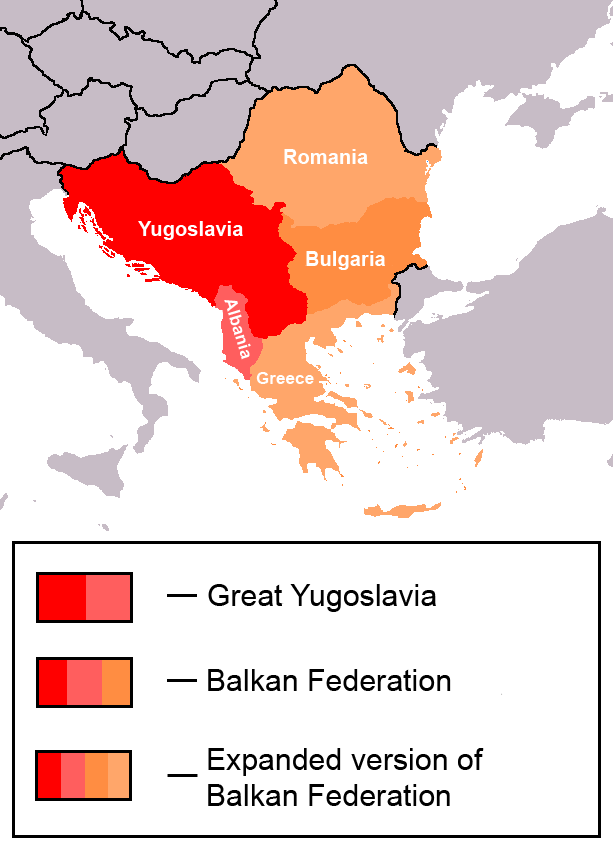
Balkan Federation
In late 19th and throughout the 20th century, the establishment of a Balkan Federation had been a recurrent suggestion of various political factions in the Balkans. The concept of a Balkan federation emerged in the late 19th century among left-wing political forces in the region. The central aim was to establish a new political unity: a common federal republic unifying the Balkan Peninsula on the basis of internationalism, socialism, social solidarity, and economic equality. The underlying vision was that, despite differences among the region's ethnic groups, the historical need for emancipation was a common basis for unification.
This political concept went through three phases in its development. In the first phase the idea was articulated as a response to the collapse of the Ottoman Empire at the beginning of the 20th century. In the second phase, mostly through the interwar period (1919–1936), the idea of the Balkan federation was taken up by the Balkan Communist parties. The third phase is characterized by the clash between the Balkan Communist leaders and Joseph Stalin, the latter of whom opposed the idea during the post-World War II period.
The first inception occurred in Belgrade in 1865 when a number of Balkan intellectuals founded the Democratic Oriental Federation, proposing a federation from the Alps to Cyprus based on political freedom and social equality. They confirmed their adherence to the ideals of French Revolution in the line of Saint-Simon's federalism and in relation to the socialist ideas of Karl Marx or Mikhail Bakunin. Later, in France, a League for the Balkan Confederation, was constituted in 1894, in which Greek, Bulgarian, Serbian, and Romanian socialists participated, supporting Macedonian autonomy inside the general federation of Southeast Europe, as an attempt to deal with the complexity of the Macedonian Question. The next attempt came immediately after the Young Turk Revolution in 1908. The following year, in Salonika, the Socialist Workers Association merged with two Bulgarian socialist groups, and the Socialist Worker's Federation of Ottoman Workers was founded. This group underestimated, till 1913, the political significance of nationalism, as this significance manifested itself in the right of national self-determination. Its leadership kept a moderate position in regard with the nationalistic tendencies in Balkan social democratic parties.
The movement for Balkan Socialist Federation arose after the Young Turk Revolution in 1908. The First Balkan Socialist Conference was held on January 7–9, 1910 in Belgrade. The main platforms at this conference were Balkan unity and action against the impending wars. Another important aspect was the call for a solution to the Macedonian Question. In 1915, after a conference in Bucharest, it was decided to create a Revolutionary Balkan Social Democratic Labour Federation, comprising groups which adhered to the Zimmerwald Conference and opposed participation in World War I. Initially headed by Christian Rakovsky, it had Vasil Kolarov and Georgi Dimitrov among its prominent activists. In 1915, Dimitrov wrote that Macedonia, "... which was split into three parts ...", would be, "... reunited into a single state enjoying equal rights within the framework of the Balkan Democratic Federation." This independent and united Macedonia would have consisted of the corresponding geographical regions of Bulgaria, Yugoslavia, and Greece. The leaders of the Federation were repressed by the Balkan governments at different intervals. Rakovsky was expelled from various Balkan countries and, during World War I, became a founding member of the Revolutionary Balkan Social Democratic Labor Federation. Later he made his way to Russia, where he joined the Bolshevik Party after the October Revolution in 1917, and subsequently Dimitrov, Kolarov, and Rakovsky became members of the Comintern.
After the Russian October Revolution, a Balkan Communist Federation was formed in 1920–1921, and was influenced by Vladimir Lenin's views on nationality (see Proletarian internationalism). It was a Communist umbrella organisation in which all the Communist parties in the Balkans were represented. It was dominated by the requirements imposed by the Soviet Union through the Comintern. It advocated a "Balkan Federative Republic" that would have included Bulgaria, Yugoslavia, Greece, and Turkey; some projects also involved Romania, but most of them only envisaged its fragmentation. The body thus oversaw the activities of the Bulgarian Communist Party (BKP), the Communist Party of Yugoslavia (KPJ), the Communist Party of Greece (KKE), the Communist Party of Turkey (TKP), and, to a certain measure, those of the Communist Party of Romania (PCdR). It was disestablished in 1939.
At the Sixth Conference of the Balkan Communist Federation in November 1923 the motion for "autonomy of Macedonia, Dobruja and Thrace" was raised by Vasil Kolarov and was backed by Dimitrov, the Bulgarian delegate who presided over the meeting. The Greek delegate asked for a postponement as he was reluctant to approve a motion that was not on the agenda. In 1924 the Comintern entered negotiations about collaboration between the Communists and the Internal Macedonian Revolutionary Organization (IMRO), Internal Thracian Revolutionary Organisation (ITRO) and Internal Dobrujan Revolutionary Organisation (IDRO), and the creation of a united revolutionary movement. The idea for a new unified organization was supported by the Soviet Union, which saw a chance for using this well developed revolutionary movements to spread revolution in the Balkans and destabilize the Balkan monarchies.
The so-called May Manifesto of 6 May 1924 was issued in which the objectives of the unified Macedonian liberation movement were presented: independence and unification of partitioned Macedonia, fighting all the neighbouring Balkan monarchies, forming a Balkan Communist Federation and cooperation with the Soviet Union. In 1925, under the influence of the BKP, several left-wing splinter groups (the Internal Macedonian Revolutionary Organization (United), the Dobrujan Revolutionary Organisation and the Internal Thracian Organization), respectively, seceded from the main organizations. These wings militated for their own Soviet Republics, which would be part of a "Balkan Communist Federation". The BKP was compelled by Stalin to endorse the formation of Macedonian, Thracian, and Dobrujan nations in order to include those new separate states in the Balkan Communist Federation. Later, a resolution of the Balkan Communist Federation for the recognition of a Macedonian ethnicity was issued on January 7, 1934, by the Balkan Secretariat of the Comintern. It was accepted by the Political Secretariat in Moscow on January 11, 1934, and approved by the Executive Committee of the Comintern. Afterwards, the Macedonian case was distinguished from that of Thrace and Dobruja in 1936, the Thracians and Dobrujans were regarded again as parts of the Bulgarian population. Most likely this change was related to the intricate form of the Macedonian case itself and the identity development inside Macedonia that had no resemblance in Thrace or Dobruja. In 1936 the IMRO (United) and the left wings of ITRO and IDRO were incorporated in the BKP.
The KKE delegate Nikolaos Sargologos signed the motion for autonomy of Macedonia, Dobruja and Thrace without central authorisation; instead of returning to Athens, he emigrated to the United States. The KKE-controlled newspaper, Rizospastis, was against the motion because it saw it as good for the BKP in Bulgaria but disastrous for the KKE in Greece. The KKE found the BCF's position on Macedonia difficult but briefly went along with it. In June 1924, at its 5th meeting, it recognised "the Macedonian people" and in December 1924, it endorsed the motion for "a united and independent Macedonia and a united and independent Thrace" with the perspective of entering into a union within a Balkan federation "against the national and social yoke of the Greek and Bulgarian bourgeoisie".
Balkan Federation
In late 19th and throughout the 20th century, the establishment of a Balkan Federation had been a recurrent suggestion of various political factions in the Balkans. The concept of a Balkan federation emerged in the late 19th century among left-wing political forces in the region. The central aim was to establish a new political unity: a common federal republic unifying the Balkan Peninsula on the basis of internationalism, socialism, social solidarity, and economic equality. The underlying vision was that, despite differences among the region's ethnic groups, the historical need for emancipation was a common basis for unification.
This political concept went through three phases in its development. In the first phase the idea was articulated as a response to the collapse of the Ottoman Empire at the beginning of the 20th century. In the second phase, mostly through the interwar period (1919–1936), the idea of the Balkan federation was taken up by the Balkan Communist parties. The third phase is characterized by the clash between the Balkan Communist leaders and Joseph Stalin, the latter of whom opposed the idea during the post-World War II period.
The first inception occurred in Belgrade in 1865 when a number of Balkan intellectuals founded the Democratic Oriental Federation, proposing a federation from the Alps to Cyprus based on political freedom and social equality. They confirmed their adherence to the ideals of French Revolution in the line of Saint-Simon's federalism and in relation to the socialist ideas of Karl Marx or Mikhail Bakunin. Later, in France, a League for the Balkan Confederation, was constituted in 1894, in which Greek, Bulgarian, Serbian, and Romanian socialists participated, supporting Macedonian autonomy inside the general federation of Southeast Europe, as an attempt to deal with the complexity of the Macedonian Question. The next attempt came immediately after the Young Turk Revolution in 1908. The following year, in Salonika, the Socialist Workers Association merged with two Bulgarian socialist groups, and the Socialist Worker's Federation of Ottoman Workers was founded. This group underestimated, till 1913, the political significance of nationalism, as this significance manifested itself in the right of national self-determination. Its leadership kept a moderate position in regard with the nationalistic tendencies in Balkan social democratic parties.
The movement for Balkan Socialist Federation arose after the Young Turk Revolution in 1908. The First Balkan Socialist Conference was held on January 7–9, 1910 in Belgrade. The main platforms at this conference were Balkan unity and action against the impending wars. Another important aspect was the call for a solution to the Macedonian Question. In 1915, after a conference in Bucharest, it was decided to create a Revolutionary Balkan Social Democratic Labour Federation, comprising groups which adhered to the Zimmerwald Conference and opposed participation in World War I. Initially headed by Christian Rakovsky, it had Vasil Kolarov and Georgi Dimitrov among its prominent activists. In 1915, Dimitrov wrote that Macedonia, "... which was split into three parts ...", would be, "... reunited into a single state enjoying equal rights within the framework of the Balkan Democratic Federation." This independent and united Macedonia would have consisted of the corresponding geographical regions of Bulgaria, Yugoslavia, and Greece. The leaders of the Federation were repressed by the Balkan governments at different intervals. Rakovsky was expelled from various Balkan countries and, during World War I, became a founding member of the Revolutionary Balkan Social Democratic Labor Federation. Later he made his way to Russia, where he joined the Bolshevik Party after the October Revolution in 1917, and subsequently Dimitrov, Kolarov, and Rakovsky became members of the Comintern.
After the Russian October Revolution, a Balkan Communist Federation was formed in 1920–1921, and was influenced by Vladimir Lenin's views on nationality (see Proletarian internationalism). It was a Communist umbrella organisation in which all the Communist parties in the Balkans were represented. It was dominated by the requirements imposed by the Soviet Union through the Comintern. It advocated a "Balkan Federative Republic" that would have included Bulgaria, Yugoslavia, Greece, and Turkey; some projects also involved Romania, but most of them only envisaged its fragmentation. The body thus oversaw the activities of the Bulgarian Communist Party (BKP), the Communist Party of Yugoslavia (KPJ), the Communist Party of Greece (KKE), the Communist Party of Turkey (TKP), and, to a certain measure, those of the Communist Party of Romania (PCdR). It was disestablished in 1939.
At the Sixth Conference of the Balkan Communist Federation in November 1923 the motion for "autonomy of Macedonia, Dobruja and Thrace" was raised by Vasil Kolarov and was backed by Dimitrov, the Bulgarian delegate who presided over the meeting. The Greek delegate asked for a postponement as he was reluctant to approve a motion that was not on the agenda. In 1924 the Comintern entered negotiations about collaboration between the Communists and the Internal Macedonian Revolutionary Organization (IMRO), Internal Thracian Revolutionary Organisation (ITRO) and Internal Dobrujan Revolutionary Organisation (IDRO), and the creation of a united revolutionary movement. The idea for a new unified organization was supported by the Soviet Union, which saw a chance for using this well developed revolutionary movements to spread revolution in the Balkans and destabilize the Balkan monarchies.
The so-called May Manifesto of 6 May 1924 was issued in which the objectives of the unified Macedonian liberation movement were presented: independence and unification of partitioned Macedonia, fighting all the neighbouring Balkan monarchies, forming a Balkan Communist Federation and cooperation with the Soviet Union. In 1925, under the influence of the BKP, several left-wing splinter groups (the Internal Macedonian Revolutionary Organization (United), the Dobrujan Revolutionary Organisation and the Internal Thracian Organization), respectively, seceded from the main organizations. These wings militated for their own Soviet Republics, which would be part of a "Balkan Communist Federation". The BKP was compelled by Stalin to endorse the formation of Macedonian, Thracian, and Dobrujan nations in order to include those new separate states in the Balkan Communist Federation. Later, a resolution of the Balkan Communist Federation for the recognition of a Macedonian ethnicity was issued on January 7, 1934, by the Balkan Secretariat of the Comintern. It was accepted by the Political Secretariat in Moscow on January 11, 1934, and approved by the Executive Committee of the Comintern. Afterwards, the Macedonian case was distinguished from that of Thrace and Dobruja in 1936, the Thracians and Dobrujans were regarded again as parts of the Bulgarian population. Most likely this change was related to the intricate form of the Macedonian case itself and the identity development inside Macedonia that had no resemblance in Thrace or Dobruja. In 1936 the IMRO (United) and the left wings of ITRO and IDRO were incorporated in the BKP.
The KKE delegate Nikolaos Sargologos signed the motion for autonomy of Macedonia, Dobruja and Thrace without central authorisation; instead of returning to Athens, he emigrated to the United States. The KKE-controlled newspaper, Rizospastis, was against the motion because it saw it as good for the BKP in Bulgaria but disastrous for the KKE in Greece. The KKE found the BCF's position on Macedonia difficult but briefly went along with it. In June 1924, at its 5th meeting, it recognised "the Macedonian people" and in December 1924, it endorsed the motion for "a united and independent Macedonia and a united and independent Thrace" with the perspective of entering into a union within a Balkan federation "against the national and social yoke of the Greek and Bulgarian bourgeoisie".
Recent media
Recent media