



Community hub
Recent from talks
Knowledge base stats:
Talk channels stats:
Members stats:
Ballymoney
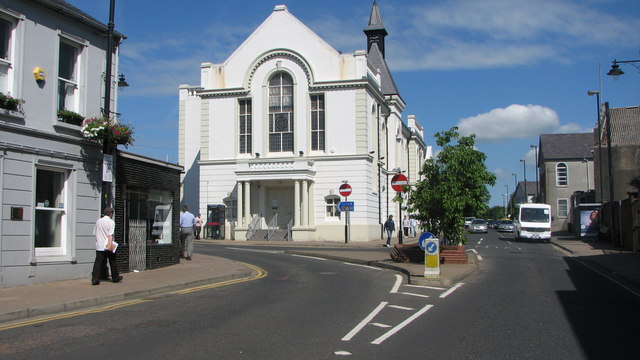
Ballymoney (Irish: Baile Monaidhⓘ [ˌbˠalʲə ˈmˠɔnˠə], meaning 'townland of the moor') is a town and civil parish in County Antrim, Northern Ireland. It is within the Causeway Coast and Glens Borough Council area. The civil parish of Ballymoney is situated in the historic baronies of Dunluce Upper and Kilconway in County Antrim, as well as the barony of North East Liberties of Coleraine in County Londonderry. It had a population of 11,048 people at the 2021 census.
Ballymoney is located on the main road between Coleraine and Ballymena, with good road and rail connections to the main cities in Northern Ireland, Belfast and Derry.
The Ballymoney area has the highest life expectancy of any area in Northern Ireland, with the average male life expectancy at birth being 79.9 years and 83.8 years for females in the years between 2010 and 2012. Conversely, it was revealed in 2013 that Ballymoney residents are more likely to die from heart disease than anywhere else in Northern Ireland.
The town hosts the Ballymoney Drama Festival, the oldest drama festival in Ireland, which was founded in 1933. The town also hosts the Ballymoney Show, which is one of the oldest agricultural shows in Northern Ireland and was founded in 1902.
In 1556, an account of an English expedition against the MacDonnells, a branch of the Scottish Clan Donald that lorded over a wide expanse of north and east Antrim known as the Route and Glynns, records "a bishop's house, which was with a castle and a church joined together in one, called Ballymonyn". Destroyed in the Irish Rebellion of 1641, no vestige of the bishop's house or castle remains, but a tower of a church built in 1637 by Sir Randal MacDonnell survives and is the town's oldest structure.
In the wake of the devastation caused by the Tudor Conquest of Ulster, Sir Randal had invited settlers from lowland Scotland. Unlike the MacDonnells and the native Irish, the majority of these were not Roman Catholics, but neither did they recognise the episcopacy of the reformed church established under the British Crown. Conscious of their disabilities both as "dissenters" from the established church and as tenants at will, after two/three generations, these Scottish Presbyterians began to leave in search of opportunity elsewhere.
In summer 1718, people from Ballymoney and the surrounding area waved goodbye to five ships carrying Presbyterian ministers and their congregations across the Atlantic to start new lives in New England. This was among the early wave of departures that, in the course of the coming decades, was to carry tens of thousands of "Scots-Irish" to the New World.
From 1778, inspired by the revolt of their kinsmen in the American colonies, the disaffection among the people of the town and district took a more radical turn, first in the drilling and political conventions of the Volunteer militia, and then from 1795 in the Society of United Irishmen. The "test" or pledge of the Society "to form a Brotherhood of affection amongst Irishmen of every religious persuasion" to secure an "equal representation of all the people in Ireland", was administered by leading residents of the town, among them a doctor, a schoolmaster and two attorneys. When in June 1798, having despaired of parliamentary reform, the Society called for insurrection, men assembled on Dungobery Hill, parading with guns, pikes, pitchforks, and scythes tied upon sticks. Although they quickly dispersed on news of the defeat of the larger rebel host at Antrim town, reprisals were taken. Government troops burned the town, and many of the rebels were either hanged or "sent for transportation" (to the West Indies or to the penal colony of New South Wales). The young licentiate minister, Richard Caldwell, who had had command of the rebels found exile in the United States, there to die in War of 1812 in a march on Canada.
Hub AI
Ballymoney AI simulator
(@Ballymoney_simulator)
Ballymoney
Ballymoney (Irish: Baile Monaidhⓘ [ˌbˠalʲə ˈmˠɔnˠə], meaning 'townland of the moor') is a town and civil parish in County Antrim, Northern Ireland. It is within the Causeway Coast and Glens Borough Council area. The civil parish of Ballymoney is situated in the historic baronies of Dunluce Upper and Kilconway in County Antrim, as well as the barony of North East Liberties of Coleraine in County Londonderry. It had a population of 11,048 people at the 2021 census.
Ballymoney is located on the main road between Coleraine and Ballymena, with good road and rail connections to the main cities in Northern Ireland, Belfast and Derry.
The Ballymoney area has the highest life expectancy of any area in Northern Ireland, with the average male life expectancy at birth being 79.9 years and 83.8 years for females in the years between 2010 and 2012. Conversely, it was revealed in 2013 that Ballymoney residents are more likely to die from heart disease than anywhere else in Northern Ireland.
The town hosts the Ballymoney Drama Festival, the oldest drama festival in Ireland, which was founded in 1933. The town also hosts the Ballymoney Show, which is one of the oldest agricultural shows in Northern Ireland and was founded in 1902.
In 1556, an account of an English expedition against the MacDonnells, a branch of the Scottish Clan Donald that lorded over a wide expanse of north and east Antrim known as the Route and Glynns, records "a bishop's house, which was with a castle and a church joined together in one, called Ballymonyn". Destroyed in the Irish Rebellion of 1641, no vestige of the bishop's house or castle remains, but a tower of a church built in 1637 by Sir Randal MacDonnell survives and is the town's oldest structure.
In the wake of the devastation caused by the Tudor Conquest of Ulster, Sir Randal had invited settlers from lowland Scotland. Unlike the MacDonnells and the native Irish, the majority of these were not Roman Catholics, but neither did they recognise the episcopacy of the reformed church established under the British Crown. Conscious of their disabilities both as "dissenters" from the established church and as tenants at will, after two/three generations, these Scottish Presbyterians began to leave in search of opportunity elsewhere.
In summer 1718, people from Ballymoney and the surrounding area waved goodbye to five ships carrying Presbyterian ministers and their congregations across the Atlantic to start new lives in New England. This was among the early wave of departures that, in the course of the coming decades, was to carry tens of thousands of "Scots-Irish" to the New World.
From 1778, inspired by the revolt of their kinsmen in the American colonies, the disaffection among the people of the town and district took a more radical turn, first in the drilling and political conventions of the Volunteer militia, and then from 1795 in the Society of United Irishmen. The "test" or pledge of the Society "to form a Brotherhood of affection amongst Irishmen of every religious persuasion" to secure an "equal representation of all the people in Ireland", was administered by leading residents of the town, among them a doctor, a schoolmaster and two attorneys. When in June 1798, having despaired of parliamentary reform, the Society called for insurrection, men assembled on Dungobery Hill, parading with guns, pikes, pitchforks, and scythes tied upon sticks. Although they quickly dispersed on news of the defeat of the larger rebel host at Antrim town, reprisals were taken. Government troops burned the town, and many of the rebels were either hanged or "sent for transportation" (to the West Indies or to the penal colony of New South Wales). The young licentiate minister, Richard Caldwell, who had had command of the rebels found exile in the United States, there to die in War of 1812 in a march on Canada.