Banked turn
Banked turn
Main page

Banked turn

logo
Community Hub0 subscribers
Read side by side
from Wikipedia

A banked turn (or banking turn) is a turn or change of direction in which the vehicle banks or inclines, usually towards the inside of the turn. For a road or railroad this is usually due to the roadbed having a transverse down-slope towards the inside of the curve. The bank angle is the angle at which the vehicle is inclined about its longitudinal axis with respect to the horizontal.

Formulations

[edit]

Turn on flat surfaces

[edit]

If the bank angle is zero, the surface is flat and the normal force is vertically upward. The only force keeping the vehicle turning on its path is friction, or traction. This must be large enough to provide the centripetal force, a relationship that can be expressed as an inequality, assuming the car is driving in a circle of radius :

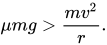
The expression on the right hand side is the centripetal acceleration multiplied by mass, the force required to turn the vehicle. The left hand side is the maximum frictional force, which equals the coefficient of friction multiplied by the normal force. Rearranging the maximum cornering speed is

Note that can be the coefficient for static or dynamic friction. In the latter case, where the vehicle is skidding around a bend, the friction is at its limit and the inequalities becomes equations. This also ignores effects such as downforce, which can increase the normal force and cornering speed.

Frictionless banked turn

[edit]
Upper panel: Ball on a banked circular track moving with constant speed ; Lower panel: Forces on the ball. The resultant or net force on the ball found by vector addition of the normal force exerted by the road and vertical force due to gravity must equal the required force for centripetal acceleration dictated by the need to travel a circular path.

As opposed to a vehicle riding along a flat circle, inclined edges add an additional force that keeps the vehicle in its path and prevents a car from being "dragged into" or "pushed out of" the circle (or a railroad wheel from moving sideways so as to nearly rub on the wheel flange). This force is the horizontal component of the vehicle's normal force (N). In the absence of friction, the normal force is the only one acting on the vehicle in the direction of the center of the circle. Therefore, as per Newton's second law, we can set the horizontal component of the normal force equal to mass multiplied by centripetal acceleration:[1]
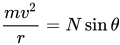
Because there is no motion in the vertical direction, the sum of all vertical forces acting on the system must be zero. Therefore, we can set the vertical component of the vehicle's normal force equal to its weight:[1]

Solving the above equation for the normal force and substituting this value into our previous equation, we get:
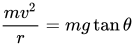
This is equivalent to:
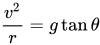
Solving for velocity we have:
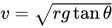
This provides the velocity that in the absence of friction and with a given angle of incline and radius of curvature, will ensure that the vehicle will remain in its designated path. The magnitude of this velocity is also known as the "rated speed" (or "balancing speed" for railroads) of a turn or curve.[2] Notice that the rated speed of the curve is the same for all massive objects, and a curve that is not inclined will have a rated speed of 0.

Banked turn with friction

[edit]
A steeply banked turn on a ramp connecting eastbound California State Route 92 to northbound Interstate 880 in Hayward, California.
Cyclists take a tight downhill corner in the Beanpot Criterium at Tufts University.

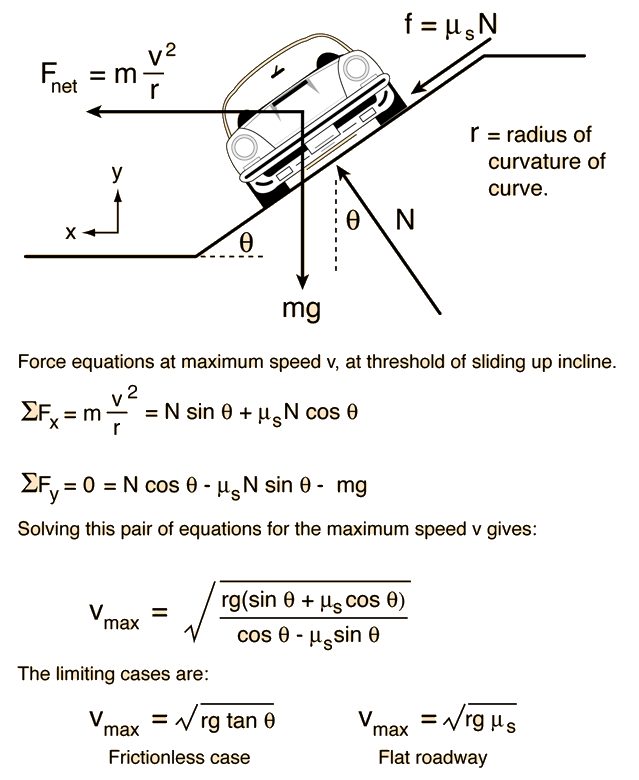
When considering the effects of friction on the system, once again we need to note which way the friction force is pointing. When calculating a maximum velocity for our automobile, friction will point down the incline and towards the center of the circle. Therefore, we must add the horizontal component of friction to that of the normal force. The sum of these two forces is our new net force in the direction of the center of the turn (the centripetal force):
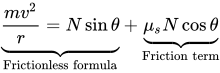
Once again, there is no motion in the vertical direction, allowing us to set all opposing vertical forces equal to one another. These forces include the vertical component of the normal force pointing upwards and both the car's weight and the vertical component of friction pointing downwards:
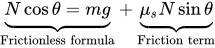
By solving the above equation for mass and substituting this value into our previous equation we get:

Solving for we get:

Where is the critical angle, such that . This equation provides the maximum velocity for the automobile with the given angle of incline, coefficient of static friction and radius of curvature. By a similar analysis of minimum velocity, the following equation is rendered:

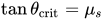
Notice
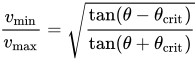
The difference in the latter analysis comes when considering the direction of friction for the minimum velocity of the automobile (towards the outside of the circle). Consequently, opposite operations are performed when inserting friction into equations for forces in the centripetal and vertical directions.

Improperly banked road curves increase the risk of run-off-road and head-on crashes. A 2% deficiency in superelevation (say, 4% superelevation on a curve that should have 6%) can be expected to increase crash frequency by 6%, and a 5% deficiency will increase it by 15%.[3] Up until now, highway engineers have been without efficient tools to identify improperly banked curves and to design relevant mitigating road actions. A modern profilograph can provide data of both road curvature and cross slope (angle of incline). A practical demonstration of how to evaluate improperly banked turns was developed in the EU Roadex III project. See the linked referenced document below.

Examples

[edit]

In aeronautics

[edit]
Douglas DC-3 banking to make a left turn.

When a fixed-wing aircraft is making a turn (changing its direction) the aircraft must roll to a banked position so that its wings are angled towards the desired direction of the turn. When the turn has been completed the aircraft must roll back to the wings-level position in order to resume straight flight.[4]

When any moving vehicle is making a turn, it is necessary for the forces acting on the vehicle to add up to a net inward force, to cause centripetal acceleration. In the case of an aircraft making a turn, the force causing centripetal acceleration is the horizontal component of the lift acting on the aircraft.

In straight, level flight, the lift acting on the aircraft acts vertically upwards to counteract the weight of the aircraft which acts downwards. If the aircraft is to continue in level flight (i.e. at constant altitude), the vertical component must continue to equal the weight of the aircraft and so the pilot must pull back on the stick to apply the elevators to pitch the nose up, and therefore increase the angle of attack, generating an increase in the lift of the wing. The total (now angled) lift is greater than the weight of the aircraft, The excess lift is the horizontal component of the total lift, which is the net force causing the aircraft to accelerate inward and execute the turn.

Vector diagram showing lift and weight acting on a fixed-wing aircraft during a banked turn. The yellow force depicted represents the net resultant force that causes centripetal acceleration.

Because centripetal acceleration is:

During a balanced turn where the angle of bank is the lift acts at an angle away from the vertical. It is useful to resolve the lift into a vertical component and a horizontal component.

Newton's second law in the horizontal direction can be expressed mathematically as:
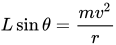
where:

is the lift acting on the aircraft
is the angle of bank of the aircraft
is the mass of the aircraft
is the true airspeed of the aircraft
is the radius of the turn

In straight level flight, lift is equal to the aircraft weight. In turning flight the lift exceeds the aircraft weight, and is equal to the weight of the aircraft () divided by the cosine of the angle of bank:

where is the gravitational field strength.

The radius of the turn can now be calculated:[5]

This formula shows that the radius of turn is proportional to the square of the aircraft's true airspeed. With a higher airspeed the radius of turn is larger, and with a lower airspeed the radius is smaller.

This formula also shows that the radius of turn decreases with the angle of bank. With a higher angle of bank the radius of turn is smaller, and with a lower angle of bank the radius is greater.

In a banked turn at constant altitude, the load factor is equal to . We can see that the load factor in straight and level flight is , since , and to generate sufficient lift to maintain constant altitude, the load factor must approach infinity as the bank angle approaches and approaches . This is physically impossible, because structural limitations of the aircraft or physical endurance of the occupants will be exceeded well before then.

In athletics

[edit]

Most indoor track and field venues have banked turns since the tracks are smaller than outdoor tracks. The tight turns on these small tracks are usually banked to allow athletes to lean inward and neutralize the centrifugal force as they race around the curve; the lean is especially noticeable on sprint events. [6]

See also

[edit]

References

[edit]

Further reading

[edit]
[edit]
Revisions and contributorsEdit on WikipediaRead on Wikipedia
from Grokipedia
A banked turn is a curved path in which the surface—such as a road, racetrack, or aircraft trajectory—is inclined at an angle to the horizontal, enabling the horizontal component of the normal force or lift to supply the centripetal force required for circular motion without sole dependence on friction.[1] This design counters the outward tendency of vehicles or aircraft during turns by aligning gravitational and inertial forces more efficiently.[2] In road and track engineering, banked turns, also known as superelevated curves, raise the outer edge higher than the inner edge to facilitate safer navigation at higher speeds, particularly for automobiles and motorcycles.[1] For an ideal banked curve without friction, the banking angle θ satisfies tan θ = v² / (r g), where v is the vehicle's speed, r is the radius of curvature, and g is the acceleration due to gravity (approximately 9.8 m/s²).[1] This formula ensures that the vertical component of the normal force balances the vehicle's weight while the horizontal component provides the exact centripetal acceleration mv²/r, minimizing tire wear and slip risk; real-world designs often incorporate a safety margin with friction.[2] Applications include highway offramps and high-speed oval racetracks like those at Daytona International Speedway, where banking angles can exceed 30 degrees to support speeds over 300 km/h.[1] In aviation, a banked turn occurs when an aircraft rolls to an angle φ, redirecting part of the wing-generated lift horizontally to produce the centripetal force for the turn while the vertical lift component counters weight.[3] The load factor n, defined as the ratio of total lift to weight, increases with bank angle according to n = 1 / cos φ, requiring higher thrust to maintain altitude and resulting in tighter turns at steeper banks, such as a 60-degree bank yielding a 2g load factor.[4] Pilots must coordinate banking with rudder and aileron inputs to avoid adverse yaw or overbanking, ensuring stable flight paths in maneuvers.[4]

Introduction to Banked Turns

Definition and Basic Principles

A banked turn is a curved path in which the surface is inclined, or "banked," at an angle θ to the horizontal plane, enabling the horizontal component of the normal force to contribute to the centripetal force required for circular motion. This design leverages gravity's downward pull to assist in maintaining the vehicle's trajectory around the curve, particularly in scenarios where high speeds are involved.[5] The basic principle behind a banked turn involves the alignment of forces acting on the moving object. The normal force exerted by the banked surface on the vehicle has both a vertical component that balances the weight and a horizontal component directed toward the center of the curve, providing the necessary centripetal acceleration without depending entirely on frictional forces. This reduces lateral slipping or excessive tire wear, allowing safer and more efficient navigation of turns at higher velocities compared to flat surfaces, where friction alone must supply the centripetal force.[6][7] Historically, banked turns were introduced in racing tracks during the late 19th and early 20th centuries to mitigate skidding risks, with early implementations appearing in horse racing venues such as the Douglas Park Racetrack in Louisville, Kentucky, which opened in 1895 featuring banked turns on its one-mile oval.[8] A simple force diagram for a vehicle in a banked turn illustrates the key interactions: the gravitational force mg acts vertically downward from the vehicle's center of mass; the normal force N is perpendicular to the inclined surface, resolving into vertical and horizontal components; and the required centripetal force mv²/r is provided by the horizontal component of N, directed inward toward the curve's center. This vector representation highlights how the banking angle optimizes force distribution for stable motion.[5]

Advantages Over Flat Turns

On flat surfaces, the centripetal force required for a vehicle to navigate a turn is provided entirely by friction between the tires and the road, expressed as $ f = \mu N = \frac{m v^2}{r} $, where $ \mu $ is the coefficient of friction, $ N $ is the normal force, $ m $ is the vehicle's mass, $ v $ is its speed, and $ r $ is the radius of the turn.[9] This reliance on friction limits performance: at high speeds, vehicles risk skidding outward if the frictional force is exceeded, while at low speeds, they may slip inward due to insufficient centripetal force.[9] Banked turns offer significant advantages by tilting the road surface, allowing a component of the normal force to contribute to the centripetal force, thereby reducing dependence on friction.[9] This enables vehicles to achieve higher speeds without slipping, particularly beneficial in adverse conditions like wet or icy roads where friction is low.[9] Additionally, banking minimizes lateral tire scrub and wear on both vehicles and road surfaces by distributing forces more evenly across the tires. Overall, these benefits enhance safety by balancing forces to decrease rollover risk and improve vehicle stability.[9] However, banked turns have limitations, as they are optimized for a specific design speed; deviations can lead to issues, such as inward slipping at speeds below the optimum or outward skidding above it.[9] Excessive banking angles increase the risk of vehicle overturning, particularly for high-center-of-gravity vehicles like trucks.[9] In real-world applications, such as highway design, superelevation is tailored to match expected speeds; for instance, roads designed for 100 km/h often incorporate rates of approximately 6% on typical curve radii to safely accommodate traffic flow.[10]

Physics of Banked Turns

Frictionless Banked Turns

In the ideal case of a frictionless banked turn, the vehicle undergoes uniform circular motion at a constant speed vv along a curve of radius rr, with no frictional forces acting tangentially or radially.[11] The only forces involved are the gravitational force mgmg acting downward and the normal force NN exerted perpendicular to the banked surface, inclined at an angle θ\theta to the horizontal. This setup assumes the vehicle remains in contact with the surface without slipping or sliding, allowing the banking to provide the necessary centripetal acceleration solely through the component of the normal force.[12] To analyze the forces, consider the free-body diagram for the vehicle. In the vertical direction, the system is in equilibrium, so the vertical component of the normal force balances the weight:
Ncosθ=mg. N \cos \theta = mg.
In the horizontal direction, toward the center of the curve, the horizontal component of the normal force provides the centripetal force required for circular motion:
Nsinθ=mv2r. N \sin \theta = \frac{mv^2}{r}.
These equations arise from Newton's second law applied to the resolved components, where the net vertical force is zero and the net horizontal force equals the centripetal force.[11][12] Dividing the horizontal equation by the vertical equation eliminates NN and mm, yielding the relationship for the banking angle:
tanθ=sinθcosθ=v2/rg, \tan \theta = \frac{\sin \theta}{\cos \theta} = \frac{v^2 / r}{g},
or
tanθ=v2rg. \tan \theta = \frac{v^2}{rg}.
This derivation shows that the optimal banking angle θ\theta depends on the speed vv, radius rr, and acceleration due to gravity gg, ensuring the vehicle can navigate the turn without relying on friction. Solving for the speed gives
v=rgtanθ. v = \sqrt{rg \tan \theta}.
At this exact speed, the turn is stable under frictionless conditions.[11][12] For example, consider a banked curve with θ=30\theta = 30^\circ and r=100r = 100 m, using g=9.8g = 9.8 m/s². Then tan30=1/30.577\tan 30^\circ = 1/\sqrt{3} \approx 0.577, so
v=100×9.8×0.57756624 m/s(86 km/h). v = \sqrt{100 \times 9.8 \times 0.577} \approx \sqrt{566} \approx 24 \text{ m/s} \quad (\approx 86 \text{ km/h}).
This speed represents the precise value at which the vehicle would follow the curve without lateral forces.[11]

Banked Turns with Friction

In real-world banked turns, friction between the vehicle and the surface introduces a range of safe speeds, extending beyond the single ideal speed of the frictionless case. The coefficient of static friction μ determines the maximum friction force f = μN, where N is the normal force, acting either up or down the incline to counteract tendencies to slide outward (at high speeds) or inward (at low speeds). This model assumes uniform circular motion at constant speed, with the banking angle θ fixed and no slipping occurring.[13] At the neutral speed $ v = \sqrt{r g \tan \theta} $, where r is the radius of curvature and g is gravitational acceleration, the required centripetal force is provided solely by the horizontal component of the normal force, resulting in zero friction.[2] For speeds above this, friction acts down the slope to augment the centripetal force and prevent sliding up the bank; below it, friction acts up the slope to supplement the inward force and prevent sliding down. The derivations begin by resolving forces perpendicular and parallel to the inclined surface. Perpendicular to the incline, there is no acceleration, so the normal force balances the components of weight and centripetal acceleration:
N=mgcosθ+mv2rsinθ N = m g \cos \theta + m \frac{v^2}{r} \sin \theta
where m is mass. Parallel to the incline, the net force provides the parallel component of the centripetal acceleration. For maximum speed (friction down the slope, tending to slide up):
mgsinθ+μN=mv2rcosθ m g \sin \theta + \mu N = m \frac{v^2}{r} \cos \theta
Substituting N and solving for v yields the maximum speed:
vmax=rgtanθ+μ1μtanθ v_{\max} = \sqrt{r g \frac{\tan \theta + \mu}{1 - \mu \tan \theta}}
This formula assumes μ tan θ < 1 to avoid unconditional sliding.[13] For minimum speed (friction up the slope, tending to slide down), the parallel equation becomes:
mgsinθμN=mv2rcosθ m g \sin \theta - \mu N = m \frac{v^2}{r} \cos \theta
Substituting N and solving gives:
vmin=rgtanθμ1+μtanθ v_{\min} = \sqrt{r g \frac{\tan \theta - \mu}{1 + \mu \tan \theta}}
This requires tan θ > μ for a positive v_min; otherwise, the vehicle remains stable down to rest.[14] As an illustrative example, consider a banked turn with θ = 15°, μ = 0.2, and r = 200 m (using g ≈ 9.8 m/s²). The minimum speed is approximately 11 m/s, and the maximum speed is approximately 31 m/s, defining the safe range around the neutral speed of about 23 m/s.

Applications in Engineering and Transportation

Road and Track Design

In road and track design, superelevation refers to the transverse tilting of the roadway surface, where the outer edge is elevated relative to the inner edge by an angle $ e $, with $ \tan e \approx e $ (in radians) for small angles typically encountered in highway applications. This banking counteracts centrifugal forces during turns, enhancing vehicle stability and reducing reliance on tire friction. According to the American Association of State Highway and Transportation Officials (AASHTO) Green Book, superelevation rates are designed based on design speed, curve radius, and site conditions, with maximum rates generally limited to 6-8% (equivalent to approximately 3.4-4.6 degrees) for high-speed highways to balance safety and drivability.[10][15] The design process for superelevation involves calculating the rate $ e $ to achieve comfortable lateral accelerations of 0.1-0.2g, using the formula $ e = \frac{v^2}{15r} $ in U.S. customary units, where $ v $ is the design speed in miles per hour and $ r $ is the curve radius in feet; this assumes frictionless conditions for the ideal case but incorporates friction limits in practice. Designers balance speed, radius, and superelevation to minimize side friction demand, often iterating with AASHTO tables or software to ensure the final rate does not exceed regional maxima while providing adequate margin for varying vehicle types. In banked turns with friction, the effective superelevation adjusts the maximum safe speed upward, as the frictional component $ f $ contributes to the centripetal force balance.[10] Representative examples illustrate varying applications: the Nürburgring Nordschleife racetrack features steeply banked sections like the Karussell corner with up to 30 degrees of banking to accommodate high-speed cornering by professional drivers. In contrast, interstate highways employ milder superelevation, such as 4-6%, with variable transitions over spiral curves to gradually introduce the full rate, preventing abrupt changes that could disorient drivers or cause vehicle instability.[16][17] Key challenges in banked road design include providing adequate runoff areas—clear, forgiving zones adjacent to curves for errant vehicles—and accounting for climate effects on surface friction, where wet conditions can typically reduce the coefficient of friction $ \mu $ by 20-30% compared to dry pavement, potentially requiring lower design speeds or enhanced drainage. These factors are addressed through standards emphasizing spiral transitions for smooth superelevation application and climate-specific adjustments to maximum rates, such as limiting to 6% in icy regions to mitigate hydroplaning risks.[18][19][20]

Aeronautics

In aeronautics, a banked turn is a maneuver where an aircraft rolls to tilt its wings at a bank angle ϕ\phi, redirecting the lift vector to enable a change in heading without relying on yaw alone. The total lift LL produced by the wings acts perpendicular to the wing plane; its horizontal component LsinϕL \sin \phi supplies the centripetal force required to maintain the curved path, while the vertical component LcosϕL \cos \phi counters the aircraft's weight to sustain level flight. This mechanism ensures coordinated turning by aligning the net aerodynamic force with the turn's radius, preventing excessive sideslip.[21][22][23] For standard instrument flight, pilots typically execute a standard rate turn at 3° per second, completing a full circle in two minutes, which aids in precise navigation and holding patterns. The bank angle ϕ\phi for coordination in such turns is approximated by ϕv/10\phi \approx v / 10 degrees, with vv as the true airspeed in knots; for instance, at 100 knots, a 10° bank suffices. This rule of thumb derives from the relationship between turn rate, speed, and radius, balancing turn responsiveness with stability. The load factor nn during a level banked turn is n=1/cosϕn = 1 / \cos \phi, elevating the effective g-loading and thereby increasing stall speed by n\sqrt{n}; at a 30° bank, n1.15gn \approx 1.15g, demanding higher power and angle of attack to avoid departure from controlled flight.[24][25][26] The concept of banking for turns traces to early aviation pioneers, including the Wright brothers, who in their 1903 powered flights employed wing warping to induce roll and bank, enabling controlled directional changes during takeoff and sustained flight. Safety in banked turns hinges on preventing overbanking tendency, where the faster outer wing generates excess lift, potentially steepening the bank uncontrollably and inducing sideslip toward the lower wing. Pilots mitigate this by applying opposite aileron input once the desired ϕ\phi is reached and monitoring turn coordinators, which integrate rate-of-turn indicators with slip-skid balls to ensure coordinated flight and avert stalls or loss of control.[27][28][29]

Applications in Sports and Recreation

Athletics Tracks

In athletics, banked turns are primarily implemented in indoor running tracks and velodromes to enable athletes to maintain higher speeds through curves while minimizing lateral forces that could lead to slips or injuries, thereby promoting fair competition across lanes. For standard indoor facilities, World Athletics specifies a 200-meter oval track with banked curves at a 10-degree angle to counteract the tighter radius compared to outdoor venues, allowing sprinters to lean naturally into the turn without excessive energy expenditure on balance. This design contrasts with outdoor 400-meter tracks, which remain flat to ensure equitable lane distances, achieved through staggered starting positions that compensate for the progressively longer paths in outer lanes.[30][31][32] The physics of banking in these tracks adapts to the centripetal force required during sprinting, where the incline provides a normal force component that partially supplies the inward acceleration, reducing the athlete's need to generate lateral forces through muscle effort and thus lowering energy loss and injury risk from uneven loading on joints. On a typical 400-meter outdoor track, the curve radius measures 36.5 meters, amplifying these forces at high speeds, but indoor banking mitigates this for shorter 200-meter ovals with radii around 17.2 meters. Frictional effects allow a range of speeds without slipping, as the bank angle balances the forces for elite sprint velocities around 10-12 meters per second.[33][32] Velodromes, dedicated to track cycling, feature 250-meter circuits with banking angles ranging from 12 degrees on straights to 45 degrees at the curved ends, enabling cyclists to enter turns at speeds exceeding 50 kilometers per hour without braking, which enhances race safety and fairness by standardizing cornering dynamics. These tracks are constructed from smooth concrete or Siberian pine wood to optimize grip and speed, with surface friction coefficients tuned to approximately 0.8 for bicycle tires, allowing precise control during high-speed maneuvers.[34] Historically, the concept of banked tracks traces back to ancient Greek hippodromes used for chariot racing, where earthen banks facilitated high-speed turns around a central spine, influencing later athletic venue designs for safety and performance. Modern velodromes emerged in the late 19th century, with the Neo Phaliron Velodrome hosting cycling events at the inaugural 1896 Athens Olympics, marking the integration of banked tracks into competitive athletics.[35][36]

Roller Coasters and Amusement Rides

In roller coaster design, banking is employed to align the track's curvature with the forces experienced by passengers, minimizing lateral accelerations to enhance comfort and safety during high-speed turns. By tilting the track outward, the normal force from the seat provides the necessary centripetal component, converting potentially disruptive sideways forces into downward pressure akin to positive vertical g-forces. Designers typically aim for lateral g-forces between 0.5 and 1g in banked sections to balance thrill with physiological tolerance, avoiding discomfort from excessive side-loading that could exceed 1.5g on unbanked curves. For instance, transitions into banked elements often incorporate clothoid shapes—Euler spirals that gradually vary the radius of curvature from straight sections to circular arcs—ensuring smooth onset of forces and preventing abrupt jerks.[37][38][39] The physics of banked turns in roller coasters parallels that of vehicular roads but accommodates dramatically higher speeds, often reaching 160-200 km/h in modern steel designs, where the banking angle θ satisfies tan(θ) = v²/(rg) under frictionless approximations due to the low coefficient of friction (μ < 0.1) between steel wheels and tubular tracks. This ideal condition assumes the centripetal force is supplied solely by the horizontal component of the normal force, with gravity aiding stability; in practice, slight underbanking is applied to account for minor friction and air resistance, directing a controlled outward sensation toward riders for added excitement without compromising control. At these velocities, precise banking prevents derailment by keeping the net force vector aligned with the passenger's body, particularly in multi-g maneuvers where vertical and lateral components interact.[40][37][38] A prominent example is Millennium Force at Cedar Point, which features a 360-degree helix turn at 87 feet followed by a 122-degree overbanked left turn at 100 feet, demonstrating advanced banking to handle speeds exceeding 150 km/h while maintaining rider orientation. This evolution traces back to wooden coasters like the 1884 Switchback Railway at Coney Island, which used rudimentary flat or minimally banked curves at modest 10 km/h speeds, limited by timber's flexibility and safety constraints. The shift to steel in the 1950s, exemplified by Disneyland's 1959 Matterhorn Bobsleds, enabled steeper banking up to 45-60 degrees in helical and overbanked elements, allowing for tighter radii and higher velocities without structural failure.[41][42][38] Safety in banked turns incorporates over-the-shoulder harnesses or lap bars that secure passengers against varying speeds and forces, with computer-controlled systems monitoring train position to ensure restraints engage properly across the ride profile. These mechanisms are rated for peaks well beyond operational loads, such as 4-5g in turns, while banking itself mitigates wind effects—up to 50 km/h gusts—by stabilizing the train's path through aerodynamic profiling and precomputed load simulations. Daily inspections and redundant braking further verify banking integrity, preventing shifts that could amplify lateral forces under environmental influences.[43][44][37]

References

User Avatar
No comments yet.