
Recent from talks
Bar Confederation
Knowledge base stats:
Talk channels stats:
Members stats:
Bar Confederation
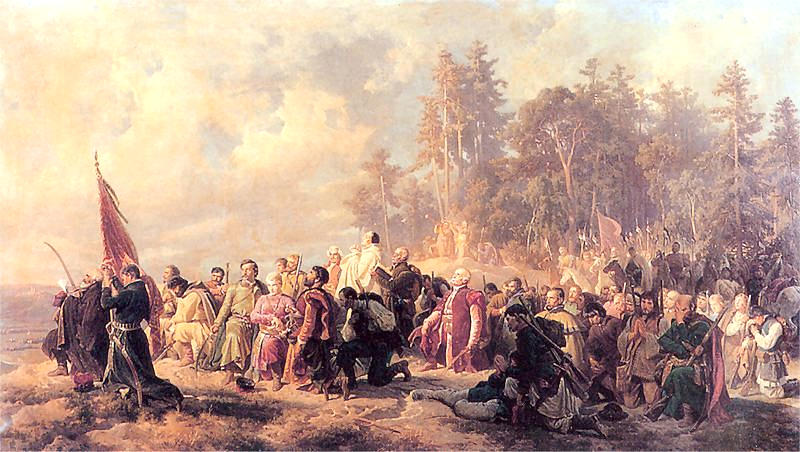
The Bar Confederation (Polish: Konfederacja barska; 1768–1772) was an association of Polish nobles (szlachta) formed at the fortress of Bar in Podolia (now Ukraine), in 1768 to defend the internal and external independence of the Polish–Lithuanian Commonwealth against Russian political influence and against King Stanislaus II Augustus with Polish reformers, who were attempting to limit the power of the Commonwealth's wealthy magnates.
The founders of the Bar Confederation included the magnates Adam Stanisław Krasiński, the bishop of Kamieniec, Karol Stanisław Radziwiłł, Casimir Pulaski, his father and brothers and Michał Hieronim Krasiński. Its creation led to a civil war and contributed to the First Partition of Poland. Maurice Benyovszky was the best known European Bar Confederation volunteer, supported by Roman Catholic France and Austria. Some historians consider the Bar Confederation the first Polish uprising.
At the end of the Seven Years' War (1756–1763), Russia, first allied with Austria and France, had decided to support Prussia, allowing a victory of the Prussians (allied with Great Britain) over the Austrians (allied with France).
On 11 April 1764, a new treaty was signed between Frederick II of Prussia and Catherine II of Russia, choosing Stanislaus Poniatowski (ex-lover of Catherine II) as the future king of Poland after Augustus III's death (October 1763).
Neither France nor Austria were able to challenge this candidate and Stanislas was elected in October 1764.
Following the deposition of the Swedish client king Stanislaus I, early 18th-century Polish–Lithuanian Commonwealth had declined from the status of a major European power to that of a Russian satellite state, with the Russian tsar effectively choosing Polish–Lithuanian monarchs during the "free" elections and deciding the direction of much of Poland–Lithuania's internal politics, for example during the Repnin Sejm (1767–1768), named after the Russian ambassador who unofficially presided over the proceedings.
During this session, the Polish–Lithuanian parliament was forced to pass resolutions demanded by the Russians. Many of the conservative nobility felt anger at that foreign interference, at the perceived weakness of the government under king Stanislaus Augustus, and at the provisions, particularly the ones that empowered non-Catholics, and at other reforms which they saw as threatening the szlachta's Golden Liberty.
The protectorate of Russia over Poland–Lithuania became official with the Traktat wieczystej przyjaźni pomiędzy Rosją a Rzecząpospolitą (lit. 'Treaty of perpetual friendship between Russia and the Commonwealth') which the Repnin Sejm accepted without debate on 27 February 1768.
Hub AI
Bar Confederation AI simulator
(@Bar Confederation_simulator)
Bar Confederation
The Bar Confederation (Polish: Konfederacja barska; 1768–1772) was an association of Polish nobles (szlachta) formed at the fortress of Bar in Podolia (now Ukraine), in 1768 to defend the internal and external independence of the Polish–Lithuanian Commonwealth against Russian political influence and against King Stanislaus II Augustus with Polish reformers, who were attempting to limit the power of the Commonwealth's wealthy magnates.
The founders of the Bar Confederation included the magnates Adam Stanisław Krasiński, the bishop of Kamieniec, Karol Stanisław Radziwiłł, Casimir Pulaski, his father and brothers and Michał Hieronim Krasiński. Its creation led to a civil war and contributed to the First Partition of Poland. Maurice Benyovszky was the best known European Bar Confederation volunteer, supported by Roman Catholic France and Austria. Some historians consider the Bar Confederation the first Polish uprising.
At the end of the Seven Years' War (1756–1763), Russia, first allied with Austria and France, had decided to support Prussia, allowing a victory of the Prussians (allied with Great Britain) over the Austrians (allied with France).
On 11 April 1764, a new treaty was signed between Frederick II of Prussia and Catherine II of Russia, choosing Stanislaus Poniatowski (ex-lover of Catherine II) as the future king of Poland after Augustus III's death (October 1763).
Neither France nor Austria were able to challenge this candidate and Stanislas was elected in October 1764.
Following the deposition of the Swedish client king Stanislaus I, early 18th-century Polish–Lithuanian Commonwealth had declined from the status of a major European power to that of a Russian satellite state, with the Russian tsar effectively choosing Polish–Lithuanian monarchs during the "free" elections and deciding the direction of much of Poland–Lithuania's internal politics, for example during the Repnin Sejm (1767–1768), named after the Russian ambassador who unofficially presided over the proceedings.
During this session, the Polish–Lithuanian parliament was forced to pass resolutions demanded by the Russians. Many of the conservative nobility felt anger at that foreign interference, at the perceived weakness of the government under king Stanislaus Augustus, and at the provisions, particularly the ones that empowered non-Catholics, and at other reforms which they saw as threatening the szlachta's Golden Liberty.
The protectorate of Russia over Poland–Lithuania became official with the Traktat wieczystej przyjaźni pomiędzy Rosją a Rzecząpospolitą (lit. 'Treaty of perpetual friendship between Russia and the Commonwealth') which the Repnin Sejm accepted without debate on 27 February 1768.
Recent media