Recent from talks
Nothing was collected or created yet.
Barbara Lynn
View on WikipediaKey Information
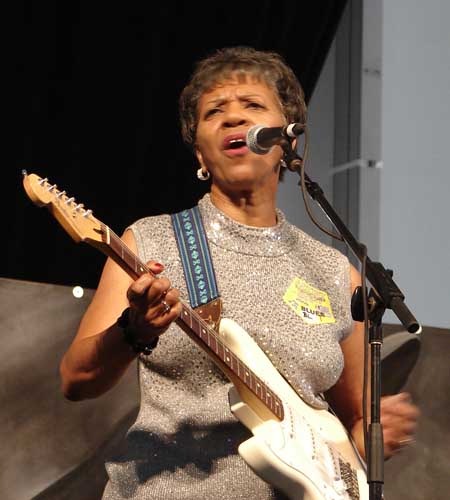
Barbara Lynn (born Barbara Lynn Ozen, later Barbara Lynn Cumby, January 16, 1942)[2] is an American rhythm and blues and electric blues guitarist, singer and songwriter.[1] She is best known for her R&B chart-topping hit, "You'll Lose a Good Thing" (1962). In 2018, Lynn received a National Heritage Fellowship.[3]
Life and career
[edit]She was born in Beaumont, Texas, and attended Hebert High School.[4] She was raised Catholic and sang in the choir at her local parish.[5] She also played piano as a child, but switched to guitar, which she plays left-handed. Inspired by blues artists Guitar Slim and Jimmy Reed, and pop acts Elvis Presley and Brenda Lee, and winning several local talent shows, she created an all-female band, Bobbie Lynn and Her Idols.[2]
She began performing in local clubs in Texas.[4] Singer Joe Barry saw her and introduced Lynn to producer Huey P. Meaux, who ran several record labels in New Orleans. Her first single, "You'll Lose a Good Thing", for which she was the songwriter, was recorded at Cosimo Matassa's J&M Recording Studio with session musicians including Mac Rebennack (Dr. John).[6] Released by Jamie Records, it was a number 1 US Billboard R&B chart hit and Top 10 Billboard Hot 100 hit in 1962.[2] The song was later recorded by Aretha Franklin and became a country hit record for Freddy Fender.
Lynn released an album, also titled You'll Lose A Good Thing, which featured ten of her compositions.[7][8]
Unusual for the time, Lynn was a female African American singer who both wrote most of her own songs and played a lead instrument. Soon Lynn was touring with such soul musicians as Gladys Knight, Stevie Wonder, Smokey Robinson, Dionne Warwick, Jackie Wilson, Sam Cooke, Otis Redding, James Brown, Al Green, Carla Thomas, Marvin Gaye, Ike and Tina Turner, the Temptations, and B.B. King. She appeared at the Apollo Theater, twice on American Bandstand. In 1965, she had her song, "Oh Baby (We've Got A Good Thing Goin')" (1964) covered by the Rolling Stones on their album The Rolling Stones Now! in America and Out Of Our Heads in the UK. The song was also recorded by Bill Wyman's Rhythm Kings, with Beverly Skeete lead singing. Lynn continued to record for the Jamie label until 1966 and had several more minor hits.[2]
In 1966 she signed to Meaux's Tribe label, and recorded "You Left the Water Running," which was originally recorded by Otis Redding (as a demo), covered by Wilson Pickett among others. She signed with Atlantic the following year, and recorded another album, Here Is Barbara Lynn, in 1968. She married for the first time, at age 28, in 1970 and had three children. This, together with dissatisfaction with poor promotion by the record company, contributed to her decision to largely retire from the music business for most of the 1970s and 1980s.[2] However, while living in Los Angeles, she occasionally appeared at local clubs, and released several singles on Jetstream and other small labels.[9]
In 1984 she toured Japan, and recorded a live album, You Don't Have to Go, which was released later in the US. She resumed her recording career after her husband's death, and returned to her hometown of Beaumont, Texas, where her mother lived.[4] She also undertook further international tours, to Europe and elsewhere. In 1994, she recorded her first studio album in over twenty years, So Good, and released several more albums for various labels in later years.[2]
She continues to reside in Beaumont, and was given a Pioneer Award by the Rhythm and Blues Foundation in 1999.[4][10] In 2002, electronic musician Moby sampled Lynn's "I'm A Good Woman" on his album 18.
She appears in the 2015 music documentary film I Am the Blues.[11]
She is a recipient of a 2018 National Heritage Fellowship awarded by the National Endowment for the Arts, which is the United States government's highest honor in the folk and traditional arts.[12]
Discography
[edit]Chart singles
[edit]| Year | Single | Chart Positions | |
|---|---|---|---|
| US Pop[13] | US R&B[14] | ||
| 1962 | "You'll Lose a Good Thing" | 8 | 1 |
| "Second Fiddle Girl" | 63 | - | |
| "You're Gonna Need Me" | 65 | 13 | |
| 1963 | "Don't Be Cruel" | 93 | - |
| "To Love or Not to Love" | 135 | - | |
| "(I Cried at) Laura's Wedding" | 68 | - | |
| 1964 | "Oh! Baby (We Got a Good Thing Goin')" | 69 | 19[15] |
| "Don't Spread It Around" | 93 | 35[15] | |
| 1965 | "It's Better to Have It" | 95 | 26 |
| 1966 | "I'm a Good Woman" | 129 | - |
| "You Left the Water Running" | 110 | 42 | |
| 1968 | "This Is the Thanks I Get" | 65 | 39 |
| 1971 | "(Until Then) I'll Suffer" | - | 31 |
Albums
[edit]- 1963 You'll Lose a Good Thing (Jamie)
- 1964 Sister of Soul (Jamie)
- 1968 Here Is Barbara Lynn (Atlantic)
- 1988 You Don't Have to Go (Ichiban)
- 1993 So Good (Bullseye Blues)
- 1996 Until Then I'll Suffer (I.T.P.)
- 2000 Hot Night Tonight (Antone's)
- 2004 Blues & Soul Situation (Dialtone)
Further reading
[edit]References
[edit]- ^ a b Du Noyer, Paul, ed. (2003). The Illustrated Encyclopedia of Music. Fulham, London: Flame Tree Publishing. p. 181. ISBN 9781904041702. OCLC 59304761.
- ^ a b c d e f Steve, Huey (n.d.). "Barbara Lynn: Biography". AllMusic. Retrieved February 24, 2021.
- ^ "NEA National Heritage Fellowships 2018". www.arts.gov. National Endowment for the Arts. n.d. Retrieved February 24, 2021.
- ^ a b c d Amelia Feathers, An R&B comeback, more than three decades in the making, Blues Music Now, 1999. Retrieved 24 January 2013
- ^ "Barbara Lynn: True Hero of Texas Music | MichaelCorcoran.net". 2017-07-06. Retrieved 2022-07-11.
- ^ Aswell, Tom (23 September 2010). Louisiana Rocks!. Pelican. ISBN 9781455607839. Retrieved 7 January 2015.
- ^ Steve, Huey (n.d.). "Barbara Lynn: Biography". AllMusic. Retrieved February 24, 2021.
- ^ Amelia Feathers, An R&B comeback, more than three decades in the making, Blues Music Now, 1999. Retrieved 24 January 2013
- ^ Discography at Soulful Kinda Music. Retrieved 24 January 2013
- ^ Tommy Mann Jr., Musicians gather to celebrate local R&B legend, The Orange Leader, January 14, 2012. Retrieved 24 January 2013
- ^ "Here Are 6 Must-See Music Films at Hot Docs". Exclaim!, April 19, 2016.
- ^ "Barbara Lynn: R&B musician". www.arts.gov. National Endowment for the Arts. n.d. Retrieved February 24, 2021.
- ^ Whitburn, Joel (2003). Top Pop Singles 1955-2002 (1st ed.). Menomonee Falls, Wisconsin: Record Research Inc. p. 429. ISBN 0-89820-155-1.
- ^ Whitburn, Joel (1996). Top R&B Singles: 1942-1995. Menomonee Falls, Wisconsin: Record Research Inc. p. 278. ISBN 0-89820-115-2.
- ^ a b Billboard did not publish an R&B chart between November 1963 and January 1965
- ^ Broven, John (1983). South to Louisiana: Music of the Cajun Bayous. Gretna, Louisiana: Pelican. ISBN 9780882893006. LCCN 82-11247. OCLC 8553153.
- ^ Bernard, Shane K. (1996). Swamp Pop: Cajun and Creole Rhythm and Blues. Jackson: University Press of Mississippi. ISBN 9780878058754. LCCN 95-53231. OCLC 34080195.
- ^ Govenar, Alan B. (2008). Texas Blues: The Rise of a Contemporary Sound. College Station: Texas A & M University Press. ISBN 9781585446056. LCCN 2007-39152. OCLC 173748318.
External links
[edit]- Complete discography
- Barbara Lynn at AllMusic
- Barbara Lynn discography at Discogs
Barbara Lynn
View on GrokipediaEarly life
Childhood and family
Barbara Lynn was born Barbara Linda Ozen on January 16, 1942, in Beaumont, Texas, the daughter of Preston Ozen and Mildred Williams, members of a working-class Black family of Creole descent.[9][4] Her father worked in a factory, while her mother managed the household amid the economic constraints of the era.[4] The family faced the socioeconomic challenges typical of African American households in the segregated Jim Crow South, including limited opportunities and racial barriers that permeated daily life in 1940s and 1950s Texas.[4] Her parents divorced when she was young, which influenced the dynamics of her immediate family environment.[9] Growing up in Beaumont, Lynn attended Hebert High School, where the segregated educational system reflected the broader racial divisions of the region.[4] This upbringing provided her with early exposure to music through local radio broadcasts and church activities, fostering an environment that nurtured her budding interest in performance.[1]Musical beginnings
Barbara Lynn began developing her musical talents during her childhood in Beaumont, Texas, where she taught herself to play the piano before switching to the ukulele and then guitar in grade school around age 12 or 13, drawing inspiration from artists such as Elvis Presley, Guitar Slim, and Jimmy Reed amid the vibrant local R&B and blues scenes.[1][10][11] Growing up in a supportive family environment that encouraged her artistic pursuits, she honed her left-handed guitar skills through trial and error without formal lessons. Producer Huey P. Meaux later renamed her "Barbara Lynn" as her stage name.[9] In high school around 1959, Lynn formed her first band, the all-female group Bobbie Lynn and the Idols, which marked her entry into organized performance. The ensemble allowed her to take on the role of lead guitarist and vocalist, a bold choice for a young Black woman in the segregated South. They focused on covering popular R&B and rock tunes, reflecting the era's hits that Lynn admired from radio and local airwaves.[11][10] The band quickly secured early local gigs in Beaumont and surrounding areas, including small clubs like the Derrick Club and venues in nearby Louisiana, where they performed for audiences in juke joints and community spots. These appearances, often winning talent shows, built Lynn's confidence and exposed her to the rough-and-tumble world of regional music circuits, all while she balanced school and began self-composing songs.[11][10][12][9] Following her high school graduation in 1960, Lynn's path advanced when she caught the attention of singer Joe Barry during a performance at Lou Ann's club in Beaumont, leading to an introduction to producer Huey P. Meaux. With her parents' consent, Meaux signed her and facilitated initial demo recordings in Houston, capturing her raw talent and setting the stage for her professional transition.[10][11][1]Professional career
1960s breakthrough
Barbara Lynn signed with Jamie Records in 1961, marking her entry into the professional recording industry after local performances in Texas.[13] Her debut single, "You'll Lose a Good Thing," self-written by Lynn and released in 1962, became a breakthrough hit, topping the Billboard R&B chart for three weeks and reaching number 8 on the Billboard Hot 100.[14] This track, featuring Lynn's distinctive left-handed guitar work and emotive vocals, established her as a rising star in rhythm and blues, blending Gulf Coast soul with pop appeal.[12] Building on this success, Lynn released follow-up singles on Jamie, including "Second Fiddle Girl" in 1962, which charted at number 63 on the Billboard Hot 100, and "Oh! Baby (We Got a Good Thing Goin')" in 1964, another original composition that highlighted her songwriting prowess.[13] The latter gained wider recognition when The Rolling Stones covered it on their 1965 album The Rolling Stones Now!, introducing Lynn's material to a broader rock audience.[15] During this period, she toured extensively with prominent soul artists such as James Brown and Otis Redding, sharing stages that elevated her profile in the national R&B scene.[16] Notable appearances included performances at the Apollo Theater in Harlem and two guest spots on American Bandstand, where she showcased her guitar skills and hits to television viewers.[12] In 1967, seeking new opportunities, Lynn transitioned to Atlantic Records, a major label known for its soul roster.[17] Her first project there was the 1968 album Here Is Barbara Lynn, which featured a mix of covers and originals, including the single "This Is the Thanks I Get," reflecting her continued evolution as a performer amid the shifting sounds of late-1960s soul.[13]1970s to 1980s
Following her breakthrough hits in the early 1960s, Barbara Lynn continued recording for Atlantic Records into the early 1970s, releasing singles such as "Take Your Love and Run" in 1971.[18] Her time with the label marked a period of transition, as she shifted focus amid personal changes, with output tapering off after a few additional tracks like "(Until Then) I'll Suffer" that same year.[19] In 1970, Lynn married an Army serviceman from her hometown of Beaumont, Texas, and became a mother to three children, which significantly scaled back her touring and recording commitments.[4] Widowed in 1983 after 13 years of marriage, she prioritized family while performing sporadically in local clubs, particularly in Los Angeles where she resided during this time, leading to a near-hiatus from major label activity by the mid-1970s.[4] This personal shift aligned with broader industry challenges, as the rise of disco in the late 1970s overshadowed traditional R&B and soul artists, limiting opportunities for performers like Lynn whose style rooted in Gulf Coast soul struggled to adapt to the dance-oriented trends.[20] Through the 1980s, Lynn's releases remained sporadic on smaller labels, reflecting her reduced commercial presence but sustained regional appeal.[21] In 1984, she toured Japan, where she recorded the live album We Got a Good Thing Goin' (Recorded Live in Japan '84) for Dead Ball Records, capturing her energetic performances abroad.[22] Domestically, she maintained visibility through live shows in Texas, including a notable 1978 appearance at Antone's in Austin and a mid-decade revival there facilitated by club owner Clifford Antone.[23] By 1988, she returned to studio work with the album You Don't Have to Go on Ichiban Records, a modest effort that underscored her persistence amid the era's shifting musical landscape.[21]1990s revival and later years
In the 1990s, Barbara Lynn experienced a notable career resurgence following a period of reduced recording activity, marking her return to studio work after more than two decades. Her comeback album, So Good, released in 1994 on Bullseye Blues, featured a blend of original material and covers tailored to her distinctive vocal and guitar style, produced by Ron Levy in Memphis and Los Angeles.[24][25] This effort, her first full-length studio recording since 1971, highlighted her enduring blues and R&B roots with tracks like "Guilty" and "Payback," receiving positive recognition for revitalizing her presence in the genre.[26] Building on this momentum, Lynn issued several subsequent albums through the early 2000s, including Until Then I'll Suffer in 1996 on Discovery Records and Hot Night Tonight in 2000 on Antone's Records, which captured her vibrant style in studio recordings and further solidified her revival.[21] She also appeared in the 2015 documentary I Am the Blues, directed by Daniel Cross, where she shared insights into her life and music alongside other Southern blues legends like Bobby Rush and Henry Gray, contributing to footage of jam sessions and personal stories from the genre's heartland.[27] Throughout the 2010s, Lynn maintained an active touring schedule, performing at events such as the 2007 South by Southwest (SXSW) festival in Austin, where she commanded the stage at the Continental Club with her left-handed guitar prowess, and participating in the Experience Hendrix Tour, including the 2016 Houston date alongside artists like Billy Cox.[28][16] Into the 2020s, she continued selective live appearances, such as a 2024 show with the Silver Eagle Band at the West Virginia Country Music Hall of Fame, and contributed vocals to the 2023 track "We'll Understand" on the Light in the Attic & Friends compilation, recorded in Houston with family members including her daughters and granddaughter.[8] No new studio albums since 2021's To Love or Not to Love. Entering 2025 at age 83, Lynn continues to be celebrated through video reposts and archival mentions, though no new major performances are scheduled.[29]Musical style and influences
Guitar technique and songwriting
Barbara Lynn's guitar technique is distinguished by her left-handed playing on a right-handed instrument without restringing the strings, a self-taught approach that produced a unique, percussive tone suited to R&B and blues contexts.[30] She plucked melodies with her thumb while strumming chords using her index finger, creating an intimate, driving rhythm that complemented her vocals and set her apart as a pioneering female guitarist in the male-dominated genre.[30] This method, developed without formal lessons, contributed to the gritty, heartfelt quality of her performances within the Gulf Coast soul tradition.[31] As a songwriter, Lynn earned credits for several key tracks, most notably "You'll Lose a Good Thing," which she composed at age 19 drawing from personal experiences of romantic betrayal.[31] Her lyrics often explored themes of relationships and female empowerment, advising partners of the consequences of mistreatment and asserting emotional independence, as evident in the song's direct, cautionary narrative.[32] This focus on relatable, assertive storytelling marked her as an influential voice for women in R&B songcraft.[1] Lynn's integration of guitar riffs with her vocals is exemplified in "Oh! Baby (We’ve Got a Good Thing Goin')," where her thumb-plucked lines weave seamlessly around her soulful delivery, enhancing the song's playful yet urgent romantic tension.[30] This technique not only amplified the emotional depth of her performances but also inspired subsequent generations of female instrumentalists, earning her recognition as the "Lefty Queen of R&B" and one of the first Black women to achieve prominence as a singing guitarist on national stages.[33][34] Her guitar style evolved from early high school performances, which included covers of blues influences like Guitar Slim and Jimmy Reed, to more original compositions in her later albums, such as the 1988 release You Don't Have to Go, where she blended established R&B elements with fresh songwriting.[35] This progression reflected her growing confidence in leading all-female bands and crafting material that highlighted her instrumental prowess alongside vocal expression.[31]Genre contributions to Gulf Coast soul
Barbara Lynn earned the moniker "Empress of Gulf Coast Soul" for her innovative fusion of Texas blues traditions with the rhythmic propulsion of New Orleans R&B, creating a distinctive regional sound that bridged raw emotional depth with upbeat energy.[1] This blend emerged prominently in her early recordings, where she incorporated the gritty, percussive guitar lines of Texas blues artists like Gatemouth Brown alongside the horn-driven swing of Crescent City R&B, defining a Gulf Coast aesthetic that emphasized soulful storytelling and danceable grooves.[11] Her contributions to the electric blues subgenre within Gulf Coast soul were marked by fiery, uptempo tracks in the 1960s that showcased her left-handed, thumb-picked guitar style, delivering sharp, rhythmic riffs that propelled songs forward with infectious vitality.[1] Tracks like her 1962 hit exemplified this approach, infusing electric blues with a soul-inflected urgency that highlighted her ability to merge instrumental prowess with vocal intensity, influencing the evolution of the genre's high-energy expressions.[11] Lynn advanced women in soul instrumentation by leading all-female bands, starting with her school group Bobbie Lynn and Her Idols, which performed locally and challenged gender norms in a male-dominated field during the early 1960s.[11] As a pioneering female guitarist fronting such ensembles, she paved the way for greater female participation in live soul performances, demonstrating that women could command stages with both voice and instrument in the Gulf Coast scene.[36] Through her raw, emotive delivery—characterized by a gritty vocal timbre that conveyed heartache and resilience—Lynn influenced subsequent Gulf Coast artists, including Marcia Ball and Lou Ann Barton, who drew from her unfiltered emotional authenticity in their own blues-soul hybrids.[1] Her style's enduring impact is evident in how later musicians adopted similar vocal inflections and genre-blending techniques to capture the region's cultural spirit.[1]Personal life
Marriage and family
Barbara Lynn married her first husband, Batchlor Wise Johnson Jr., an Army veteran from Beaumont, Texas, in 1970. The couple had three children: daughters Elke and Keisha, and son Batchlor III. Johnson died of emphysema before 1975, after which Lynn relocated to Los Angeles as a single mother.[4][9] There she largely paused her music career to focus on family life, balancing motherhood with occasional club performances during the late 1970s, amid disputes with her record label over promotion.[37][12] In Los Angeles, Lynn remarried Robert Eugene Cumby, but he passed away in 1985, prompting her return to Beaumont, Texas, to be near her mother and rebuild her professional life.[38][39] There were no reported separations or major controversies in her marriages. During her career revival in the 1990s and beyond, Lynn's family provided key support, with her son Batchlor Wise Johnson IV contributing as a rapper on her 2000 album Hot Night Tonight and her grandchildren—Shania, Bachelor, and Corey—forming a band called the Johnsons that opened for her performances in Texas.[37] This familial involvement helped sustain her return to the stage while she continued to emphasize the importance of family in interviews.[37]Residence and later health
Barbara Lynn has resided in Beaumont, Texas, throughout much of her life, having been born and raised there before living in Los Angeles from 1975 to 1985. She returned permanently to Beaumont in 1985 after the death of her second husband and has maintained her home in the city since.[40][12] In recognition of her deep roots, the City of Beaumont renamed Ollie Street—where she had lived for over 40 years—to Barbara Lynn Street in November 2010. She continues to occupy the house she originally built in the 1960s, underscoring her enduring ties to the local community.[41][9] Lynn remains engaged with Beaumont's cultural scene into her later years, including participating in a 2022 lecture series event at the McFaddin-Ward House, where she discussed her musical heritage as part of a celebration of American folk traditions. Born on January 16, 1942, she turned 83 in 2025 and has shown no reports of major health issues, sustaining her involvement in community activities that highlight her legacy.[42][40][16]Discography
Studio albums
Barbara Lynn released her debut studio album, You'll Lose a Good Thing, in 1963 on Jamie Records. This collection compiled her early singles, with a primary focus on relationship songs that she wrote, capturing the emotional depth of romantic turmoil through her smooth R&B vocals and subtle guitar lines.[43][21] In 1964, she followed with Sister of Soul on Jamie Records, another compilation of her recent singles that continued to highlight her soulful songwriting and emerging guitar style in the R&B genre.[21][3] In 1968, she issued Here Is Barbara Lynn on Atlantic Records, an album blending original compositions with select covers to highlight her proficient left-handed guitar technique alongside her soulful delivery. The record emphasized her versatility as a performer, incorporating rhythmic grooves that showcased her instrumental skills in a more prominent role.[21][43] Following a long hiatus from full-length releases, Lynn returned with the revival album So Good in 1993 on Bullseye Blues. This set featured new original material, shifting toward a stronger blues emphasis while retaining her signature soul roots, with themes exploring love, resilience, and personal reflection.[21][43][44] In 1996, she released Until Then I'll Suffer on I.T.P. Records, a collection of new recordings that revisited her classic soul sound with updated blues influences and continued to feature her distinctive guitar work.[21][3] Lynn continued recording into the early 2000s, including Hot Night Tonight (2000, Antone's Records), produced with a modern blues-soul aesthetic that incorporated family collaborations, such as rap contributions from her son. No new studio albums followed after her 2004 release, Blues & Soul Situation (Dialtone Records), which fused mature blues arrangements with retro-soul production styles.[21][45][43]Chart singles
Barbara Lynn achieved significant commercial success in the early 1960s with several R&B and pop chart entries on the Jamie Records label, marking her as a prominent female R&B artist of the era. Her debut single, "You'll Lose a Good Thing," released in 1962, became her biggest hit, topping the Billboard R&B chart and reaching number 8 on the Hot 100, while also showcasing her songwriting prowess.[46][47] Subsequent releases maintained momentum on both charts, though her chart activity tapered off after the late 1960s, with only sporadic R&B entries in the 1970s on Atlantic Records and minimal charting in later decades through reissues or blues-oriented releases.[46] The following table lists her verified charting singles, focusing on peak positions from Billboard charts:| Year | Title | Label | Hot 100 Peak | R&B Peak |
|---|---|---|---|---|
| 1962 | You'll Lose a Good Thing | Jamie | #8 | #1 |
| 1962 | Second Fiddle Girl | Jamie | #63 | - |
| 1963 | You're Gonna Need Me | Jamie | #65 | #13 |
| 1963 | (I Cried At) Laura's Wedding | Jamie | #68 | - |
| 1963 | Don't Be Cruel | Jamie | #93 | - |
| 1964 | Oh! Baby (We Got a Good Thing Goin') | Jamie | #69 | #19 |
| 1964 | Don't Spread It Around | Jamie | #93 | #35 |
| 1965 | It's Better to Have It | Jamie | #95 | #26 |
| 1966 | You Left the Water Running | Tribe | #110 | #42 |
| 1966 | I'm a Good Woman | Tribe | #129 | - |
| 1968 | This Is the Thanks I Get | Atlantic | #65 | #39 |
| 1971 | (Until Then) I'll Suffer | Atlantic | - | #31 |
