Hubbry Logo
BaroboBaroboMain
Open search
Barobo
Community hub
Barobo
logo
8 pages, 0 posts
0 subscribers
Be the first to start a discussion here.
Barobo
Barobo
from Wikipedia

Barobo, officially the Municipality of Barobo (Surigaonon: Lungsod nan Barobo; Tagalog: Bayan ng Barobo) is a municipality in the province of Surigao del Sur, Philippines. According to the 2020 census, it has a population of 53,146 people.[5]

Key Information

History

[edit]

Legend has it that the Manobo tribesmen first inhabited the area in the central part of Surigao del Sur. Sometime in the 1930s, five families who were engaged in fishing landed in the up-end of the river, and settled in the area for easy access to the fishing grounds. The area became known for its bountiful fish catch, and therefore more people from neighboring areas also came and settled. The distinctive visual quality of the area was an endemic species of tree known as "barobo" (diplodiscus paniculatus), which was plentiful on the site of the settlement. Subsequently, the place became popularly known as Barobo.

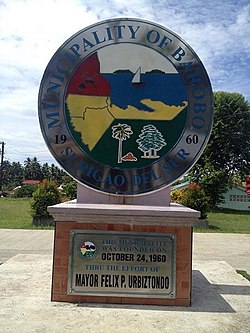
Barobo subsequently became a barrio under the municipality of Lianga. The creation of the province of Surigao del Sur under R.A. No. 2786, series of June 1960, created the municipality of Barobo on October 24, 1960, by virtue of Executive Order No. 407 issued by President Carlos P. Garcia. Thus the Municipality of Barobo was carved out (in a shape resembling that of a cigar pipe) from its mother municipality, Lianga.

Geography

[edit]

Barobo lies in the central part of the province of Surigao del Sur. It is located between 8'34'00" and 8'25'00" latitude and 125'59"00 and 126'22'4" longitude. It is bounded on the north by Lianga Bay and the municipality of Lianga, on the south by the municipality of Tagbina, on the southeast by the municipality of Hinatuan, on the east by the Pacific Ocean, and on the west by the municipality of San Francisco, Agusan del Sur.

It has total land area of 24,250 hectares (59,900 acres). It is linked by a national road to the provincial capital of Tandag, Surigao del Sur, of 103 kilometers (64 mi) and the gateway to the regional center of the Caraga Region in Butuan of 107 kilometers (66 mi).

Tourism

[edit]

15,000 hectares (37,000 acres) of its total land is used for the tourism industry with declared tourist destinations namely, Turtle Island, Cabgan Island, Vanishing Islet, Pongpong Resort, Pagbutuanan Cave, Bogac Cold Spring, Beto Lagoon, Panaraga Beach Resorts and Dapdap Beach Resorts. The Barobo River was named as the cleanest urban river in the country by numerous blogging award-giving bodies.

Barangays

[edit]

Barobo is politically subdivided into 22 barangays. Each barangay consists of puroks while some have sitios.

  • Amaga
  • Bahi
  • Cabacungan
  • Cambagang
  • Causwagan
  • Dapdap
  • Dughan
  • Gamut
  • Guinhalinan
  • Javier
  • Kinayan
  • Mamis
  • Poblacion
  • Guinhalinan
  • Rizal
  • San Jose
  • San Roque
  • San Vicente (Poblacion)
  • Sua
  • Sudlon
  • Tambis
  • Unidad
  • Wakat

Climate

[edit]
Climate data for Barobo
Month Jan Feb Mar Apr May Jun Jul Aug Sep Oct Nov Dec Year
Mean daily maximum °C (°F) 29.0
(84.2)
29.1
(84.4)
30.1
(86.2)
31.1
(88.0)
31.7
(89.1)
31.6
(88.9)
31.7
(89.1)
31.9
(89.4)
31.9
(89.4)
31.5
(88.7)
30.7
(87.3)
29.7
(85.5)
30.8
(87.5)
Daily mean °C (°F) 25.3
(77.5)
25.4
(77.7)
26.1
(79.0)
26.8
(80.2)
27.4
(81.3)
27.2
(81.0)
27.2
(81.0)
27.3
(81.1)
27.3
(81.1)
27.1
(80.8)
26.5
(79.7)
25.9
(78.6)
26.6
(79.9)
Mean daily minimum °C (°F) 21.7
(71.1)
21.8
(71.2)
22.1
(71.8)
22.6
(72.7)
23.2
(73.8)
22.9
(73.2)
22.7
(72.9)
22.8
(73.0)
22.7
(72.9)
22.7
(72.9)
22.4
(72.3)
22.2
(72.0)
22.5
(72.5)
Average rainfall mm (inches) 639
(25.2)
482
(19.0)
402
(15.8)
297
(11.7)
264
(10.4)
227
(8.9)
207
(8.1)
198
(7.8)
211
(8.3)
221
(8.7)
325
(12.8)
535
(21.1)
4,008
(157.8)
Source: Climate-Data.org[6]

Barobo has a tropical rainforest climate (Af) with heavy to very heavy rainfall year-round.

Demographics

[edit]
Population census of Barobo
YearPop.±% p.a.
1970 16,717—    
1975 21,090+4.77%
1980 23,346+2.05%
1990 32,991+3.52%
1995 32,226−0.44%
2000 34,558+1.51%
2007 40,933+2.36%
2010 43,663+2.38%
2015 49,730+2.51%
2020 53,146+1.41%
2024 53,729+0.26%
Source: Philippine Statistics Authority[7][8][9][10][11]

Language

[edit]

A native Barobohanon speaks Kamayo, a minor language spoken in the area of Barobo and also in Bislig, San Agustin and Marihatag, Surigao del Sur province in the southern Philippines. It has 7,565 speakers (2000, WCD). The dialect known as "Kamayo" varies from one municipality to another — Lingiganons are quite different from other municipalities on the way they speak the Kamayo language.

Economy

[edit]

Poverty incidence of Barobo

10
20
30
40
50
60
2000
57.02
2003
54.36
2006
42.50
2009
45.65
2012
30.48
2015
43.76
2018
33.17
2021
31.71

Source: Philippine Statistics Authority[12][13][14][15][16][17][18][19]

References

[edit]
[edit]
Revisions and contributorsEdit on WikipediaRead on Wikipedia
from Grokipedia
Barobo is a coastal in the central part of province, (Region XIII), on the island of in the , covering an area of 242.50 square kilometers and situated along the with coordinates approximately 8°32′N 126°7′E. As of the 2020 census, it has a of 53,146 people distributed across 21 barangays, with a of 219 inhabitants per square kilometer and a age of 21 years. The municipality was established on October 24, 1960, through No. 407, separating it from the nearby municipality of shortly after the creation of province in June of that year. Named after the endemic Balobo tree (Diplodiscus paniculatus), a medium-sized species native to the known for its timber and fiber uses, Barobo reflects its Kamayo linguistic and cultural origins, where the name evokes the abundance of such trees in the area. The local economy relies on , , and emerging , supported by an annual revenue of approximately ₱127 million as of 2016, with fertile lands, verdant hills, and rich contributing to livelihoods. Barobo is renowned for its natural attractions, including white sand beaches, beautiful , and hotspots that draw visitors for eco-tourism and outdoor activities. Key sites include the Bogac Cold Spring, a refreshing natural pool; Cabgan Island, ideal for amid coral reefs; , a for sea turtles; Beto with its clear waters; and Panaraga Golden for relaxation. Other notable spots are the Vanishing Bar Island, Radin’s Hidden Camping Site, and Ragga Ragga Leisure Park, which offer opportunities for island hopping, , and marine exploration, underscoring the municipality's role in promoting within .

History

Founding and Colonial Era

The territory now encompassing Barobo was pre-colonially inhabited by indigenous Manobo and Kamayo peoples, who formed semi-nomadic settlements along the fertile river systems of what is today , relying on swidden agriculture, fishing, and forest resources for sustenance. The Manobo, recognized as a dominant group in the province, maintained social structures centered on and communal land use, while the Kamayo, descendants of Manobo and Mandaya lineages, contributed to the region's cultural diversity through their distinct language and traditions. Under Spanish colonial rule from the , the broader region—including the Barobo area—fell within the administrative Distrito de , established in 1609 to consolidate control over eastern . Missionary efforts by Jesuit and Augustinian orders radiated from key centers like , introducing and establishing reducciones (resettlement villages) to convert and pacify indigenous populations; however, the rugged mountainous terrain and dense tropical forests limited direct governance, allowing many Manobo and Kamayo communities to retain autonomy and resist full assimilation until the late . The American colonial period, beginning after 1898, marked initial infrastructural integration of the Surigao province, with post-1900 initiatives focusing on road networks to link coastal and interior barrios, improving access to markets and administrative hubs. Public school systems were also introduced under the U.S. colonial education framework, establishing primary institutions in rural areas like those near modern Barobo to promote English-language instruction and American civic values, though penetration remained uneven due to geographic isolation. During , Barobo and surrounding areas endured Japanese occupation from 1942 onward, prompting local residents to join guerrilla units affiliated with provincial resistance networks in , conducting sabotage, intelligence gathering, and ambushes against Imperial forces to support Allied liberation efforts. These activities, often coordinated with U.S. remnants and Filipino regulars, highlighted the community's resilience amid wartime hardships. Barobo originated as a barrio within the municipality of Lianga in the former Surigao province; it was formally established as an independent on October 24, 1960, via No. 407 signed by President , which segregated 13 barrios from Lianga—namely Barobo, Wacat, San Vicente, Amaga, Bahi, Canbagang, Javier, Yaco, Dapdap, Kinayan, Rizal, Gamut, and Cabacoñgan—to form the new entity in the newly created province under Republic Act No. 2786. This separation reflected post-war administrative reorganization to address local governance needs amid growing population and economic pressures.

Post-War Development

Following , the region encompassing what would become Barobo experienced recovery efforts focused on administrative reorganization and economic revitalization, culminating in the creation of as a separate province on June 19, 1960, under Republic Act No. 2786 to enhance local governance and development in the post-war era. Barobo itself was established as a on October 24, 1960, through No. 407, carved out from the territory of , reflecting broader reconstruction initiatives that included agricultural expansion to support resettled populations displaced by the war. These efforts facilitated population influx, with the area's original Manobo settlers contributing to agriculture. In the 1960s, municipal infrastructure development advanced with the construction of essential facilities, including the town hall, to support the new administrative unit's operations and foster stability. The 1970s brought significant challenges under , declared in 1972, as the communist insurgency led by the intensified in rural Mindanao, including , disrupting local governance through guerrilla activities, forced collections, and military operations that affected agricultural communities in areas like Barobo. Entering the , Barobo pursued economic diversification beyond traditional and , with small-scale emerging as a sector. In 2012, (locally known as ) struck eastern , impacting —including Barobo—with destruction to homes, , and crops; the was declared under a state of calamity, prompting coordinated national and international relief efforts focused on evacuation, rebuilding, and agricultural recovery. Barobo's population has grown steadily amid these developments, increasing from 28,051 in 1990 to 53,146 in 2020, driven by natural growth and economic opportunities in and services.

Geography

Location and Terrain

Barobo is situated in the central portion of province in the Region of the , with geographic coordinates approximately at 8°32′N 126°07′E. The municipality borders Marihatag to the north, to the south, and the to the east, while its western limits adjoin the province of . This positioning places Barobo along the eastern coastline of island, contributing to its coastal character and exposure to marine influences. The terrain of Barobo features coastal plains along its eastern shoreline, gradually transitioning to hilly interiors as elevation rises to an average of about 43 meters above . Major rivers, such as the Barobo River, traverse the landscape, supporting local and bisecting the through its urban areas. Offshore, small islands like Cabgan Island enhance the natural seascape, offering white sand beaches and coral reefs accessible by short rides from the mainland. Natural features include fertile volcanic soils derived from the broader Diwata Mountain Range, including the nearby Mount Hilong-Hilong, which spans parts of and influences regional geology. Forested areas cover approximately 19% of Barobo's land as of , with natural forest extent at 3.6 thousand hectares, though has resulted in an annual loss of about 15 hectares in recent years.

Administrative Divisions

Barobo is politically subdivided into 22 barangays, the smallest in the . These include the urban , which serves as the municipal , and rural barangays such as Dapdap, Amaga, and Sudlon. The barangays encompass a mix of coastal units, like Wakat and Gamut along the Pacific shoreline, and inland ones, such as San Vicente and Rizal, reflecting the municipality's position as a coastal area with interior extensions. The total land area of Barobo spans 242.50 square kilometers, distributed across these divisions with centrally located for administrative functions. Each is headed by a (barangay captain) elected every three years, supported by a council of seven members responsible for local policies and services. The most recent administrative adjustment occurred in 2024, when Republic Act No. 11986 established Barangay Guinhalinan from portions of Barangay Dughan and Barangay Wakat to enhance local and development . Population distribution across the barangays shows variation, with denser concentrations in and coastal areas.

Climate

Barobo exhibits a classified as Köppen , marked by consistently high temperatures and substantial year-round precipitation. The average annual temperature hovers around 27°C (81°F), with daily highs typically ranging from 29°C to 31°C (84°F to 88°F) and lows around 24°C (76°F), with minimal variation across seasons. Annual rainfall averages approximately 2,140 mm, distributed unevenly with a pronounced from to March, during which monthly often exceeds 200 mm from to , peaking in and . In contrast, the drier months from to see reduced rainfall, averaging 100-150 mm per month, which facilitates agricultural pursuits despite occasional showers. This pattern aligns with the broader Type II climate of eastern , featuring no true but a maximum rainfall period influenced by the northeast . Due to its Pacific coastal location, Barobo is susceptible to tropical cyclones, which can intensify seasonal rains and cause flooding; notable examples include Tropical Storm Auring in February 2021, which led to evacuations and inundated local rivers. Relative humidity remains elevated at 80-90% throughout the year, contributing to an oppressive atmosphere and supporting lush vegetation, while seasonal river level fluctuations impact aquatic habitats and biodiversity in the surrounding rainforests. The from May to offers optimal conditions for , with lower rainfall enhancing outdoor activities.

Demographics

Population Statistics

According to the 2020 Census of and Housing conducted by the (PSA), Barobo has a total population of 53,146 residents, representing an increase from 49,730 in the 2015 . This equates to a of 219 persons per square kilometer across the municipality's 242.5 square kilometers of land area. Barobo's has shown steady growth, with an annual rate of 1.41% between 2015 and 2020, driven by natural increase and some . trends are evident, reflecting economic opportunities in central locales. This shift contributes to the municipality's evolving . The age of Barobo's is 21 years as of the 2015 census, indicative of a youthful demographic structure common in rural municipalities. Females constitute a slight of the total . Projections based on regional growth patterns from the PSA suggest the population could reach around 60,000 by 2030, assuming continued moderate expansion rates of 1-1.5% annually.

Languages and Ethnicity

The linguistic landscape of Barobo is characterized by a mix of indigenous and regional languages, reflecting its position in the diverse region of the . Cebuano, also known as Bisaya, serves as the dominant language, widely used in daily communication, trade, and education across the municipality. Kamayo, an indigenous Austronesian language belonging to the Meso-Philippine family and related to Tausug and Butuanon, is native to the area and spoken primarily by the local Kamayo people in Barobo and nearby municipalities like , San Agustin, and Marihatag. Tagalog (as Filipino, the ) and English are employed in official administration, schooling, and formal settings, promoting among residents. Ethnically, Barobo's population comprises a majority of , who form the predominant group along the coastal and lowland areas, influencing local customs and social structures. The indigenous Kamayo constitute a significant portion, preserving ancestral practices amid interactions with migrant communities. Small populations of migrants from , often of Tagalog descent, add to the ethnic diversity through intermarriage and cultural exchange. Cultural influences in Barobo blend indigenous Kamayo traditions—such as , , and animistic rituals—with Visayan customs like communal feasting and Catholic-influenced practices, fostering a hybrid identity. efforts are evident in local schools, where programs integrate Kamayo alongside Cebuano and Filipino to counter urbanization's threat to indigenous tongues, though challenges persist due to the dominance of mainstream languages. These linguistic and ethnic elements also manifest briefly in festivals, where multilingual songs and dances highlight communal harmony.

Economy

Agriculture and Fishing

Agriculture in Barobo centers on traditional crop production, which occupies approximately 75% of the municipality's land area and serves as the primary livelihood for about 41% of the local workforce. The dominant crop is coconut, accounting for 86% of agricultural land, with paddy rice cultivated in lowland areas and abaca grown as a fiber crop in suitable upland zones. Coconut farming supports copra processing as a key export commodity, shipped to nearby ports for further trade, while abaca production involves around 16 farmers in the municipality focusing on varieties like Inusa for local and regional markets. Rice paddies contribute to food security, though yields are influenced by the region's Type II climate with distinct wet and dry seasons. Fishing operations in Barobo are predominantly small-scale, encompassing coastal and riverine activities along Lianga Bay and the Tambis River system, employing roughly 20-40% of the coastal workforce depending on the community. Common species include bangus (milkfish) from aquaculture cages and sardines targeted under regional management plans. The sector features 167 hectares dedicated to aquaculture with 668 fish cages, supporting initiatives like multi-species marine hatcheries established under Republic Act No. 10941 to boost production. In 2024, a women-led group in Barobo harvested 1.9 metric tons of bangus from a BFAR-supported cage, generating ₱232,080 in sales, highlighting ongoing aquaculture advancements. Sustainable practices have been emphasized since the early 2010s through Bureau of Fisheries and Aquatic Resources (BFAR) programs, including participatory resource assessments and fisheries management plans to prevent overexploitation. Both sectors face significant challenges from the region's vulnerability to typhoons, which frequently damage paddies, plantations, and infrastructure, leading to reduced yields and income losses. interventions, such as the Department of Agriculture's distribution of and corn seeds along with other inputs since the 2000s, aim to enhance resilience and productivity in lowland farming areas. These efforts include support for systems combining with abaca and short-term crops to diversify outputs and mitigate risks.

Trade and Services

Barobo's trade sector revolves around local markets and the exchange of agricultural products, serving as a vital link for the municipality's rural economy. The Barobo Public Market, constructed in 2009 at a cost of PHP 18 million, functions as the primary commercial hub in Poblacion, accommodating daily and weekly trading activities for residents and vendors. This facility supports the sale of fresh produce, seafood, and other goods, benefiting the local population of approximately 42,000 as of 2009. A seafood market in Barangay Rizal further enhances trade in marine products, drawing buyers from surrounding areas. The Department of Trade and Industry's Negosyo Center in Barobo promotes commercial activities by assisting micro, small, and medium enterprises (MSMEs) with livelihood support and training, fostering growth in retail and trading. Cooperatives play a key role in organized trade, with the Barobo Integrated Farmers and Fisherfolk Marketing Cooperative facilitating the distribution of agricultural and fishery products to regional markets. Established under the broader framework post-1990, such organizations have strengthened and for local producers. In the services sector, has emerged as a growing contributor, with accommodations like homestays and inns catering to visitors exploring natural attractions such as Beto Lagoon and Cabgan Island. Options include Alizer Travellers Inn and various facilities in , providing budget-friendly lodging and supporting ancillary services like dining at local eateries. Small-scale banking and retail outlets, including branches of regional institutions like Cantilan Bank, underpin everyday transactions and consumer needs in the municipality. Remittances from overseas Filipino workers (OFWs) bolster household incomes, mirroring national trends where such inflows constitute around 8.7% of GDP as of 2024, though local impacts remain tied to informal channels. Infrastructure developments, including connections to , have enhanced trade efficiency by improving access to urban centers like Davao and for agricultural exports such as . trading remains a staple activity, with local traders handling dried kernels for regional shipment, contributing to the area's non-primary economic output.

Government and Infrastructure

Local Administration

Barobo's municipal government operates under the framework established by Republic Act No. 7160, the Local Government Code of 1991, with a serving as the chief executive responsible for policy implementation and administration. The vice-mayor presides over the , the legislative council comprising eight elected members, the president of the Association of Barangay Captains, and the president of the Federation, for a total of ten councilors who enact ordinances and approve the annual budget. Elections for the , vice-mayor, and eight regular councilors occur every three years in synchronized national polls, a system established by Republic Act No. 7166 in 1992. The municipality was created on October 24, 1960, via No. 407 as part of regional reorganization following Surigao del Sur's establishment. As of November 2025, Ronnie L. Martizano of the party serves as mayor, elected with 15,991 votes in the May 2025 polls, while Bong Bernal of the Padayon Pilipino Party holds the vice-mayoral position with 20,880 votes. The eight elected councilors are Dodong Moresca (, 18,288 votes), Weng Sanchez (Padayon Pilipino Party, 17,811 votes), Nancy Silva (Padayon Pilipino Party, 17,465 votes), Ellen Conde (Independent, 16,666 votes), Toto Caybot (National Unity Party, 15,928 votes), Alilo Luarez (Independent, 15,802 votes), Biboy Avila (Independent, 15,078 votes), and Che Che Balahay (Padayon Pilipino Party, 14,281 votes), completing the regular membership of the alongside the two ex-officio representatives. The current leadership emphasizes , with Martizano enforcing a ban on large-scale near riverbanks using heavy equipment and confiscating such machinery for turnover to the , while permitting regulated small-scale activities like tunnel and away from water sources to preserve ecosystems. Policies also target poverty alleviation by encouraging a transition from mining-dependent livelihoods to , including negotiations with landowners to convert idle areas into farmlands and providing support to constituents shifting to farming. The municipality's 2025 annual budget totals 311 million, funding these initiatives alongside general governance.

Transportation and Utilities

Barobo's transportation network is anchored by the Maharlika Highway, a major national arterial road that traverses the municipality, facilitating connectivity to neighboring areas in and beyond. This highway serves as the primary route for inter-municipal travel and goods transport, supporting local economic activities such as and . Local mobility within Barobo relies predominantly on jeepneys for longer routes between barangays and tricycles for short-distance trips in urban and rural areas, reflecting the common public transport modes in rural Philippine municipalities. The nearest commercial airport is Butuan Airport in , located approximately 105 kilometers by road north, accessible via a 1.5- to 2-hour drive along the Maharlika Highway. Maritime access in Barobo is limited to small-scale facilities suited for and local trade. The Wakat Fish Port in Barangay Wakat functions as a key landing site for small fishing vessels, handling daily catches from coastal waters. While there is no major international or commercial , inter-island boats operate from these local ports to connect Barobo with adjacent municipalities like Tagbina and San Miguel, enabling the movement of passengers and goods across the Pacific coastal areas. Utilities in Barobo are managed through and district-level systems to ensure reliable basic services. is distributed by the Surigao del Sur I Electric (SURSECO I), which achieved a household electrification rate of 99.87% across its franchise area, including Barobo, as of December 2023. is overseen by the Barobo Water District, drawing primarily from the Barobo River and local spring sources to provide potable water to residential and commercial users. infrastructure, including mobile and services from major providers such as and Smart, has been available since the early , with recent expansions including free access points in public areas to enhance connectivity.

Culture and Tourism

Festivals and Traditions

Barobo's cultural life is vibrant, centered around annual festivals that highlight its indigenous Kamayo heritage and colonial influences. The Sarapang Festival, held every to coincide with the municipality's founding anniversary, serves as the premier event celebrating the town's indigenous roots through traditional dances, musical performances, and communal feasts. This multi-day celebration features street parades, cultural shows, and a coronation night for local talents, drawing participants who don traditional attire to showcase Kamayo motifs and rhythms. The festival emphasizes community unity and cultural , incorporating elements like ethnic songs in the to preserve linguistic ties. In 2025, the 65th Araw ng Barobo and 9th Sarapang Festival included street dance competitions and live performances, underscoring ongoing cultural engagement. Complementing the Sarapang Festival is the Araw ng Barobo, also observed on , which includes civic parades honoring the municipality's in 1960. These processions feature floats representing and , often accompanied by family-oriented rituals such as sinulog-inspired dances—adaptations of prayer dances blending indigenous movements with Catholic devotion. Catholic holidays further shape traditions, with feasts and processions incorporating Kamayo storytelling sessions recounting ancestral tales around communal meals. Everyday traditions among Barobo residents reflect Kamayo influences, including weaving practices that produce textiles with geometric patterns symbolizing and bonds. These handwoven items, used in and household decor, are passed down through generations as markers of identity. Oral storytelling remains a core practice, with elders sharing myths and moral lessons during family gatherings, reinforcing values of harmony and resilience. Preservation efforts have intensified since the early 2000s, with community organizations documenting oral histories through interviews and recordings to safeguard Kamayo narratives against modernization. These initiatives, supported by provincial cultural offices, ensure that festivals and rituals continue to evolve while honoring their origins.

Natural and Cultural Attractions

Barobo, a coastal in , , boasts a variety of natural attractions that draw eco-conscious visitors seeking serene landscapes and biodiversity hotspots. Among these, Beto Lagoon stands out for its striking turquoise waters, formed by natural springs and surrounded by lush vegetation, offering a spot for relaxation though swimming is prohibited to preserve its fragile . Located just a short 2-minute walk from Bogac Cold Spring in , it is easily accessible via or a brief hike from the highway, making it ideal for day trips. Nearby, Cabgan Island features a notable sandbar that emerges at low tide, connecting to adjacent islets and providing opportunities for gentle exploration amid clear coastal waters; the area is also linked to , known for its turtle-like shape and potential as a nesting site for sea turtles, emphasizing the need for guided visits to minimize environmental impact. Access to Cabgan involves a 20-30 minute boat ride from Barobo's port, often part of island-hopping tours that highlight . Complementing these coastal gems, Bogac Cold Spring emerges as a refreshing inland retreat with crystal-clear, cold waters flowing directly from mountain sources, historically serving as a vital clean for early settlers. The spring feeds into the pristine Barobo River, renowned as one of the cleanest rivers in the due to community efforts in waste management and watershed protection, supporting eco-tours that include swimming, picnicking, and nature walks along its banks. Reachable by a short ride from the Barobo Bus Terminal, it features basic facilities like cottages and life jackets for safe enjoyment, with entrance fees around 15. On the cultural front, Barobo's heritage sites reflect its blend of colonial history and indigenous traditions rooted in the Kamayo ethnic group, descendants of Manobo and Mandaya peoples who speak the . The Municipal Plaza in serves as the community's central gathering space, surrounded by local shops and greenery, where visitors can observe daily life and occasional cultural events. Adjacent to it, the Church of the Mother of Mercy, established in 1975, represents modern religious architecture while echoing the town's historical Christian influences, though remnants of older structures hint at earlier settlement patterns. For a deeper dive into indigenous culture, nearby villages inhabited by Kamayo communities showcase traditional crafts such as woven baskets, , and wooden carvings made from local materials, often demonstrated in community settings to promote cultural preservation and . These sites are conveniently located in the poblacion area, accessible on foot or by tricycle from the main terminal, with guided tours available to learn about Kamayo folklore and artisanal techniques. Tourism in Barobo has seen steady growth since the mid-2010s, driven by promotion of its natural sites and sustainable practices, contributing to the broader region's increase in domestic and foreign arrivals to 1,442,032 in 2023 and 1,667,504 in 2024. Local eco-guidelines, enforced by the municipal tourism office, include no-trace policies at sensitive areas like the Barobo River and lagoons to maintain water quality and , ensuring attractions remain viable for future visitors.

References

Add your contribution
Related Hubs
User Avatar
No comments yet.