Hubbry Logo
Barry FarmBarry FarmMain
Open search
Barry Farm
Community hub
Barry Farm
logo
8 pages, 0 posts
0 subscribers
Be the first to start a discussion here.
Barry Farm
Barry Farm
from Wikipedia

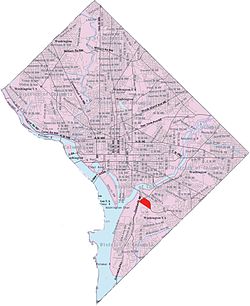
Barry Farm is a neighborhood in Southeast Washington, D.C., located east of the Anacostia River and bounded by the Southeast Freeway to the northwest, Suitland Parkway to the northeast and east, and St. Elizabeths Hospital to the south. The neighborhood was renowned as a significant post-Civil-War settlement of free Blacks and freed slaves established by the Freedmen's Bureau.[1] The streets were named to commemorate the Union generals, Radical Republicans, and Freedmen's Bureau officials who advanced the rights of Black Americans during the Civil War and Reconstruction: Howard Road SE for General Oliver O. Howard; Sumner Road SE for Massachusetts Senator Charles Sumner; Wade Road SE for Ohio Senator Benjamin Wade; Pomeroy Road SE for Kansas Senator Samuel C. Pomeroy; Stevens Road SE for Pennsylvania Congressman Thaddeus Stevens,[2] and Nichols Avenue (now Martin Luther King Jr. Avenue SE) for Henry Nichols who was the first superintendent of Saint Elizabeth's Hospital (Formerly called the Government Insane Asylum).[3] The neighborhood name is not a reference to the late former mayor of Washington, D.C., Marion Barry, but coincidentally has the same spelling.[citation needed]

Key Information

History

[edit]
The neighborhood of Barry Farm at the intersection of Eaton Rd. and Firth Sterling Ave. before, April 2018, prior to redevelopment

In 1867, the Freedmen's Bureau (officially the U.S. Bureau of Refugees, Freedmen, and Abandoned Lands) bought a 375-acre farm from Julia Barry, a white landowner and recent owner of enslaved people, enabling the transformation of Barry's Farm into a thriving, independent community of formerly enslaved and free-born African Americans.[4][5] The Commissioner of the Freedmen's Bureau, General Oliver O. Howard, had asked Black migrants squatting in temporary structures at Meridian Hill, what might help them to become self-supporting.[6] They said, "Land! Give us land!" Howard promised to acquire land near the city. He then transferred $52,000 from the refugees' and freedmen's fund to be held in trust by himself, Senator Samuel C. Pomeroy, and John R. Elvans for the use of three institutions: Howard University, Richmond Normal School, and St. Augustine Normal School in Raleigh. They used some of these funds to purchase Barry's Farm. The Bureau sub-divided the farm into one-acre plots, which the freedmen could purchase over a period of seven years. For an additional $76, they could buy lumber to begin constructing a house. By 1869, money from the sale of the land, reportedly $31,178.12 (~$650,953 in 2024), had been returned to the fund and distributed to the three institutions listed above.[7]

Barry Farm was initially a large homestead, stretching all the way to 13th Street on the east, Poplar Point on the West, and the present-day Morris Road SE on the north. In 1871, the area between 13th Street, Sheridan Road, and Martin Luther King Jr. Avenue SE (then known as Nichols Avenue), residents renamed the area Hillsdale. Railroad tracks laid around 1913 cut off Barry Farm from Poplar Point. The 1940s construction of a Suitland Parkway, originally a military highway from Bolling Field to Camp Springs, MD, further isolated the neighborhood between busy traffic arteries, required the demolition of nearly 100 houses, and displaced more than 600 residents.[8][9] Beginning in the late 1950s, I-295, or the Anacostia Freeway, further restricted access to and visibility of the Anacostia River. Only a few old frame houses, mostly along Wade Road just at the edge of the thicket that separates Barry Farm from St. Elizabeth's Hospital, resemble those of the original Freedman's community.

The National Capital Housing Authority built the 442-unit Barry Farm Dwellings public housing project in 1943.[10] Barry Farm was built with two- to four-bedroom town houses, with some later combined to create six-bedroom units, and a recreation center.[11]

Tenant activism and community life

[edit]

Residents organized over the years both to pressure the city for assistance and to protect and support each other. Their actions brought them to the forefront of the civil rights movement. In the summer of 1949, Barry Farm-Hillsdale youth—Richard Robinson, Carl Contee, Richard Cook, Clarence "Dusty" Prue, Everett and Eugene "Mann" McKenzie, Toussaint Pierce, James Chester Jennings Jr, and Otis, Thomas and Bill Anderson—tried to enter the Anacostia Pool without success and continued to try over several days. Legally, the public pools were not segregated, but in practice this was a white segregated pool. There were violent clashes between hundreds of Whites and African Americans. The pool was closed, and the following year all the public pools were desegregated.[12]

In the 1940s, there was just one junior high and no high schools for African Americans east of the Anacostia River.[13] In 1950, Barry Farm Dwelling residents requested that they be admitted to the new, white-segregated Sousa Junior High and that the school be integrated. Their complaint became Bolling v. Sharpe and was one of several companion cases to Brown v. Board of Education. In 1954, the U.S. Supreme Court unanimously declared that segregated public education was inherently unequal, violated the Equal Protection Clause and the right to due process, and therefore was unconstitutional.[14]

In the 1960s, there were new tenant organizing groups. The Band of Angels, a tenants' council made up of women and led by Stevens Road residents Lillian Wright and Etta Mae Horn, was one such group. The Angels' first achievement was an urgently needed $1.5 million renovation of Barry Farm Dwellings. Etta Horn later became an influential civil rights leader and served as vice chair of the National Welfare Rights Organization.

Since 1975, Barry Farm has been the home to Barry Farms Community Basketball League. This summer league was renamed the Goodman League after community activist and Barry Farm Recreation Center counselor George Goodman.[15] The Goodman League features current and former NBA players, college players, and participants from various communities. The Barry Farm Beavers football team also plays at the recreation center.

In 1982, Barry Farm Dwellings residents, including Gladys Bunker, started a food co-op. The food co-op lasted for at least four years and accepted food stamps. Cornbread Givens and the Poor People's Development Foundation helped the co-op organizers.[16]

In 1997, the Capital Area Community Food Bank and Community Educational Economic Development worked with Barry Farm Dwellings residents to start a farm.[17]

Notable residents

[edit]
  • James G. Banks (1920–2005) was born in Barry Farm-Hillsdale, lived in Barry Farm Dwellings, and became the Executive Director of the National Capital Housing Authority in the 1970s.[18]
  • Solomon G. Brown was the first African American employee at the Smithsonian Institution, serving for fifty-four years from 1852 to 1906.[19]
  • Emily Edmonson (1835–1895), later Emily Johnson, was a founding member of the Barry Farm-Hillsdale community. On April 15, 1848, she and her sister Mary were among the seventy-seven slaves who tried to escape from Washington, DC on the schooner The Pearl to sail from the Chesapeake Bay to freedom in New Jersey. This is known as the Pearl incident.
  • Etta M. Horn (1928 – 2001), later Etta M. Horn-Prather, was a key figure in the Welfare Rights Movement and became active in a tenants' council named The Band of Angels which successfully negotiated the $1.5 million renovation of Barry Farm in the 1960s. She went on to serve as the Director of D.C. Child Development Center on Martin Luther King Avenue SE for 25 years.[20]
  • John Shippen (1879–1968) was the first African American player to compete in the U.S. Open golf tournament (in 1896) and took fifth place. He participated five more times in the U.S. Open and made his career in golf.
  • Georgiana Simpson (1865–1944) was the first African American woman to receive a doctorate and was a professor of German language and literature at Howard University.
  • Several families involved in the national movement to desegregate schools, either as activists or plaintiffs in lawsuits, lived at Barry Farm Dwellings: the Jennings family, including sisters Adrienne and Barbara lived at 1139 Stevens Road; the Briscoe family lived at 1232 Eaton Road; Valerie Cogdell lived at 1269 Stevens Road; Wallace Morris lived at 1234 Eaton Road; Lauretta Parker lived at 1149 Stevens Road; and the Bolling family, including brothers Spottswood and Wanamaker, lived at 1732 Stanton Terrace, just southeast of Barry Farm.[14]
  • The Junk Yard Band is a go-go band, founded in the early 1980s at Barry Farm Dwellings.

Demolition and preserved elements

[edit]

In the 1940s, government agencies sought to destroy and completely redevelop the Barry Farm-Hillsdale community. Two reasons have been suggested: 1) the community's "inability "to pay for municipal services" through the collection of real estate taxes" and 2) these government agencies' desire to clear downtown Washington, DC, of African Americans and move them to Barry Farm-Hillsdale and Marshall Heights.[5] The residents successfully stopped this redevelopment, but continually had to battle future destruction.

Through the city's New Communities Initiative and the Federal Choice program (the new HOPE VI), the DC Government demolished almost all of Barry Farm to redevelop Barry Farm from single-use public housing where households pay 30% of their incomes to reside in the community, into a mixed-use, higher density community with 1,600 units including homes for sale. In 2013, about 50 Barry Farm residents teamed up with community organizing group Empower DC.[21] They formed the Barry Farm Tenants and Allies Association to stop the city from evicting them from their homes before new housing was built, to demand that the redeveloped site match the intentions of the site's original design in providing sufficient green space, and to guarantee their right to return.

Barry Farm redevelopment in southeast Washington, D.C.

From April 2018 until January 2019, hundreds of families were relocated from Barry Farm, and early 2019, demolition began.[22] The Barry Farm Tenants and Allies Association successfully won a historic landmark designation for five public housing buildings that were home to well-known activists.[23] Other than a recreation center, these were the only buildings that remained on the site as of 2022.

See also

[edit]

References

[edit]

Further reading

[edit]
[edit]
Revisions and contributorsEdit on WikipediaRead on Wikipedia
from Grokipedia
Barry Farm was a predominantly African American neighborhood in Southeast Washington, D.C.'s Anacostia area, originally founded in 1867 by the Freedmen's Bureau as a cooperative farming community for emancipated slaves seeking land ownership and self-sufficiency in the post-Civil War era. In 1942–1943, the federal government expropriated approximately 34 acres of the original settlement to construct Barry Farm Dwellings, a 442-unit public housing complex built by the National Capital Housing Authority to provide segregated accommodations for African American workers amid wartime labor demands and housing shortages. The development, consisting of low-rise rowhouses, served as a focal point for civil rights organizing, including school desegregation efforts and tenant advocacy against substandard conditions, while later exemplifying the socioeconomic distress prevalent in mid-20th-century urban public housing, marked by physical decay and concentrated disadvantage. Selected in 2005 for the District of Columbia's New Communities Initiative, the site underwent phased demolition starting in 2019 to facilitate redevelopment into mixed-income housing, a process contested by residents through legal challenges over relocation terms and the erosion of community cohesion.

Origins and Early Development

Establishment as a Freedmen's Village (1867)

In 1867, the Freedmen's Bureau, under General Oliver Otis Howard, acquired approximately 375 acres of land in southeast Washington, D.C., from the heirs of James Barry, a pre-Civil War merchant and former city councilman who had owned the estate. The purchase, funded with $52,000 from Bureau resources, followed failed attempts to secure land nearer to the Navy Yard due to white residents' opposition, leading to a discreet negotiation for the Barry tract south of the Anacostia River. This site, initially envisioned to accommodate up to 40,000 freed African Americans displaced by the war, was designated as a freedmen's village to promote land ownership, self-sufficiency, and stable homesteading among former slaves. The Bureau subdivided the land into 359 one-acre lots, which were sold at affordable prices—typically $125 to $300 per acre—to qualified freedmen, enabling homeownership rather than tenancy. By October 1868, most lots had been allocated, and within two years, 266 families had relocated, with Black laborers hired at $1.25 per day to clear trees and prepare the wooded terrain. Residents constructed modest two-room frame houses using lumber supplied by the Bureau, fostering a oriented toward and basic trades. Early infrastructure emphasized communal self-reliance, including the rapid establishment of schools and churches such as African Methodist Episcopal (AME) and Baptist congregations, which served as anchors for social and religious life. The village's design reflected Bureau ideals of moral and economic upliftment, with streets named after abolitionists and Union figures—such as for Senator —to symbolize its post-emancipation aspirations. By promoting individual lot ownership, Barry Farm diverged from other federal relief efforts reliant on temporary rations, aiming instead for long-term independence amid the uncertainties of Reconstruction.

19th-Century Community Formation and Self-Sufficiency

Barry Farm was established in 1867 by the Bureau of Refugees, Freedmen, and Abandoned Lands (Freedmen's Bureau) as a settlement for African American refugees who had escaped slavery during the Civil War, providing an opportunity for land ownership and community autonomy in Southeast Washington, D.C. In early 1868, the federal government acquired approximately 375 acres from the heirs of James Barry, a former Washington merchant and city councilman whose estate had previously relied on enslaved labor for cultivation. This acquisition transformed the wooded, undeveloped tract into a planned freedmen's village, emphasizing individual lot ownership to foster economic independence amid post-emancipation challenges like limited job access and white hostility. Settlement proceeded rapidly, with 359 one-acre lots auctioned by October 1868, enabling 266 families to establish homes within two years and promoting through private land titles rather than communal or rental arrangements. Residents, primarily formerly enslaved individuals, cleared the heavily forested land manually and constructed rudimentary dwellings often by candlelight, while organizing civic infrastructure such as African Methodist Episcopal (AME) and Baptist churches, schools, and named streets honoring abolitionists like Sumner Road after Senator . These efforts reflected a deliberate for isolation and self-containment, requiring community initiative for basic services absent from the remote location. Self-sufficiency was achieved primarily through agricultural pursuits on the sizable lots, where families cultivated vegetable gardens, planted fruit trees, and raised to meet subsistence needs and generate surplus for local exchange. Many supplemented farming with wage labor at nearby institutions like and the , but land ownership underpinned long-term stability, allowing generational inheritance and reducing dependence on urban charity or prevalent elsewhere. By the late , this model had solidified Barry Farm as a resilient Black landowning enclave, though external pressures like for gradually eroded portions of the original holdings.

Transition to Public Housing

Federal Land Acquisition and WWII-Era Construction (1940s)

In 1941, the Alley Dwelling Authority, a federal entity tasked with , acquired 34 acres within Block 8 of the Barry Farm community through proceedings, including 32 existing houses on the site. This federal land seizure displaced 23 families and involved the condemnation and demolition of 30 houses, fragmenting the longstanding freedmen's settlement and separating it from adjacent Hillsdale neighborhoods. The acquisition was driven by acute housing shortages in , exacerbated by wartime industrial mobilization, with the land repurposed for segregated targeted at African American residents. Construction of the Barry Farm Dwellings commenced in 1942 under the oversight of the National Capital Housing Authority, yielding a 442-unit complex completed by 1943. Designed as temporary wartime accommodations, the project featured low-rise brick row houses and apartment buildings to house African American defense workers and their families amid labor demands, marking it as the largest federally development for Black residents in the District at the time. The effort reflected broader New Deal-era federal interventions in urban housing, though it prioritized rapid erection over long-term durability, with units intended for low-income occupancy post-war. This development overlaid and supplanted portions of the original 19th-century farmstead layout, further entrenching spatial divisions in southeast .

Initial Operations and Segregation Context

Barry Farm Dwellings commenced operations in 1942 as a segregated complex, with full construction completion by 1943 under the oversight of the National Capital Housing Authority. The project encompassed 442 units in two- to four-story brick townhouses designed for families, offering two- to four-bedroom accommodations to support stable household living amid wartime population influxes. Initial tenancy focused on low-income African American residents, prioritizing those displaced by related infrastructure projects, occupants of substandard alley dwellings, war industry workers, and U.S. military personnel to address acute housing shortages driven by federal job growth in Rent was subsidized to ensure affordability, with units managed to promote community cohesion through on-site facilities like playgrounds and green spaces, though operational maintenance fell under standard protocols of the era, including eligibility verification and income-based tenancy rules. By , the complex had stabilized as a residential hub, housing thousands in the Anacostia neighborhood east of the , where it served as a key resource for Black wartime migrants facing discriminatory barriers in private markets. The segregation context stemmed from entrenched Jim Crow policies in the District, where public housing developments were racially designated until desegregation efforts in the 1950s; Barry Farm was explicitly allocated for African American tenants, paralleling white-only projects elsewhere in D.C. managed by the same authority. This racial partitioning extended to adjacent public services, such as segregated schools—Kelly Miller Junior High for Black students versus John Philip Sousa Junior High for whites—reinforcing systemic separation despite the project's aim to provide dignified, modern shelter for underserved Black families. Federal guidelines under the Housing Act of 1937, as implemented locally, permitted and often mandated such divisions to align with prevailing community standards, limiting integration until court challenges and policy shifts post-Brown v. Board of Education.

Social and Economic Conditions

Daily Community Life and Tenant Experiences

Residents of Barry Farm public housing described a tight-knit community characterized by mutual support and intergenerational bonds, where neighbors often assisted one another with childcare, meals, and emotional encouragement. For instance, long-term resident Michelle Hamilton, who lived there from 1998 to 2018, served as a community leader organizing youth activities like Camp Nowhere and providing clothing and outings for children, while maintaining close ties with elders such as Ms. Ferrell. Similarly, teenager Dasani Watkins, who resided in the complex from 2013 until 2018, highlighted the contrast between Barry Farm's communal warmth—where residents knew and looked out for each other—and the isolation she experienced after relocating to a Northwest D.C. neighborhood. Such interactions fostered resilience, with Hamilton crediting the environment for her role as a "team mom" and godmother figure amid personal hardships. Daily routines revolved around navigating limited amenities and long commutes, with many tenants relying on public transit for work or ; Watkins endured a 30-minute ride to her while contending with summer heat exceeding 97°F in units lacking . Community gatherings, such as Fourth of July viewed from the complex and access to a local pool, provided occasional respite and fostered shared traditions. Employment among residents varied, with Hamilton working as a cook for 34 years and operating a home daycare, though persisted, exemplified by reliance on food stamps and back rent accumulation as reported by tenants like Paulette Matthews. The Barry Farm Recreation Center served as a hub for youth programs, contributing to a despite external stigmatization. Tenant experiences were markedly shaped by deteriorating physical conditions and safety concerns, including chronic failures such as water leaks, mold growth, pest infestations (mice, roaches, bed bugs), and outdated plumbing and electrical systems that led to issues and uninhabitable units. By 2015, only 254 of 432 units remained occupied amid boarded-up vacancies and fenced yards cluttered with rusted grills and discarded toys. , including , drug activity, and frequent break-ins facilitated by inadequate locks and window bars, created pervasive fear; the area was designated a police "HOT SPOT" in 2011, with residents reporting assaults, gun possession, and the loss of 16 youth to during Hamilton's tenure. These challenges, compounded by slow responses from the D.C. Authority's understaffed team (16 members citywide), underscored institutional , though tenants organized councils as early as 1965 to advocate for improvements. Insiders viewed the as beloved and self-sustaining, contrasting with outsiders' perceptions of it as rife with poverty and .

Persistent Challenges: Poverty, Crime, and Housing Deterioration

Barry Farm tenants faced entrenched , exemplified by the census tract's median household income declining from $20,680 in 2000 to $13,750 in 2018, with 65% of residents below the federal line according to 2019 data. Childhood poverty rates reached 76.8%, far exceeding national norms and reflecting intergenerational economic stagnation in the context. Elevated crime plagued the community, with violent offense rates including assaults at 478.9 per 100,000 residents—nearly double the national average of 282.7—murders at 59.9 versus 6.1 nationally, and robberies at 578.6 compared to 135.5. These figures underscored Barry Farm's reputation as a high-risk area within Southeast Washington, D.C., where drug-related and violent incidents were severe, mirroring patterns in distressed public housing nationwide. Housing deterioration intensified these challenges, beginning with neglect by the National Capital Housing Authority in the mid-1960s and worsening to include mold, lead contamination, rodent infestations, and structural failures by the 2000s. The District of Columbia Housing Authority's slow or unresponsive maintenance—such as delayed repairs for habitability issues—left units in poor to deteriorated states, with boarded windows and crumbling infrastructure prevalent prior to demolition. This institutional shortfall, compounded by concentrated poverty, perpetuated unsafe conditions despite federal oversight requirements.

Activism and Civic Engagement

Tenant Organizing and Local Advocacy

In 1966, residents Etta Horn and Lillian Wright established the Barry Farms , a women's group supported by the Southeast Neighborhood House and funded through programs, to address deteriorating housing conditions including pest infestations and plumbing failures at Barry Farm Dwellings. The organization picketed local welfare offices and pressured the National Capital Housing Authority, securing $1.5 million in federal funds for interior renovations prioritized by tenants. This effort marked an early instance of structured tenant advocacy leveraging federal resources to enforce maintenance accountability from housing authorities. That same year, Leroy Washington organized Rebels with a Cause, a that grew to over 300 members, advocating for job opportunities, recreational facilities, and improved policing in response to local infrastructure deficits and racial disparities in . Through sit-ins at the United Planning Organization and negotiations with city officials, the group obtained funding for a dedicated recreation center, serving more than 1,500 youth annually and establishing a model for community-led demands on public services. In the 1990s, the Barry Farm Residents Council, under leader Dorothea Ferrell, focused on environmental advocacy, pressing federal agencies to investigate pollution sources affecting resident health and prompting cleanup commitments. By the 2010s, amid District of Columbia Housing Authority plans for mixed-income redevelopment approved by HUD in 2018, residents formed the Barry Farm Tenants and Allies Association in partnership with Empower DC to oppose and displacement. The association met with council members, shared tenant testimonies, and pursued legal challenges, securing a 2018 court ruling that temporarily halted the project and advanced a resident-proposed alternative emphasizing rapid right-to-return provisions. In 2019, their efforts culminated in historic landmark designation for a portion of the dwellings, preserving select units amid broader reconstruction.

Involvement in Broader Civil Rights Efforts

In 1877, residents of Barry Farm–Hillsdale, including 18 men and 15 women, signed a to as part of the National Woman Suffrage Association's campaign, demanding voting rights for women amid a drive that gathered over 10,000 signatures nationwide. During the 1940s, Barry Farm residents, led by figures such as Norman E. Dale, organized pickets against white-owned businesses on Nichols Avenue to protest hiring discrimination, contributing to broader efforts against economic exclusion in segregated In 1949, community members participated in actions to integrate Pool following violent clashes, resulting in its reopening to all races in 1950 with significantly reduced white attendance. Barry Farm emerged as a key center for civil rights activism in the 1950s and 1960s, particularly through resident-led organizing that precipitated (1954), a companion case to . In 1950, families including the Jennings (Adrienne and Barbara) and Spottswood Bolling petitioned to enroll their teenage children in the nearby whites-only High School, facing denial that escalated into a lawsuit argued by attorneys Gardner Bishop, Reverend Samuel Everette Guiles, James Nabrit, and George E.C. Hayes; the ruled segregated D.C. schools unconstitutional under the Fifth Amendment's , extending equal protection principles to federal jurisdictions. Tenant activism at Barry Farm Dwellings also intersected with national economic justice campaigns, as residents formed a tenants' council co-led by Lillian Wright and Etta Horn, which evolved into the Citywide Welfare Alliance and helped establish the National Welfare Rights Organization (NWRO) in the 1960s, growing to 25,000 members advocating for welfare recipients' rights, including access to credit and policy reforms. Etta Horn, in particular, rose to vice chair of the NWRO and advised during planning for the 1968 , while the community's group protested inadequate housing and healthcare, securing commitments from Mayor for repairs. In 1966, a rally organized by the Free DC movement at Barry Farm featured Stokely Carmichael's introduction of the "" slogan to an audience of over 150, amplifying calls for racial . These efforts underscored Barry Farm's role in linking local grievances to systemic civil rights struggles, yielding tangible victories like a $1.5 million of the dwellings in 1966.

Notable Residents and Contributions

Prominent Individuals and Their Achievements

Solomon G. Brown (ca. 1829–1906), an early settler and leader in the Barry Farm–Hillsdale community established in 1867, served as the first African American employee at the , where he worked as a technician and lecturer on scientific topics. Self-educated, Brown contributed to astronomy, microscopy, and natural history exhibits, while also authoring poetry and advocating for Black education as a trustee of . Elected to the House of Delegates representing , he advanced local governance for both Black and white constituents in the post-Civil War era. Charles R. Douglass (1852–1920), son of abolitionist and a resident of Barry Farm, advocated for opening teaching positions to in , schools during the late . As a civil servant and community figure, he supported the self-sufficient Black settlement's development, reflecting the area's early emphasis on professional and political engagement among residents including teachers, lawyers, and nurses. Etta Mae Horn (1928–2001), a longtime resident of Barry Farm Dwellings , co-founded of Angels tenants' council in with Lillian , securing a $1.5 million renovation through advocacy amid neglect. Rising to national prominence in the welfare rights movement, Horn campaigned for expanded benefits, women's healthcare access, and parental rights, influencing policy under President Lyndon B. Johnson's initiatives. Her organizing extended to protests against inadequate police protection and substandard housing conditions in the segregated complex. Maurice "Moe" Shorter, a former Barry Farm Dwellings resident, managed the Junkyard Band, originating from children in the community who pioneered Washington's go-go music genre in the 1970s using improvised instruments like cans and pipes. The band's innovations shaped DC's cultural scene, blending funk, jazz, and percussion, and persisted through relocation amid 2019 demolitions, symbolizing enduring neighborhood creativity.

Decline Under Public Housing Model

Policy Failures and Institutional Neglect

The transformation of Barry Farm into under the District of Columbia Housing Authority (DCHA) in the mid-20th century exposed residents to policies that perpetuated isolation and disinvestment. By the mid-1960s, municipal authorities had ceased basic maintenance services east of the , including street lighting, contributing to the neighborhood's abandonment by those able to relocate and fostering an environment of . Invasive welfare policies during this era, which included discouraging through benefit structures and intrusive family investigations, further eroded community stability without addressing root . These institutional shortcomings, compounded by segregated practices that concentrated low-income Black families—94% of the 1962 public housing waitlist consisted of Black applicants—set the stage for long-term deterioration rather than . DCHA's management exacerbated these issues through chronic under-maintenance and delayed repairs, particularly after the 2014 filing and 2015 approval of plans under the New Communities Initiative. Routine repairs at Barry Farm took 15 days in 2015 and 17 days in 2016, compared to 8 and 9 days at similar properties, allowing problems like leaking ceilings, holes in floors and walls, prolonged lack of (up to two years in some units), rodent infestations, mold growth, and raw leaks to persist. Resident accounts documented severe habitability issues, such as Ismael Vazquez experiencing infestations, no , and mold from 2010 to 2017, and Jacqueline Thrash facing similar conditions since 2001. DCHA officials acknowledged , with Deputy Adrianne Todman stating in January 2016 that resources would not be allocated to units slated for , prioritizing relocation over upkeep. This pattern culminated in a August 2017 class-action lawsuit by Barry Farm residents against DCHA, alleging to maintain the property, which constituted constructive and violated federal housing standards. The suit highlighted DCHA's refusal to invest in a site eyed for mixed-income , reducing family-sized units significantly (e.g., 78 fewer two-bedroom and 77 fewer three-bedroom units in plans). Broader federal underfunding of contributed, but local mismanagement—evident in high vacancy rates (225 of 426 units vacant by 2016) and unaddressed hazards like elevated lead levels reported in a 1998 study—directly attributable to DCHA oversight failures, undermined resident health and safety without remedial action.

Escalating Social Pathologies and Empirical Data on Conditions

By the late 20th and early 21st centuries, Barry Farm exemplified the social pathologies associated with concentrated , including elevated , pervasive activity, family fragmentation, and entrenched , which intensified under institutional management despite citywide crime reductions. rates reached 4,197 incidents per square mile in 2006, among the highest for Washington, D.C. developments, though they declined 37.1% to 2,044 per square mile by 2013 amid partial . These rates persisted at levels far exceeding national averages, with ongoing shootings and s linked to territorial disputes, even as overall D.C. rates fell. markets dominated community life, with , crack, and ("needle drugs") identified as primary substances fueling and related among residents. Poverty metrics underscored systemic entrenchment, with 76.8% of children living below the poverty line—a figure exceeding 99.2% of U.S. neighborhoods—and median household income at $33,146 in 2010, reflecting socioeconomic decline including a 25% income drop in low-income clusters like Barry Farm from 1989 to 1999. Family structures deteriorated markedly, with single-mother households comprising a share higher than in 97.9% of U.S. neighborhoods, correlating with broader patterns of father absence and intergenerational welfare dependency in such isolated, high-poverty environments. Physical isolation exacerbated these issues, as Barry Farm's separation by highways limited access to jobs and services, perpetuating unemployment and low educational attainment without targeted interventions. Empirical indicators of decline included sustained of , contributing to and hazards, alongside that claimed lives in public spaces and deterred investment. While citywide dropped dramatically from 2000 onward, Barry Farm's concentrated disadvantages—high density in 444 units—sustained pathologies like chronic absenteeism from schools and substance-related disorders, as documented in assessments. These conditions, rooted in policy-driven segregation of the poor, highlighted causal links between geographic isolation, welfare incentives disrupting norms, and amplified criminal incentives, rather than isolated individual failings.

Redevelopment Initiatives

In 2006, the District of Columbia Council approved the Barry Farm Redevelopment Plan as part of the New Communities Initiative, aiming to transform the aging complex into a mixed-income, mixed-use community spanning Barry Farm, Park Chester, and Wade Road sites. The plan projected a $128 million funding shortfall, to be addressed through public-private partnerships, while preserving 444 units alongside new market-rate and . The District of Columbia Housing Authority (DCHA), in collaboration with the Barry Farm Advisory Committee, initiated to outline phased development, emphasizing resident input and relocation support. By 2013, the Preservation of Affordable Housing (POAH) was selected as the master developer, leading to extensive planning involving over 50 resident meetings with DCHA, the Office of the Deputy Mayor for Planning and Economic Development (DMPED), and community stakeholders. In October 2014, the D.C. Commission approved the initial stages under a framework, authorizing up to 1,400 units, including retail space and upgrades. March 2016 saw D.C. Resolution 16-06 pass, greenlighting relocation for approximately 197 families to temporary with promises of right-to-return provisions. Relocations commenced that year, managed by partners like Housing Opportunities Unlimited, amid rising development costs exceeding $120 million by 2017, with NCI committing $36.6 million in gap financing. Tenant opposition, led by the Barry Farm Tenants and Allies Association, escalated through legal challenges alleging inadequate consideration of relocation hardships, unit density, amenity losses, and familial status discrimination under the Fair Housing Act. A 2017 federal lawsuit in U.S. District Court claimed DCHA violated and relocation rights during planning, though the case focused on implementation rather than halting approvals outright. The pivotal hurdle came on April 26, 2018, when the D.C. Court of Appeals vacated the Commission's 2014 approval in Barry Farm Tenants & Allies Ass'n v. D.C. Zoning Comm'n, ruling that the commission failed to substantiate findings on project impacts and remanding for evidentiary review. Concurrent historic preservation efforts by residents sought landmark status for Barry Farm Dwellings to compel design modifications and delay , arguing the site's post-Civil origins warranted under D.C. law. However, in July 2019, D.C. Office staff recommended against designation, citing the structures' mid-20th-century construction and lack of exceptional architectural merit, despite acknowledging cultural significance. These combined , litigation, and preservation disputes prolonged approvals, complicating funding commitments and resident relocations, though DCHA proceeded toward 2019 under existing relocation protocols.

Demolition, Construction Progress, and Mixed-Income Model (2019–Present)

Demolition of the original Barry Farm Dwellings units continued into 2019, following initial phases that began in spring 2018, clearing the site for the first phase of redevelopment under the District of Columbia Housing Authority (DCHA) and partners including the Preservation of Affordable Housing (POAH). By mid-2019, significant portions of the aging structures along roads such as Eaton Road and Sumner Road had been razed, enabling site preparation for new infrastructure and . Construction for Phase 1 commenced post-demolition, focusing on 432 apartments across three multifamily and 115 townhomes, incorporating standards for energy efficiency and totaling approximately 547 units with upgraded public infrastructure. A key milestone in this phase was the completion of The Asberry in October 2024, a five-story building providing 108 affordable units for aged 55 and older, including 77 replacement units distributed across income tiers: 33 at 30% of area median family income (MFI), 44 at 50% MFI, 21 at 60% MFI, and 10 at 80% MFI, alongside 5,096 square feet of ground-floor commercial space and amenities like a sundeck, fitness center, and wellness room. The Asberry received certification from the Passive Housing Institute US in 2025 and held its grand opening on November 21, 2024. Phase 1 progress has generated 351 construction jobs, with 68 in Ward 7 and 92 in Ward 8, funded in part by $14.5 million from the Deputy Mayor for Planning and Economic Development (DMPED) and $33.7 million in tax-exempt bonds. On the same date as The Asberry's ribbon-cutting, groundbreaking occurred for The Edmonson, adding 139 affordable units—including 50 public housing replacements and 52 two-bedroom units—plus 20,000 square feet of retail space and community amenities, supported by $61.1 million in bonds, $52 million in low-income housing tax credit equity, a $21 million New Communities Initiative (NCI) loan, and other grants. As of July 2025, officials from the U.S. Department of Housing and Urban Development toured The Asberry and inspected ongoing Edmonson construction. The mixed-income model, aligned with the NCI's goal of deconcentrating , mandates one-for-one replacement of the original 380 units onsite, with overall targeting at least 900 units comprising 380 replacements, 320 additional affordable rentals, and 100 homeownership opportunities, integrated with market-rate housing to foster . This approach includes supportive services such as financial , , and credit repair to aid resident transitions, while Phase 2 encompasses further multifamily buildings, townhomes, a community center, park, and preservation of historic elements like a cultural center and heritage trail. DCHA anticipates financing closure for Barry Farms Rental Flats by late 2025 or early 2026, advancing toward full buildout with Silver-certified green designs and neighborhood-serving retail exceeding 40,000 square feet.

Controversies and Critiques

Debates on Preservation Versus Necessary Renewal

Residents and advocates, organized through the Barry Farm Tenants and Allies Association (BFTAA), argued for historic designation to safeguard the site's social and cultural legacy, emphasizing its origins in 1867 as a settlement for freed and its role in mid-20th-century civil rights activism, including ties to (1954) and tenant organizing led by figures like Etta Mae Horn. They contended that preserving the street grid, duplex townhouses, and overall layout would maintain community character against denser redevelopment, potentially enabling renovations or a to honor ancestors rather than erasure through demolition. The BFTAA filed a nomination on April 8, 2019, with support from groups like Empower DC and Prologue DC, framing preservation as essential to equity and cultural continuity in a neighborhood long neglected by systemic underinvestment. Opponents, including the D.C. Housing Authority (DCHA) and Historic Preservation Office (HPO) staff, prioritized to rectify the site's decades of physical deterioration and functional obsolescence, arguing that full designation would delay critically needed mixed-income housing and risk the loss of approximately 400 affordable units. HPO staff recommended against landmark status in June 2019, citing the buildings' lack of physical integrity due to extensive alterations (such as overlays, removed porches, and roof modifications), severe deterioration (including cracked facades and boarded windows), and absence of original 19th-century structures, while deeming claims of unique or insufficiently tied to the extant . DCHA advocated alternative commemorations like oral histories and over structural preservation, asserting that the 1942-1943 buildings no longer supported viable habitation amid broader evidence of concentrated poverty's harms in such complexes. The debate underscored tensions in law's application to low-income communities, where requirements for physical continuity disadvantage sites maintained under resource constraints, often privileging architectural aesthetics over social histories of marginalized groups, as critiqued in analyses of Barry Farm's case. Ultimately, the Historic Preservation Review Board approved only partial designation of five rowhouse blocks (40 units) on January 30, 2020, allowing demolition of the rest to proceed while incorporating limited preservation into the mixed-use plan, which aims to deliver over 900 affordable units in a revitalized setting. This compromise reflected empirical priorities for deconcentrating through integration, evidenced by the original site's high vacancy and maintenance failures, over comprehensive retention of altered structures.

Displacement Concerns, Right-to-Return Promises, and Gentrification Claims

Residents of Barry Farm expressed significant concerns over displacement as demolition commenced in May 2019, affecting approximately 500 households in the 444-unit public housing complex, many of whom had resided there for decades amid deteriorating conditions including mold, lead paint, and pest infestations. Advocacy groups and tenants, such as the Barry Farm Tenant and Allies Association, argued that the process exacerbated vulnerability for low-income, predominantly African American families, citing historical precedents from the federal HOPE VI program where relocated residents often faced barriers to returning due to income requirements and voucher limitations, with return rates typically below 20% in similar initiatives. These fears were compounded by a 2017 class-action lawsuit against the D.C. Housing Authority (DCHA), alleging inadequate relocation support and violations of resident input requirements under the New Communities Initiative. In response, DCHA adopted Resolution 16-06 in March 2016, establishing a formal "right to return" policy guaranteeing priority access to replacement units for eligible original residents upon completion, with relocation assistance including Section 8 vouchers and temporary placements in comparable units. District officials reiterated this commitment during zoning hearings and groundbreakings, promising over 900 total units in the redeveloped site—including at least 480 replacement units—to restore community ties and expand affordable options beyond the original footprint. As of November 2024, the opening of 247 units in the Asberry phase marked initial progress, with Mayor affirming ongoing efforts to facilitate returns, though some residents reported persistent uncertainty over eligibility verification and unit availability as late as 2021. Gentrification claims framed the redevelopment as a mechanism for displacing long-term low-income residents to make way for higher-income newcomers and commercial development, with critics pointing to a proposed reduction in dedicated units from 444 to 380 initially (later offset by net increases) and the addition of 40,000 square feet of retail space as evidence of prioritizing market-rate integration over preservation. Such assertions, often voiced in media and activist outlets like Street Sense, invoked broader narratives of economic displacement in , including a 2019 alleging discriminatory impacts on families through smaller unit sizes. However, DCHA and city planners countered that the mixed-income model—requiring 30% affordable units at varying income tiers—addresses decades of institutional and concentrated , which empirical data linked to elevated and , rather than imposing on a viable ; the site's prior designation as severely distressed under HUD criteria supported renewal over maintenance. Independent analyses of analogous projects have shown mixed outcomes, with some displacement offset by citywide housing gains but persistent challenges in ensuring equitable returns without stricter enforcement.

Broader Critiques of Concentrated

Concentrated public housing developments, characterized by high-density clustering of low-income residents, have faced empirical scrutiny for amplifying 's negative effects through and reduced access to economic opportunities. Research demonstrates that such concentrations correlate with diminished property values and rental rates in adjacent neighborhoods, as proximity to distressed public housing signals higher perceived risks and perpetuates neighborhood decline. For example, econometric models reveal that a 10% increase in nearby concentrated poverty can depress surrounding home values by up to 5-7%, reflecting causal links to neglect and investor flight. Crime rates in these developments substantially exceed citywide averages, with violent incidents often 2-3 times higher due to limited guardianship, anonymous environments, and peer reinforcement of antisocial behavior. Evaluations of large-scale demolitions, such as Chicago's high-rises in the 1990s and 2000s, found that deconcentrating residents via vouchers or relocation reduced local rates by 10-20% and property crimes by similar margins, without displacing offenses to other areas. High-density designs exacerbate this by hindering natural surveillance and community cohesion, as theorized in defensible space literature and borne out in data from failed projects like Pruitt-Igoe, where vacancy rates reached 70% amid rampant vandalism by the 1970s. Family and health outcomes suffer under concentration, with residents exhibiting higher incidences of child health issues, including and behavioral disorders, linked to environmental stressors and limited service access. Longitudinal studies report that children in face 15-25% elevated risks of developmental delays compared to voucher recipients in dispersed settings, attributable to concentrated exposure to rather than alone. lags, with high school completion rates in such areas often below 60%, fostering intergenerational traps absent countervailing influences like stable employment networks. The shift to mixed-income models via programs like underscores these failings, as redevelopments replacing concentrated units with integrated housing have lowered tract by 2.9 percentage points on average and improved resident self-sufficiency metrics, such as employment rates rising 10-15% post-relocation. Critics argue that traditional concentration policies, rooted in mid-20th-century , ignored causal mechanisms of persistence—such as norm erosion and opportunity scarcity—yielding systemic underperformance relative to scattered-site alternatives, which maintain similar affordability without the social costs. This evidence supports deconcentration as a corrective, prioritizing causal interventions over spatial segregation.

Legacy and Ongoing Impacts

Historical Significance and Empirical Outcomes

Barry Farm, established in 1867 by the , represented a pioneering post-Civil War effort to enable land ownership among freed in General , the Bureau's commissioner, purchased approximately 375 acres from landowners David and Julia Barry using federal funds, subdividing it into lots sold for $215 to $300 per acre to former slaves who had sought refuge in the during the war. This initiative addressed the urgent housing needs of over 40,000 freedpeople by fostering a self-sustaining community east of the , where residents built homes, churches, and schools, embodying early black self-determination amid Reconstruction-era constraints. The site's historical role as one of the first such freedmen's villages underscored federal attempts at economic , though limited by white resistance to land sales nearer the city center and broader systemic barriers to capital access for buyers. By the early , much of the original farmland had been subdivided or repurposed, reducing the community to about 24 acres. In 1943, the National Capital Housing Authority constructed Barry Farm Dwellings, a 442-unit segregated complex targeted at low-income African American wartime workers, shifting the area from owner-occupied lots to federally subsidized rentals. This transformation aligned with New Deal-era policies but entrenched , as 94 percent of D.C.'s 5,000-family public housing waitlist in 1962 consisted of black households. Over subsequent decades, institutional neglect exacerbated decline: by the mid-1960s, the ceased basic maintenance, such as replacing burned-out streetlights, contributing to physical deterioration and . Empirical outcomes of this evolution revealed persistent concentrated and social challenges. data for the Barry Farm tract (74.01) indicated 76.8 percent of children lived in , far exceeding national averages, amid absent access and ongoing . Between 1989 and 1999, while D.C. rose 7.4 percent, Barry Farm's low-income cluster experienced up to 25 percent income loss, reflecting broader stagnation in distressed neighborhoods. metrics highlighted severity: analyses of phases showed elevated weighted displacement quotients (e.g., 1.345 for 2006–2010 in adjacent areas), signaling spillover effects from site-specific pathologies like activity and rates that outpaced city trends. These patterns, driven by policy-induced density of rather than initial community intent, underscored public housing's causal role in perpetuating cycles of dependency and disorder, with limited upward mobility evidenced by static socioeconomic indicators over decades.

Future Prospects Under Redevelopment

The Barry Farm redevelopment, upon full completion projected for 2030, will transform the 19-acre site into a mixed-income featuring approximately 900 new residential units, including at least 380 affordable replacement units for former residents, an additional 320 affordable rentals, and 200 homeownership opportunities, alongside 40,000 square feet of neighborhood-serving retail space, a , and enhanced public parks. This model aims to deconcentrate by integrating market-rate with subsidized units, supported by new such as upgraded utilities and streets, while preserving select historic elements like the Barry Farm Dwellings sign and original homestead markers to honor the site's legacy as one of Washington, D.C.'s earliest freedmen's communities. Recent milestones signal steady advancement toward these goals, with Phase 1 delivering the Asberry building in Q3 2024—a five-story structure with 108 affordable senior apartments and 5,000 square feet of ground-floor retail—and ongoing of the Edmonson building, which will add 139 affordable units (including 50 reserved for returning Barry Farm residents) equipped with community spaces and a community-scale geothermal system for efficient heating and cooling. Additional phases will incorporate 115 townhomes and further multifamily buildings, financed in part by $3 million from the DC Green Bank for energy-efficient features, potentially reducing long-term operational costs and environmental impact. Opportunities for private development, such as 50 townhomes announced in October 2025, indicate continued momentum in attracting investment while prioritizing affordability commitments under the New Communities Initiative. Prospects hinge on realizing promised socioeconomic integration and resident relocation support, with empirical precedents from similar U.S. transformations—such as projects—showing reductions in concentrated and but variable in retaining original low-income households, often below 20-30% return rates due to relocation barriers and rising area costs. In Barry Farm's case, the inclusion of onsite replacement units and partnerships with the District of Columbia Housing Authority (DCHA) and Preservation of (POAH) could mitigate displacement risks if right-to-return programs are effectively implemented, fostering a stable, diverse neighborhood with improved access to jobs, , and services proximate to Metro and . However, sustained oversight will be essential to counter pressures, as evidenced by broader D.C. trends where mixed-income redevelopments have elevated values but sometimes eroded affordable stock without rigorous enforcement.

References

Add your contribution
Related Hubs
User Avatar
No comments yet.