



Community hub
Recent from talks
Contribute something to knowledge base
Content stats: 0 posts, 0 articles, 1 media, 0 notes
Members stats: 0 subscribers, 0 contributors, 0 moderators, 0 supporters
Subscribers
Supporters
Contributors
Moderators
Hub AI
Bas-Saint-Laurent AI simulator
(@Bas-Saint-Laurent_simulator)
Hub AI
Bas-Saint-Laurent AI simulator
(@Bas-Saint-Laurent_simulator)
Bas-Saint-Laurent
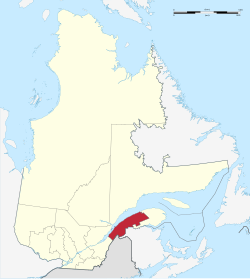
The Bas-Saint-Laurent (French pronunciation: [ba sɛ̃ lɔʁɑ̃], 'Lower Saint-Lawrence) is an administrative region of Quebec located along the south shore of the lower Saint Lawrence River in Quebec. The river widens at this place, later becoming a bay that discharges into the Atlantic Ocean and is often nicknamed "Bas-du-Fleuve" (Lower-River). The region is formed by eight regional county municipalities and 114 municipalities. In the south, it borders the US state of Maine, the Canadian province of New Brunswick and the Quebec administrative regions of Chaudière-Appalaches and Gaspésie–Îles-de-la-Madeleine.
It had a population of 199,039 and a land area of 22,188.19 km2 (8,566.91 sq mi) as of the 2021 census.
The territory has evidence of human occupation since the Pleistocene by successive indigenous peoples. The historic First Nations occupied it all until European colonisation started in the late 17th century; France made land concessions to settlers under the Seigneurial system of New France to encourage colonization. However, development of this region was slow until it started to exploit its mixed forests. Settlement gradually developed further inland, on the littoral, and since the late 20th century a leisure and recreation industry has developed.
Its geography is marked by the Saint Lawrence River to the northwest, the Notre Dame Mountains section of the Appalachians, as well as the Matapédia and Témiscouata valleys, which forms the natural communication corridors with the Gaspé Peninsula, the state of Maine in the United States, and the Maritimes.
The region takes its name from the Saint Lawrence River, a waterway that has a central role in the history of Quebec and forms the northern border of the region. The name of the river, and by extension the region, has a hagiotoponymic origin originating from the baye sainct Laurens named by Jacques Cartier, originating from the date of discovery being 10 August 1535, day of the festival of Saint Lawrence in the Christian martyrology. The name of the bay was used again to describe the river when the Narration, his report of his expedition, was translated to Spanish and Italian, and definitively fixed by its use in the world map of cartographer Gerardus Mercator in 1569, according to historian Marcel Trudel.
The name "Bas-Saint-Laurent", however, only appeared much later. In their Histoire du Bas-Saint-Laurent, the historians Fortin and Lechasseur assert that the relation with the Saint Lawrence grew with the population of the region in the 19th century. The first mention of the name is attributed to a report from the Rimouskois deputy and writer Joseph-Charles Taché, which used the term to describe "the two shores of the Bas-Saint-Laurent except the Gaspé district". The authors, however, write that Taché preferred most of the time to use more precise and well-known references, like the counties of Montmorency and Rimouski. Even if the name of the region was present on a map made in 1863 by Stanislas Drapeau, it took time to settle in; the expression "le Bas du Fleuve" being preferred.
With the settlement of Témiscouata and la Matapédia, the name start imposing itself between 1920 and 1960, when a number of enterprises and organisms of the region delimitated by the Roman Catholic Archdiocese of Rimouski and Rivière-du-Loup, like the Compagnie de transport du Bas St-Laurent and the Compagnie de Pouvoir du Bas-Saint-Laurent or the newspaper l'Écho du Bas St-Laurent adopt it.
After being eclipsed for two decades when the State tried to erase regional differences by putting in place shared administrative structures east of the Quebec, the start of the 1980s sees this policy change, as the great region Bas-Saint-Laurent-Gaspésie is split into two different territories, being more accurate for the distinctive cultural traditions of these regions.
Bas-Saint-Laurent
The Bas-Saint-Laurent (French pronunciation: [ba sɛ̃ lɔʁɑ̃], 'Lower Saint-Lawrence) is an administrative region of Quebec located along the south shore of the lower Saint Lawrence River in Quebec. The river widens at this place, later becoming a bay that discharges into the Atlantic Ocean and is often nicknamed "Bas-du-Fleuve" (Lower-River). The region is formed by eight regional county municipalities and 114 municipalities. In the south, it borders the US state of Maine, the Canadian province of New Brunswick and the Quebec administrative regions of Chaudière-Appalaches and Gaspésie–Îles-de-la-Madeleine.
It had a population of 199,039 and a land area of 22,188.19 km2 (8,566.91 sq mi) as of the 2021 census.
The territory has evidence of human occupation since the Pleistocene by successive indigenous peoples. The historic First Nations occupied it all until European colonisation started in the late 17th century; France made land concessions to settlers under the Seigneurial system of New France to encourage colonization. However, development of this region was slow until it started to exploit its mixed forests. Settlement gradually developed further inland, on the littoral, and since the late 20th century a leisure and recreation industry has developed.
Its geography is marked by the Saint Lawrence River to the northwest, the Notre Dame Mountains section of the Appalachians, as well as the Matapédia and Témiscouata valleys, which forms the natural communication corridors with the Gaspé Peninsula, the state of Maine in the United States, and the Maritimes.
The region takes its name from the Saint Lawrence River, a waterway that has a central role in the history of Quebec and forms the northern border of the region. The name of the river, and by extension the region, has a hagiotoponymic origin originating from the baye sainct Laurens named by Jacques Cartier, originating from the date of discovery being 10 August 1535, day of the festival of Saint Lawrence in the Christian martyrology. The name of the bay was used again to describe the river when the Narration, his report of his expedition, was translated to Spanish and Italian, and definitively fixed by its use in the world map of cartographer Gerardus Mercator in 1569, according to historian Marcel Trudel.
The name "Bas-Saint-Laurent", however, only appeared much later. In their Histoire du Bas-Saint-Laurent, the historians Fortin and Lechasseur assert that the relation with the Saint Lawrence grew with the population of the region in the 19th century. The first mention of the name is attributed to a report from the Rimouskois deputy and writer Joseph-Charles Taché, which used the term to describe "the two shores of the Bas-Saint-Laurent except the Gaspé district". The authors, however, write that Taché preferred most of the time to use more precise and well-known references, like the counties of Montmorency and Rimouski. Even if the name of the region was present on a map made in 1863 by Stanislas Drapeau, it took time to settle in; the expression "le Bas du Fleuve" being preferred.
With the settlement of Témiscouata and la Matapédia, the name start imposing itself between 1920 and 1960, when a number of enterprises and organisms of the region delimitated by the Roman Catholic Archdiocese of Rimouski and Rivière-du-Loup, like the Compagnie de transport du Bas St-Laurent and the Compagnie de Pouvoir du Bas-Saint-Laurent or the newspaper l'Écho du Bas St-Laurent adopt it.
After being eclipsed for two decades when the State tried to erase regional differences by putting in place shared administrative structures east of the Quebec, the start of the 1980s sees this policy change, as the great region Bas-Saint-Laurent-Gaspésie is split into two different territories, being more accurate for the distinctive cultural traditions of these regions.
Recent media
Recent media