



Community hub
Recent from talks
Knowledge base stats:
Talk channels stats:
Members stats:
Baserri
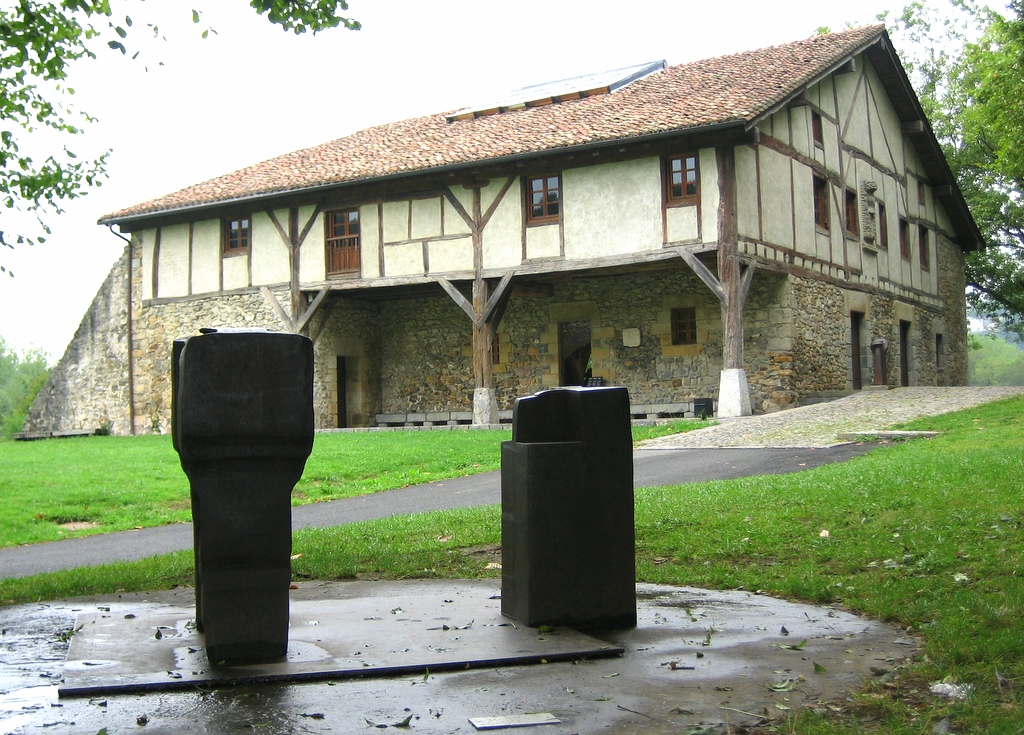
A baserri (Basque pronunciation: [bas̺eri]; Spanish: caserío vasco; French: maison basque) is a traditional half-timbered or stone-built type of housebarn farmhouse found in the Basque Country in northern Spain and Southwestern France. The baserris, with their gently sloping roofs and entrance portals, are highly characteristic of the region and form a vital part in traditional Basque societal structures. They are also seen to have played an important role in protecting the Basque language in periods of persecution by providing the language with a very dispersed but substantial speaker base.
The term baserri is derived from the roots basa "wild" and herri "settlement" and denotes a farmstead not located in a village or town. People who live on a baserri are referred to as baserritarrak (Basque pronunciation: [bas̺eritarak]), a term which contrasts with kaletarrak (Basque pronunciation: [kaletarak]) (street people), i.e., people who live in a town or city.
The present-day term baserri in Basque has a fairly restricted meaning, denoting the building and its occupants, especially in the Gipuzkoan dialect. Originally, however, it denoted the building (still called in some places baserri-etxea 'baserri house'), its dwellers and the whole estate. The originally wide connotation of the term is related to the inherent ambiguity of the Basque word herri which can be translated as "land", "home", "people" or "settlement" depending on the context.
In Spanish, mostly the term caserío vasco is used but note that a caserío may also denote an entire settlement in parts of the Spanish speaking world. In French, the term maison basque is commonly encountered, although this overlaps to some extent with the Basque concept of etxea (the house).
Overall, they are almost non-existent in the flatter terrains of Álava and central and southern Navarre (Ager Vasconum). These areas went through a more thorough period of Romanisation, in which the ancient Roman fundi provided the grounds for the new small population clusters and villages that dotted the whole region at the turn of the first millennium, after Muslim raids stopped. They are often named after an old landowner, e.g. Barbarin, Andoin, Amatrain, etc. In Navarre, parts of Álava and parts of the Northern Basque Country, baserris often form rather spaced out settlements, but virtually never wall-to-wall to minimise fire risks. Baserris in Gipuzkoa and Biscay on the whole are solitary buildings, but generally within view of another baserri.
The predecessor of the baserri was the farming community of the late Middle Ages in the hilly Atlantic area, who at one point had learnt and taken up sowing and harvesting (cf. the legend of San Martin Txiki). The families didn't live in baserri buildings as we know today, but in clusters of small wooden fragile shacks with room enough for the family, the cattle and the stored hay. However, the press house, granaries, pigsty and sheepfolds were located in separate buildings. At this stage, the baserri stands clearly for the whole community behind the economic unit. This period also saw the development of the linguistic counterpart to the baserri for religious matters, the baseliza or "wild church".
During the 14th and 15th century, as the population began to grow, agricultural activity increased and so did the linking of agricultural activities and animal husbandry on a baserri, leading to an increase in the number of baserris. The late 15th and the 16th century are a period of peace among warring nobiliary factions after years of clashes, in which exactions and abuses on farmers had been rife, leading to a time of optimism and stability. The American and Andalusian conquest opened new opportunities, with small fortunes made by Basque venturers, which propelled the construction of baserris, thriving in the hundreds. Maize from the Americas substituted less productive millet, taking its Basque name arto. While private land ownership had been known if not widespread in the southern parts of Álava and Navarre since Roman times, most land further north was still common land in this period. Councils fostered the building activity with tax exemption on tree chopping for baserri construction, which enabled Basque farmers to develop swathes of common land into privately owned baserris. Several of these new baserris were named simply Etxeberria, "the new house".
At this transitional stage, the baserri buildings consisted of timbered structures that are barely reminiscent of dwellings, made up often in oak from the surrounding forests. In fact, the central position in the house was occupied by the press, since cider was a very important economic activity for the family's economy. Then, families started to move in for the initially cider producing mill, cattle stall and granary, eventually complementing or even replacing its original function with the dwelling. A well-known example of this type of baserri is the Igartubeiti baserri (built 1530), now an interactive museum and exhibition space, hosting events related to cider making (e.g. txalaparta) and traditional rural life.
Hub AI
Baserri AI simulator
(@Baserri_simulator)
Baserri
A baserri (Basque pronunciation: [bas̺eri]; Spanish: caserío vasco; French: maison basque) is a traditional half-timbered or stone-built type of housebarn farmhouse found in the Basque Country in northern Spain and Southwestern France. The baserris, with their gently sloping roofs and entrance portals, are highly characteristic of the region and form a vital part in traditional Basque societal structures. They are also seen to have played an important role in protecting the Basque language in periods of persecution by providing the language with a very dispersed but substantial speaker base.
The term baserri is derived from the roots basa "wild" and herri "settlement" and denotes a farmstead not located in a village or town. People who live on a baserri are referred to as baserritarrak (Basque pronunciation: [bas̺eritarak]), a term which contrasts with kaletarrak (Basque pronunciation: [kaletarak]) (street people), i.e., people who live in a town or city.
The present-day term baserri in Basque has a fairly restricted meaning, denoting the building and its occupants, especially in the Gipuzkoan dialect. Originally, however, it denoted the building (still called in some places baserri-etxea 'baserri house'), its dwellers and the whole estate. The originally wide connotation of the term is related to the inherent ambiguity of the Basque word herri which can be translated as "land", "home", "people" or "settlement" depending on the context.
In Spanish, mostly the term caserío vasco is used but note that a caserío may also denote an entire settlement in parts of the Spanish speaking world. In French, the term maison basque is commonly encountered, although this overlaps to some extent with the Basque concept of etxea (the house).
Overall, they are almost non-existent in the flatter terrains of Álava and central and southern Navarre (Ager Vasconum). These areas went through a more thorough period of Romanisation, in which the ancient Roman fundi provided the grounds for the new small population clusters and villages that dotted the whole region at the turn of the first millennium, after Muslim raids stopped. They are often named after an old landowner, e.g. Barbarin, Andoin, Amatrain, etc. In Navarre, parts of Álava and parts of the Northern Basque Country, baserris often form rather spaced out settlements, but virtually never wall-to-wall to minimise fire risks. Baserris in Gipuzkoa and Biscay on the whole are solitary buildings, but generally within view of another baserri.
The predecessor of the baserri was the farming community of the late Middle Ages in the hilly Atlantic area, who at one point had learnt and taken up sowing and harvesting (cf. the legend of San Martin Txiki). The families didn't live in baserri buildings as we know today, but in clusters of small wooden fragile shacks with room enough for the family, the cattle and the stored hay. However, the press house, granaries, pigsty and sheepfolds were located in separate buildings. At this stage, the baserri stands clearly for the whole community behind the economic unit. This period also saw the development of the linguistic counterpart to the baserri for religious matters, the baseliza or "wild church".
During the 14th and 15th century, as the population began to grow, agricultural activity increased and so did the linking of agricultural activities and animal husbandry on a baserri, leading to an increase in the number of baserris. The late 15th and the 16th century are a period of peace among warring nobiliary factions after years of clashes, in which exactions and abuses on farmers had been rife, leading to a time of optimism and stability. The American and Andalusian conquest opened new opportunities, with small fortunes made by Basque venturers, which propelled the construction of baserris, thriving in the hundreds. Maize from the Americas substituted less productive millet, taking its Basque name arto. While private land ownership had been known if not widespread in the southern parts of Álava and Navarre since Roman times, most land further north was still common land in this period. Councils fostered the building activity with tax exemption on tree chopping for baserri construction, which enabled Basque farmers to develop swathes of common land into privately owned baserris. Several of these new baserris were named simply Etxeberria, "the new house".
At this transitional stage, the baserri buildings consisted of timbered structures that are barely reminiscent of dwellings, made up often in oak from the surrounding forests. In fact, the central position in the house was occupied by the press, since cider was a very important economic activity for the family's economy. Then, families started to move in for the initially cider producing mill, cattle stall and granary, eventually complementing or even replacing its original function with the dwelling. A well-known example of this type of baserri is the Igartubeiti baserri (built 1530), now an interactive museum and exhibition space, hosting events related to cider making (e.g. txalaparta) and traditional rural life.