Hubbry Logo
Bates numberingBates numberingMain
Open search
Bates numbering
Community hub
Bates numbering
logo
8 pages, 0 posts
0 subscribers
Be the first to start a discussion here.
Bates numbering
Bates numbering
from Wikipedia
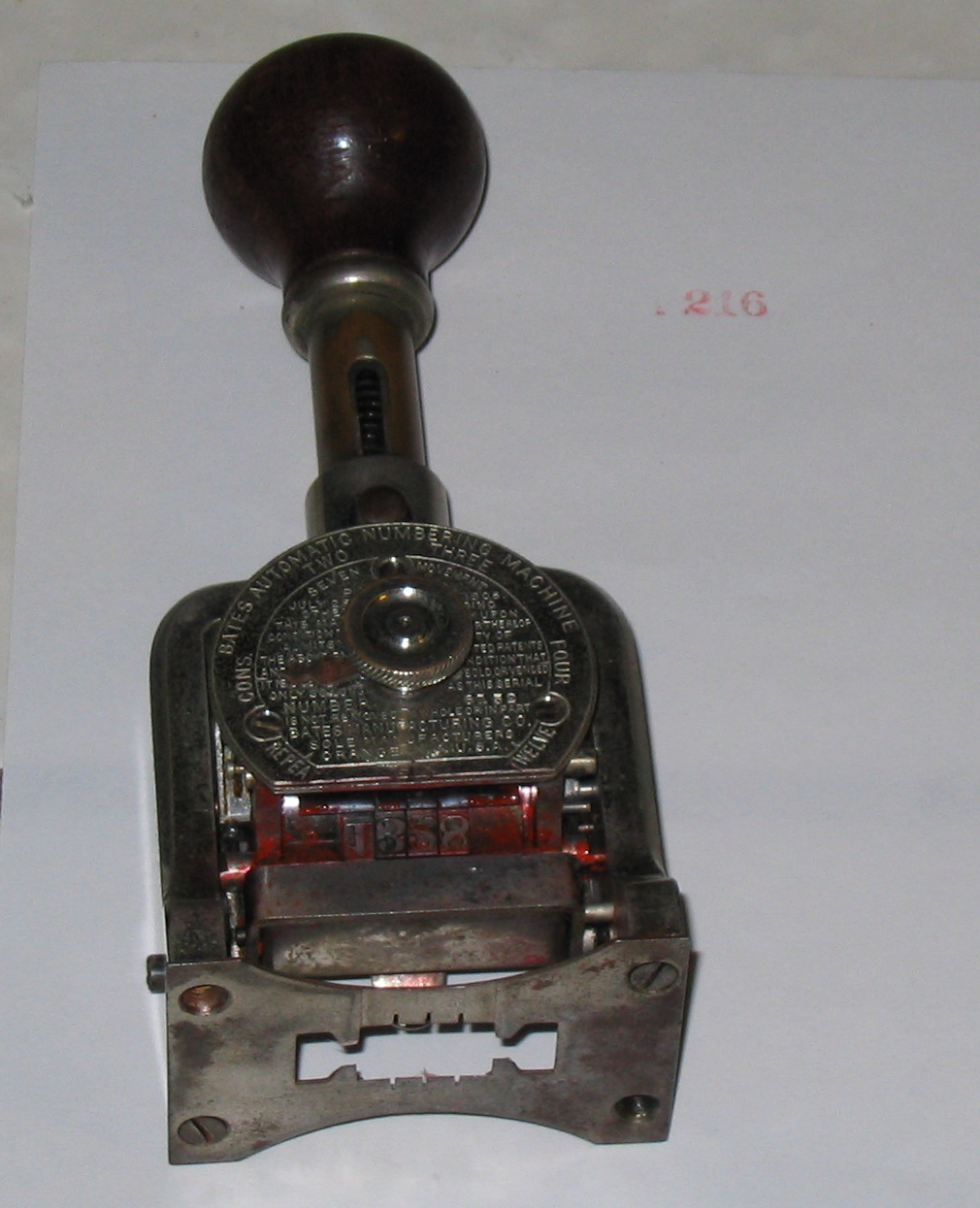
Bates Automatic Numbering-Machine, approx 1906, with a number printed by the machine

Bates numbering (also known as Bates stamping, Bates branding, Bates coding or Bates labeling) is a method of sequentially numbering pages with a reference number. A hand-operated Bates numbering device is used to "stamp" a number on a page, and the numbers will automatically advance after each stamping. Bates numbering is used in the legal, medical, and business fields to place one or more of identifying numbers, date and time marks on images and documents as they are scanned or processed, for example, during the discovery stage of preparations for trial or identifying business receipts. Bates stamping can be used to mark and identify images with copyrights by putting a company name, logo, and/or legal copyright on them. This process provides identification, protection, and automatic consecutive numbering of the pages.

History

[edit]

The Bates Automatic Numbering-Machine or Bates stamper is named after the inventor Edwin Granville Bates of New York City. Office workers used it to stamp consecutive numbers or numbers in a repeated pattern onto pages of documents. The mechanism -- an improvement patented by Edwin G. Bates in 1891 -- automatically changed the number, making quick work for staff.[1] Bates obtained several US patents for the device in the late 1800s and early 1900s,[2] and in 1895 he received a Longstreth award from the Franklin Institute for his invention of a typographic number machine.[3]

The earliest patent claimed a "new and useful improvement in Consecutive-Numbering Machines",[4] indicating that Bates was not the originator of the idea. Bates' objective was "generally to increase the effectiveness, simplicity and compactness of machines of this general character". Each time the machine was pressed down onto a sheet of paper, a rotating wheel was moved incrementally. The original machine described by Bates allowed numbering with a four-digit sequence, ranging from 0000 to 9999. For example, page 852 in a document set would be 0852. Courts and law firms quickly adopted this system.[citation needed]

In later versions, the machine could be set to stamp the number multiple times, i.e., duplicates or triplicates. One drawback was the ink and pad: they could dry, making the numbers illegible.

Operating as Bates Manufacturing Company since its incorporation in 1890,[5] Bates later used the name Bates Machine Company, later renamed to Bates Numbering Machine Company. This company became Roberts Numbering Machine Company.[6][7]

In 1921, Clarence S. A. Williams purchased the company and served as its president until 1958.[5]

In 1993, General Binding Corporation (now General Binding LLC) acquired Bates Manufacturing Company.[8]

Usage

[edit]

Bates numbering is commonly used as an organizational method to label and identify legal documents.[1] Named for the Bates Automatic Numbering-Machine, it assigns an arbitrary unique numeric or alphanumeric identifier to each page, making each page easily identifiable and retrievable. Such identification may be solely numeric or may contain a combination of letters and numbers (alphanumeric). There is no standard method for numbering documents, nor is there a standard type face used for such numbers.

Bates numbers are used in the legal, medical and business fields.[9] Nearly all American law firms use Bates stamps, though the use of manual hand-stamping is becoming increasingly rare because of the rise in electronic numbering, mostly in Portable Document Format (PDF) files rather than printed material. During the discovery phase of litigation, a large number of documents might require the use of unique identifiers for each page of each document for reference and retrieval.

Manual Bates stampers use a self-inking mechanism with four to seven numbered wheels. Some stampers allow for consecutive, repeat, duplicate, and triplicate numbering.

Self-adhesive labels printed with Bates numbers are common today, as is electronic discovery (eDiscovery) software that can electronically "stamp" documents stored as computer files by superimposing numbers onto them.

Bates numbering is neither universally used nor consistently applied; for example, The Bluebook style guide does not reference it. But, consistent with The Bluebook, the first citation should make it very clear what is being referenced, such as (Bates Jones000001) or (Bates d123-002), and subsequent consecutive cites should follow the usual practice of Id. followed by the page number, such as (Id. 000017) or (Id. -017).

See also

[edit]

References

[edit]
[edit]
Revisions and contributorsEdit on WikipediaRead on Wikipedia
from Grokipedia
Bates numbering, also known as Bates stamping, is a systematic method of assigning unique, sequential identifiers to individual pages within a set of documents, enabling precise organization, reference, and retrieval in legal, medical, and business applications. Invented in the late 19th century by Edwin G. Bates to streamline document indexing, the technique originated with a mechanical stamping device that automatically incremented numbers upon each impression. Bates secured several U.S. patents for his invention, including U.S. Patent No. 484,391 in 1892 for a "Consecutive-Numbering Machine," which featured revolving type-wheels to print sequential digits integrated into printing forms, and U.S. Patent No. 489,449 in 1893 for a repeat-numbering mechanism allowing controlled increments. Initially manual and used for physical pages, Bates numbering has evolved into digital formats, where identifiers—often prefixed with case details, dates, or confidentiality markers—are embedded in headers or footers of PDF files and electronic records. In modern legal practice, U.S. federal courts' e-filing systems like CM/ECF use PageID numbering, which functions similarly to Bates numbering by assigning a unique identifier to every page in case records, ensuring no duplicates or gaps and facilitating evidence tracking during litigation. Beyond law, it supports medical record management by labeling patient files sequentially and aids business document production for audit trails and compliance. Best practices include maintaining consistent formats with leading zeros, avoiding alterations to sequences, and incorporating metadata for enhanced traceability.

Overview

Definition

Bates numbering, also known as Bates stamping, is a method of assigning sequential unique identifiers to individual pages within a collection of documents, images, or files to facilitate organization and retrieval. These identifiers typically consist of a prefixed alphanumeric followed by a series of digits, such as "BATES-000001" or "ABC-123456", ensuring each page can be precisely located across large volumes. This system originated with the use of the Bates Automatic Numbering-Machine, a hand-operated mechanical device invented in the late for physically stamping consecutive numbers onto paper documents. Key components of Bates numbering include the core sequential number, which advances automatically, along with optional prefixes, suffixes, dates, or times to provide additional context or categorization. For instance, a stamp might incorporate a date in formats like "YYYY-MM-DD" or a to record when the marking was applied, enhancing in professional settings. In digital implementations, these elements are embedded electronically into PDF files or other formats without altering the original content. Unlike simple pagination, which merely numbers pages within a single document and can be easily duplicated or removed, Bates numbering provides tamper-evident tracking by creating immutable, unique identifiers across entire document sets, making alterations detectable and maintaining chain-of-custody integrity. This distinction is particularly valuable in scenarios requiring verifiable document management, such as legal proceedings.

Purpose and Importance

Bates numbering primarily serves to index documents for easy retrieval by assigning unique, sequential identifiers to each page, enabling quick location within large sets. This system prevents the loss or alteration of pages by providing a verifiable sequence that highlights any missing or tampered elements, thus maintaining document integrity. Additionally, it facilitates precise references in multi-document collections, allowing users to cite specific pages across disparate files without ambiguity. In professional workflows, Bates numbering holds significant importance by enabling accurate citations in reports, audits, and litigation, where referencing exact pages can determine outcomes in high-stakes scenarios. It reduces errors in handling voluminous documents by standardizing identification, which streamlines collaboration among teams and minimizes retrieval time. For instance, in complex cases involving thousands of pages, this method ensures all parties can locate and discuss the same material efficiently. The benefits of Bates numbering extend to enhanced , which promotes in regulated industries such as legal and fields, where maintaining a clear is essential for compliance and defensibility. By creating an from document collection to production, it supports evidentiary requirements and prevents disputes over authenticity. This is particularly vital in environments demanding rigorous record-keeping, like federal appeals or corporate audits. The need for Bates numbering has evolved with the in both and digital volumes in professional settings, transforming from a manual tool for physical files to a digital standard essential for managing terabytes of data in modern eDiscovery processes. As proliferation continues due to electronic communications and records, its role in ensuring accessibility and organization remains indispensable, adapting to technological shifts while preserving core principles of reliability.

History

Invention and Patents

Bates numbering originated with the invention of an automatic consecutive-numbering machine by Edwin Granville Bates, an American inventor and patent attorney based in . Bates developed the device in response to the challenges of manual pagination in legal and office environments, where tracking multi-page documents was labor-intensive and prone to errors. His innovation aimed to streamline document organization by enabling quick, sequential imprinting of numbers directly onto pages. Bates filed the initial for his consecutive-numbering on November 14, 1887, and it was granted as U.S. 484,391 on October 18, 1892. The hand-operated stamper utilized four revolving type-wheels mounted on a spring-supported hub, allowing it to print numbers sequentially from 0000 to 9999. Key mechanisms included internal ratchets for compact advancement, pawls and gearing to rotate the wheels under pressure, adjustable sections for inserting ciphers or blanks, and a retarding device to delay wheel movement and avoid ink blurring. These features made the machine simple, effective, and suitable for integration into standard printing forms. The device also supported printing duplicates or triplicates simultaneously on carbon copies, which was particularly valuable for reproducing numbered sets in legal filings and business records. In 1895, Bates received the Longstreth Medal from the for his typographic numbering machine, recognizing its contributions to office efficiency and document management.

Company Development

The Bates Manufacturing Company was incorporated on September 13, 1890, in New York to manufacture and sell automatic hand-held numbering machines based on the invention of Edwin G. Bates. Initially backed by investors including , who held 50% of the stock, the company focused on producing these devices for office use, with early production tied to partnerships like the Edison Phonograph Works after its acquisition in 1892. By the early , under evolving ownership, the firm developed advanced models such as the Model No. 49, incorporating improved mechanisms for sequential stamping to meet growing demand in professional settings. In 1921, Clarence S. A. Williams acquired the company and served as its president from 1921 to 1958, during which time he oversaw significant expansions and prosperity, including diversification into related office products like staplers. Williams' leadership emphasized quality manufacturing and broad distribution, establishing the Bates numbering system as a standard in legal and business document management through extensive sales across these sectors. His tenure solidified the company's reputation, with production scaling to thousands of units annually to support organized record-keeping practices. Following Williams' era, the company remained family-operated until 1993, when it was acquired by the General Binding Corporation, marking a shift toward integration with larger office supply operations. This acquisition reflected broader industry changes, as the rise of digital technologies in the late reduced reliance on manual stamping machines, leading to a gradual decline in their production.

Methods of Implementation

Traditional Mechanical Stamping

The traditional mechanical stamping process for Bates numbering relied on hand-operated devices that physically imprinted sequential numbers onto individual pages of paper documents, typically positioned in the header or footer for easy reference. Invented by Edwin G. Bates, these machines featured a compact metal frame housing a non-rotary shaft with multiple rotatable number wheels, each carrying inked type characters (often felt-tipped for durability on rough surfaces). To apply a stamp, the operator aligned the document beneath the printing platen, depressed a or to bring the wheels into contact with an pad and then the paper, and released it; a built-in mechanism using a stepped pawl-plate and ratchet system automatically advanced the wheels by one unit after each impression, ensuring sequential progression from the current number. Device variations accommodated different office needs, such as single-impression models for standard originals, which advanced after every stamp, and adjustable configurations for duplicating the same number multiple times—useful for creating carbon copies in pre-photocopy eras—via selectable modes like "duplicate" or "repeat" controlled by push-buttons or levers that temporarily halted wheel advancement. These machines, produced by the , could handle up to four or more digits and were designed for portability, often weighing under a pound for use. The primary advantages of mechanical Bates stamping included its simplicity and reliability, with fewer than earlier numbering tools, enabling consistent, indelible marks that resisted fading or alteration on , thus enhancing document integrity in paper-based workflows. However, limitations were evident in high-volume applications: the process was inherently labor-intensive, requiring manual handling of each page, and susceptible to , such as misalignment or forgotten advancements, which could disrupt sequences; mechanical wear over time also risked jamming or inconsistent inking. Historically, mechanical Bates stamping dominated document management from its invention in the late through the mid-20th century, as enabled by Bates' patents including , US 489,449 (1893), , and , when it became a staple in legal, , and administrative offices reliant on typewriters and for record-keeping.

Digital and Electronic Numbering

In contemporary legal and document management practices, Bates numbering has transitioned to digital methods primarily through PDF software and specialized eDiscovery platforms, enabling efficient application of identifiers without physical stamping. Tools such as Adobe Acrobat Pro allow users to insert Bates numbers as headers, footers, watermarks, or embedded metadata directly into PDF files, supporting sequential labeling across single or multiple documents. These software solutions automatically convert non-PDF files, such as Word documents or images, to PDF format before applying the numbering, ensuring compatibility while preserving document integrity. eDiscovery platforms further enhance this process by offering automated batch processing for large volumes of documents, which is essential for litigation and compliance workflows. Platforms like GoldFynch and Everlaw integrate Bates numbering into their core functionality, allowing for the assignment of unique identifiers to both PDF and native files during data ingestion and production phases. For native files, including emails and scanned documents processed via OCR, these systems typically apply a single Bates number per file while enabling page-level stamping upon conversion to viewable formats like TIFF or PDF. Key features of digital Bates numbering include customizable formats, such as prefixes, suffixes, digit lengths, and increments, often combined with marks like "Privileged" or "Confidential" overlaid on the document. Support for load files—metadata exports in formats like DAT or CSV—facilitates integration with case management systems by embedding Bates ranges alongside other production details. These capabilities extend to handling OCR-scanned documents, where text recognition ensures accurate placement of numbers on image-based pages, and native files like emails (e.g., .MSG or .EML), which receive Bates prefixes for file-level tracking. The typical process begins with selecting files or folders within the software interface, followed by defining the —specifying the starting number, increment (usually 1), prefixes (e.g., "ABC-"), and positioning (e.g., bottom right corner). Users then preview the application, apply the numbers, and export the stamped documents with embedded identifiers preserved in the PDF metadata for searchability. In eDiscovery environments, this culminates in generating production sets with accompanying load files for seamless transfer to opposing parties or archives. Recent advancements include integration with cloud storage services, such as those in GoldFynch's platform, which enable real-time collaboration and scalable processing of documents stored in systems like or AWS without local downloads. further supports dynamic numbering by automating quality checks on Bates applications, verifying consistency across productions, and suggesting optimal schemes based on document volume and type, as seen in tools from Consilio and TC Di. These developments allow handling of diverse non-PDF formats, including emails and images, through automated conversion and metadata tagging, reducing manual intervention in high-volume eDiscovery tasks.

Applications

Bates numbering plays a central role in legal document management, particularly during the discovery phase of litigation, where it serves as a standardized method to organize and identify vast quantities of produced . This sequential labeling system assigns unique identifiers, such as "ABC000001" for the first page of a document set from party ABC, enabling precise referencing in legal briefs, depositions, and trials. By imprinting these numbers on each page, legal teams can efficiently track across production, , and presentation stages, minimizing errors in high-stakes adversarial environments. In the document production process, Bates numbering integrates seamlessly to facilitate compliance with evidentiary standards and privilege assertions. During discovery, producing parties apply Bates stamps to documents, often in TIFF or PDF formats, to denote redactions for attorney-client privilege or work-product while maintaining the of the original record. This practice ensures that specific pages can be cited accurately, such as in motions or cross-examinations, and supports the creation of exhibit lists for filings. For instance, in eDiscovery workflows handling terabytes of , Bates numbering allows reviewers to navigate electronic repositories by range, expediting searches and reducing the risk of oversight in complex cases. Legal requirements under the , specifically , mandate that documents be produced either as kept in the usual course of or organized and labeled to correspond with request categories, with Bates numbering fulfilling the latter obligation to ensure usability. to implement proper Bates labeling can result in disorganized productions deemed non-compliant, potentially leading to court sanctions for spoliation or inadequate disclosure. In the case of Branhaven, LLC v. Beeftek, Inc., 2013 U.S. Dist. LEXIS 917 (D. Md. Jan. 4, 2013), the court ruled that without Bates stamping and formatting, the production was not reasonably usable under , ordering re-production to meet discovery standards. Similarly, courts have emphasized Bates numbering's role in enabling judges to locate specific pages in voluminous filings, as seen in disputes over unindexed ESI productions.

Medical and Business Uses

In healthcare, Bates numbering serves as a critical tool for organizing patient records, imaging files, and research documents, ensuring traceability and compliance with regulations such as the Health Insurance Portability and Accountability Act (HIPAA). By assigning unique sequential identifiers to each page, it creates an that demonstrates secure handling of , reducing errors in retrieval and supporting efficient transitions between departments like general care to specialties. For instance, hospitals integrate Bates numbering into (EHR) systems to label scanned imaging files, such as X-rays or MRI results, and sequential lab reports, which aids by enabling quick access during time-sensitive procedures or diagnostics. In , it organizes consent forms and study reports, facilitating comprehensive file management and regulatory adherence in trials. The benefits extend to streamlined archival processes in healthcare facilities, where Bates-numbered documents minimize misfiling and enhance overall record integrity, ultimately building patient trust through reliable organization. American Retrieval's HIPAA-compliant portal exemplifies this by automatically assigning Bates numbers to pages, improving efficiency in internal document handling. In business environments, Bates numbering supports record-keeping for contracts, audits, and corporate filings, providing a standardized system to manage large volumes of documents with precision. It enables easy tracking of contract revisions during negotiations or , using prefixes like "DOC-0001_v1" to clarify versions and prevent confusion among stakeholders. For audits, sequential numbering allows auditors to reference specific pages swiftly, enhancing in reviewing financial records or compliance reports. During in corporate transactions, it streamlines document organization with project-specific identifiers, such as "ACQ001-0001," ensuring accurate and verifiable access to filings and agreements. These applications promote operational reliability in enterprises, where Bates-numbered archives facilitate long-term storage and retrieval, similar to its role in legal contexts but focused on internal compliance and efficiency.

Standards and Best Practices

Guidelines for Consistent Numbering

To ensure uniformity in Bates numbering, practitioners should adopt a fixed-width format using leading zeros to maintain consistent digit lengths, which facilitates alphabetical sorting and readability. For example, numbers might appear as "000001" rather than "1" to preserve alignment across pages. Placement of these numbers is critical; they should be positioned in visible yet non-obstructive locations, such as the bottom right corner or footer of each page, to avoid interfering with the document's content while remaining accessible during review. Best practices emphasize the use of descriptive prefixes to categorize documents, such as "MED-" for medical records or "CON-" for contracts, which enhances quick identification without compromising the core sequential structure. Numbering must proceed sequentially without gaps to preserve the integrity of the document production, ensuring each page receives a that reflects its order in the set. Additionally, the entire numbering scheme should be documented in production logs, including details on prefixes, digit length, and starting points, to support auditability and reproducibility in legal processes. Standards from organizations like The Sedona Conference provide foundational recommendations for eDiscovery, advocating for discussions on Bates form—including allowances for spaces or special characters—digit requirements, and zero padding to ensure compatibility across parties. While no universal is mandated, consistent fonts should be used for clarity and legibility in both print and digital formats. To prevent errors, protocols should include mechanisms for detecting and resolving duplicates or the need for renumbering, such as automated validation checks during application, and embedding Bates numbers directly into document metadata for enhanced searchability and verification. These measures help maintain the reliability of the numbering system, particularly when using digital tools for large-scale productions.

Variations and Modern Adaptations

Variations in Bates numbering often incorporate alphanumeric elements to enhance identification and context, such as prefixes or suffixes combined with sequential numbers, for example, "CONTRACT0001" or "EMAIL0002". These hybrids may include timestamps or date codes to denote production timing, adapting the system for time-sensitive legal workflows while maintaining sequential integrity. Slip sheets serve as placeholders for multi-file sets or non-document items, providing descriptive metadata like file names or types without altering the original content, particularly useful in productions involving attachments or chained records. Internationally, formats adapt to local conventions, such as incorporating party-specific letters in jurisdictions like or the to identify producers, ensuring compatibility across borders without disrupting core sequencing. Modern adaptations leverage digital technologies to extend Bates numbering beyond traditional documents. In cloud-based platforms, AI-assisted tools automate numbering by analyzing document sets for optimal prefixes, suffixes, and sequences, streamlining eDiscovery processes for large-scale reviews. For immutability, hashing techniques—generating unique cryptographic identifiers like truncated or values (e.g., "162.A35")—function as a "digital Bates stamp," ensuring document integrity akin to blockchain's tamper-evident chains by detecting even minor alterations. In and eDiscovery, adaptations apply to non-document files such as videos or , using slip sheets with Bates identifiers to catalog and reference them without embedding stamps directly into the media. Traditional Bates systems face gaps in handling dynamic content like web pages or , where static numbering struggles with evolving or non-linear formats, prompting reliance on metadata overlays for tracking. Proposals exist for using verifiable hashes or timestamps to authenticate origins in AI-generated content, though Bates numbering remains a standard for sequential reference as of 2025. As of 2025, Bates numbering continues to be essential in AI-driven environments, with digital tools enhancing its application rather than replacing visible stamps, preserving traceability through sequential identifiers. This evolution aligns with guidelines for consistent numbering by prioritizing flexibility in electronic productions.

References

Add your contribution
Related Hubs
User Avatar
No comments yet.