
Recent from talks
Battle of Ap Bac
Knowledge base stats:
Talk channels stats:
Members stats:
Battle of Ap Bac
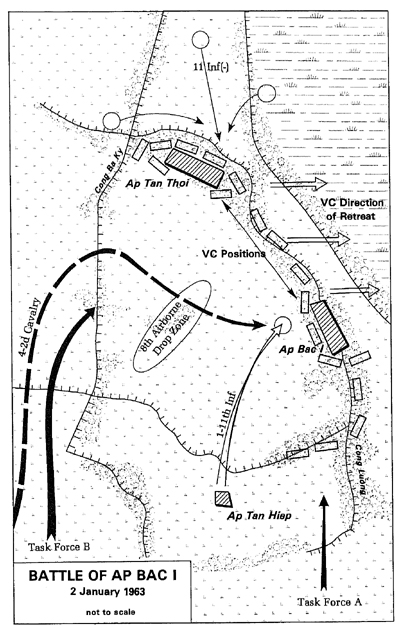
The Battle of Ấp Bắc was a major battle fought on 2 January 1963 during the Vietnam War in Định Tường Province, South Vietnam. On 28 December 1962, US intelligence detected the presence of a radio transmitter along with a sizable force of Viet Cong (VC) soldiers, reported to number around 120, in the hamlet of Ấp Tân Thới in Định Tường Province, home of the Army of the Republic of South Vietnam (ARVN) 7th Infantry Division. The South Vietnamese and their US advisers planned to attack Ấp Tân Thới from three directions to destroy the VC force by using two provincial Civil Guard battalions and elements of the 11th Infantry Regiment, 7th Infantry Division. The infantry units would be supported by artillery, M113 armored personnel carriers (APCs), and helicopters. However, VC forces anticipated a major attack from the South Vietnamese government from a variety of sources including movement of supplies, an undercover VC agent, and decoded radio communications from the ARVN. Accordingly, the VC prepared for an attack by US and South Vietnamese forces.
On the morning of 2 January 1963, the Civil Guards spearheaded the attack by marching toward Ấp Tân Thới from the south. However, when they reached the hamlet of Ấp Bắc, southeast of Ấp Tân Thới, they were immediately pinned down by elements of the VC 261st Battalion. Shortly afterward, three companies of the 11th Infantry Regiment were committed into battle in northern Ấp Tân Thới. However, they too could not overcome the VC soldiers who had entrenched themselves in the area. Just before midday, further reinforcements were flown in from Thân Cửu Nghĩa Airbase in Tân Hiệp. The 15 US helicopters ferrying the troops were riddled by VC gunfire and five helicopters were lost as a result.
The ARVN 4th Mechanized Rifle Squadron was then deployed to rescue the South Vietnamese soldiers and US aircrews trapped at the southwest end of Ấp Bắc. However, its commander was highly reluctant to move heavy M113 APCs across the local terrain. Ultimately, their presence made little difference as the VC stood its ground and killed more than a dozen South Vietnamese M113 crew members in the process. The ARVN 8th Airborne Battalion was dropped late in the afternoon onto the battlefield. In a scene that characterized much of the day's fighting, they were pinned down and could not break the VC's line of defense. Under cover of darkness, the VC withdrew from the battlefield, winning their first major victory.
Small-scale military actions, which would eventually escalate into the Vietnam War, started in the late 1950s, when South Vietnamese President Ngô Đình Diệm instituted an anti-Communist campaign aimed at rooting out "left behind" Việt Minh forces. At that time, North Vietnam was hoping for an election, promised under the Geneva Accords of 1954, that would unite North and South Vietnam. It was also worried about inciting the United States into directly supporting South Vietnam and had recommended avoiding battle at all costs. However, Diem's campaign was too successful to allow them to do nothing, and small-scale actions broke out across the country. North Vietnam remained worried about US involvement and refused military support, forcing the remaining Việt Minh to retreat into inaccessible areas in the forests and mountains. A stalemate of sorts followed as South Vietnamese forces took so long to reach these areas that the guerrilla fighters were able to retreat with little difficulty.
Large-scale American support began during the Kennedy Administration in the early 1960s, with the arrival of large numbers of the US Special Forces to help out in the field. The arrival of helicopters changed the nature of the battle considerably. Helicopters enabled South Vietnamese soldiers to quickly fly to almost any point in the country, leaving little time for a retreat. Throughout 1962, the combined forces were increasingly effective in routing the VC. These tactics, combined with armored personnel carriers, took a heavy toll on various fledgling VC units. The lightly armed VC had no weaponry capable of stopping the armored carriers and inevitably were forced to flee, taking heavy casualties.
The most successful South Vietnamese force had been the 7th Infantry Division, then under the command of Colonel Huỳnh Văn Cao. His US adviser was Lieutenant Colonel John Paul Vann, who directed much of the unit's activity in concert with his planner, Captain Richard Ziegler. They had scored the biggest successes of the military campaigns of 1962, killing along with the paramilitary and Civil Guard and Self Defense Corps, more than 2,000 VC fighters, and leaving thousands of others cut off from supplies.
However, South Vietnamese officers were often reluctant to absorb heavy casualties. On several occasions, Cao's forces were in an excellent position to trap and wipe out whole battalions of VC. However, he would fail to close the trap on one pretext or another and allow the enemy to escape. This behavior initially mystified Vann, who was attempting to build Cao into an aggressive commander. Unknown to Vann, Diem would reprimand or demote any officer who lost too many men, no matter how successful the operation. After a skirmish on a highway that resulted in a small number of South Vietnamese casualties along with several trucks destroyed, Cao was called to Saigon and reprimanded by Diệm. Upon his return, Vann and his group of advisers were forced to end the joint planning sessions that had been so successful earlier, and action essentially wound down in their region. Cao used the excellent military intelligence network they had developed to find areas devoid of VC, and planned operations only in those areas. In many other cases, operations were executed on paper only to report an increasing tempo of operations that did not exist.
In 1962, Diệm decided to split the command of the area in the south around Saigon into two, the former III Corps area being reduced in size to cover the area northeast of Saigon, and the newly created IV Corps taking over the west and southwest. Cao was promoted to general and assumed command of the new IV Corps Tactical Zone, which included the area of operations of his 7th Infantry Division. Command of the 7th was given to Cao's chief of staff, Colonel Bùi Đình Đạm. Dam expressed concerns about his own abilities when the promotion was first presented to him by Diệm. Nevertheless, he took Cao's former position and welcomed Vann's advisers back into the planning effort. Despite the change in leadership, the same problems continued to plague the 7th Infantry Division.
Hub AI
Battle of Ap Bac AI simulator
(@Battle of Ap Bac_simulator)
Battle of Ap Bac
The Battle of Ấp Bắc was a major battle fought on 2 January 1963 during the Vietnam War in Định Tường Province, South Vietnam. On 28 December 1962, US intelligence detected the presence of a radio transmitter along with a sizable force of Viet Cong (VC) soldiers, reported to number around 120, in the hamlet of Ấp Tân Thới in Định Tường Province, home of the Army of the Republic of South Vietnam (ARVN) 7th Infantry Division. The South Vietnamese and their US advisers planned to attack Ấp Tân Thới from three directions to destroy the VC force by using two provincial Civil Guard battalions and elements of the 11th Infantry Regiment, 7th Infantry Division. The infantry units would be supported by artillery, M113 armored personnel carriers (APCs), and helicopters. However, VC forces anticipated a major attack from the South Vietnamese government from a variety of sources including movement of supplies, an undercover VC agent, and decoded radio communications from the ARVN. Accordingly, the VC prepared for an attack by US and South Vietnamese forces.
On the morning of 2 January 1963, the Civil Guards spearheaded the attack by marching toward Ấp Tân Thới from the south. However, when they reached the hamlet of Ấp Bắc, southeast of Ấp Tân Thới, they were immediately pinned down by elements of the VC 261st Battalion. Shortly afterward, three companies of the 11th Infantry Regiment were committed into battle in northern Ấp Tân Thới. However, they too could not overcome the VC soldiers who had entrenched themselves in the area. Just before midday, further reinforcements were flown in from Thân Cửu Nghĩa Airbase in Tân Hiệp. The 15 US helicopters ferrying the troops were riddled by VC gunfire and five helicopters were lost as a result.
The ARVN 4th Mechanized Rifle Squadron was then deployed to rescue the South Vietnamese soldiers and US aircrews trapped at the southwest end of Ấp Bắc. However, its commander was highly reluctant to move heavy M113 APCs across the local terrain. Ultimately, their presence made little difference as the VC stood its ground and killed more than a dozen South Vietnamese M113 crew members in the process. The ARVN 8th Airborne Battalion was dropped late in the afternoon onto the battlefield. In a scene that characterized much of the day's fighting, they were pinned down and could not break the VC's line of defense. Under cover of darkness, the VC withdrew from the battlefield, winning their first major victory.
Small-scale military actions, which would eventually escalate into the Vietnam War, started in the late 1950s, when South Vietnamese President Ngô Đình Diệm instituted an anti-Communist campaign aimed at rooting out "left behind" Việt Minh forces. At that time, North Vietnam was hoping for an election, promised under the Geneva Accords of 1954, that would unite North and South Vietnam. It was also worried about inciting the United States into directly supporting South Vietnam and had recommended avoiding battle at all costs. However, Diem's campaign was too successful to allow them to do nothing, and small-scale actions broke out across the country. North Vietnam remained worried about US involvement and refused military support, forcing the remaining Việt Minh to retreat into inaccessible areas in the forests and mountains. A stalemate of sorts followed as South Vietnamese forces took so long to reach these areas that the guerrilla fighters were able to retreat with little difficulty.
Large-scale American support began during the Kennedy Administration in the early 1960s, with the arrival of large numbers of the US Special Forces to help out in the field. The arrival of helicopters changed the nature of the battle considerably. Helicopters enabled South Vietnamese soldiers to quickly fly to almost any point in the country, leaving little time for a retreat. Throughout 1962, the combined forces were increasingly effective in routing the VC. These tactics, combined with armored personnel carriers, took a heavy toll on various fledgling VC units. The lightly armed VC had no weaponry capable of stopping the armored carriers and inevitably were forced to flee, taking heavy casualties.
The most successful South Vietnamese force had been the 7th Infantry Division, then under the command of Colonel Huỳnh Văn Cao. His US adviser was Lieutenant Colonel John Paul Vann, who directed much of the unit's activity in concert with his planner, Captain Richard Ziegler. They had scored the biggest successes of the military campaigns of 1962, killing along with the paramilitary and Civil Guard and Self Defense Corps, more than 2,000 VC fighters, and leaving thousands of others cut off from supplies.
However, South Vietnamese officers were often reluctant to absorb heavy casualties. On several occasions, Cao's forces were in an excellent position to trap and wipe out whole battalions of VC. However, he would fail to close the trap on one pretext or another and allow the enemy to escape. This behavior initially mystified Vann, who was attempting to build Cao into an aggressive commander. Unknown to Vann, Diem would reprimand or demote any officer who lost too many men, no matter how successful the operation. After a skirmish on a highway that resulted in a small number of South Vietnamese casualties along with several trucks destroyed, Cao was called to Saigon and reprimanded by Diệm. Upon his return, Vann and his group of advisers were forced to end the joint planning sessions that had been so successful earlier, and action essentially wound down in their region. Cao used the excellent military intelligence network they had developed to find areas devoid of VC, and planned operations only in those areas. In many other cases, operations were executed on paper only to report an increasing tempo of operations that did not exist.
In 1962, Diệm decided to split the command of the area in the south around Saigon into two, the former III Corps area being reduced in size to cover the area northeast of Saigon, and the newly created IV Corps taking over the west and southwest. Cao was promoted to general and assumed command of the new IV Corps Tactical Zone, which included the area of operations of his 7th Infantry Division. Command of the 7th was given to Cao's chief of staff, Colonel Bùi Đình Đạm. Dam expressed concerns about his own abilities when the promotion was first presented to him by Diệm. Nevertheless, he took Cao's former position and welcomed Vann's advisers back into the planning effort. Despite the change in leadership, the same problems continued to plague the 7th Infantry Division.
Recent media