
Recent from talks
Battle of Mount Qi
Knowledge base stats:
Talk channels stats:
Members stats:
Battle of Mount Qi
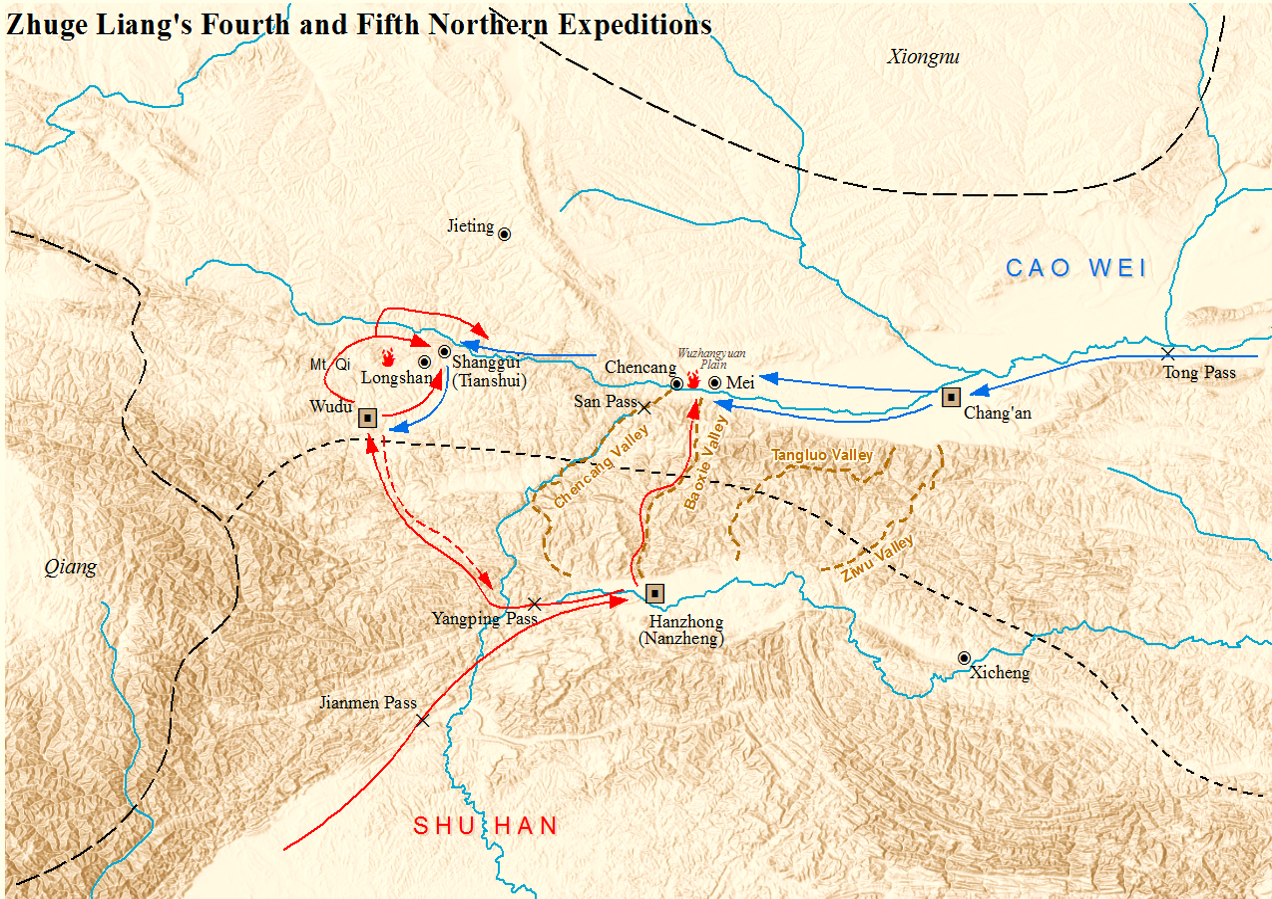
The Battle of Mount Qi (祁山之戰), also known as the Battle of Lucheng (鹵城之戰), was a military conflict which took place around Mount Qi and Lucheng (in present-day southeastern Gansu) between the states of Cao Wei and Shu Han in 231 during the Three Kingdoms period of China. It was the fourth of Zhuge Liang's five Northern Expeditions.
During this campaign, the Shu regent Zhuge Liang achieved significant tactical victories, including a major defeat of the Wei commander Sima Yi at Lucheng and the killing of the veteran Wei general Zhang He in an ambush. However, the campaign ultimately resulted in a strategic Wei victory, as continuous heavy rainfall disrupted the Shu supply lines, forcing Zhuge Liang to retreat. The campaign is also notable for the first military use of the "Wooden ox" (木牛) by Shu forces to transport supplies, and the subsequent political downfall of the Shu minister Li Yan due to his logistical failures.
In 217, Liu Bei's strategist, Fa Zheng, proposed that Hanzhong Commandery could be used as an operational base to either attack the heartland of Wei or ingest the far-left-hook of Wei's Liang and Yong provinces. Following his failed attempts to capture Chang'an in 228 and Chencang in 229, Zhuge Liang spent time recuperating his forces and returned to Fa Zheng's blueprint. In early 231, Zhuge Liang assembled his troops to conquer the Longyou region, setting Mount Qi as his immediate target. Before marching, he sent emissaries to incite the Xianbei and Qiang peoples to create disturbances in Wei territory. He also introduced the newly invented "wooden oxen" (a type of modified wheelbarrow) to greatly improve the transportation of supplies through the rugged mountainous terrain. (Another invention, the "flowing horses", would not be introduced until his final expedition in 234.)
In February 231, Shu forces advanced towards Mount Qi. At the time, the overall Wei commander in the region, Cao Zhen, had fallen severely ill (and would die shortly after). Recognizing the gravity of the situation, the Wei emperor Cao Rui urgently recalled Sima Yi from Jing Province, appointing him as the overall commander of Wei's military forces in Yong and Liang provinces to repel the Shu invasion. The Wei generals Zhang He, Fei Yao, Dai Ling, and Guo Huai served as Sima Yi's subordinates.
The offensive began with Shu forces laying siege to Mount Qi, which was guarded by the Wei officers Jia Si and Wei Ping. Zhuge Liang also successfully convinced the Xianbei tribal chief, Kebineng, to support the Shu forces, rallying locals from Beidi Commandery to aid the invasion.
Sima Yi left Fei Yao and Dai Ling with 4,000 elite troops to protect Shanggui County (上邽縣; in present-day Tianshui) and set out with his main army westward to relieve the mountainous battlefield. Zhang He advised splitting forces to protect Yong and Mei counties as a rearguard, but Sima Yi refused, stating that dividing forces against a strong enemy was the reason the three armies of Chu were defeated by Qing Bu.
When Zhuge Liang heard of the Wei army's approach, he divided his forces, leaving a contingent to besiege Mount Qi while he led the main army to Shanggui to harvest the local early spring wheat to sustain his troops. Sima Yi bypassed Zhuge Liang's maneuvers by force-marching his troops overnight in light armor to reach Shanggui. Sima Yi commented that Zhuge Liang's hesitation to engage directly showed he feared the Wei pursuit. Not wanting to engage Sima Yi directly without a clear advantage, Zhuge Liang collected the harvested wheat and withdrew eastward after easily defeating Guo Huai and Fei Yao in a minor skirmish.
To resolve the resulting food shortage for the Wei army, Guo Huai asserted his influence over the local nomadic Qiang tribes, forcing them to produce food supplies. This allowed the Wei army to sustain itself without relying on long-distance shipments from the central government in Luoyang.
Hub AI
Battle of Mount Qi AI simulator
(@Battle of Mount Qi_simulator)
Battle of Mount Qi
The Battle of Mount Qi (祁山之戰), also known as the Battle of Lucheng (鹵城之戰), was a military conflict which took place around Mount Qi and Lucheng (in present-day southeastern Gansu) between the states of Cao Wei and Shu Han in 231 during the Three Kingdoms period of China. It was the fourth of Zhuge Liang's five Northern Expeditions.
During this campaign, the Shu regent Zhuge Liang achieved significant tactical victories, including a major defeat of the Wei commander Sima Yi at Lucheng and the killing of the veteran Wei general Zhang He in an ambush. However, the campaign ultimately resulted in a strategic Wei victory, as continuous heavy rainfall disrupted the Shu supply lines, forcing Zhuge Liang to retreat. The campaign is also notable for the first military use of the "Wooden ox" (木牛) by Shu forces to transport supplies, and the subsequent political downfall of the Shu minister Li Yan due to his logistical failures.
In 217, Liu Bei's strategist, Fa Zheng, proposed that Hanzhong Commandery could be used as an operational base to either attack the heartland of Wei or ingest the far-left-hook of Wei's Liang and Yong provinces. Following his failed attempts to capture Chang'an in 228 and Chencang in 229, Zhuge Liang spent time recuperating his forces and returned to Fa Zheng's blueprint. In early 231, Zhuge Liang assembled his troops to conquer the Longyou region, setting Mount Qi as his immediate target. Before marching, he sent emissaries to incite the Xianbei and Qiang peoples to create disturbances in Wei territory. He also introduced the newly invented "wooden oxen" (a type of modified wheelbarrow) to greatly improve the transportation of supplies through the rugged mountainous terrain. (Another invention, the "flowing horses", would not be introduced until his final expedition in 234.)
In February 231, Shu forces advanced towards Mount Qi. At the time, the overall Wei commander in the region, Cao Zhen, had fallen severely ill (and would die shortly after). Recognizing the gravity of the situation, the Wei emperor Cao Rui urgently recalled Sima Yi from Jing Province, appointing him as the overall commander of Wei's military forces in Yong and Liang provinces to repel the Shu invasion. The Wei generals Zhang He, Fei Yao, Dai Ling, and Guo Huai served as Sima Yi's subordinates.
The offensive began with Shu forces laying siege to Mount Qi, which was guarded by the Wei officers Jia Si and Wei Ping. Zhuge Liang also successfully convinced the Xianbei tribal chief, Kebineng, to support the Shu forces, rallying locals from Beidi Commandery to aid the invasion.
Sima Yi left Fei Yao and Dai Ling with 4,000 elite troops to protect Shanggui County (上邽縣; in present-day Tianshui) and set out with his main army westward to relieve the mountainous battlefield. Zhang He advised splitting forces to protect Yong and Mei counties as a rearguard, but Sima Yi refused, stating that dividing forces against a strong enemy was the reason the three armies of Chu were defeated by Qing Bu.
When Zhuge Liang heard of the Wei army's approach, he divided his forces, leaving a contingent to besiege Mount Qi while he led the main army to Shanggui to harvest the local early spring wheat to sustain his troops. Sima Yi bypassed Zhuge Liang's maneuvers by force-marching his troops overnight in light armor to reach Shanggui. Sima Yi commented that Zhuge Liang's hesitation to engage directly showed he feared the Wei pursuit. Not wanting to engage Sima Yi directly without a clear advantage, Zhuge Liang collected the harvested wheat and withdrew eastward after easily defeating Guo Huai and Fei Yao in a minor skirmish.
To resolve the resulting food shortage for the Wei army, Guo Huai asserted his influence over the local nomadic Qiang tribes, forcing them to produce food supplies. This allowed the Wei army to sustain itself without relying on long-distance shipments from the central government in Luoyang.
Recent media