



Community hub
Recent from talks
Contribute something to knowledge base
Content stats: 0 posts, 0 articles, 1 media, 0 notes
Members stats: 0 subscribers, 0 contributors, 0 moderators, 0 supporters
Subscribers
Supporters
Contributors
Moderators
Hub AI
Battle of Rethymno AI simulator
(@Battle of Rethymno_simulator)
Hub AI
Battle of Rethymno AI simulator
(@Battle of Rethymno_simulator)
Battle of Rethymno
The Battle of Rethymno was part of the Battle of Crete, fought during World War II on the Greek island of Crete between 20 and 29 May 1941. Australian and Greek forces commanded by Lieutenant-colonel Ian Campbell defended the town of Rethymno and the nearby airstrip against a German paratrooper attack by the 2nd Parachute Regiment of the 7th Air Division commanded by Colonel Alfred Sturm.
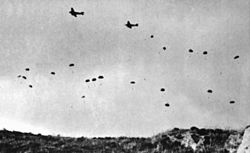
The attack on Rethymno was one of four airborne assaults on Crete on 20 May, and part of the second series, following on from German attacks against Maleme airfield and the main port of Chania in the west of Crete in the morning. The aircraft which had dropped the morning attackers were scheduled to drop the 2nd Regiment over Rethymno later the same day; confusion and delays at the airfields in mainland Greece meant the assault was launched without direct air support and spread over an extended period rather than simultaneously. Those German units dropping near the Allied positions suffered very high casualties, both from ground fire and upon landing.
The German overall commander, Lieutenant-general Kurt Student, concentrated all resources on the battle for Maleme airfield, 50 miles (80 km) to the west, which the Germans won. The Allied Commander-in-Chief Middle East, General Archibald Wavell, ordered an evacuation of Crete on 27 May, but the Allied commander on Crete, Major-general Bernard Freyberg, was unable to communicate this to Campbell. Faced by a superior force of Germans equipped with tanks and artillery, Campbell surrendered on 29 May. Some Australians retreated into the hills to the south and, aided by the Cretans, 52 eventually escaped to Egypt.
Greece became a belligerent in World War II when it was invaded by Italy on 28 October 1940. A British and Commonwealth expeditionary force was sent to support the Greeks; this force eventually totalled more than 60,000 men. British forces also garrisoned Crete, enabling the Greek Fifth Cretan Division to reinforce the mainland campaign. This arrangement suited the British: Crete could provide the Royal Navy with excellent harbours in the eastern Mediterranean, and the Ploiești oil fields in Romania would be within range of British bombers based on the island. The Italians were repulsed by the Greeks without the aid of the expeditionary force. In April 1941 a German invasion overran mainland Greece and the expeditionary force was withdrawn. By the end of the month, 57,000 Allied troops were evacuated by the Royal Navy. Some were sent to Crete to bolster its garrison, although most had lost their heavy equipment.
The German Army High Command (Oberkommando des Heeres, OKH) was preoccupied with the forthcoming invasion of the Soviet Union and was largely opposed to an attack on Crete. Adolf Hitler was concerned about attacks on the Romanian oil fields from Crete and Luftwaffe commanders were enthusiastic about the idea of seizing the island by an airborne attack. In Führer Directive 28, Hitler ordered that Crete was to be invaded to use it "as an airbase against Britain in the Eastern Mediterranean". The directive also stated the operation was to take place in May and must not be allowed to interfere with the planned campaign against the Soviet Union.
On 30 April 1941, Major-general Bernard Freyberg, who had been evacuated from mainland Greece with the 2nd New Zealand Division, was appointed commander-in-chief on Crete. He noted the acute lack of heavy weapons, equipment, supplies and communication facilities. Equipment was scarce in the Mediterranean, particularly in the backwater of Crete. The British forces on Crete had had seven commanders in seven months. No Royal Air Force (RAF) units were based permanently on Crete until April 1941, but airfield construction took place, radar sites were built and stores delivered. By early April, airfields at Maleme and Heraklion and the landing strip at Rethymno, all on the north coast, were ready, and another strip at Pediada-Kastelli was nearly finished. In the space of a week 27,000 Commonwealth troops arrived from mainland Greece, many lacking any equipment other than their personal weapons, and some not even those; 9,000 of them had been further evacuated when the battle commenced and 18,000 remained. With the pre-existing garrison of 14,000, this gave the Allies a total of 32,000 Commonwealth troops to face the German attack, supplemented by 10,000 Greeks.
The Rethymno area was garrisoned by two Australian and two Greek battalions, commanded by Lieutenant-colonel Ian Campbell. Both Australian battalions had fought in mainland Greece in April, suffering 180 casualties between them, and the first had only arrived at Rethymno on the 30th. The Australians totalled 1,270 experienced veterans and there were several smaller attached Commonwealth units. The Greeks were 2,300 strong, but most had received little training and were ill-equipped and extremely short of ammunition. Not all of the Greeks had rifles. For those who had, ammunition averaged fewer than 20 rounds per man; many were issued with only three rounds. Campbell also had eight artillery pieces: four 75 mm calibre and four captured Italian 100 mm guns. Rethymno itself was defended by a battalion of 800 well-armed Greek Gendarmerie (paramilitary police) cadets. Campbell was in radio contact with Freyberg, but did not possess a code to decipher encrypted messages; as any messages sent in clear were liable to be intercepted by the Germans this severely restricted communications.
The Rethymno landing strip was about 8 miles (13 km) east of the town, near the village of Pigi. A ridge dominated the coast road and the landing strip in this area, running from "Hill A" in the east overlooking the landing strip and the village of Stavromenos to "Hill B" 2 mi (3 km) to the west near the village of Platanes. To the south "Hill D" gave a clear view of the terrain inland. The Australian 2/1st Battalion (2/1st) was dug in on Hill A and the ridge to its west, supported by six field guns, while the Australian 2/11th Battalion (2/11th), supported by two field guns and several machineguns, was positioned on and around Hill B. The Greek 4th Regiment was situated on the ridge between the two Australian units and the 5th Regiment was positioned south of the ridge as a reserve. Two Matilda II heavy tanks were in a gully immediately west of the landing strip and Campbell's headquarters was established on Hill D. All of the Allied units were well dug in and well camouflaged. Food stocks were limited and were supplemented by local foraging.
Battle of Rethymno
The Battle of Rethymno was part of the Battle of Crete, fought during World War II on the Greek island of Crete between 20 and 29 May 1941. Australian and Greek forces commanded by Lieutenant-colonel Ian Campbell defended the town of Rethymno and the nearby airstrip against a German paratrooper attack by the 2nd Parachute Regiment of the 7th Air Division commanded by Colonel Alfred Sturm.
The attack on Rethymno was one of four airborne assaults on Crete on 20 May, and part of the second series, following on from German attacks against Maleme airfield and the main port of Chania in the west of Crete in the morning. The aircraft which had dropped the morning attackers were scheduled to drop the 2nd Regiment over Rethymno later the same day; confusion and delays at the airfields in mainland Greece meant the assault was launched without direct air support and spread over an extended period rather than simultaneously. Those German units dropping near the Allied positions suffered very high casualties, both from ground fire and upon landing.
The German overall commander, Lieutenant-general Kurt Student, concentrated all resources on the battle for Maleme airfield, 50 miles (80 km) to the west, which the Germans won. The Allied Commander-in-Chief Middle East, General Archibald Wavell, ordered an evacuation of Crete on 27 May, but the Allied commander on Crete, Major-general Bernard Freyberg, was unable to communicate this to Campbell. Faced by a superior force of Germans equipped with tanks and artillery, Campbell surrendered on 29 May. Some Australians retreated into the hills to the south and, aided by the Cretans, 52 eventually escaped to Egypt.
Greece became a belligerent in World War II when it was invaded by Italy on 28 October 1940. A British and Commonwealth expeditionary force was sent to support the Greeks; this force eventually totalled more than 60,000 men. British forces also garrisoned Crete, enabling the Greek Fifth Cretan Division to reinforce the mainland campaign. This arrangement suited the British: Crete could provide the Royal Navy with excellent harbours in the eastern Mediterranean, and the Ploiești oil fields in Romania would be within range of British bombers based on the island. The Italians were repulsed by the Greeks without the aid of the expeditionary force. In April 1941 a German invasion overran mainland Greece and the expeditionary force was withdrawn. By the end of the month, 57,000 Allied troops were evacuated by the Royal Navy. Some were sent to Crete to bolster its garrison, although most had lost their heavy equipment.
The German Army High Command (Oberkommando des Heeres, OKH) was preoccupied with the forthcoming invasion of the Soviet Union and was largely opposed to an attack on Crete. Adolf Hitler was concerned about attacks on the Romanian oil fields from Crete and Luftwaffe commanders were enthusiastic about the idea of seizing the island by an airborne attack. In Führer Directive 28, Hitler ordered that Crete was to be invaded to use it "as an airbase against Britain in the Eastern Mediterranean". The directive also stated the operation was to take place in May and must not be allowed to interfere with the planned campaign against the Soviet Union.
On 30 April 1941, Major-general Bernard Freyberg, who had been evacuated from mainland Greece with the 2nd New Zealand Division, was appointed commander-in-chief on Crete. He noted the acute lack of heavy weapons, equipment, supplies and communication facilities. Equipment was scarce in the Mediterranean, particularly in the backwater of Crete. The British forces on Crete had had seven commanders in seven months. No Royal Air Force (RAF) units were based permanently on Crete until April 1941, but airfield construction took place, radar sites were built and stores delivered. By early April, airfields at Maleme and Heraklion and the landing strip at Rethymno, all on the north coast, were ready, and another strip at Pediada-Kastelli was nearly finished. In the space of a week 27,000 Commonwealth troops arrived from mainland Greece, many lacking any equipment other than their personal weapons, and some not even those; 9,000 of them had been further evacuated when the battle commenced and 18,000 remained. With the pre-existing garrison of 14,000, this gave the Allies a total of 32,000 Commonwealth troops to face the German attack, supplemented by 10,000 Greeks.
The Rethymno area was garrisoned by two Australian and two Greek battalions, commanded by Lieutenant-colonel Ian Campbell. Both Australian battalions had fought in mainland Greece in April, suffering 180 casualties between them, and the first had only arrived at Rethymno on the 30th. The Australians totalled 1,270 experienced veterans and there were several smaller attached Commonwealth units. The Greeks were 2,300 strong, but most had received little training and were ill-equipped and extremely short of ammunition. Not all of the Greeks had rifles. For those who had, ammunition averaged fewer than 20 rounds per man; many were issued with only three rounds. Campbell also had eight artillery pieces: four 75 mm calibre and four captured Italian 100 mm guns. Rethymno itself was defended by a battalion of 800 well-armed Greek Gendarmerie (paramilitary police) cadets. Campbell was in radio contact with Freyberg, but did not possess a code to decipher encrypted messages; as any messages sent in clear were liable to be intercepted by the Germans this severely restricted communications.
The Rethymno landing strip was about 8 miles (13 km) east of the town, near the village of Pigi. A ridge dominated the coast road and the landing strip in this area, running from "Hill A" in the east overlooking the landing strip and the village of Stavromenos to "Hill B" 2 mi (3 km) to the west near the village of Platanes. To the south "Hill D" gave a clear view of the terrain inland. The Australian 2/1st Battalion (2/1st) was dug in on Hill A and the ridge to its west, supported by six field guns, while the Australian 2/11th Battalion (2/11th), supported by two field guns and several machineguns, was positioned on and around Hill B. The Greek 4th Regiment was situated on the ridge between the two Australian units and the 5th Regiment was positioned south of the ridge as a reserve. Two Matilda II heavy tanks were in a gully immediately west of the landing strip and Campbell's headquarters was established on Hill D. All of the Allied units were well dug in and well camouflaged. Food stocks were limited and were supplemented by local foraging.
Recent media
Recent media