
Recent from talks
Battle of Sluys
Knowledge base stats:
Talk channels stats:
Members stats:
Battle of Sluys
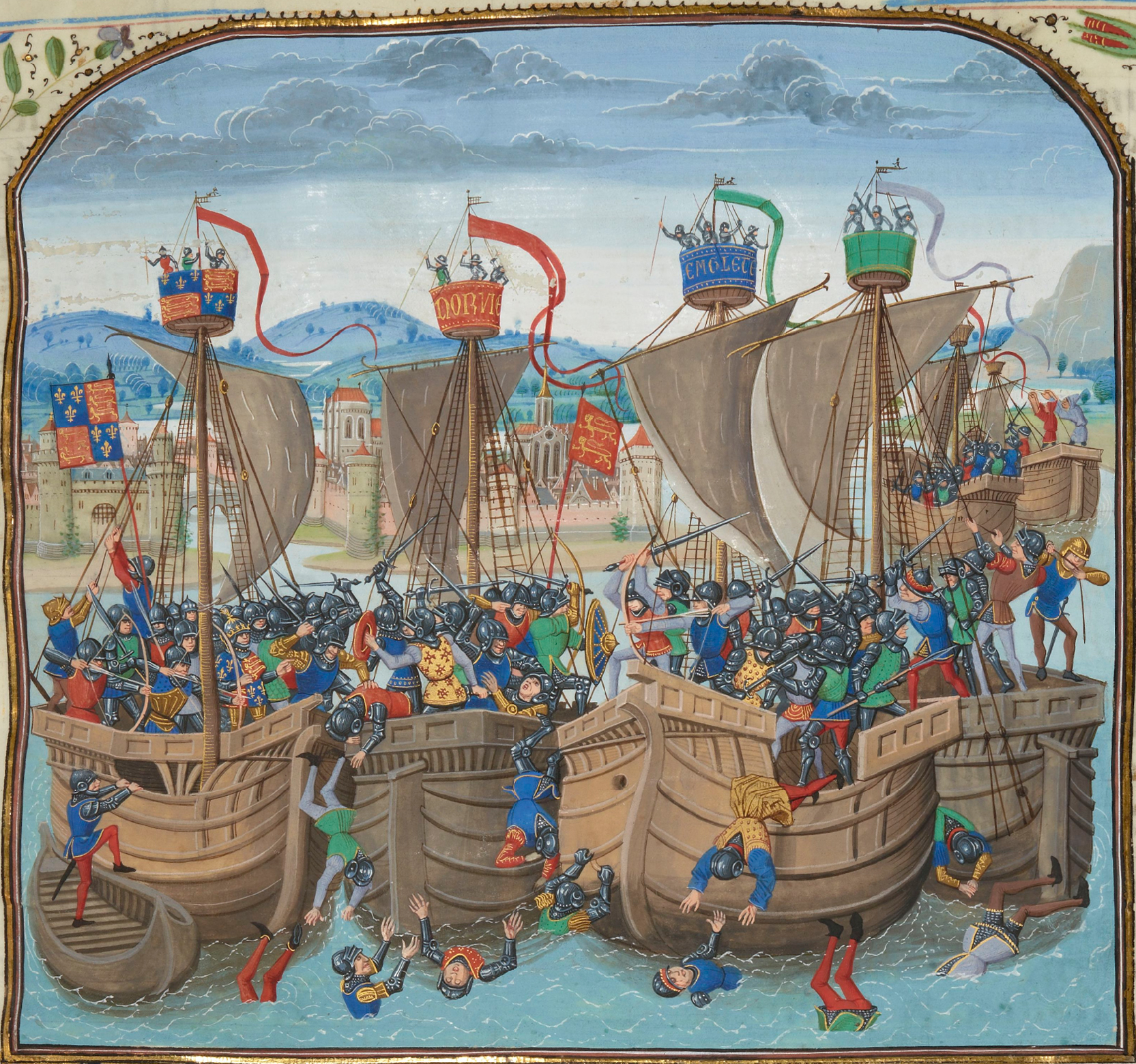
The Battle of Sluys (/slɔɪz/ SLOYZ, Dutch: [slœys]), also called the Battle of l'Écluse, was a naval battle fought on 24 June 1340 between England and France. It took place in the roadstead of the port of Sluys (French Écluse), on a since silted-up inlet between Zeeland and West Flanders. The English fleet of 120–150 ships was led by Edward III of England and the 230-strong French fleet by the Breton knight Hugues Quiéret, Admiral of France, and Nicolas Béhuchet, Constable of France. The battle was one of the opening engagements of the Hundred Years' War.
Edward sailed from the River Orwell on 22 June and encountered the French blocking his way to Sluys harbour. The French had bound their ships into three lines, forming large floating fighting platforms. The English fleet spent some time manoeuvring to gain the advantage of wind and tide. During this delay the French ships were driven to the east of their starting positions and became entangled with each other. Béhuchet and Quiéret ordered the ships to be separated and the fleet attempted to move back to the west, against the wind and the tide. While the French were in this disorganised state, the English attacked.
The English were able to manoeuvre against the French and defeat them in detail, capturing most of their ships. The French lost 16,000–20,000 men. The battle gave the English fleet naval supremacy in the English Channel. However, they were unable to take strategic advantage of this, and their success barely interrupted French raids on English territories and shipping. Operationally, the battle allowed the English army to land and to then besiege the French town of Tournai, albeit unsuccessfully.
Since the Norman Conquest of 1066, English monarchs had held titles and lands within France, the possession of which made them vassals of the kings of France. French monarchs systematically sought to check the growth of English power, stripping away lands as the opportunity arose. Over the centuries, English holdings in France had varied in size, but by 1337 only Gascony in south-western France and Ponthieu in northern France were left. The independent-minded Gascons had their own customs and their own language. A large proportion of the red wine they produced was shipped to England in a profitable trade. The tax raised from this trade provided the English king with much of his revenue. The Gascons preferred their relationship with a distant English king, who left them alone, to one with a French king, who would interfere in their affairs. Following a series of disagreements between Philip VI of France (r. 1328–1350) and Edward III of England (r. 1327–1377), on 24 May 1337 Philip's Great Council in Paris agreed that the Duchy of Aquitaine, effectively Gascony, should be taken back into Philip's hands on the grounds that Edward was in breach of his obligations as a vassal. This marked the start of the Hundred Years' War, which was to last 116 years.
At the beginning of the war the French had the advantage at sea. Galleys had long been used by the Mediterranean powers and the French adopted them for use in the English Channel. Being shallow-draught vessels propelled by banks of oars the galleys could penetrate shallow harbours and were highly manoeuvrable, making them effective for raiding and ship-to-ship combat in meeting engagements. The French galleys were supplemented by galleys hired from Genoa and Monaco. The French were able to disrupt English commercial shipping, principally the Gascon wine and the Flanders wool trades, as well as raiding the south and east coasts of England at will. Operating the galleys was a specialist activity and called for highly trained crews, who were normally also drawn from Genoa, Monaco, and, to a lesser extent, other Mediterranean ports.
The English did not have a purpose-built navy; Edward owned only three warships. The king relied on requisitioning cogs, the merchant vessels of English traders. Cogs had a deep draught, a round hull and were propelled by a single large sail set on a mast amidships. They were converted into warships by the addition of wooden "castles" at the bow and stern and the erection of crow's nest platforms at the masthead. The cogs had a displacement of 200–300 long tons (203–305 t) and were able to carry many fighting men. Their high freeboard made them superior to the oared vessels in close combat, particularly when they were fitted with castles from which arrows or bolts could be fired or stones dropped on to enemy craft alongside. By English common law, the crown was required to compensate the owners of ships impressed into service, but in practice, the king paid little and late, which caused shipowners to be reluctant to answer summonses to arms.
In March 1338 the English town of Portsmouth was captured and razed by French galleys. Five English ships carrying wool were captured off Walcheren in September after a fierce fight known as the Battle of Arnemuiden. The lost ships included two of Edward's three warships: the Christopher and the "great cog" Cog Edward. In October the major port of Southampton was captured and burnt down. The following year it was the turn of Hastings.
In 1339, there had been discontent among the Genoese mercenaries hired by the French, whose commander had not been passing on their pay. Believing the fault lay with their French paymasters, a deputation sought an audience with the French king in August. The deputation was jailed, causing the Genoese crews to mutiny and return to the Mediterranean. When the mutinous sailors arrived back in Genoa, they led an uprising that overthrew the ruling patricians. The new regime was disinclined to enter into new contracts with the French. When several ship captains were persuaded to do so, they were bribed by English agents to renege. In January 1340 the English successfully raided the port of Boulogne, where the majority of the French galley fleet was drawn up on the harbour beach and was inadequately guarded. Taking advantage of mist, the English surprised the French and destroyed 18 galleys, 24 other ships, large stocks of naval equipment, and much of the harbour district before being driven off. The French were left with only 6 galleys, which they supplemented with 22 oared barges.
Hub AI
Battle of Sluys AI simulator
(@Battle of Sluys_simulator)
Battle of Sluys
The Battle of Sluys (/slɔɪz/ SLOYZ, Dutch: [slœys]), also called the Battle of l'Écluse, was a naval battle fought on 24 June 1340 between England and France. It took place in the roadstead of the port of Sluys (French Écluse), on a since silted-up inlet between Zeeland and West Flanders. The English fleet of 120–150 ships was led by Edward III of England and the 230-strong French fleet by the Breton knight Hugues Quiéret, Admiral of France, and Nicolas Béhuchet, Constable of France. The battle was one of the opening engagements of the Hundred Years' War.
Edward sailed from the River Orwell on 22 June and encountered the French blocking his way to Sluys harbour. The French had bound their ships into three lines, forming large floating fighting platforms. The English fleet spent some time manoeuvring to gain the advantage of wind and tide. During this delay the French ships were driven to the east of their starting positions and became entangled with each other. Béhuchet and Quiéret ordered the ships to be separated and the fleet attempted to move back to the west, against the wind and the tide. While the French were in this disorganised state, the English attacked.
The English were able to manoeuvre against the French and defeat them in detail, capturing most of their ships. The French lost 16,000–20,000 men. The battle gave the English fleet naval supremacy in the English Channel. However, they were unable to take strategic advantage of this, and their success barely interrupted French raids on English territories and shipping. Operationally, the battle allowed the English army to land and to then besiege the French town of Tournai, albeit unsuccessfully.
Since the Norman Conquest of 1066, English monarchs had held titles and lands within France, the possession of which made them vassals of the kings of France. French monarchs systematically sought to check the growth of English power, stripping away lands as the opportunity arose. Over the centuries, English holdings in France had varied in size, but by 1337 only Gascony in south-western France and Ponthieu in northern France were left. The independent-minded Gascons had their own customs and their own language. A large proportion of the red wine they produced was shipped to England in a profitable trade. The tax raised from this trade provided the English king with much of his revenue. The Gascons preferred their relationship with a distant English king, who left them alone, to one with a French king, who would interfere in their affairs. Following a series of disagreements between Philip VI of France (r. 1328–1350) and Edward III of England (r. 1327–1377), on 24 May 1337 Philip's Great Council in Paris agreed that the Duchy of Aquitaine, effectively Gascony, should be taken back into Philip's hands on the grounds that Edward was in breach of his obligations as a vassal. This marked the start of the Hundred Years' War, which was to last 116 years.
At the beginning of the war the French had the advantage at sea. Galleys had long been used by the Mediterranean powers and the French adopted them for use in the English Channel. Being shallow-draught vessels propelled by banks of oars the galleys could penetrate shallow harbours and were highly manoeuvrable, making them effective for raiding and ship-to-ship combat in meeting engagements. The French galleys were supplemented by galleys hired from Genoa and Monaco. The French were able to disrupt English commercial shipping, principally the Gascon wine and the Flanders wool trades, as well as raiding the south and east coasts of England at will. Operating the galleys was a specialist activity and called for highly trained crews, who were normally also drawn from Genoa, Monaco, and, to a lesser extent, other Mediterranean ports.
The English did not have a purpose-built navy; Edward owned only three warships. The king relied on requisitioning cogs, the merchant vessels of English traders. Cogs had a deep draught, a round hull and were propelled by a single large sail set on a mast amidships. They were converted into warships by the addition of wooden "castles" at the bow and stern and the erection of crow's nest platforms at the masthead. The cogs had a displacement of 200–300 long tons (203–305 t) and were able to carry many fighting men. Their high freeboard made them superior to the oared vessels in close combat, particularly when they were fitted with castles from which arrows or bolts could be fired or stones dropped on to enemy craft alongside. By English common law, the crown was required to compensate the owners of ships impressed into service, but in practice, the king paid little and late, which caused shipowners to be reluctant to answer summonses to arms.
In March 1338 the English town of Portsmouth was captured and razed by French galleys. Five English ships carrying wool were captured off Walcheren in September after a fierce fight known as the Battle of Arnemuiden. The lost ships included two of Edward's three warships: the Christopher and the "great cog" Cog Edward. In October the major port of Southampton was captured and burnt down. The following year it was the turn of Hastings.
In 1339, there had been discontent among the Genoese mercenaries hired by the French, whose commander had not been passing on their pay. Believing the fault lay with their French paymasters, a deputation sought an audience with the French king in August. The deputation was jailed, causing the Genoese crews to mutiny and return to the Mediterranean. When the mutinous sailors arrived back in Genoa, they led an uprising that overthrew the ruling patricians. The new regime was disinclined to enter into new contracts with the French. When several ship captains were persuaded to do so, they were bribed by English agents to renege. In January 1340 the English successfully raided the port of Boulogne, where the majority of the French galley fleet was drawn up on the harbour beach and was inadequately guarded. Taking advantage of mist, the English surprised the French and destroyed 18 galleys, 24 other ships, large stocks of naval equipment, and much of the harbour district before being driven off. The French were left with only 6 galleys, which they supplemented with 22 oared barges.
Recent media