


Community hub
Recent from talks
Contribute something to knowledge base
Content stats: 0 posts, 0 articles, 1 media, 0 notes
Members stats: 0 subscribers, 0 contributors, 0 moderators, 0 supporters
Subscribers
Supporters
Contributors
Moderators
Hub AI
Battle of Wau AI simulator
(@Battle of Wau_simulator)
Hub AI
Battle of Wau AI simulator
(@Battle of Wau_simulator)
Battle of Wau
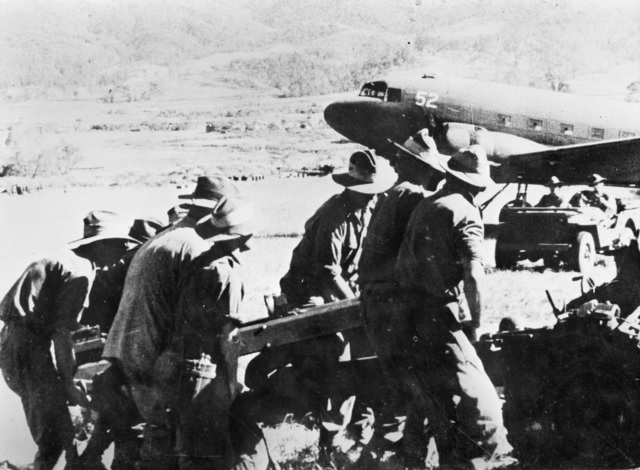
The Battle of Wau, 29 January – 4 February 1943, was a battle in the New Guinea campaign of World War II. Forces of the Empire of Japan sailed from Rabaul and crossed the Solomon Sea and, despite Allied air attacks, successfully reached Lae, where they disembarked. Japanese troops then advanced overland on Wau, an Australian base that potentially threatened the Japanese positions at Salamaua and Lae. A race developed between the Japanese moving overland, hampered by the terrain, and the Australians, moving by air, hampered by the weather. By the time the Japanese reached the Wau area after a trek over the mountains, the Australian defenders had been greatly reinforced by air. In the battle that followed, despite achieving tactical surprise by approaching from an unexpected direction, the Japanese attackers were unable to capture Wau.
Wau is a town in New Guinea, in the province of Morobe situated at one end of the Wau-Bulolo Valley. It was the site of a gold rush during the 1920s and 1930s. Gold prospectors arrived at the coast at Salamaua and struggled inland along the Black Cat Track. The miners partially cleared the area and built houses and workshops, and established a water supply and an electricity grid. They constructed the aerodromes at Wau and Bulolo which were the primary means of reaching the Wau-Bulolo Valley. Wau aerodrome was a rough Kunai grass airstrip 3,100 ft (940 m) in length with a 10 per cent slope heading directly for Mount Kaindi. Aircraft could approach from the north east only, landing uphill and taking off downhill. The mountain at the end of the runway prevented second attempts at landing and precluded extension of the strip. Pilots had to manoeuvre Dakotas under clouds and through dangerous passes, "dodging a peak here and cloud there", landing at high speeds. This required good visibility, but the weather over Owen Stanley Range was characterised by frequent storms, vertical drafts, and mists which rose from the jungle floor. The first landing at Wau was made by Ernest Mustard in his De Havilland DH.37 on 19 April 1927. Osmar White, who reached Wau in June 1942, wrote:
[Wau and Bulolo] were towns built sole by virtue of man's conquest of the air. Every nail, sheet of iron, weatherboard, spot of paint, pane of glass, crock, wire or sheet of paper was carried in by air at freight rates between 4d and 1/5d per pound. The wrecked trucks that now dotted the highways, rusted out and twisted by fire, were brought in by air. The billiard tables at the hotels were brought in by air. Easy chairs, refrigerators, bathtubs, stoves, dynamos, linoleum, carpets, garden statuary, even great mining dredges, bulldozers and power shovels—all were brought in by air, and this in a decade when most people in Australia were still thinking it adventurous to take a five-minute joy ride over an airfield.
After the war with Japan began, Wau became an evacuation centre, receiving refugees from Lae and Salamaua. Non-native women and children were evacuated while men of military age were called up for service in the New Guinea Volunteer Rifles, the local militia unit. Initially, civilians were evacuated by civilian aircraft but as the Japanese drew closer—bombing Wau on 23 January 1942—it became too dangerous to fly without fighter escort, which was unavailable. This left some 250 European and Asian men stranded. These refugees made a hazardous journey over the Owen Stanley Range on foot by way of Kudjeru and Tekadu to Bulldog, a disused mining settlement where there was an aerodrome, and thence down the Lakekamu River to the sea.
With the feasibility of the route thus demonstrated, New Guinea Force decided to establish a line of communications to Wau via the Bulldog Track. A platoon of the 1st Independent Company left Port Moresby in the schooner Royal Endeavour and traversed the route, joining the men of the New Guinea Volunteer Rifles holding the Wau area. This was the beginning of what became Kanga Force on 23 April 1942. On 22 May, the 21st Troop Carrier Squadron USAAF flew in commandos of the 2/5th Independent Company to join Kanga Force. The 2/7th Independent Company followed in October 1942.
Supplies could be flown into Wau if fighter cover was available. On 5 September, 12 planeloads of supplies were dropped at Kudjeru. To economise on scarce transport aircraft, air transport was supplemented by an overland route. Supplies were shipped to the mouth of the Lakekamu in luggers, transported up the river to Bulldog in launches or powered dugout canoes, and then carried over the Bulldog Track by native carriers.
Kanga Force achieved one notable success, in a raid on Salamaua in June 1942, but "apart from that they had done little to harass the Japanese at their Salamaua and Lae bases." They had however managed to threaten the Japanese without provoking them into an offensive against Wau at a time when the Allies did not have the resources to reinforce Kanga Force, and they had provided valuable information. Wau occupied an important place in the strategy of the Commander, Allied Land Forces, South West Pacific Area, General Sir Thomas Blamey, who was concurrently commanding New Guinea Force from Port Moresby. At the time, the Japanese held air superiority over the Solomon Sea, precluding airborne or seaborne operations against the Japanese base at Lae. Blamey therefore decided that he would have to capture Lae with a land campaign. The Bulldog Track would be upgraded to a highway capable of carrying trucks and tanks that could support a division that would advance overland on Lae.
Lieutenant General Hitoshi Imamura, the commander of the Japanese Eighth Area Army at Rabaul, correctly deduced his opponent's intentions and the strength of Kanga Force and resolved to head off the danger to Lae. He ordered Lieutenant General Hatazō Adachi's Eighteenth Army to secure "important areas to the west of Lae and Salamaua". On 29 December 1942, Adachi ordered the 102nd Infantry Regiment and other units under the command of Major General Toru Okabe, the commander of the infantry group of the 51st Division, to move from Rabaul to Lae and then immediately advance inland to capture Wau. Okabe's force was known as the Okabe Detachment.
Battle of Wau
The Battle of Wau, 29 January – 4 February 1943, was a battle in the New Guinea campaign of World War II. Forces of the Empire of Japan sailed from Rabaul and crossed the Solomon Sea and, despite Allied air attacks, successfully reached Lae, where they disembarked. Japanese troops then advanced overland on Wau, an Australian base that potentially threatened the Japanese positions at Salamaua and Lae. A race developed between the Japanese moving overland, hampered by the terrain, and the Australians, moving by air, hampered by the weather. By the time the Japanese reached the Wau area after a trek over the mountains, the Australian defenders had been greatly reinforced by air. In the battle that followed, despite achieving tactical surprise by approaching from an unexpected direction, the Japanese attackers were unable to capture Wau.
Wau is a town in New Guinea, in the province of Morobe situated at one end of the Wau-Bulolo Valley. It was the site of a gold rush during the 1920s and 1930s. Gold prospectors arrived at the coast at Salamaua and struggled inland along the Black Cat Track. The miners partially cleared the area and built houses and workshops, and established a water supply and an electricity grid. They constructed the aerodromes at Wau and Bulolo which were the primary means of reaching the Wau-Bulolo Valley. Wau aerodrome was a rough Kunai grass airstrip 3,100 ft (940 m) in length with a 10 per cent slope heading directly for Mount Kaindi. Aircraft could approach from the north east only, landing uphill and taking off downhill. The mountain at the end of the runway prevented second attempts at landing and precluded extension of the strip. Pilots had to manoeuvre Dakotas under clouds and through dangerous passes, "dodging a peak here and cloud there", landing at high speeds. This required good visibility, but the weather over Owen Stanley Range was characterised by frequent storms, vertical drafts, and mists which rose from the jungle floor. The first landing at Wau was made by Ernest Mustard in his De Havilland DH.37 on 19 April 1927. Osmar White, who reached Wau in June 1942, wrote:
[Wau and Bulolo] were towns built sole by virtue of man's conquest of the air. Every nail, sheet of iron, weatherboard, spot of paint, pane of glass, crock, wire or sheet of paper was carried in by air at freight rates between 4d and 1/5d per pound. The wrecked trucks that now dotted the highways, rusted out and twisted by fire, were brought in by air. The billiard tables at the hotels were brought in by air. Easy chairs, refrigerators, bathtubs, stoves, dynamos, linoleum, carpets, garden statuary, even great mining dredges, bulldozers and power shovels—all were brought in by air, and this in a decade when most people in Australia were still thinking it adventurous to take a five-minute joy ride over an airfield.
After the war with Japan began, Wau became an evacuation centre, receiving refugees from Lae and Salamaua. Non-native women and children were evacuated while men of military age were called up for service in the New Guinea Volunteer Rifles, the local militia unit. Initially, civilians were evacuated by civilian aircraft but as the Japanese drew closer—bombing Wau on 23 January 1942—it became too dangerous to fly without fighter escort, which was unavailable. This left some 250 European and Asian men stranded. These refugees made a hazardous journey over the Owen Stanley Range on foot by way of Kudjeru and Tekadu to Bulldog, a disused mining settlement where there was an aerodrome, and thence down the Lakekamu River to the sea.
With the feasibility of the route thus demonstrated, New Guinea Force decided to establish a line of communications to Wau via the Bulldog Track. A platoon of the 1st Independent Company left Port Moresby in the schooner Royal Endeavour and traversed the route, joining the men of the New Guinea Volunteer Rifles holding the Wau area. This was the beginning of what became Kanga Force on 23 April 1942. On 22 May, the 21st Troop Carrier Squadron USAAF flew in commandos of the 2/5th Independent Company to join Kanga Force. The 2/7th Independent Company followed in October 1942.
Supplies could be flown into Wau if fighter cover was available. On 5 September, 12 planeloads of supplies were dropped at Kudjeru. To economise on scarce transport aircraft, air transport was supplemented by an overland route. Supplies were shipped to the mouth of the Lakekamu in luggers, transported up the river to Bulldog in launches or powered dugout canoes, and then carried over the Bulldog Track by native carriers.
Kanga Force achieved one notable success, in a raid on Salamaua in June 1942, but "apart from that they had done little to harass the Japanese at their Salamaua and Lae bases." They had however managed to threaten the Japanese without provoking them into an offensive against Wau at a time when the Allies did not have the resources to reinforce Kanga Force, and they had provided valuable information. Wau occupied an important place in the strategy of the Commander, Allied Land Forces, South West Pacific Area, General Sir Thomas Blamey, who was concurrently commanding New Guinea Force from Port Moresby. At the time, the Japanese held air superiority over the Solomon Sea, precluding airborne or seaborne operations against the Japanese base at Lae. Blamey therefore decided that he would have to capture Lae with a land campaign. The Bulldog Track would be upgraded to a highway capable of carrying trucks and tanks that could support a division that would advance overland on Lae.
Lieutenant General Hitoshi Imamura, the commander of the Japanese Eighth Area Army at Rabaul, correctly deduced his opponent's intentions and the strength of Kanga Force and resolved to head off the danger to Lae. He ordered Lieutenant General Hatazō Adachi's Eighteenth Army to secure "important areas to the west of Lae and Salamaua". On 29 December 1942, Adachi ordered the 102nd Infantry Regiment and other units under the command of Major General Toru Okabe, the commander of the infantry group of the 51st Division, to move from Rabaul to Lae and then immediately advance inland to capture Wau. Okabe's force was known as the Okabe Detachment.
Recent media
Recent media