
Recent from talks
Battle of the Mediterranean
Knowledge base stats:
Talk channels stats:
Members stats:
Battle of the Mediterranean
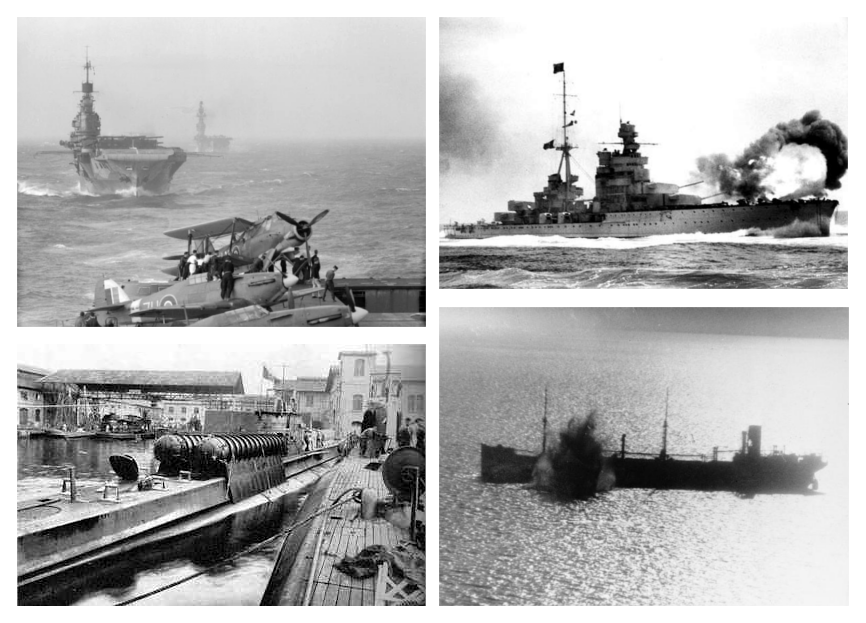
The Battle of the Mediterranean was the naval campaign fought in the Mediterranean Sea during World War II, from 10 June 1940 to 2 May 1945.
For the most part, the campaign was fought between the Italian Royal Navy (Regia Marina), supported by other Axis naval and air forces, those of Nazi Germany and Vichy France, and the British Royal Navy, supported by other Allied naval forces, such as those of Australia, the Netherlands, Poland, and Greece.
American naval and air units joined the Allied side on 8 November 1942. The Vichy French scuttled the bulk of their fleet on 27 November 1942, to prevent the Germans seizing it. As part of the Armistice of Cassibile in September 1943, most of the Italian Navy became the Italian Co-belligerent Navy, and fought alongside the Allies.
Each side had three overall objectives in this battle. The first was to attack the supply lines of the other side. The second was to keep open the supply lines to their own armies in North Africa. The third was to destroy the ability of the opposing navy to wage war at sea. Outside of the Pacific theatre, the Mediterranean saw the largest conventional naval warfare actions during the conflict. In particular, Allied forces struggled to supply and retain the key naval and air base of Malta.
By the time of the Armistice of Cassibile, Italian ships, submarines and aircraft had sunk Allied surface warships totalling 145,800 tons, while German forces had sunk 169,700 tons, for a total of 315,500 tons. In total the Allies lost 76 warships and 46 submarines. The Allies sank 83 Italian warships totalling 195,100 tons (161,200 by the British Empire and 33,900 by the Americans) and 83 submarines.German losses in the Mediterranean from the start of the campaign to the end were 17 warships and 68 submarines.
The Mediterranean was a traditional focus of British maritime power. Outnumbered by the forces of the Regia Marina, the British plan was to hold the three key strategic points of Gibraltar, Malta, and the Suez Canal. By holding these points, the Mediterranean Fleet held open vital supply routes. Malta was the lynch-pin of the whole system. It provided a needed stop for Allied convoys and a base from which to attack the Axis supply routes.
The Mediterranean strategy of Winston Churchill and Alan Brooke was the British policy of opening the Mediterranean to British and allied ships and knocking Italy out of the war before invading Europe, as it would save a million tons of shipping per year in having to send ships to Egypt and the Middle East via the route around Africa. See also Percentages agreement.
The Americans were keen on a (premature?) cross-channel invasion in 1943
Hub AI
Battle of the Mediterranean AI simulator
(@Battle of the Mediterranean_simulator)
Battle of the Mediterranean
The Battle of the Mediterranean was the naval campaign fought in the Mediterranean Sea during World War II, from 10 June 1940 to 2 May 1945.
For the most part, the campaign was fought between the Italian Royal Navy (Regia Marina), supported by other Axis naval and air forces, those of Nazi Germany and Vichy France, and the British Royal Navy, supported by other Allied naval forces, such as those of Australia, the Netherlands, Poland, and Greece.
American naval and air units joined the Allied side on 8 November 1942. The Vichy French scuttled the bulk of their fleet on 27 November 1942, to prevent the Germans seizing it. As part of the Armistice of Cassibile in September 1943, most of the Italian Navy became the Italian Co-belligerent Navy, and fought alongside the Allies.
Each side had three overall objectives in this battle. The first was to attack the supply lines of the other side. The second was to keep open the supply lines to their own armies in North Africa. The third was to destroy the ability of the opposing navy to wage war at sea. Outside of the Pacific theatre, the Mediterranean saw the largest conventional naval warfare actions during the conflict. In particular, Allied forces struggled to supply and retain the key naval and air base of Malta.
By the time of the Armistice of Cassibile, Italian ships, submarines and aircraft had sunk Allied surface warships totalling 145,800 tons, while German forces had sunk 169,700 tons, for a total of 315,500 tons. In total the Allies lost 76 warships and 46 submarines. The Allies sank 83 Italian warships totalling 195,100 tons (161,200 by the British Empire and 33,900 by the Americans) and 83 submarines.German losses in the Mediterranean from the start of the campaign to the end were 17 warships and 68 submarines.
The Mediterranean was a traditional focus of British maritime power. Outnumbered by the forces of the Regia Marina, the British plan was to hold the three key strategic points of Gibraltar, Malta, and the Suez Canal. By holding these points, the Mediterranean Fleet held open vital supply routes. Malta was the lynch-pin of the whole system. It provided a needed stop for Allied convoys and a base from which to attack the Axis supply routes.
The Mediterranean strategy of Winston Churchill and Alan Brooke was the British policy of opening the Mediterranean to British and allied ships and knocking Italy out of the war before invading Europe, as it would save a million tons of shipping per year in having to send ships to Egypt and the Middle East via the route around Africa. See also Percentages agreement.
The Americans were keen on a (premature?) cross-channel invasion in 1943
Recent media