Recent from talks
Nothing was collected or created yet.
Passamaquoddy
View on WikipediaKey Information
| Person | Peskotomuhkat |
|---|---|
| People | Peskotomuhkatiyik |
| Language | Peskotomuhkatuwey |
| Country | Peskotomuhkatihkuk Wabanaki |
The Passamaquoddy (Passamaquoddy: Peskotomuhkati, Plural: Peskotomuhkatiyik) are a Native American/First Nations people who live in northeastern North America. Their traditional homeland, Peskotomuhkatikuk, straddles the Canadian province of New Brunswick and the U.S. state of Maine in a region called Dawnland. They are one of the constituent nations of the Wabanaki Confederacy.
The Passamaquoddy Tribe in Maine is a federally recognized tribe. The Passamaquoddy people in Canada have an organization known as the Peskotomuhkati Nation, but it does not have official First Nations status.
Etymology
[edit]The name "Passamaquoddy" is an anglicization of the Passamaquoddy word peskotomuhkati, the prenoun form (prenouns being a linguistic feature of Algonquian languages) of Peskotomuhkat (pestəmohkat), their endonym, or the name that they use for themselves. Peskotomuhkat literally means "pollock-spearer" or "those of the place where pollock are plentiful",[1] reflecting the importance of this fish in their culture.[2] Their method of fishing was spear-fishing, rather than angling or using nets. Passamaquoddy Bay is shared by both New Brunswick and Maine; its name was derived by the English settlers from the Passamaquoddy people.
History
[edit]
The Passamaquoddy have an oral history supported with visual imagery, such as birchbark etching and petrographs prior to European contact. Among the Algonquian-speaking tribes of the loose Wabanaki Confederacy, they occupy coastal regions along the Bay of Fundy, Passamaquoddy Bay, and Gulf of Maine, and along the St. Croix River and its tributaries. Traditionally, they had seasonal patterns of settlement. In the winter, they dispersed and hunted inland. In the summer, they gathered more closely together on the coast and islands, and primarily harvested seafood, including marine mammals, mollusks, crustaceans, and fish.[3]

Settlers of European descent repeatedly forced the Passamaquoddy off their original lands from the 1800s. After the United States achieved independence from Great Britain, the tribe was eventually officially limited to the current Indian Township Reservation, at 45°15′57″N 67°36′43″W / 45.26583°N 67.61194°W, in eastern Washington County, Maine. It has a land area of 37.45 square miles (97.0 km2) and a 2000 census resident population of 676 persons. They also control the small Passamaquoddy Pleasant Point Reservation in eastern Washington County, which has a land area of 0.5 square miles (1.3 km2) and a population of 749, per the 2010 census.[4]

Populations and languages
[edit]The total Passamaquoddy population is around 3,576 people. About 500 people, most if not all over the age of 50, speak the Maliseet-Passamaquoddy language, shared (other than minor differences in dialect) with the neighboring and related Wolastoqiyik people. It belongs to the Algonquian branch of the Algic language family. The University of Maine published a comprehensive Passamaquoddy Dictionary in 2008. Another resource for the language is the online Passamaquoddy-Maliseet Language Portal, which includes many videos, subtitled in English and Passamaquoddy, of native speakers conversing in the language. Most of the people speak English as their first language.
While the Passamaquoddy population in Canada is much smaller than that in Maine, there is an organization called the Peskotomuhkati Nation, with a formal structure and a chief, Hugh Akagi. Most of its people speak French and English. It is not recognized by the Canadian government as constituting a First Nation. In 2004, Chief Akagi was authorized to represent the Passamaquoddy at events marking the 400th anniversary of French settlement of St Croix Island (the first French effort at permanent settlement in the New World). This indicates that the government had acknowledged the tribe to some extent, and progress is being made in formal recognition.[5]
Special political status in Maine
[edit]

The Passamaquoddy, along with the neighboring Penobscot, are given special political status in Maine. Both groups are allowed to send a nonvoting representative to the Maine House of Representatives. Although these representatives cannot vote, they may sponsor any legislation regarding American Indian affairs, and may co-sponsor any other legislation.
Notable Passamaquoddy
[edit]- David Moses Bridges (Passamaquoddy, 1962–2017), Sipayik, birchbark artist and canoe maker[6][7][8][9]
- Simon Dumont, freestyle skier[10]
- Tomah Joseph (1837–1914), governor, guide, and artist[11]
- Francis Joseph Neptune, former Sakom[12]
- Molly Neptune Parker, master basketmaker[13]
- Geo Soctomah Neptune, master basketmaker[14]
- Rena Newell, tribal member of the Maine House of Representatives[15]
- Donald Soctomah, former tribal state representative, tribal historic preservation officer[16]
- Madonna Soctomah, tribal council member, former state representative[17]
Maps
[edit]Maps showing the approximate locations of areas occupied by members of the Wabanaki Confederacy (from north to south):
-
Maliseet, Passamaquoddy
-
Eastern Abenaki (Penobscot, Kennebec, Arosaguntacook, Pigwacket/Pequawket)
-
Western Abenaki (Arsigantegok, Missisquoi, Cowasuck, Sokoki, Pennacook
See also
[edit]- Joint Tribal Council of the Passamaquoddy Tribe v. Morton (1st Cir. 1975)
- Passanaquoddy Tribe reacquires stolen land on Pine Island, Bangor Daily News 18 May 2021
References
[edit]Notes
[edit]- ^ Erickson, Vincent O. 1978. "Maliseet-Passamaquoddy". In Northeast, ed. Bruce G. Trigger. Vol. 15 of Handbook of North American Indians, ed. William C. Sturtevant. Washington, D.C.: Smithsonian Institution, pg. 135. Cited in Campbell, Lyle (1997). American Indian Languages: The Historical Linguistics of Native America. Oxford: Oxford University Press, pg. 401.
- ^ "Maliseet" - Passamaquoddy Dictionary
- ^ "Acadia National Park - Wabanaki Ethnography (U.S. National Park Service)". Archived from the original on 2008-08-29. Retrieved 2008-08-31.
- ^ "Profile of General Population and Housing Characteristics: 2010 Demographic Profile Data (DP-1): Passamaquoddy Pleasant Point Reservation, Washington County, Maine". United States Census Bureau. Retrieved July 20, 2012.
- ^ Rudin, Ronald. Remembering and Forgetting in Acadie: A Historian's Journey through Public Memory (Toronto: University of Toronto Press. 2009).
- ^ "DAVID MOSES BRIDGES – PASSAMAQUODDY BIRCHBARK ARTIST AND CANOE BUILDER". Retrieved Apr 27, 2020.
- ^ "David Moses Bridges Scholarship – Maine Community Foundation". Retrieved Apr 27, 2020.
- ^ "David Moses Bridges". First Peoples Fund. Retrieved Apr 27, 2020.
- ^ "David Moses Bridges, Bar Harbor Resident Who Embraced Native American Traditions, And Nature, Fully". www.wbur.org. 31 January 2018. Retrieved Apr 27, 2020.
- ^ "Native heritage source of strength for world-class athlete". Indian Country Today Media Network. 13 February 2009. Retrieved 8 April 2014.
- ^ "Tomah Joseph—Passamaquoddy Elder Who Mentored a President". U.S. National Park Service.
- ^ "Guide to the Passamaquoddy Indian Papers,1775-1912, (bulk 1830-1875)". Cornell University.
- ^ Green, Penelope (15 July 2020). "Molly Neptune Parker, Basket Maker and Tribal Elder, Dies at 81". The New York Times.
- ^ "Geo Neptune, One of the featured artists in Sharing Honors and Burdens: Renwick Invitational 2023". Smithsonian American Art Museum.
- ^ Daugherty, Owen (May 16, 2019). "Maine becomes first state to ban use of Native American mascots at public schools". The Hill. Retrieved August 26, 2019.
- ^ "Passamaquoddy Dwayne Tomah and Donald Soctomah in Pine Island". Library of Congress.
- ^ French, Edward; Tides, Quoddy (11 November 2023). "Language-keepers film stirs emotions among Passamaquoddy tribal citizens". The Maine Monitor.
Sources
[edit]- Indian Township Reservation and Passamaquoddy Trust Land, Maine United States Census Bureau
Further reading
[edit]- Sockabasin, Allen J. 2007. An Upriver Passamaquoddy. Thomaston, Maine: Tilbury House
External links
[edit]- Passamaquoddy Tribal Government Web Site (Pleasant Point)
- Passamaquoddy Tribal Government Web Site (Indian Township) Archived 2014-03-27 at the Wayback Machine
- Passamaquoddy-Maliseet Language Portal (includes dictionary and videos)
- The Boston Globe Magazine, October 27, 1985 issue, article by Peter Anderson
- Contribution to Passamaquoddy Folk-Lore, by J. Walter Fewkes, reprinted from the Journal of American Folk-Lore, October–December, 1890, from Project Gutenberg
- Passamaquoddy Origins
- Acadian Commemorative Website Archived 2015-09-22 at the Wayback Machine
- "An Unlikely Handshake Alters the Course of Maine's History," Portland Press Herald, July 5, 2014.
Passamaquoddy
View on GrokipediaName and Etymology
Linguistic and Historical Origins
The name Passamaquoddy derives from the endonym peskotomuhkatiyik or pestomuhkatiyik in the Passamaquoddy language, translating to "people of the pollock-spearing place" or "those from the place where pollock are abundant," referencing traditional fishing practices in the coastal waters of Passamaquoddy Bay.[9][10] This term highlights the tribe's historical reliance on spearing pollock (Pollachius virens), a key marine resource, and the name was anglicized by early European explorers and settlers encountering the group in the 17th century.[11] Linguistically, the Passamaquoddy language (also known as Peskotomuhkati) forms one dialect of the Passamaquoddy-Maliseet language continuum, classified within the Eastern Algonquian subgroup of the broader Algonquian language family.[12] Eastern Algonquian languages, including those spoken by neighboring Wabanaki peoples such as the Mi'kmaq and Maliseet, diverged from Proto-Algonquian around 3,000 years ago, with evidence of a shared intermediate proto-language supporting their genetic coherence as a subgroup.[13] This family originated in the northeastern woodlands of North America, with linguistic reconstructions indicating long-term stability in the region rather than recent migrations, as proto-forms align with prehistoric subsistence patterns like fishing and foraging.[14] Historically, the Passamaquoddy trace their origins to prehistoric inhabitants of the Dawnland region encompassing the St. Croix River watershed and Passamaquoddy Bay, with archaeological sites documenting continuous occupation by ancestors practicing Archaic-period subsistence strategies—such as seasonal coastal camps for fishing and inland foraging—from at least 9,000 years ago.[15] These patterns persisted into the late prehistoric period, linking material culture like stone tools and shell middens to Algonquian-speaking groups, and oral traditions corroborate this continuity, positioning the Passamaquoddy as autochthonous to the area predating European contact by millennia.[16][17] As members of the Wabanaki Confederacy, their ethnogenesis involved alliances with related Algonquian tribes, but distinct Passamaquoddy identity emerged tied to specific territories and resource exploitation, evidenced by site-specific artifacts from 6,000 to 8,000 years ago.[2][17]Pre-Colonial and Early History
Ancestral Territories and Subsistence Patterns
The ancestral territories of the Passamaquoddy, known as Peskotomuhkatikuk, encompassed the watershed of the Schoodic or Skutik (St. Croix) River and Passamaquoddy Bay, extending across northeastern Maine and western New Brunswick.[18] [4] This coastal and riverine region, part of the broader Dawnland, supported dense populations of marine life and game, shaping Passamaquoddy settlement and resource use since the post-glacial period, with archaeological evidence of continuous occupation dating back over 10,000 years.[19] [16] Prior to European contact, Passamaquoddy subsistence relied on a seasonal, mobile economy centered on fishing, hunting, and gathering, with family bands relocating between coastal, riverine, and inland camps to exploit resource availability.[4] Fishing dominated in the Quoddy region, utilizing tidal weirs, nets, and spears to harvest abundant anadromous fish such as alewives, herring, and Atlantic salmon in Passamaquoddy Bay and the St. Croix River, particularly during spring runs that could yield thousands of fish per site.[20] [16] Hunting targeted large mammals like moose, deer, and bear using bows, arrows, and snares, supplemented by trapping smaller game, while gathering included berries, roots, nuts, and maple sap boiled into sugar during late winter.[4] [20] These patterns, developed during the Archaic period (circa 8000–1000 BCE) and refined in the local Quoddy tradition around 500 BCE, emphasized sustainability through controlled resource management, such as rotating fishing sites to prevent depletion, without reliance on agriculture.[16] Communities stored surplus fish and meat in smokehouses or pits for winter, enabling semi-permanent winter villages near inland hunting grounds while summer focused on coastal exploitation.[20] This adaptive strategy supported populations estimated in the low thousands across the territory, resilient to environmental fluctuations until altered by post-contact trade.[8] ![This mannequin illustrates Passamaquoddy life in the 1500s.jpg][center]Social and Political Organization
The Passamaquoddy social structure was decentralized and fluid, centered on patrilineal kinship groups that formed extended family bands of 25 to 100 individuals related through descent and marriage. These bands relocated seasonally across territories, adapting to hunting, fishing, and gathering patterns, with cooperation emphasized through roles divided by gender and age—men typically handling hunting and fishing, while women managed camps, processing, and child-rearing. Kinship ties facilitated flexible marriages, residence choices, and group mergers or divisions, enabling easy integration of outsiders and migration without rigid hierarchies or distinct clans; instead, social cohesion relied on shared resources, intergenerational bonds, and communal harmony within nomadic family units.[4][21] Politically, the Passamaquoddy operated without centralized tribal authority pre-contact, organizing into autonomous bands or river districts, each led by a sakom (sachem or chief) responsible for local welfare, dispute mediation, and resource allocation. Sakoms were selected by consensus among family heads or community adults, prioritizing traits like hunting skill, wisdom, eloquence, and lineage rather than heredity alone, and held advisory influence without coercive power—no formal courts, prisons, or commands existed, with leaders distributing wealth equitably to maintain respect. Often grouped with the Maliseet as Etchemins, Passamaquoddy bands maintained chiefs per drainage area, as evidenced by early records of figures like Chkouden in 1604.[8][21][22] Decision-making emphasized consensus in informal councils involving men, women, elders, and sometimes all adults, focusing on collective input for issues like land use or conflicts, with individuals able to dissent or opt out; this reflected a nominal authority structure tied to personal competence over institutional force. Pre-contact alliances with other Wabanaki peoples, such as loose regional assemblies, supported mutual aid against external threats, though internal governance remained band-level and adaptive, predating formalized confederacies disrupted by epidemics around 1615.[21][4][8]Colonial Interactions and Conflicts
European Contact and Trade
The earliest documented interactions between the Passamaquoddy and Europeans occurred in the 16th century, when Basque, Portuguese, and other fishermen frequented the Gulf of Maine for cod, leading to incidental trade exchanges of fish for furs and other native goods.[23][24] These encounters introduced metal tools and beads, which archaeological evidence from Passamaquoddy Bay sites confirms were adopted by the mid-1500s, altering local tool-making practices without immediate large-scale disruption.[23] The first extensive recorded contact took place in 1604, when French explorer Samuel de Champlain and Pierre Dugua, Sieur de Mons, established a settlement of 79 colonists on Saint Croix Island in Passamaquoddy Bay, overwintering there and documenting interactions with local Passamaquoddy bands who provided guidance and provisions amid harsh conditions that claimed half the settlers.[8][25] This outpost initiated formalized fur trade, with Passamaquoddy supplying beaver and other pelts in exchange for iron axes, knives, cloth, and copper kettles, fostering economic ties that integrated European goods into subsistence economies centered on coastal resources.[4][8] By the early 17th century, competition between French and English traders intensified, but the Passamaquoddy primarily aligned with French interests due to geographic proximity and missionary influence, establishing posts like those at the mouth of the Saint Croix River for sustained barter of furs—peaking in the 1620s–1630s—for firearms, woolens, and alcohol, which shifted traditional hunting patterns toward intensified trapping.[4][26] English Plymouth Colony traders from Massachusetts Bay occasionally penetrated the region post-1620, offering similar goods but facing resistance from French-allied networks, resulting in sporadic raids that underscored the strategic value of Passamaquoddy trade routes linking interior forests to Atlantic ports.[27][8]Involvement in Wars and Treaties
The Passamaquoddy, as members of the Wabanaki Confederacy, allied with the French against British colonial expansion in the intermittent wars spanning 1689 to 1760, driven by fur trade partnerships, intermarriages, and adoption of Catholicism. These conflicts encompassed King William's War (1689–1697), Queen Anne's War (1702–1713), Dummer's War (1722–1727)—during which Passamaquoddy forces merged with Abenaki refugees amid English incursions into Penobscot territories—King George's War (1744–1748), and the French and Indian War (1754–1763).[4][28] Although efforts at neutrality occurred in later phases, English attacks in 1745 and 1755 pulled them into active defense of ancestral lands.[4] The French defeat at Quebec in 1759 ended this era, with British officials subsequently claiming Wabanaki territories, including Passamaquoddy holdings, by right of conquest over their French-aligned tribes.[8][4] Shifting allegiances during the American Revolutionary War (1775–1783), the Passamaquoddy supported the colonial rebels to safeguard their eastern frontier, enlisting a regiment under Colonel John Allen that contributed to securing Machias and surrounding areas against British forces.[8] On July 19, 1776, Passamaquoddy sachems, alongside Mi'kmaq and Maliseet leaders representing the St. John's Tribes, signed the Treaty of Watertown—the earliest formal treaty between the emerging United States and Native nations—committing up to 600 warriors to the Continental Army in return for perpetual friendship, territorial protections, and mutual defense against British aggression.[29][30] Colonial-era Peace and Friendship Treaties with the British, including those negotiated in 1726, 1749, 1752, and 1760–1761, aimed to halt hostilities and affirm Mi'kmaq, Maliseet, and Passamaquoddy rights to hunting, fishing, and passage, though disputes over implementation persisted amid ongoing land pressures.[31] After independence, the Passamaquoddy engaged in state-level agreements with Massachusetts, such as the 1794 treaty whereby they ceded vast tracts in present-day Washington County while reserving key settlements like Indian Township and Pleasant Point, with ratification following in 1795; these pacts, however, yielded no compensation for ceded lands and obligated ongoing state trusteeship.[32][8] Many such early compacts lacked federal ratification, complicating later claims.[2]19th-20th Century Developments
Land Dispossession and Reservations
The Passamaquoddy experienced significant land dispossession in the 19th century following the 1794 treaty with Massachusetts, in which the tribe ceded vast portions of its territory east of the St. Croix River but retained approximately 23,370 acres, including tracts at Indian Township, 15 islands in the St. Croix River, and two islands in Big Lake.[33] After Maine's separation from Massachusetts in 1820, the state assumed jurisdiction over Indian affairs and began systematically undermining tribal land holdings through legislative authorizations for seizures, sales, leases, and timber harvesting without tribal consent or compensation, actions that contravened the treaty's protections.[34] Between 1821 and 1842, these measures, driven by demand for timber resources, reduced the Passamaquoddy's control over their remaining lands, with the state exerting oversight via appointed agents who prioritized external economic interests over tribal needs.[2] By the mid-1830s, the cumulative effect of these encroachments had deprived the Passamaquoddy of nearly all their aboriginal territory, confining them to small reserved tracts totaling around 23,100 acres: approximately 100 acres at Pleasant Point (Sipayik) on Passamaquoddy Bay near Perry, Maine, and about 23,000 acres at Indian Township (Motahkomikuk) near the headwaters of the St. Croix River.[2] These areas formed the basis of the tribe's reservations, which Maine formalized as state-managed entities rather than sovereign holdings, with legislative acts regulating land use and resource extraction to the tribe's detriment.[8] In 1856, Maine established a tribal trust fund with $22,500 derived from land-related proceeds, but the state withheld interest payments from 1859 until 1969, further eroding economic autonomy and perpetuating subsistence-level conditions on the reservations.[33] Into the early 20th century, state control persisted, with continued mismanagement of reservation resources and barriers to land expansion, as Maine treated the Passamaquoddy as domestic entities subject to legislative oversight rather than enforcing federal treaty obligations.[34] The reservations at Pleasant Point and Indian Township remained the tribe's primary settlements, encompassing roughly 2,500 residents by mid-century, but their isolation and restricted land base limited self-sufficiency amid ongoing settler encroachment and resource depletion.[2] This framework of dispossession, rooted in state assertions of authority over unratified early agreements, set the stage for later federal interventions without restoring pre-19th-century territorial extents.[8]Assimilation Policies and Resistance
In the late 19th century, the state of Maine asserted wardship over Passamaquoddy reservations, implementing policies aimed at cultural assimilation by centralizing control under state-appointed overseers who managed education, land use, and tribal governance. These overseers promoted English-language instruction and Christian missionary activities, particularly through Catholic missions established on reservations like Peter Dana Point and Pleasant Point, to erode traditional spiritual practices and kinship structures.[35] By the early 20th century, state laws mandated the replacement of hereditary chiefs with elected tribal councils modeled on Anglo-American systems, disrupting traditional leadership and decision-making to foster integration into state citizenship norms.[4] [35] The 1930s marked intensified assimilation pressures with infrastructure developments, including road access to remote communities and the establishment of mission schools such as St. Ann's Indian Mission in Motahkomikuk, which emphasized vocational training and separation from family to instill non-Native values. These schools, supported by state and church funding, contributed to declining fluency in the Passamaquoddy language, with generations exposed to curricula designed to prioritize economic self-sufficiency through wage labor over subsistence hunting and fishing.[36] In the 1960s, Maine legislators advanced termination policies, proposing bills to dissolve reservations, redistribute lands into individual allotments, and fold Passamaquoddy into state welfare programs, explicitly to hasten assimilation by eliminating collective tribal identity.[35] Passamaquoddy communities resisted these measures through persistent adherence to oral traditions, communal ceremonies, and craft production like ash basketry, which sustained cultural knowledge amid external pressures. Tribal leaders challenged state-imposed governance reforms via petitions and internal councils, preserving elements of hereditary authority despite legal mandates.[36] By the mid-1960s, organized opposition to termination legislation, coupled with demonstrations of tribal viability through self-managed economic initiatives, compelled state policymakers to abandon assimilationist assumptions and recognize ongoing communal cohesion, averting full termination.[35] This resistance laid groundwork for later federal acknowledgment of tribal trust responsibilities in 1975.[34]Land Claims and Federal Recognition
The 1975 Lawsuit and MICSA Settlement
In 1972, the Joint Tribal Council of the Passamaquoddy Tribe filed suit in the U.S. District Court for the District of Maine against the Secretary of the Interior, challenging the validity of historical land transfers under the Indian Trade and Nonintercourse Act of 1790, which prohibited alienation of tribal lands without federal consent.[37] The tribe asserted aboriginal title to approximately 12 million acres of privately held land, 500,000 acres of public land, and sought $25 billion in damages for unauthorized encroachments dating back to colonial times, primarily encompassing what is now Washington County, Maine, and adjacent areas.[38] The state of Maine intervened, arguing the Passamaquoddy did not qualify as a federally recognized "tribe" entitled to protections under the Act, but the district court rejected this in February 1975, ruling that the tribe met the statutory definition based on its distinct political and cultural identity.[39] The U.S. Court of Appeals for the First Circuit affirmed the district court's decision in December 1975, holding in Joint Tribal Council of the Passamaquoddy Tribe v. Morton that the Passamaquoddy constituted a "tribe" within the meaning of the Nonintercourse Act, thereby imposing a federal trust responsibility to protect their land rights against non-federal transfers.[37] This ruling invalidated numerous 19th-century state-sanctioned land sales and leases, exposing private property titles across much of eastern Maine to potential reversion and prompting widespread economic alarm, as the claims overlapped with over half the state's land area and threatened development, timber, and real estate sectors.[38] In response, the U.S. Department of Justice initiated negotiations involving the Passamaquoddy, Penobscot Nation, Houlton Band of Maliseet Indians, Maine state officials, and federal representatives to avert protracted litigation that could destabilize land tenure.[40] The negotiations culminated in the Maine Indian Claims Settlement Act (MICSA), enacted as Public Law 96-420 on October 10, 1980, which extinguished all aboriginal title claims by the Passamaquoddy, Penobscot, and Maliseet tribes in Maine in exchange for federal compensation totaling $81.5 million, administered through the Bureau of Indian Affairs.[41] Of this amount, $27 million was allocated directly to the Passamaquoddy Tribe for investment in trust, with additional state contributions including 300,000 acres of land transferred into federal trust status and confirmation of existing reservations at Pleasant Point and Indian Township.[40] MICSA uniquely limited the application of broader federal Indian laws and regulations in Maine—such as those under the Indian Reorganization Act—absent explicit congressional approval, distinguishing the Wabanaki tribes' sovereignty from that of other federally recognized tribes elsewhere in the U.S.[41] Complementary state legislation ratified the agreement, establishing the Maine Indian Tribal-State Commission to oversee implementation and dispute resolution.[42]Implementation and Ongoing Disputes
The Maine Indian Claims Settlement Act (MICSA), enacted on October 18, 1980, established a $81.5 million federal trust fund to resolve aboriginal title claims by the Passamaquoddy Tribe and Penobscot Nation, with approximately $27 million allocated to the Passamaquoddy for land acquisition, economic development, and other uses under Secretary of the Interior oversight.[41] The Act authorized the acquisition of lands into federal trust status upon tribal application and Interior Department approval, enabling the Passamaquoddy to purchase properties including expansions around their existing reservations at Pleasant Point and Indian Township (Sipayik), totaling several thousand acres by the early 1980s.[40] Income from designated portions of the fund, such as $1 million principal yielding annual interest, was mandated for education, social services, and cultural preservation, with principal preserved in perpetuity.[43] Implementation proceeded through state-federal coordination via the Maine Implementing Act, which ratified prior land transfers and integrated tribal lands into state regulatory frameworks, differing from trust lands elsewhere by subjecting them to broader state civil and criminal jurisdiction.[40] The Passamaquoddy utilized funds to acquire timberlands and waterfront properties, though acquisitions required compliance with environmental reviews and state approvals, limiting flexibility compared to non-MICSA tribes.[44] By the 1990s, disputes emerged over fund management, including a 2006-2012 internal tribal debate on reallocating $12 million in unspent land acquisition funds for housing and infrastructure, resolved via member referendum favoring diversified use.[45] Ongoing disputes center on MICSA's jurisdictional constraints, which tribes contend undermine sovereignty by imposing state laws on internal matters like taxation, zoning, and courts, unlike federal Indian law protections for other reservations.[46] This has fueled advocacy for amendments, culminating in a 2019-2021 MICSA Task Force that recommended expanding tribal court authority and self-governance, though full consensus eluded reforms.[47] In May 2024, Maine enacted legislation (LD 2007) amending the state implementing act to affirm Wabanaki Nations' inherent sovereignty in select areas like child welfare and environmental regulation, providing partial relief but leaving core land and gaming jurisdiction disputes unresolved, as tribes argue the original settlement undervalued claims to over 60% of Maine's territory for insufficient compensation.[48][49] Federal bills to codify similar expansions, such as HR 4590 in 2022, have stalled amid state opposition over regulatory overlap.[50]Language and Cultural Identity
Passamaquoddy-Maliseet Linguistic Features
Passamaquoddy-Maliseet is an Eastern Algonquian language characterized by polysynthetic morphology, in which complex words are formed by combining roots, medials, and finals, often incorporating nouns into verbs to express nuanced meanings such as kinalokosse 's/he has big ears'.[51][52] Verbs constitute the core of sentences, with four primary paradigms: animate intransitive (AI), inanimate intransitive (II), transitive inanimate (TI), and transitive animate (TA), each inflecting for person, number, animacy, and mode.[51] Dialectal variations exist between Passamaquoddy and Maliseet, particularly in vowel length and pronunciation, with approximately 500 speakers as of recent estimates.[52] The phonological inventory includes five vowels (a, e, i, o realized as schwa, u) and diphthongs such as aw, ew, ay, alongside 12 consonants (p, t, k, q, c, s, h, m, n, l, w, y), with q representing a velar or uvular sound varying by dialect.[51][52] Distinctive features encompass contrastive pitch accent, stress placement, and regular syncope, where unstressed schwa (o) deletes in certain forms, as in ktomakeyu 's/he is poor' from a fuller stem.[51] Consonants exhibit aspiration or tenseness in stops (p, t, k, q), and an apostrophe denotes elided initial consonants, e.g., 'tome 's/he smokes'.[52] Nouns distinguish animate from inanimate classes, influencing verb agreement and plural marking: animates pluralize with -ak (e.g., sakom 'chief' to sakomak 'chiefs'), while inanimates use -ol.[51][52] Inflections include possessives (e.g., ntul 'my boat'), locatives (-k), diminutives (-hsis), obviatives for non-proximate animates, and absentatives for deceased or absent referents.[51] Dependent nouns require possessors, as in nikuwoss 'my mother'.[52] Verbs inflect via prefixes for subjects (e.g., n- '1st person'), suffixes for objects and tense, and modes such as independent indicative, changed conjunct (with initial vowel change, e.g., ketomakeyit), and subordinative; TA verbs mark direct/inverse alignment to reflect actor-patient hierarchy.[51][52] Obviation distinguishes proximate (topic) from obviative (background) third-person animates, a hallmark of Algonquian languages, as in obviative forms like 'tusol 'his/her daughter' avoiding proximate confusion.[51] Syntax features flexible word order, typically verb-object (VO), with prepositions governing obliques and no obligatory copula for equative sentences (e.g., Piyel wot 'That is Piyel').[51] Sentences often consist of a single inflected verb conveying full predication, such as komiwon 's/he is stealing it', or incorporate spatial relations via verb roots (e.g., -askute- 'field').[52] Particles, uninflected, handle conjunctions (naka 'and') and discourse, while qualities typically derive from stative verb roots rather than a distinct adjective class.[51] Extensive noun incorporation and stem derivation enable concise expression of events, distinguishing it from analytic languages.[51][52]Language Revitalization Efforts
Efforts to revitalize the Passamaquoddy language, known as Peskotomuhkati, focus on community-led immersion, digital archiving, and recovery of historical audio materials, given its endangered status with only a small number of fluent speakers remaining. Tribal initiatives emphasize teaching children through full immersion environments where English is excluded, aiming to build generational fluency.[53][5] In 2015, the Passamaquoddy Tribe at Pleasant Point (Sipayik) launched a language immersion program targeting young children, including plans for dedicated schools at Sipayik and Indian Township for ages 3 to 5, where instruction occurs exclusively in Peskotomuhkati. By 2017, these immersion classes were operational, using songs, visuals, and interactive methods rather than direct translation to facilitate natural acquisition, as traditional translation has proven less effective for endangered Algonquian languages. Sipayik Elementary School supplements this with classroom language instruction integrated into the curriculum.[54][53][55] Digital tools have accelerated revitalization, including the Peskotomuhkati-Wolastoqey Language Portal, which provides a 19,000-entry online dictionary linked to video archives of fluent speakers demonstrating vocabulary and phrases. This resource supports self-study and community programs, with recent expansions in 2025 incorporating decades of elder collaborations to aid new learners. Additionally, pairings of partial speakers with elders for immersion-style mentoring have been proposed to bridge fluency gaps.[56][57] A key project involves recovering 19th-century wax cylinder recordings of Passamaquoddy voices, led by fluent speaker Dwayne Tomah, who has transcribed and revived traditional songs to transmit cultural knowledge orally. These efforts, featured in PBS's Native America series in 2023, utilize the earliest field recordings of Native American languages to inspire contemporary speakers and stimulate revival programs.[58][59][60]Demographics and Settlements
Population Distribution
The Passamaquoddy maintain two primary reservations in Washington County, Maine: the Indian Township Reservation (Motahkmokuk) near Princeton and the Pleasant Point Reservation (Sipayik) near Perry. These communities serve as the core of Passamaquoddy population distribution in the United States, with the tribe tracking separate enrollment rolls for each. As of tribal records, Indian Township lists 1,364 enrolled members, while Pleasant Point has 2,005, yielding a total of 3,369 enrolled tribal members.[61] Resident populations on the reservations are smaller than total enrollment, reflecting significant off-reservation living, primarily within Maine. The 2020 United States Census recorded 760 residents at Indian Township and 692 at Pleasant Point. Projections for 2025 estimate modest growth to approximately 771 at Indian Township and 692 at Pleasant Point.[62][63] A smaller Passamaquoddy presence exists in Canada, centered in New Brunswick at the community of Qonaskamkuk (St. Croix), though exact enrollment figures are limited and the group remains culturally affiliated rather than federally recognized separately from U.S. tribes. Overall, the vast majority of enrolled Passamaquoddy reside or trace affiliation to the Maine reservations, with diaspora concentrated in nearby urban areas like Bangor and Portland.[2][64]Key Communities and Reservations
The Passamaquoddy maintain two primary federally recognized reservations in Washington County, Maine: Pleasant Point (known in Passamaquoddy as Sipayik) and Indian Township (known as Motahkokmikuk). These communities serve as central hubs for tribal governance, cultural activities, and resident populations. Pleasant Point is situated on the eastern shore of Passamaquoddy Bay, adjacent to the towns of Perry and Eastport, encompassing approximately 1,600 acres of land focused on coastal resources.[65][66] Indian Township lies inland, about 13 miles northwest of Calais, covering roughly 22,000 acres of forested and wetland terrain suitable for traditional subsistence practices.[4][64] As of recent estimates, Pleasant Point hosts around 850 tribal members, while Indian Township has approximately 800, though census figures for total residents (including non-tribal members) were 692 and 760 respectively in the 2020 U.S. Census.[6] Most of the broader Passamaquoddy population of about 2,500 in the United States lives off-reservation in other parts of Maine, with significant urban migration to areas like Bangor and Portland.[2] These reservations operate under tribal sovereignty, managing local services such as health centers, schools, and fisheries, distinct from the two separate tribal councils that govern each.[65][67] In Canada, a smaller Passamaquoddy community exists in New Brunswick near St. Andrews, referred to as the Scoodic Band or Peskotomuhkati Nation at Skutik (Point Pleasant), comprising roughly 350 individuals without formal reserve status equivalent to U.S. reservations. This group maintains ancestral ties across the international border imposed in 1783 and has pursued federal recognition for treaty rights, including hunting and fishing, with ongoing negotiations as of 2020.[2][68][69]Governance and Sovereignty
Tribal Councils and Internal Structures
The Passamaquoddy Tribe exercises self-governance through separate elected councils at its two primary reservations in Maine—Indian Township (Sipayik) and Pleasant Point (Motahkokmikuk)—each operating as sovereign entities with inherent authority to enact laws and manage internal affairs.[70][71] At Indian Township, the Tribal Council serves as the central legislative body, comprising elected representatives who oversee tribal operations, cultural preservation, and sovereignty protection, while the Sakom (tribal governor) acts as chief executive and spokesperson, supported by a lieutenant governor (Leptanet) who assumes duties in the Sakom's absence.[72][70] Pleasant Point maintains a parallel structure, with a Tribal Sakom and vice-Sakom leading alongside six elected council members responsible for community governance and decision-making.[73] Elections for governors, lieutenant governors, and council members occur biennially in even-numbered years, typically on the Tuesday following Labor Day in September, ensuring democratic accountability within each reservation's framework.[74] The Indian Township government adopted a formal tribal constitution on November 10, 1993, delineating powers such as executive administration by the Sakom and legislative oversight by the council, with provisions for general or special elections to approve major tribal actions.[74] Pleasant Point's governance similarly emphasizes open meetings for tribal members and a democratic process for nominations and voting, as outlined in its constitutional framework.[71] A Joint Tribal Council, formed by delegates from both reservations' governing bodies, facilitates coordination on shared intertribal issues, such as resource management and external relations, without superseding the autonomy of individual councils.[75] In New Brunswick, the affiliated St. Croix Schoodic Band maintains a chief and council structure for internal decision-making, though it operates without full federal recognition from Canada, relying on traditional leadership amid ongoing claims for status.[61] These structures reflect the tribe's emphasis on localized sovereignty, kinship-based divisions historically influencing political alignments, such as 19th-century "Old Party" and "New Party" factions that shaped modern reservation governance.[4]Federal and State Relations in the US
The Passamaquoddy Tribe gained formal federal acknowledgment through the U.S. District Court's 1975 ruling in Joint Tribal Council of the Passamaquoddy Tribe v. Morton, which established the federal government's trustee obligation to protect the tribe's interests in unextinguished aboriginal land title spanning much of modern Maine.[76] This decision prompted negotiations between the tribe, the State of Maine, and the federal government, culminating in the Maine Indian Claims Settlement Act (MICSA), enacted by Congress on October 10, 1980 (Public Law 96-420).[77] MICSA allocated $81.5 million in federal compensation to the Passamaquoddy Tribe and Penobscot Nation jointly—primarily for the Passamaquoddy—to resolve claims over approximately two-thirds of Maine's land area, extinguishing aboriginal title while enabling the purchase of designated trust lands exempt from state property taxes.[40] MICSA delineates a hybrid jurisdictional framework unique among federally recognized tribes, subjecting Passamaquoddy members and lands to nearly all Maine civil, criminal, and regulatory laws, with limited tribal exemptions for internal governance matters such as membership and certain domestic relations.[34] The tribe retains authority to enact ordinances, levy taxes on tribal members and businesses, and exercise exclusive jurisdiction over conduct by members within reservation boundaries, though these powers operate alongside state oversight and obligations like compliance with environmental and zoning statutes.[78] A key provision, Section 1735(b), empowers the state to preempt the application of post-1980 federal Indian laws to the tribe unless Congress explicitly overrides Maine's veto, constraining sovereignty expansions available to tribes elsewhere under acts like the Indian Gaming Regulatory Act.[79] This arrangement has engendered persistent tensions, as evidenced by a 2022 Harvard Kennedy School analysis attributing stunted economic growth—9% for Maine Wabanaki tribes from 1989 to 2019, versus 61% for the national tribal average—to MICSA's sovereignty curbs, including barriers to gaming compacts and federal program access.[80] Federal courts have intermittently upheld tribal sovereignty attributes, as in a 2022 ruling affirming Passamaquoddy regulatory authority over reservation drinking water under the Safe Drinking Water Act, bypassing state vetoes for site-specific federal mandates.[81] In May 2024, Maine amended the state implementing legislation for MICSA via bipartisan bill LD 2068, granting Wabanaki Nations (including Passamaquoddy) expanded self-governance in areas like natural resource permitting and tribal court civil jurisdiction, marking a partial restoration of inherent powers without altering core federal-state dynamics.[48]Status in Canada
The Peskotomuhkati Nation at Skutik, representing Passamaquoddy people in Canada primarily in New Brunswick, lacks formal recognition as a First Nation or band under the Indian Act, distinguishing it from federally recognized Passamaquoddy tribes in the United States.[82] [83] This absence of statutory status stems from historical administrative oversights, including the Canadian government's removal of Passamaquoddy from official records in the mid-20th century, effectively erasing their registration despite continuous presence in the region.[82] As a result, members do not access standard federal programs reserved for registered bands, such as certain health, education, and housing supports, though they assert inherent Aboriginal rights protected under section 35 of the Constitution Act, 1982.[84] [85] Efforts for official recognition have persisted for decades, with the Passamaquoddy Recognition Group Inc., a non-profit organization, leading negotiations with federal and provincial authorities since at least the early 2000s.[86] In February 2020, discussions advanced toward potential treaty affirmation and designation as a First Nation, focusing on rights to hunt, fish, and access lands along the St. Croix River border with Maine.[69] However, as of March 2025, formal status remains elusive, with Chief Hugh Akagi, aged 79, emphasizing urgency amid ongoing delays; the group maintains a three-century-old treaty relationship with the Crown, viewed as enduring despite lack of modern statutory codification.[82] [84] Despite unrecognized band status, the Peskotomuhkati have secured limited federal acknowledgments of rights, notably through a February 26, 2025, hybrid fishery agreement with the Department of Fisheries and Oceans, affirming Aboriginal rights to fish for food, social, and ceremonial purposes, alongside treaty-based commercial fishing entitlements in Passamaquoddy Bay.[83] This pact, involving co-management of groundfish like pollock, represents pragmatic cooperation without resolving broader sovereignty claims, including active land title assertions throughout traditional territories shared with Mi'kmaq and Maliseet nations.[83] [85] Canadian courts have occasionally upheld extraterritorial exercise of these rights by non-resident Indigenous individuals, reinforcing the Peskotomuhkati's position that inherent rights transcend citizenship or residency formalities.[87]Traditional Culture and Practices
Subsistence and Ceremonial Life
The Passamaquoddy traditionally maintained a subsistence economy centered on seasonal mobility, with family bands relocating between camps to exploit hunting, fishing, gathering, and limited agriculture. In winter, groups moved to inland forests to hunt large game such as moose, deer, and bears, preserving surplus meat through smoking and drying.[2][88] Spring and summer activities focused on coastal and riverine fishing for species like river herring, salmon, and other fish, supplemented by gathering wild blueberries—which have been harvested for over 1,000 years—and maple syrup from tree sap, alongside wild plants and berries.[89][90][22] Small-scale cultivation of the "three sisters" crops—corn, beans, and squash—provided additional staples, reflecting adaptation to local environments while prioritizing wild resources.[91] Ceremonial life among the Passamaquoddy, as part of the broader Wabanaki Confederacy, emphasized public rituals involving songs, dances, and wampum belts to mark significant events and maintain social cohesion. Welcoming ceremonies featured elaborate dances and accompanying songs to greet visitors or leaders, often symbolizing peace or alliance.[92][93] Wampum strings and belts served as ritual objects in feasts, councils, burial and mourning rites—particularly for chiefs—and ceremonies of peace or war, with specific protocols for their use in diplomacy and commemoration.[94][95] Inauguration of tribal leaders incorporated traditional dances and songs, as observed in events reviving these practices, such as the August 2015 ceremony at Sipayik.[96] Specialized rituals, including those for bear hunts, underscored spiritual connections to hunted animals, involving preparatory rites before consumption.[97] These elements, documented through ethnographic studies and tribal records, highlight continuity in aesthetic and survival-oriented traditions despite historical disruptions.[98]Arts, Crafts, and Oral Traditions
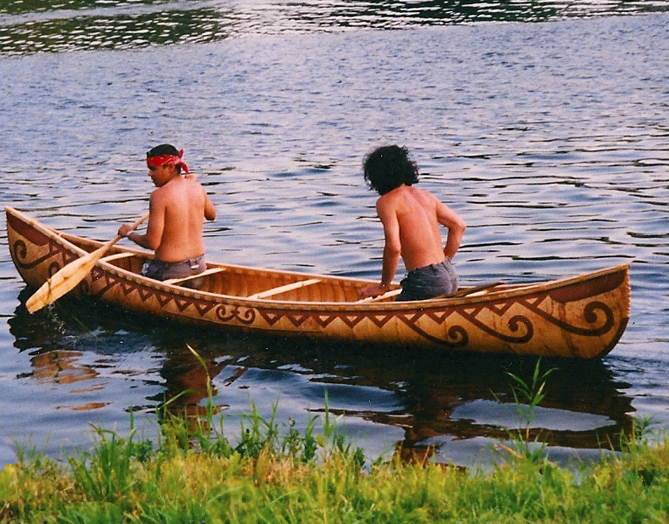
Passamaquoddy crafts emphasize utilitarian and decorative items made from natural materials abundant in their traditional territories, such as black ash for splint basketry and birchbark for containers and artistic panels. Basketry, a hallmark of Wabanaki craftsmanship shared with related tribes, involves pounding and splitting ash wood into splints woven into sturdy forms, often adorned with braided sweetgrass lids or rims for aesthetic appeal.[99][100] Artisans like Molly Neptune Parker, a National Heritage Fellow, learned the technique from family elders and produced thousands of baskets over decades, passing skills to four generations despite challenges from emerald ash borer infestations threatening ash supplies since the early 2010s.[101] Similarly, Mary Mitchell Gabriel, born in 1908, wove baskets from childhood under maternal guidance, exemplifying intergenerational transmission central to the craft's survival.[102] Woodworking traditions include birchbark canoe construction, employing sewn bark panels over cedar rib frames sealed with pine resin, as practiced by builders like David Moses Bridges.[100] Beadwork on leather, incorporating glass beads traded historically, produces jewelry and regalia, with contemporary makers like Belinda drawing on these methods for cultural reconnection and economic support.[103] Birchbark art, notably by 19th-century artist Tomah Joseph, features etched or painted scenes from Passamaquoddy life and narratives, blending pictorial and textual elements in Passamaquoddy and English to document history.[104] Oral traditions form a core repository of Passamaquoddy knowledge, transmitted verbally across generations to convey cosmology, moral lessons, and historical events. Central to these are Passamaquoddy legends, which include creation stories, heroic exploits of figures like the culture hero Glooskap (Gluskap) who shapes the world and battles giants or sorcerers, and explanations of natural phenomena shared within Wabanaki oral heritage.[105] Early 20th-century recordings by anthropologist John Dyneley Prince captured texts from elders like Newell S. Francis, encompassing witchcraft narratives and supernatural encounters that reflect pre-contact beliefs in animistic spirits (kolusuwakon).[106] These stories emphasize harmony with nature and communal ethics, as seen in motifs of politeness enforced by transformative punishments, such as turning insolent men into serpents.[107] Tribal digital archives now preserve audio and textual versions, originating from traditional homelands, to sustain revitalization amid language shift pressures.[108] Collections like Charles G. Leland's 1884 compilation of Micmac, Passamaquoddy, and Penobscot myths provide early transcriptions, though filtered through non-Indigenous interpretation, highlighting the primacy of oral authenticity over written adaptations.[109]Economy and Resource Use
Historical Economic Systems
The Passamaquoddy sustained themselves through a subsistence economy reliant on hunting, fishing, and gathering, patterns that originated in the Archaic period and emphasized marine resources in the Passamaquoddy Bay and St. Croix River regions.[16] Small, mobile family bands occupied seasonal camps, often wigwams near water edges, facilitating access to estuarine and coastal foods as evidenced by ancient shell middens.[16] This sea-oriented system persisted into the 17th century, with groups relocating based on resource cycles rather than fixed agriculture.[16][4] Seasonal movements structured economic activities: winters were spent in deep inland forests pursuing large game like moose and deer, while spring gatherings at river waterfalls targeted salmon runs using traditional methods such as spears or traps.[2] Summers shifted to coastal sites for harvesting shellfish, eels, and ocean fish, and autumn followed migrating herds during mating seasons.[2] Gathering supplemented these pursuits with wild berries, plants, and other forest products, minimizing waste through sustainable practices tied to environmental rhythms.[4] These cycles supported patrilineal kinship groups without intensive farming, reflecting adaptation to the region's abundant waterways and forests spanning the ancestral St. Croix watershed of over 3 million acres.[2] Intertribal trade via rivers, lakes, and portages exchanged goods like furs and tools across New England and the Maritime Provinces, predating European contact but expanding post-1600s with fur pelts to French and English traders.[2][4] Early alliances, such as provisioning game to French settlers on St. Croix Island around 1604, integrated colonial exchanges into traditional systems without immediate disruption.[24] This fluid economy, rooted in empirical resource tracking, sustained populations in 22 pre-contact villages under loose confederacies until epidemics and conflicts altered dynamics by the mid-17th century.[4]

