
Recent from talks
Bengali language movement
Knowledge base stats:
Talk channels stats:
Members stats:
Bengali language movement
The Bengali language movement was a political movement in East Bengal (modern-day Bangladesh) in 1952, advocating the recognition of the Bengali language as a co-lingua franca of the then-Dominion of Pakistan to allow its use in government affairs, the continuation of its use as a medium of education, its use in media, currency and stamps, and to maintain its writing in the Bengali alphabet and Bengali script.
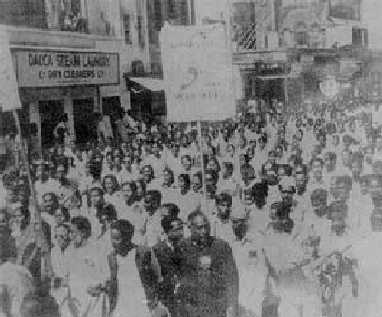
When the Dominion of Pakistan was formed after the separation of the Indian subcontinent in 1947, when the British left, it was composed of various ethnic and linguistic groups, with the geographically non-contiguous East Bengal province having a mainly ethnic Bengali population. In 1948, the Government of the Dominion of Pakistan ordained as part of Islamization of East Pakistan or East Bengal that Urdu will be the sole federal language, alternately Bengali writing in the Perso-Arabic script or Roman script (Romanisation of Bengali) or Arabic as the state language of the whole of Pakistan was also proposed, sparking extensive protests among the Bengali-speaking majority of East Bengal. Facing rising sectarian tensions and mass discontent with the new law, the government outlawed public meetings and rallies. The students of the University of Dhaka and other political activists defied the law and organised a protest on 21 February 1952. The movement reached its climax when police killed student demonstrators on that day. The deaths provoked widespread civil unrest. After years of conflict, the central government relented and granted official status to the Bengali language in 1956.
The Language Movement catalysed the assertion of Bengali national identity in East Bengal and later East Pakistan, and became a forerunner to Bengali nationalist movements, including the 6-Point Movement and subsequently the Bangladesh Liberation War and the Bengali Language Implementation Act, 1987. In Bangladesh, 21 February (Ekushey February) is observed as Language Movement Day, a national holiday. The Shaheed Minar monument was constructed near Dhaka Medical College in memory of the movement and its victims. On 17 September 1999, UNESCO declared 21 February as International Mother Language Day, in tribute to the Language Movement and the ethnolinguistic rights of people around the world.
The present-day nations of Pakistan and Bangladesh were part of the British Indian Empire. From the mid-19th century, the Urdu language had been promoted as the lingua franca of Indian Muslims by political and religious leaders, such as Sir Khwaja Salimullah, Sir Syed Ahmed Khan, Nawab Viqar-ul-Mulk and Maulvi Abdul Haq. Urdu is a Central Indo-Aryan language of the Indo-Iranian branch, closely related to Hindi and belonging to the Indo-European family of languages. It developed under Persian, Arabic and Turkic influence on apabhramshas (last linguistic stage of the medieval Indian Aryan language Pali–Prakrit) in South Asia during the Delhi Sultanate and Mughal Empire. With its Perso-Arabic script, the language was considered a vital element of the Islamic culture for Indian Muslims; Hindi and the Devanagari script were seen as fundamentals of Hindu culture.
While Urdu became common among Muslims in northern India, Muslims in Bengal—then a province in the eastern part of British India—primarily spoke Bengali. Bengali is an Eastern Indo-Aryan language that arose from the eastern Middle Indic languages around 1000 CE and developed considerably with a rich literature, history and cultural identity. Unlike many other Indic Languages, Bengali got patronage from the States and Empires in the Middle Ages. During the Bengal Renaissance, the modern Bengali literature developed its stronghold. Bengalis irrespective of religious identity used Bengali language. Supporters of Bengali opposed Urdu even before the partition of India, when delegates from Bengal rejected the idea of making Urdu the lingua franca of Muslim India in the 1937 Lucknow session of the All-India Muslim League. The Muslim League was a British Indian political party that became the driving force behind the creation of Pakistan as a Muslim state separate from British India.
After the partition of India in 1947, Bengali-speaking people in East Bengal, the non-contiguous eastern part of the Dominion of Pakistan, made up 44 million of the newly formed Dominion of Pakistan's 69 million people. The Dominion of Pakistan's government, civil services, and military, however, were dominated by personnel from the western wing of the Dominion of Pakistan. In November 1947, a key resolution at a national education summit in Karachi advocated Urdu and English as the sole state languages. Opposition and protests arose immediately. Students from Dhaka rallied under the leadership of Abul Kashem, the secretary of Tamaddun Majlish, a Bengali Islamic cultural organisation. The meeting stipulated Bengali as an official language of the Dominion of Pakistan and as a medium of education in East Bengal. However, the Pakistan Public Service Commission removed Bengali from the list of approved subjects, as well as from currency notes and stamps. The central education minister Fazlur Rahman made extensive preparations to make Urdu the only state language of the Dominion of Pakistan. Public outrage spread, and many Bengali students met on the University of Dhaka campus on 8 December 1947 to formally demand that Bengali be made an official language. To promote their cause, Bengali students organised processions and rallies in Dhaka.
Leading Bengali scholars argued why Urdu should not be the only state language. The writer Abul Mansur Ahmed said if Urdu became the state language, the educated society of East Bengal would become 'illiterate' and 'ineligible' for government positions. The first Rastrabhasa Sangram Parishad (National Language Action Committee), an organisation in favour of Bengali as a state language was formed towards the end of December 1947. Professor Nurul Huq Bhuiyan of the Tamaddun Majlish convened the committee. Later, Parliament member Shamsul Huq convened a new committee to push for Bengali as a state language.
Assembly member Dhirendranath Datta proposed legislation in the Constituent Assembly of Pakistan to allow members to speak in Bengali and authorise its use for official purposes. Datta's proposal was supported by legislators Prem Hari Burman, Bhupendra Kumar Datta and Sris Chandra Chattaopadhyaya of East Bengal, as well as the people from the region. Prime minister Liaquat Ali Khan and the Muslim League denounced the proposal as an attempt to divide the Pakistani people, thus the legislation was defeated.
Hub AI
Bengali language movement AI simulator
(@Bengali language movement_simulator)
Bengali language movement
The Bengali language movement was a political movement in East Bengal (modern-day Bangladesh) in 1952, advocating the recognition of the Bengali language as a co-lingua franca of the then-Dominion of Pakistan to allow its use in government affairs, the continuation of its use as a medium of education, its use in media, currency and stamps, and to maintain its writing in the Bengali alphabet and Bengali script.
When the Dominion of Pakistan was formed after the separation of the Indian subcontinent in 1947, when the British left, it was composed of various ethnic and linguistic groups, with the geographically non-contiguous East Bengal province having a mainly ethnic Bengali population. In 1948, the Government of the Dominion of Pakistan ordained as part of Islamization of East Pakistan or East Bengal that Urdu will be the sole federal language, alternately Bengali writing in the Perso-Arabic script or Roman script (Romanisation of Bengali) or Arabic as the state language of the whole of Pakistan was also proposed, sparking extensive protests among the Bengali-speaking majority of East Bengal. Facing rising sectarian tensions and mass discontent with the new law, the government outlawed public meetings and rallies. The students of the University of Dhaka and other political activists defied the law and organised a protest on 21 February 1952. The movement reached its climax when police killed student demonstrators on that day. The deaths provoked widespread civil unrest. After years of conflict, the central government relented and granted official status to the Bengali language in 1956.
The Language Movement catalysed the assertion of Bengali national identity in East Bengal and later East Pakistan, and became a forerunner to Bengali nationalist movements, including the 6-Point Movement and subsequently the Bangladesh Liberation War and the Bengali Language Implementation Act, 1987. In Bangladesh, 21 February (Ekushey February) is observed as Language Movement Day, a national holiday. The Shaheed Minar monument was constructed near Dhaka Medical College in memory of the movement and its victims. On 17 September 1999, UNESCO declared 21 February as International Mother Language Day, in tribute to the Language Movement and the ethnolinguistic rights of people around the world.
The present-day nations of Pakistan and Bangladesh were part of the British Indian Empire. From the mid-19th century, the Urdu language had been promoted as the lingua franca of Indian Muslims by political and religious leaders, such as Sir Khwaja Salimullah, Sir Syed Ahmed Khan, Nawab Viqar-ul-Mulk and Maulvi Abdul Haq. Urdu is a Central Indo-Aryan language of the Indo-Iranian branch, closely related to Hindi and belonging to the Indo-European family of languages. It developed under Persian, Arabic and Turkic influence on apabhramshas (last linguistic stage of the medieval Indian Aryan language Pali–Prakrit) in South Asia during the Delhi Sultanate and Mughal Empire. With its Perso-Arabic script, the language was considered a vital element of the Islamic culture for Indian Muslims; Hindi and the Devanagari script were seen as fundamentals of Hindu culture.
While Urdu became common among Muslims in northern India, Muslims in Bengal—then a province in the eastern part of British India—primarily spoke Bengali. Bengali is an Eastern Indo-Aryan language that arose from the eastern Middle Indic languages around 1000 CE and developed considerably with a rich literature, history and cultural identity. Unlike many other Indic Languages, Bengali got patronage from the States and Empires in the Middle Ages. During the Bengal Renaissance, the modern Bengali literature developed its stronghold. Bengalis irrespective of religious identity used Bengali language. Supporters of Bengali opposed Urdu even before the partition of India, when delegates from Bengal rejected the idea of making Urdu the lingua franca of Muslim India in the 1937 Lucknow session of the All-India Muslim League. The Muslim League was a British Indian political party that became the driving force behind the creation of Pakistan as a Muslim state separate from British India.
After the partition of India in 1947, Bengali-speaking people in East Bengal, the non-contiguous eastern part of the Dominion of Pakistan, made up 44 million of the newly formed Dominion of Pakistan's 69 million people. The Dominion of Pakistan's government, civil services, and military, however, were dominated by personnel from the western wing of the Dominion of Pakistan. In November 1947, a key resolution at a national education summit in Karachi advocated Urdu and English as the sole state languages. Opposition and protests arose immediately. Students from Dhaka rallied under the leadership of Abul Kashem, the secretary of Tamaddun Majlish, a Bengali Islamic cultural organisation. The meeting stipulated Bengali as an official language of the Dominion of Pakistan and as a medium of education in East Bengal. However, the Pakistan Public Service Commission removed Bengali from the list of approved subjects, as well as from currency notes and stamps. The central education minister Fazlur Rahman made extensive preparations to make Urdu the only state language of the Dominion of Pakistan. Public outrage spread, and many Bengali students met on the University of Dhaka campus on 8 December 1947 to formally demand that Bengali be made an official language. To promote their cause, Bengali students organised processions and rallies in Dhaka.
Leading Bengali scholars argued why Urdu should not be the only state language. The writer Abul Mansur Ahmed said if Urdu became the state language, the educated society of East Bengal would become 'illiterate' and 'ineligible' for government positions. The first Rastrabhasa Sangram Parishad (National Language Action Committee), an organisation in favour of Bengali as a state language was formed towards the end of December 1947. Professor Nurul Huq Bhuiyan of the Tamaddun Majlish convened the committee. Later, Parliament member Shamsul Huq convened a new committee to push for Bengali as a state language.
Assembly member Dhirendranath Datta proposed legislation in the Constituent Assembly of Pakistan to allow members to speak in Bengali and authorise its use for official purposes. Datta's proposal was supported by legislators Prem Hari Burman, Bhupendra Kumar Datta and Sris Chandra Chattaopadhyaya of East Bengal, as well as the people from the region. Prime minister Liaquat Ali Khan and the Muslim League denounced the proposal as an attempt to divide the Pakistani people, thus the legislation was defeated.
Recent media